Big Party Games: 12 Large Group Games for 20+ Guests
The big party games that hold up with 20 or more guests do one of two things: everybody plays at the same moment (bingo, team trivia), or the crowd splits into small groups that play side by side (bunco tables, relay teams, two pass-the-parcel circles). A game that gives one person a turn while 25 others watch falls apart around the tenth turn, however good it is with eight.
Start with the table below, then read the game you picked. The player counts, ages and times are our planning estimates, not rules, so stretch them to fit your room and your guests.
| Game | Group size | Who it suits | Time | What you need |
|---|---|---|---|---|
| Picture bingo | Any, one caller | Ages 3 to 10, mixed families | 10 to 15 min a round | Printed cards, calling cards, markers |
| Team trivia | Teams of 4 to 8 | Teens and adults | 45 to 60 min | Question sheets, pens, one quizmaster |
| Mafia | 9 to 21 per game | Teens and adults | 20 to 40 min | Playing cards, one moderator |
| Pass the parcel, two circles | 10 to 14 per circle | Ages 3 to 8 | 15 to 20 min | One wrapped parcel per circle, music |
| Four corners | 15 to 40 | Ages 5 to 10 | 5 to 10 min | A room with four corners |
| One-minute team relays | Teams of 3 or 4 | Ages 8 to adult | 20 to 30 min | Cups, balloons, a hula hoop, score sheet |
| Bunco | 12, 16, 20 or 24 | Adults, older kids | 60 to 90 min | 3 dice per table, score cards |
| Tug of war | 8 or more a side | Ages 8 to adult | 5 min a pull | A long, sound rope, soft ground |
| Capture the flag | 16 to 40 | Ages 8 to adult | 20 to 40 min | A big yard or park, 2 flags |
| Water balloon toss | Pairs, any number | All ages | 10 min | Filled water balloons |
| Human knot | 8 to 12 per knot | Teens and adults | 5 to 10 min | Nothing |
| Cornhole bracket | 2 or 4 per match | Teens and adults | 15 to 20 min a match | Boards and bags |
How to split a big group without hurt feelings
Split the crowd before the first game, and keep the same teams for the night. Re-sorting 30 people between every game eats ten minutes each time and leaves the shy guests standing in the middle of the room.
- Skip captains picking teams. Someone is always picked last, and with 30 people that wait is long and public. Count off down the line instead (“one, two, three, four”), or sort by birthday month.
- Mix ages on purpose. At a family party, put at least one adult or older kid on every team, so the youngest guests have someone to read cards and keep them in the game.
- Match the team size to the game. Tables of four suit bunco and trivia. Circles of 10 to 14 suit pass the parcel. Two halves suit tug of war and capture the flag. If you settle on teams of four at the door, you can combine them into halves later.
- Give every team a name card or color. It saves you shouting “the team by the window” across a loud room.
A two-hour party usually has room for three or four games. Open with something guests can join as they arrive (bingo works, since a late guest just picks up a card), put the loudest or most active game in the middle, and finish with something seated while food comes out. Leave ten minutes between games for drinks and bathroom trips. Big groups lose more time on transitions than on the games.
Space matters more than the game list. A living room fits bingo, trivia, mafia and bunco. Relays and four corners need a cleared floor. Tug of war, capture the flag and water balloons belong outside. If the party is indoors, decide which room will be cleared before guests arrive, not halfway through.
Games the whole room plays at once
These three keep everyone in the game from the first minute to the last. They work in a living room, a classroom or a rented hall.
Picture bingo
Bingo is the easiest big party game to run because one caller can handle 50 players as easily as five. Everyone gets a card, the caller draws and announces one picture at a time, and the first player to complete the agreed pattern shouts BINGO.
- Players: any number, plus one caller.
- Time: 10 to 15 minutes a round, depending on the pattern.
- You need: one card per player, the calling cards in a bag or bowl, and markers (the printed ones, or buttons, coins or cereal).
- How to start: agree on the winning pattern before the first call. A line across, down or diagonal is fastest. Four corners or a full card makes a longer round.
- How it ends: check the winner’s card against the called pictures before handing over a prize, then clear the cards and play again.
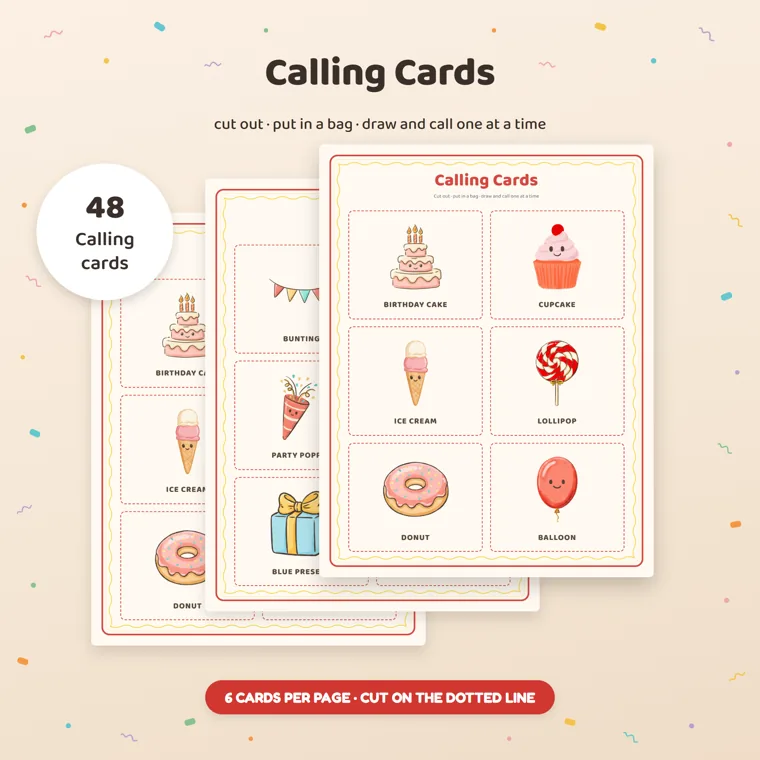
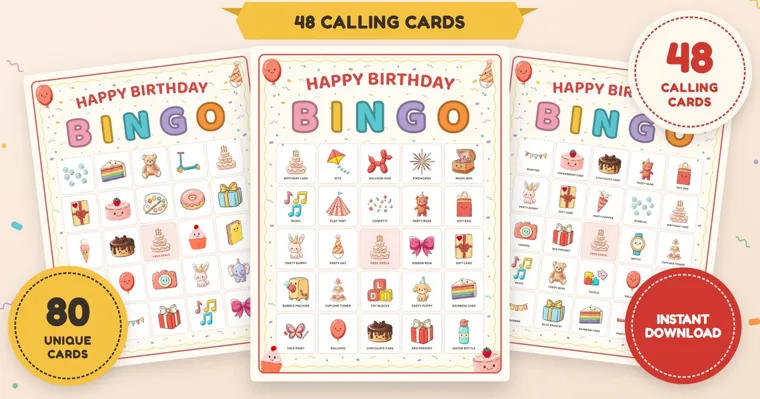
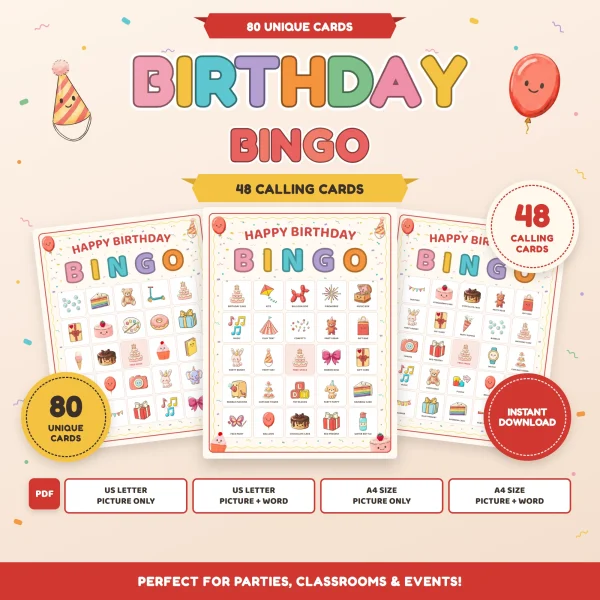
For a crowd, the number of different cards matters. Our Birthday Party Bingo has a 30-card set and a 50-card set that share no layouts, so a guest list of up to 80 can each hold a different card. Each card shows 24 of the 48 pictures, which means a call often misses your card. That slower pace is a good thing with 40 kids: winners come one at a time instead of in a crowd.
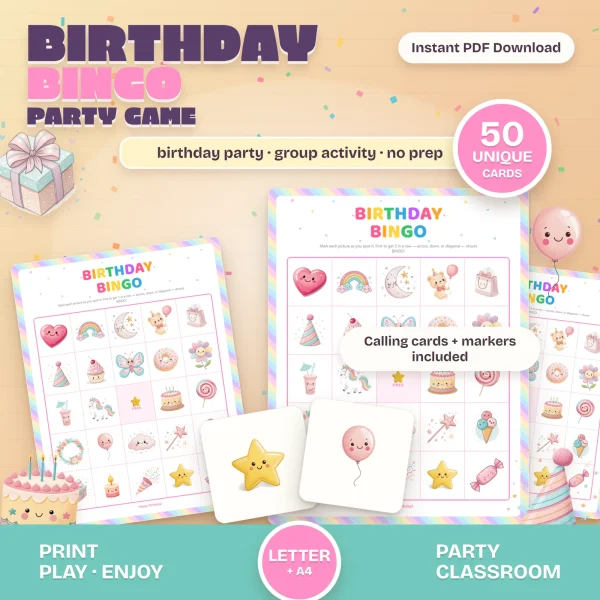
Our pastel Birthday Bingo behaves differently. It has 25 pictures, and every card holds 24 of them, so nearly every call covers a square for everyone. Rounds go fast, and in a big group several players will shout BINGO on the same call. Use that version with a smaller group or a class, or play a full card and keep a few extra prizes in your pocket for ties.
Where it goes wrong: with a big room, half the players miss a call while they chat. Have the caller say each picture twice and hold the calling card up. Keep the called cards in a line on a table, so you can check a claim in seconds. Our printable bingo rules cover patterns and settling ties in more detail.
Team trivia
Team trivia works for any crowd you can split into tables. The format comes from the pub quiz: teams sit together, a quizmaster reads questions aloud, and each team writes its answers on paper. Many pubs cap teams at six to ten players. For a home party, four to eight per team keeps everyone talking.
- Players: as many teams as you have tables.
- Time: about 45 to 60 minutes for four or five rounds.
- You need: an answer sheet per team per round, pens, and one quizmaster who doesn’t play.
- How to play: read each question twice, give a set time to write, then collect the sheets after each round and mark them while the next round runs.
- How it ends: the team with the most points after the last round wins. Read out the scores after every round, not only at the end, so the trailing teams know they’re still in it.
When there are more teams than you can mark quickly, the pub quiz “infinite bounce” format helps: one question goes to each team in turn, and a missed question passes to the next team. Write your own rounds about the guest of honor, a decade, or the town you live in. For ready-made question formats, see our party games for adults.
Where it goes wrong: one table has the trivia buff and wins by a mile. Mix the rounds (a picture round, a music round, a round about the host) so different people carry the team.
Mafia (Werewolf)
Mafia is a social deduction game where a small group of secret mafiosi try to outlast everyone else. It needs a moderator who doesn’t play. The moderator hands out roles using cards, and each mafioso learns who their teammates are.
- Players: about 9 to 21 per game, plus a moderator.
- Time: 20 to 40 minutes.
- You need: a deck of playing cards (for example, black cards for the mafia, red for villagers).
- How to play: at “night,” everyone closes their eyes, the mafiosi open theirs and silently point to a victim. At “day,” the moderator announces who was eliminated, everyone debates, and a majority vote removes one suspect.
- How it ends: the villagers win when every mafioso is gone. The mafia wins when they equal the number of villagers left.
The game’s creator suggested about a third of the players be mafiosi. Another popular version uses exactly two. With 20 guests, three or four mafiosi keep the game moving. An odd number of players, counting the moderator, helps avoid tied votes.
Where it goes wrong: players knocked out early sit and watch for half an hour. With more than about 20 guests, run two games in two rooms with two moderators, so fewer people are waiting. Eliminated players must stay quiet, because a whispered hint can wreck the game.
Kids’ parties of 20 to 30
Big kids’ parties need games with short waits and clear endings. Under-tens lose interest fast if they’re standing in a line, so these games split the room or keep every child moving.
Pass the parcel in two circles
Pass the parcel is classic because every child gets to unwrap a layer, but one circle of 26 kids takes too long. Split the children into two circles, each with its own parcel and an adult running the music. In each layer, put a small prize, and (if you like) a task card that each child reads out loud and acts out.
- Players: 10 to 14 per circle.
- Time: about 15 to 20 minutes per circle.
- You need: one parcel per circle, wrapped with one layer per child in that circle, music, and an adult on the pause button.
- How to play: pass the parcel around while the music plays. When it stops, whoever holds it unwraps one layer, does the card, and keeps the small prize.
- How it ends: the last layer holds the grand prize, and nobody is out at any point.
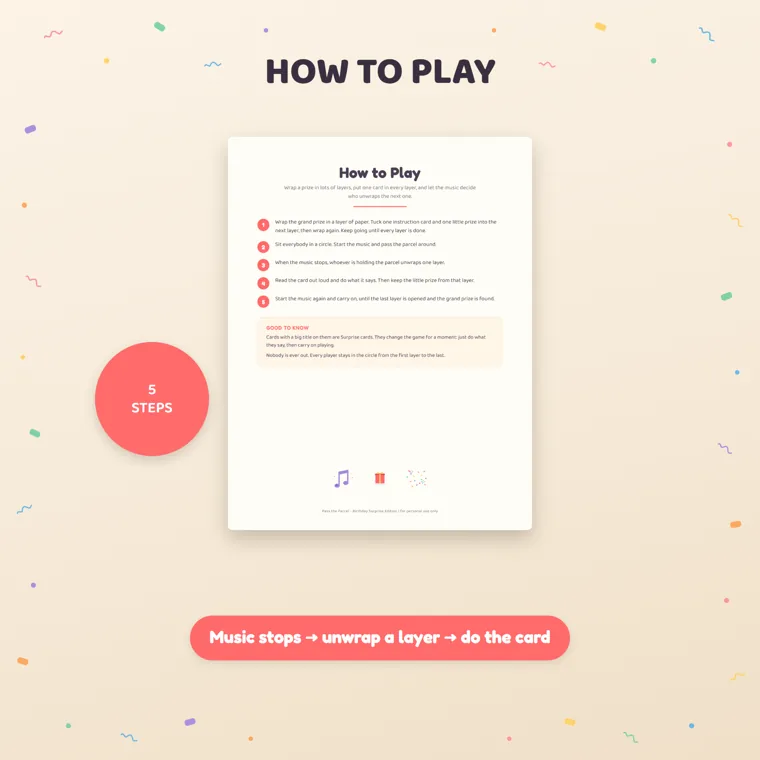
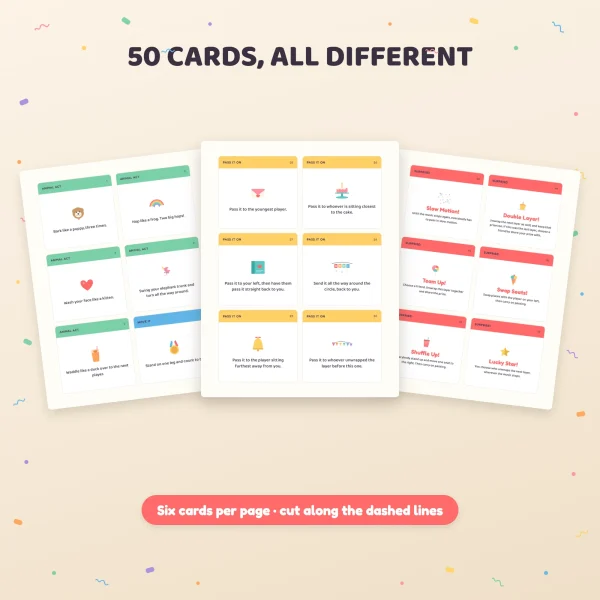
Our pass the parcel game has 50 numbered cards to tuck into the layers, plus four blank ones. Its music page suggests stopping every 20 to 40 seconds, turning away so you can’t see who has the parcel, and keeping a tally so you can steer the stops toward children who haven’t had a turn. With two circles, that tally matters even more, because each adult only knows their own circle.
Where it goes wrong: one layer per child is the rule that keeps it fair. Count the children in each circle again right before you start, since a late arrival changes the count. If toddlers are coming, leave out small toys and hard candy from the layers, since they’re a choking risk. Our pass the parcel guide covers wrapping and music in full.
Four corners
Four corners needs no supplies and works with a whole class. Mark the four corners of the room with the numbers 1 to 4. One child is “It,” sits in the middle with eyes closed, and counts to ten while everyone else tiptoes to a corner.
- Players: 15 to 40.
- Time: 5 to 10 minutes a game.
- You need: a room with four clear corners, and four signs.
- How to play: when It finishes counting, It calls out a number. Every child in that corner is out and sits down. It counts again, and the rest move to new corners.
- How it ends: the last child standing wins and usually becomes the next It. If It calls an empty corner, either call again straight away or have everyone move. Choose one version before starting.
Where it goes wrong: with 30 kids, a whole corner sits down at once, and those kids get bored. As a house rule, let the children who are out help It by pointing to a corner, or run quick rounds so nobody sits for long.
One-minute team relays
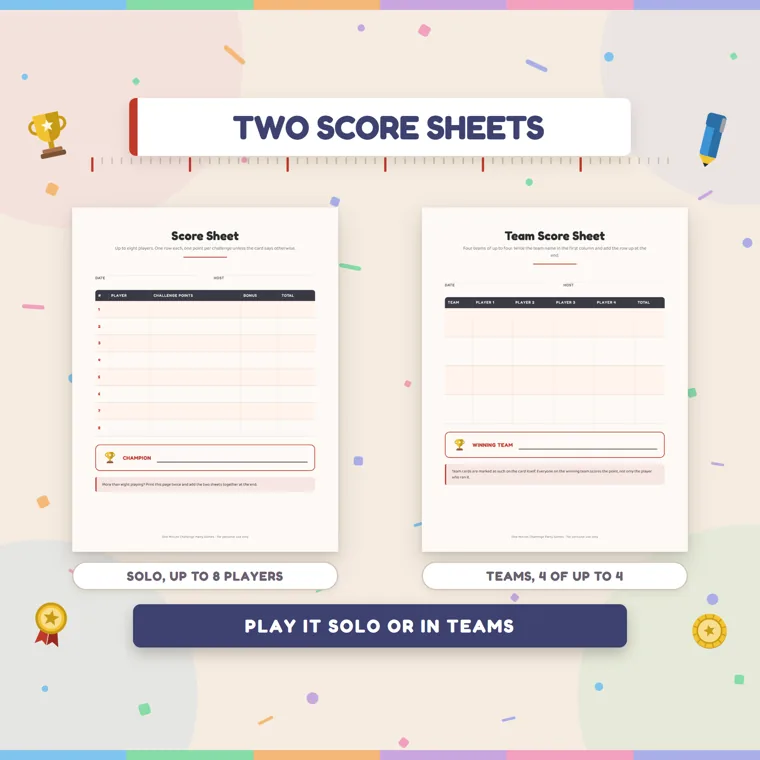
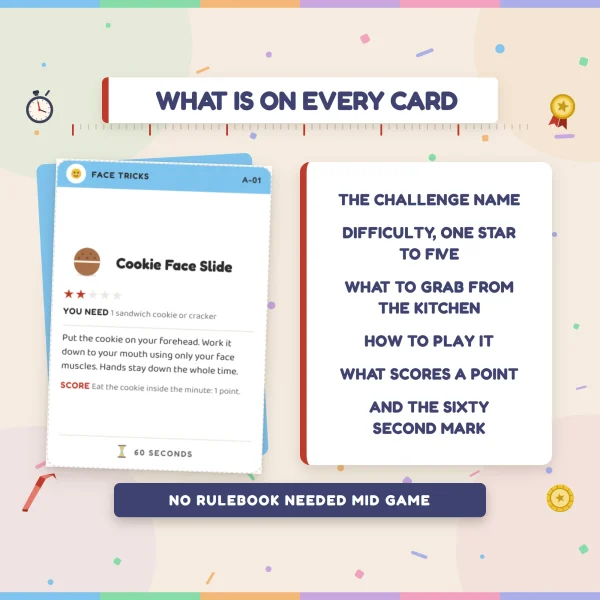
One-minute challenges are usually played one at a time. With a big group, the team cards are the ones to use, because a whole team plays at once. Our One Minute Challenge Party Games pack says six players is the sweet spot and twenty still works. Past that, split into teams of three or four.
- Players: teams of 3 or 4, with several teams racing side by side.
- Time: 20 to 30 minutes for five or six relays.
- You need: what each card lists. A few relays use only household things: Hoop Pass needs one hula hoop, Coat Relay needs four oversized jackets or shirts, Kangaroo Relay needs four balloons, and Stack Relay needs 30 paper cups.
- How to play: read the card aloud, start the timer, and run every team at the same moment, with one copy of the supplies per team.
- How it ends: the card says what scores a point. On team cards, everyone on the winning team gets the point.
Where it goes wrong: one set of supplies means teams take turns, and four teams wait while one plays. Buy enough cups and balloons for every team before you start. Pass the Water, where players hold a cup rim in their teeth and tip water into the next cup, is best saved for outdoors. For the full deck and how a solo round runs, see our one-minute party game ideas.
Table games for adults and mixed ages
When the crowd is mostly adults, or the party is a sit-down event, a rotating table game keeps people mixing without anyone having to perform.
Bunco
Bunco is a dice game built for twelve or more players, seated in groups of four. Every table needs three dice. A game has six rounds, numbered one to six.
- Players: 12, 16, 20 or 24, in groups of four.
- Time: about 60 to 90 minutes for a full game, depending on how much people chat.
- You need: three dice and a score card per table, pencils, and a bell for the head table if you like.
- How to play: players take turns rolling three dice. Each die that matches the round number scores 1 point. Three of a kind that doesn’t match the round scores 5. Three of the round number is a “bunco,” worth 21. Keep rolling while you score, then pass the dice.
- How it ends: a round ends when someone reaches 21 points. After six rounds, the player who won the most rounds wins the game, with total points as a tiebreaker.
In larger bunco events, people play in pairs. After each round, the winning pair moves to the next table up, and the losers at the top table move to the bottom. That’s the part that suits a big party, since every round brings new tablemates.
Where it goes wrong: the guest count isn’t a multiple of four. Decide at the door: the host can sit in or out, or an extra guest can act as the scorekeeper for the head table.
Backyard and park games for 20 to 60
Outdoors, a big group finally has room to run. These games need a yard, a park, or a beach, and an adult who watches the whole field.
Tug of war
Tug of war needs only a rope and a lot of people, so it’s made for a big crowd. Two teams, usually eight or more a side, pull from opposite ends. The rope has a center line and two markers the same distance from the middle, and a team wins by pulling the other team’s marker across the center line.
- Players: 8 or more a side.
- Time: about 5 minutes per pull. Best of three is plenty.
- You need: a long, strong rope in good condition, and grass or sand to fall on.
- How to play: both teams take the strain, someone shouts “pull,” and the teams pull until a marker crosses.
- How it ends: the first team to win two pulls wins.
Where it goes wrong: this is the one game here that can cause a serious injury. Never loop or wrap the rope around a hand or wrist, because a looped rope under full strain can cost someone a finger or a hand. A rope that breaks under strain whips back toward the people at the front. Use a rope rated for the job, keep teams small with children, and balance teams by size, not by friendships.
Capture the flag
Capture the flag gives 30 kids or adults a full-field game. The field is split into two halves, one per team. Each team puts a flag (a bandana or a T-shirt works) at the back of its half.
- Players: 16 to 40, in two teams.
- Time: 20 to 40 minutes.
- You need: a large yard or park, two flags, and something to mark the center line and two “jails.”
- How to play: you’re safe in your own half. Cross into the other half and you can be tagged, which sends you to that team’s jail. A teammate can free you by tagging you, or you can leave jail after a set time, such as three minutes.
- How it ends: the first team to carry the other team’s flag back to its own half wins.
Where it goes wrong: without a jail time limit, the same kids get tagged early and spend the whole game standing in jail. Set a three-minute release from the start. Mark the center line clearly, because most arguments are about which side someone was on.
Water balloon toss
The water balloon toss is a twist on the egg toss and works with any number of pairs. Partners stand facing each other a few steps apart and toss one balloon back and forth. After each catch, both step back.
- Players: any number, in pairs.
- Time: about 10 minutes.
- You need: one filled water balloon per pair, plus spares.
- How to play: everyone tosses on the same call. If your balloon breaks, your pair is out.
- How it ends: the last pair with an unbroken balloon wins.
Where it goes wrong: balloon scraps end up all over the lawn. Hand each pair a bag for their pieces, and do a sweep before anyone mows or lets a dog out.
Human knot
The human knot is a puzzle the group solves together, with no supplies. Stand in a circle, then each person grabs hands with two people who aren’t next to them. Without letting go, the group steps over and under arms until it’s one circle again.
- Players: about ten per knot, so 30 guests make three knots racing each other.
- Time: 5 to 10 minutes.
- You need: nothing.
- How to play: untangle by stepping over or ducking under, never by letting go.
- How it ends: the knot is done when the group stands in a circle, even if some people now face outward.
Where it goes wrong: not every random knot can be solved. Some end up as two circles or stay stuck. For a solvable knot, start with everyone holding hands in a normal circle, then have a few people cross their arms and grab the same neighbors again. Skip this game for groups that don’t know each other well, or for guests who’d rather not be in close contact.
Cornhole bracket
Cornhole fits big backyard parties because a bracket keeps 16 or 32 people involved even with only one set of boards. Each match uses two boards and two sets of four bags.
- Players: 2 or 4 per match, in a single-elimination bracket.
- Time: about 15 to 20 minutes a match.
- You need: two boards set 27 feet apart (closer for kids), eight bags in two colors, and a bracket sheet on a clipboard.
- How to play: players take turns tossing bags from beside their board. A bag on the board scores 1, a bag through the hole scores 3. Only the difference between the two sides scores each inning.
- How it ends: the first side to reach 21 at the end of an inning wins the match.
Where it goes wrong: with one set of boards, a 16-player bracket can take most of the afternoon. Run cornhole alongside the other yard games, and post the bracket somewhere people can see when they’re up next.
Keeping a big party game night on track
A few habits make every game on this list easier with a crowd.
- One person runs each game. That person explains the rules once, holds the timer, and settles disputes. When two adults run the same game, the rules change halfway through.
- Explain with a demo, not a speech. Read the rules in under a minute, then play a practice round. Thirty people can’t all hear a long explanation.
- Plan for the guests who don’t want to play. Give them a job: scorekeeper, caller, music, judge. Being on the edge of a game is still being part of it.
- Keep small prizes in one bag. Big groups produce ties and surprise winners. A bag of stickers or candy settles them quickly.
- Stop while it’s still fun. End each game a round early rather than a round late, then move on.
For more ideas sorted by age, see our birthday party games. For adult crowds meeting for the first time, our icebreaker games for adults include mixers like human bingo. The party games shop has printable versions of several games on this page.
Printables from this article
Related articles
Printable Party Games
New Year’s Eve Party Ideas: Themes, Food & a Night at Home
Choose the kind of New Year's Eve party first, then pick a theme, a timeline that ends where your guests will, food that can sit out for hours, and a countdown that fits the youngest person in the room.
Printable Party Games
Christmas Pajama Party Ideas: Invitation, Food & Games
Pick the kind of Christmas pajama party first, then send an invitation that says pajamas and pickup time, plan food and a simple timeline for that group, and end with bedtime, breakfast or a thank-you card.
Printable Party Games
Western Party Ideas: Cowboy Theme Food, Games and Decor
Pick the western party that fits your crowd first: a 90-minute cowpoke birthday for preschoolers, a two-hour cowgirl or rodeo party for older kids, an evening barbecue and line dance for adults, or a western day at school. Each plan below covers guests, timing, decor, food, games and how to wrap up.