10 Year Old Birthday Party Ideas: Home, Outings, Sleepovers

A 10-year-old can read a clue card, follow a rule sheet and argue a logic puzzle through with a teammate, so the parties that land best at this age hand the guests a challenge and step back. A printable escape room or a spy mission fills an at-home party for 6 to 10 kids in about two hours. A field day, a cupcake bar or a skating rink covers the kids who would rather move than solve. Pick the idea by how many friends are coming and where you have room, then use the matching section below. Guest counts and times in the table are our planning estimates unless a section quotes a printed game.
Pick a 10th birthday party idea by guests, space and time
| Idea | Guests | Time | Space | What to get ready |
|---|---|---|---|---|
| Printable escape room | 2 to 12, in teams of 2 to 4 | 30 to 60 minutes of play | A table per team | Printed puzzles, pencils, cut hint cards |
| Spy mission party | 4 to 10 | 90 minutes | A table plus a hallway or yard | Printed missions, string or tape, a blindfold |
| One-minute challenge tournament | 6 to 16 | 45 to 60 minutes | Kitchen or living room | Cups, balloons, a timer |
| Backyard field day | 8 to 20 | 60 minutes | Yard or park | Sacks, spoons, a finish line |
| Flashlight tag | 6 to 15 | 30 to 45 minutes | A fenced yard after dark | A flashlight per “it” player |
| Birthday bingo for a mixed-age crowd | Any number | 15 to 30 minutes | Seats for everyone | Bingo cards, markers |
| Cupcake or pizza bar | 4 to 10 | 45 minutes | Kitchen counter | Toppings in bowls, an oven for pizza |
| Bowling, skating or a climbing gym | 6 to 12 | 90 minutes to 2 hours | The venue | A booking and signed forms |
| Small sleepover or late-over | 2 to 5 | Evening, or overnight | Living room floor | Sleeping bags, a movie, breakfast |
What changes when the birthday kid turns 10
Ten is the first birthday with two digits, and most kids notice. Play that up once, with one of the ideas in the next section, and skip the baby-party trimmings.
Guests at this age can run a game themselves. Hand a team a rule page and they’ll read it. You’re there to referee, keep time and settle disputes. That makes printable puzzle games work in a way they don’t at 6.
Reading and puzzle skills vary a lot in a fourth- or fifth-grade class. Build teams so each has a confident reader, and choose games where a kid who reads slowly can still be the one who spots the answer.
Let the birthday kid help choose the guest list and the main activity. A 10-year-old who picked the plan is far more likely to enjoy it than one who is surprised by a theme they’ve outgrown. For the date, budget and invitation timeline, follow the steps in how to plan a birthday party; this page covers what to do once the guests are in the door.
Ideas that mark turning 10
Ten-thing time capsule
Have the birthday kid pick ten things that sum up being 10: a drawing, a ticket stub, a list of favorite songs, a school photo, a note about their best friend. Seal them in a shoebox or large envelope, write “Open at 18” on the front and store it somewhere safe. It’s about 20 minutes of work. Guests are optional. At a party, ask each guest to add one line on a card: “When you open this, I hope you…”
Ten questions, every year
Write ten questions the birthday kid answers out loud or on paper: favorite food, best friend, what they want to be, the hardest thing about school. Ask the same ten on every birthday from here on. This takes 10 minutes, needs one adult to ask and write down the answers, and is best done away from guests, before or after the party.
Double-digit cake and candles
Put a “10” candle in the middle and ten small candles around it, one for each year. Before blowing them out, let guests call out one thing the birthday kid did in each year of age they remember. Keep this to two minutes so the cake doesn’t wait.
Puzzle and mystery parties at home
They’re the strongest at-home choice for a group of 10-year-olds, because the game supplies its own story, rules and finish line. You’ll need one table per team and an adult who knows the answers.
Printable escape room
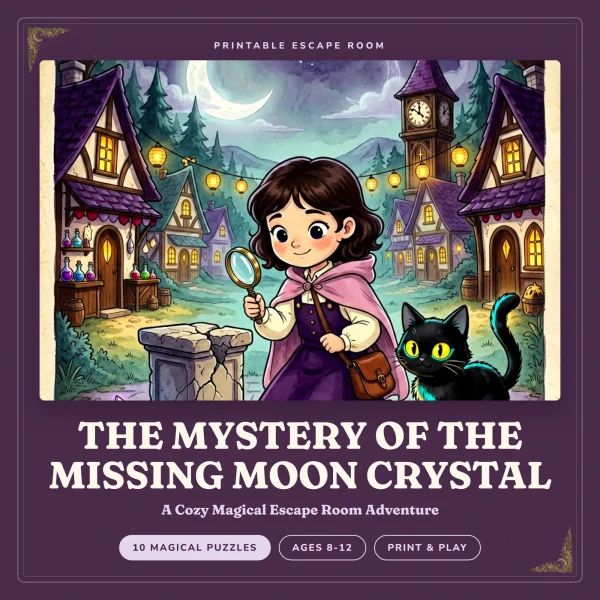
Players work in teams of 2 to 4 through a chain of puzzles, each answer unlocking part of a final code. Our Moon Crystal escape room is written for ages 8 to 12 and gives 30 to 60 minutes for most kids that age. It needs nothing but a pencil per team: there are no locks or boxes, and players say the four-digit code out loud.
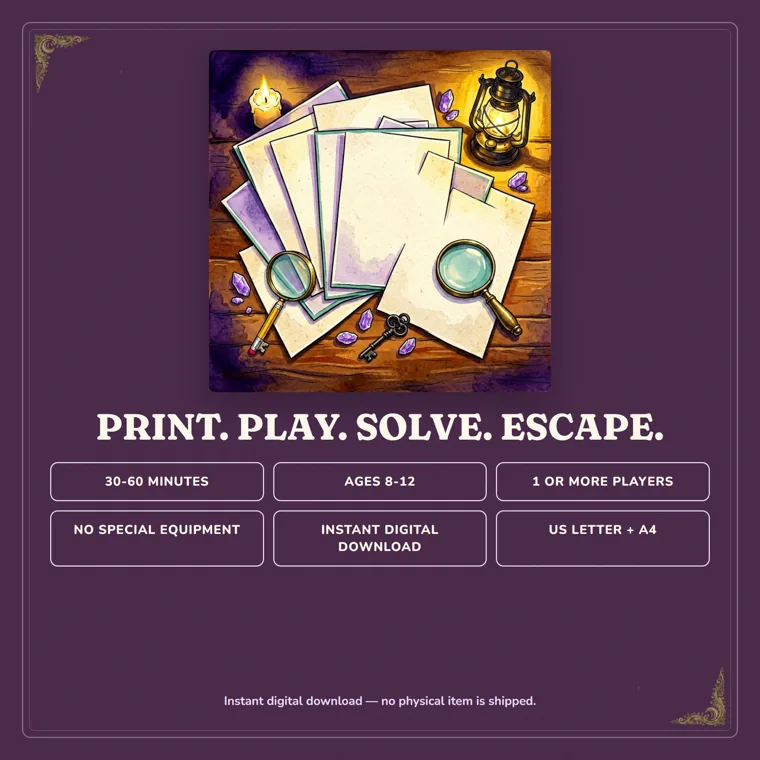
How it runs. Read the story pages (pages 1 to 4) out loud together. Each team gets a recording sheet (page 5) and the ten puzzles (pages 6 to 15). Every puzzle gives a single digit, and the tenth puzzle names four earlier ones whose answers, in order, open the final lock on page 16. The first team to say the right code wins. Pages 17 and 18 are the “you found it” page and the certificate, so print one certificate per player and hand them out at the end.
Print the decoder card for every team. The book’s note on page 4 says to print pages 5 to 16 for the players, which leaves out the Magic Symbol Decoder card on page 20. Puzzles 3 and 5 print the decoder on their own pages, but puzzles 6, 7 and 9 only tell players to look it up. Without page 20, teams end up flipping back through finished puzzles to find it.
Keep pages 27 to 29 to yourself. Those three pages are the answer key, and page 29 explains how the final code works. Two checks from it will save you from refereeing: puzzles 1 to 9 use each digit from 1 to 9 exactly once, so a repeated digit on a recording sheet means a mistake. And the final code must stay in the Keeper’s order. Teams who sort the four digits from low to high get it wrong.
Hints. There are 11 hint cards on pages 21 to 26, one per puzzle plus one for the final code, each with a small nudge, a bigger clue and an “almost there.” Cut them apart and hand over one level at a time. With 8 or more guests, try the stretch on page 26: hide the hint cards around the room and make teams trade for them. That turns it into a scavenger hunt and adds 10 to 15 minutes.
Two teams finishing far apart is the usual snag. It’s easy to fix. Have the fast team sign their certificates and then design one extra riddle for the slower team, which keeps them busy and makes them feel clever.
Homemade escape room
If your 10-year-old wants a room built around a favorite book or game, make your own: a story, a chain of five or six puzzles and one final answer. You’ll spend about an evening on prep for a 45-minute game. Our DIY escape room guide walks through the puzzle chain, hiding spots, locks and hints step by step.
Spy mission party
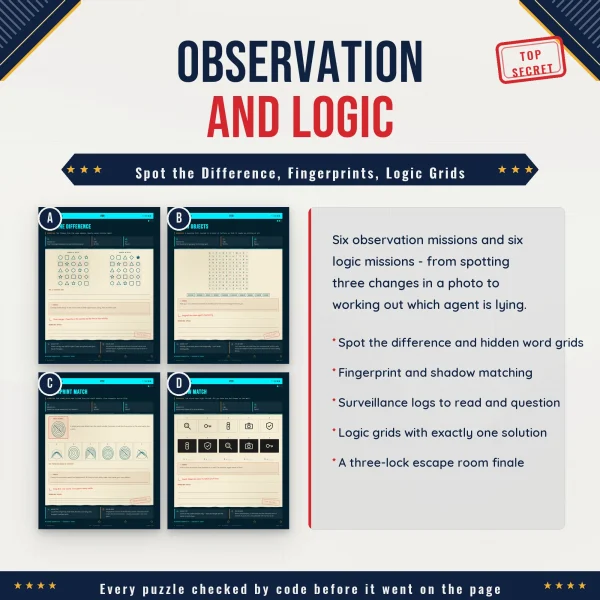
Every guest becomes an agent with a code name and works through a string of short missions: code breaking at the table, a laser maze in the hallway, a team finale. It suits 4 to 10 kids and runs about 90 minutes. Kids who’d rather move than read still get their turn.
Our Spy Games for Kids manual has 30 missions and a party planner on page 43 that lays out a 90-minute party:
| Time | What happens |
|---|---|
| 0 to 10 minutes | Hand out agent ID cards and code names |
| 10 to 20 minutes | Three table missions: a decoding page, a symbol cipher and spot the difference |
| 20 to 40 minutes | Two missions that need space: the laser maze and silent movement |
| 40 to 50 minutes | Snacks |
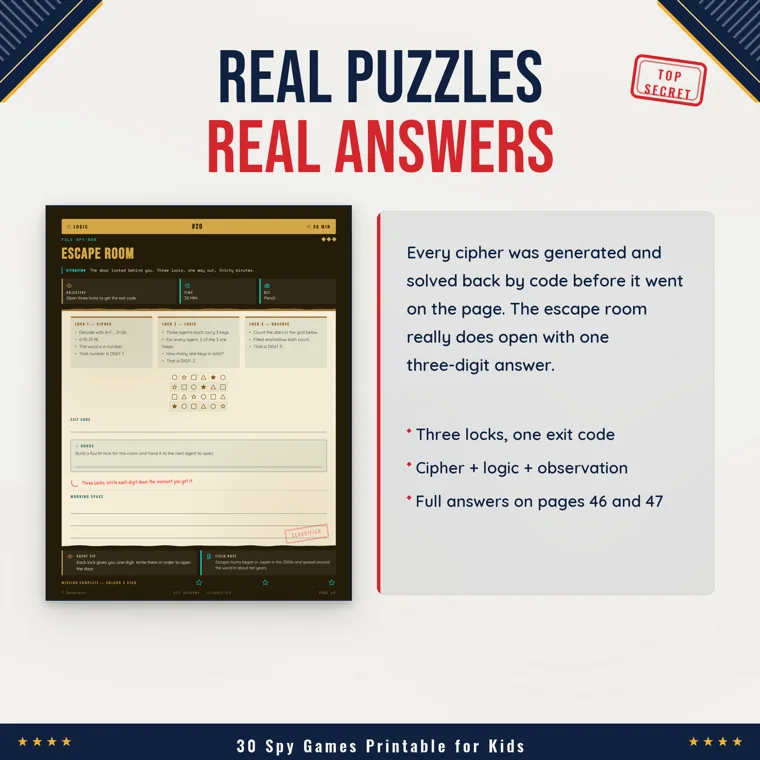
| 50 to 75 minutes | The finale: the three-lock escape room mission or the four-station team escape |
| 75 to 90 minutes | Certificates |
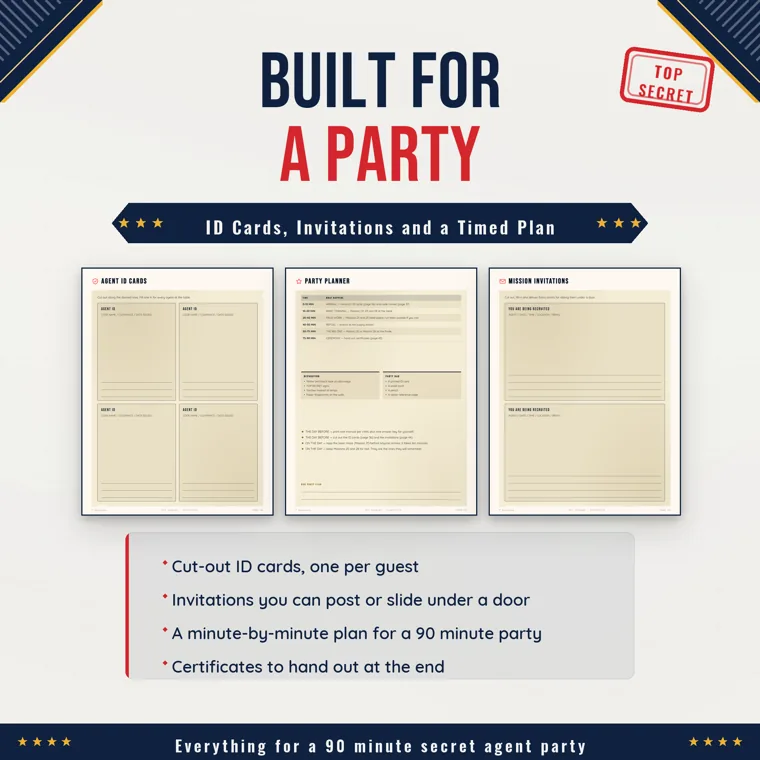
Don’t print the whole manual for every kid. The planner says to print one manual per child the day before. That’s 48 pages each, most of which the party won’t use. Print only the mission pages on your plan, one set per team, plus the ID cards (page 36), the code name generator (page 37) and the certificates (page 45). Leave out pages 46 and 47; they hold the answers.
Set up the laser maze before guests arrive. Mission 21 has players cross a hallway strung with “beams” of string or tape at different heights, and the planner gives it ten minutes to set up. Tape the string ends to the wall rather than tying them, so a beam pulls loose if a running kid catches a foot. Each touch costs 5 seconds, and the fastest total time wins.
Silent movement needs a quiet room. In Mission 23, one blindfolded “guard” sits with keys on the floor, and the other agents creep up to take them. If the guard points straight at you, you’re out. It doesn’t work next to a loud room. Run it after the table missions, when everyone’s ready for something new.
For more spy activities, including invisible ink and a case-solving finish, see secret agent activities.
Active game parties for 10-year-olds who want to move
One-minute challenge tournament
Set up stations with cups, balloons, cookies and string, and give each player or pair 60 seconds to stack, flip, blow or balance their way through a challenge. It works for 6 to 16 kids in about 45 minutes and fits in a kitchen. Score each round on a sheet so the tournament has a champion at the end. Our list of one-minute party game ideas has the challenges, the supplies for each and how to run the clock.
Backyard field day
Split guests into two or three color teams and run four or five short races: a sack race, a three-legged race, an egg-and-spoon race, a water-balloon toss and a relay. Allow about 10 minutes per event and an hour in total. Ten-year-olds care about the score, so post team points on a big sheet of paper where everyone can see it. The rules for these races are in our birthday party games guide.
Flashlight tag
It’s a good fit for a fall or winter party that runs past sunset. One player is “it” and holds the flashlight. Everyone else hides and moves around the yard, and anyone caught in the beam is tagged and becomes the next “it.” Play only in a fenced or familiar yard, walk the boundaries in daylight first and mark anything kids could trip on. Rounds last about 5 minutes; plan for 30 to 45 minutes in all.
Birthday bingo for a mixed-age crowd
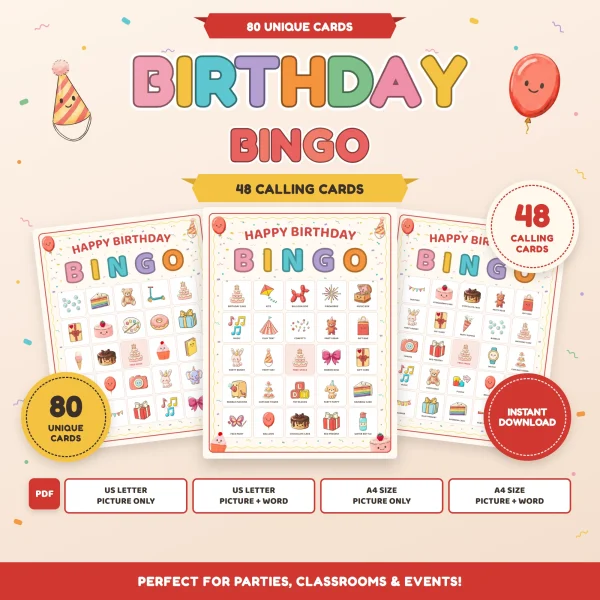
Bingo’s calm, it takes no explaining, and it works when younger siblings or cousins come along. Our Birthday Party Bingo has 48 pictures of cakes, presents, toys and party animals, with each card showing 24 of them around a free space. The cover marks it for ages 3 to 10, so for a room of 10-year-olds alone it can feel young. It’s at its best as the game guests play while they wait for everyone to arrive, or as the one game the whole family plays together.
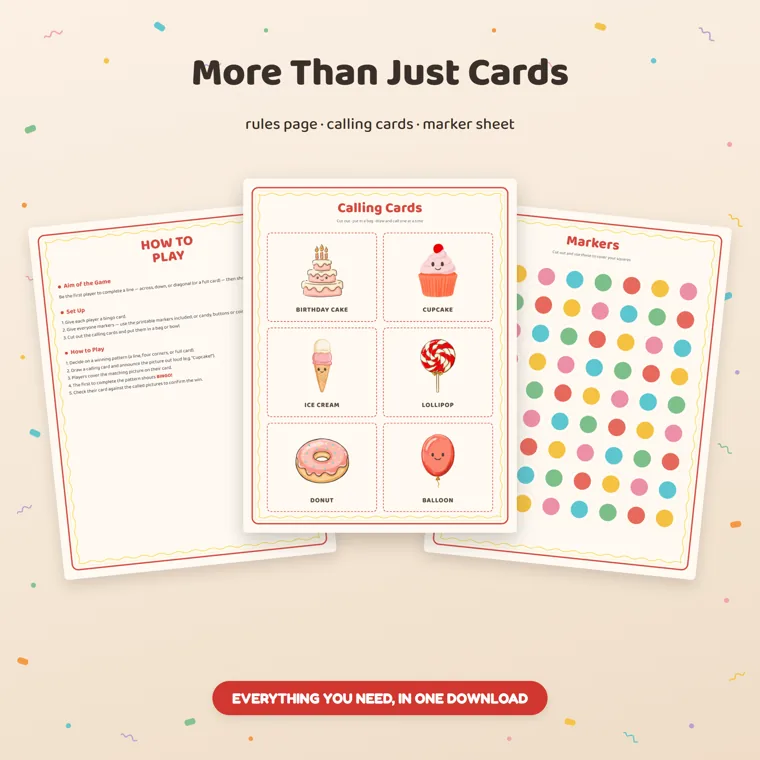
Want it to last? Play for a full card, not a single line. A card holds only half the pictures, so many calls miss your board and a full-card game takes a while. One printing note: in the 30-card set, the cover page reads “50 unique cards inside.” That file holds 30 cards; the 50-card set is a separate file. The layouts don’t repeat between the two, so you can print both for a big crowd.
Make-and-take party ideas
Cupcake decorating bar
Bake plain cupcakes the day before and set out frosting, sprinkles, candy and piping bags in bowls along the counter. Give each guest two or three cupcakes, a paper plate with their name and 30 minutes. That’s the cake and the party favor in one. Have small boxes or plates with lids for taking them home. Ask about food allergies on the invitation, and keep nut candy off the table if anyone is allergic.
Build-your-own pizza
Hand each guest a small dough round or flatbread, then set out sauce, cheese and toppings. Kids build their own. An adult runs the oven. Lunch is sorted. Allow about 15 minutes to build and 10 to 15 minutes to bake, depending on your oven. Write each kid’s initial on a scrap of parchment under their pizza so nobody fights over whose is whose.
Friendship bracelet table
Embroidery floss, safety pins to anchor the strands to jeans or a cushion, and a few printed pattern sheets will keep 4 to 8 kids busy for 30 to 45 minutes. It’s a quiet option for a sleepover evening or the last half hour of a party while parents arrive. Cut floss into lengths of about 2 feet before the party, or the first 10 minutes go to untangling.
10th birthday party ideas away from home
Bowling, skating, a trampoline park or a climbing gym
A venue takes setup and cleanup off your hands and suits 6 to 12 guests for 90 minutes to 2 hours. Most venues sell party packages with a set number of kids, a reserved table and a time slot, so check the guest cap before sending invitations. Many active venues also ask for a signed waiver from each child’s parent or guardian. Send the waiver link with the invitation, or kids end up waiting at the desk while an adult tracks down a parent.
Movie and pizza outing
Take 3 to 6 friends to a matinee, then to pizza or ice cream. Check the rating before you buy tickets; parents of guests may not agree with a PG-13 pick, so stick with G or PG unless you’ve asked. You’ll want two adults for tickets, bathroom trips and snacks.
Pottery painting or a cooking class
Paint-your-own pottery studios and kids’ cooking classes run parties for small groups. Ask how long the finished piece takes: pottery has to be fired and is usually picked up days later, so plan a small favor for the day itself.
Sleepover and late-over ideas at 10
For a lot of kids, 10 is the age of the first birthday sleepover. Keep it small, 2 to 5 friends, and let the birthday kid choose who. Plan the evening around one movie, one game and a big breakfast. The sleepover games guide has the games.
If some guests aren’t ready to stay overnight, or you’re not ready to host it, run a late-over instead: pajamas, the movie and snacks, with pickup at 9:30 or 10 p.m. It’s the same fun, minus the 2 a.m. homesick phone calls.
A two-hour plan for a 10-year-old’s party at home
This schedule fits the escape room or spy mission party. The times are our estimates; stretch the main game if the group is into it.
| Time | What happens |
|---|---|
| 0:00 to 0:15 | Guests arrive. Bingo or a code-name sheet keeps early arrivals busy |
| 0:15 to 0:20 | Split into teams and read the story or mission briefing together |
| 0:20 to 1:15 | The main game: escape room or spy missions |
| 1:15 to 1:35 | Food and cake |
| 1:35 to 1:55 | One active game: a one-minute challenge round or a relay |
| 1:55 to 2:00 | Certificates, favors and pickup |
Run the puzzle game before the food. Kids who have eaten cake and run around have a hard time sitting down to a logic grid.
When a 10-year-old’s party goes sideways
One team races ahead. Give finished teams a job: designing a bonus puzzle, judging the next game or setting up the cake table. Don’t let them wander over to “help” another team with answers.
A guest can’t keep up with the reading. Read clue boxes aloud for the whole room, and give that guest a hands-on role, such as maze runner, decoder card holder or timekeeper.
Arguments about who won. Decide the tie rule before the game starts and say it out loud. For puzzle games, the first team to say the right answer wins; for races, the referee’s call stands.
Someone feels left out. When kids pick teams, someone gets picked last. Don’t do it. Draw team colors from a bag instead, and have the birthday kid’s team picked the same way.
Printables from this article
Related articles
Printable Party Games
Morning Meeting Questions for Kids: Monday, Friday, Check-In
Read-aloud morning meeting questions for K–5 teachers, grouped by day, grade and topic, with circle timing, partner sharing, help for shy students and the questions to keep out of a whole-class circle.
Printable Party Games
Princess Party Ideas: Games, Crafts, Food & a 2-Hour Plan
A fairy-tale princess birthday at home, sorted by party stage, with guest counts, timing, supplies and the snags to plan around for kids 3 to 8.
Printable Party Games
Games for a Couples Shower: Icebreakers and Team Games
Fourteen couples shower games sorted by when you need them: mixing two friend groups, getting the whole room playing, his side against hers, quizzing the couple and winding down.