How to Plan a Birthday Party: Timeline, Budget & Checklist
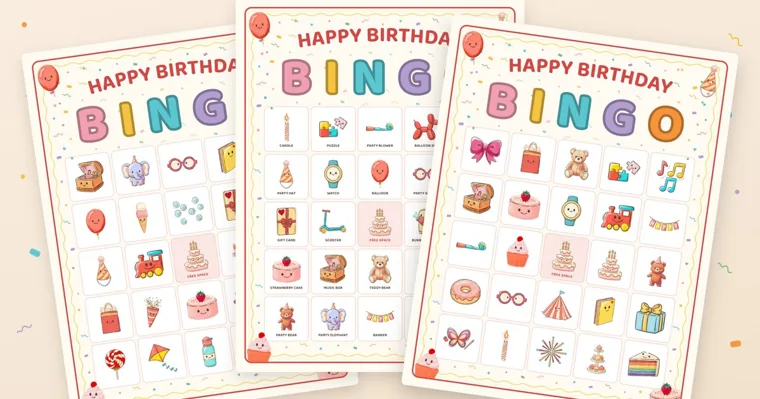
Start planning a birthday party about six weeks out. Make four decisions first: the date, the budget, the guest count and the place. Everything else follows from those four, from when the invitations go out to how much food you buy. Below is a countdown you can work through week by week, a two-hour schedule for the day itself, and the problems most worth planning around before they happen.
This guide is written for a kids’ party run by a parent, the most common case. For teen parties and adult milestones, the steps are the same and the games change. Our teen party ideas and adult birthday party games cover those crowds.
The four decisions to make first
These four choices limit each other. A small budget points to a party at home, a party at home caps the guest list, and the guest list sets the food order. Settle them together before you book or buy anything.
Date and time
Pick a date that doesn’t clash with a long weekend, a school event or another class party. For children under three, plan around nap time; a late-morning start usually fits best. School-age kids handle early afternoon well, between lunch and dinner, which also means you can serve snacks and cake instead of a full meal.
A weekend party a week before or after the real birthday is normal. The birthday child rarely minds, and it often makes room for more guests.
Budget
Set a total first, then divide it, rather than adding up purchases as you go. Most of a kids’ party budget lands in five places:
- The venue, or nothing if you host at home
- Food and drinks
- The cake
- Favors or prizes
- Decorations, plates and invitations
Divide the food and favor lines by the number of guests to get a per-child cost. If that number is too high, cut guests or switch the venue before you trim the cake. Printable games and decorations are an easy place to save, because you print only what the headcount needs. Our birthday party games by age and space lists which games need nothing beyond paper and music.
Guest count
A simple starting point for young children is the child’s age plus one, so six guests for a fifth birthday. Treat that as a suggestion, not a rule. It keeps a party at home manageable and gives every guest some attention from the host.
When you count, remember three groups that are easy to forget:
- Parents who stay. With children under five, many parents stay for the whole party, so plan chairs, drinks and food for them too.
- Siblings. Decide before the invitations go out whether siblings are welcome, and say so on the invitation.
- Helpers. One adult helper for every five or six young kids frees you to run games while someone else handles drinks and the door.
If you want to hand out invitations at school, ask the teacher first, since some classrooms have a rule about it. Inviting the whole class or sending invitations home privately are the usual ways around hurt feelings.
At home or at a venue
The place decides your workload. Here’s how the common options compare:
| At home | Park or backyard | Venue (play space, bowling, studio) | |
|---|---|---|---|
| Cost | Lowest | Low, check if a pavilion needs booking | Highest, usually priced per child |
| Who runs the games | You | You | Often the venue staff |
| Weather risk | None | High, needs a rain plan | None |
| Guest limit | Your space | Flexible | Set by the package |
| Cleanup | You | You | Mostly the venue |
| Book how early | No booking | A few weeks for a pavilion | Six weeks or more for weekends |
A venue costs more but buys back most of the planning in the countdown below. A party at home costs less and gives you full control of the schedule, which is the main thing a young child’s party needs.
Birthday party planning timeline
This countdown assumes a party at home or in a park with 6 to 15 kids. For a venue, booking moves to the top, since popular weekend slots can fill weeks ahead.
| When | What to do |
|---|---|
| 6 weeks out | Pick the date and time. Set the total budget. Decide home, park or venue, and book a venue or entertainer now if you want one |
| 4 to 5 weeks out | Write the guest list. Choose a theme if the birthday child wants one. Order anything that has to ship, like decorations or a custom cake topper |
| 3 weeks out | Send the invitations with an RSVP date about a week before the party. Ask on the invitation about food allergies |
| 2 weeks out | Plan the schedule and pick the games. Print one test page of every printable. Order the cake or plan the bake |
| 1 week out | Chase anyone who hasn’t replied. Fix the headcount. Write the shopping list and buy favors or prizes |
| 2 to 3 days out | Shop for food. Cut out game cards. Charge the speaker and make the playlist |
| The day before | Set up the room, or pack the car for the park. Bake or pick up the cake. Wrap the prize parcel. Lay out a basket of supplies for each game |
| Party day | Buy ice, set out food just before guests arrive, and keep the first game on the table by the door |
The RSVP date is the line that matters most. Food, favors and the number of parcel layers all depend on the final count, so a reply a week ahead gives you time to shop.
How long a kids’ birthday party should run
Ninety minutes is plenty for children three to five. For six to ten, two hours works well, and much past that most groups start to fall apart. These lengths are our planning suggestions; a party with a bouncy house or a venue activity can stretch longer because the activity carries the time.
Write the end time on the invitation. Parents plan pickup around it, and it gives you a firm point to hand out favors.
A sample two-hour schedule
| Time | What happens |
|---|---|
| 0:00 to 0:20 | Guests arrive. A table game that kids can join late |
| 0:20 to 0:50 | Active games, outside if you can |
| 0:50 to 1:15 | Food |
| 1:15 to 1:30 | Candles, song and cake |
| 1:30 to 1:50 | A seated game that includes every guest |
| 1:50 to 2:00 | Favors, coats and goodbyes |
Food comes after the active games for a reason. Kids eat better after running around, and the cake keeps them seated long enough to calm down before pickup.
Start with a game that works as guests trickle in
Guests rarely arrive on time, so the first activity needs to run with three kids or with fifteen. Bingo at a table by the door does that: each child gets a card as they come in and joins the next call.
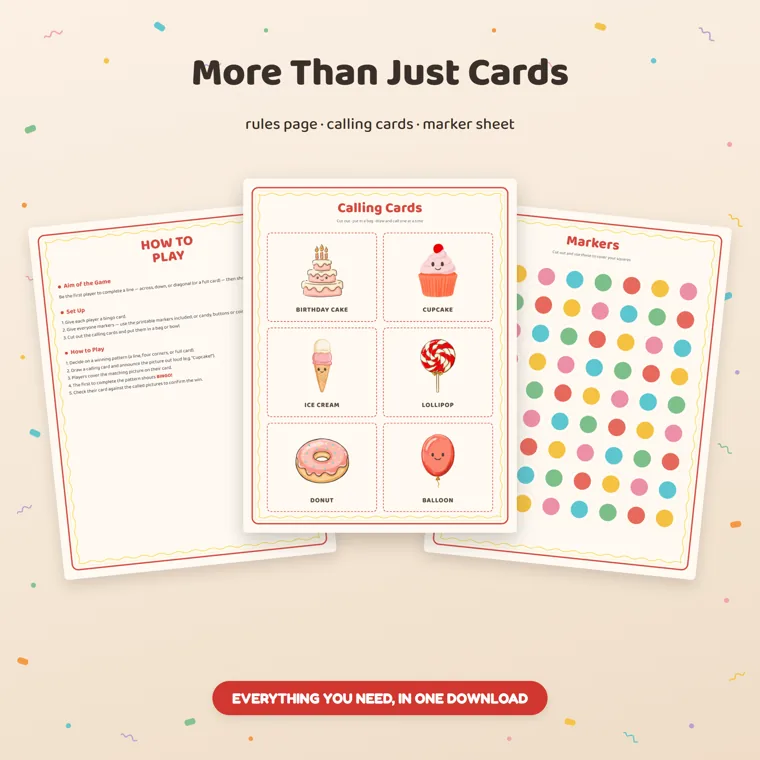
Our birthday party bingo comes as a 30-card set and a 50-card set, with calling cards printed six to a page. The how-to-play page lets you choose the winning pattern: a single line, four corners or a full card. Choose a line for the arrival game so rounds end quickly and latecomers can join the next one. Keep the full card for later, when you need to fill time.
End with a game where every guest wins something
The last game before goodbyes sets the mood for pickup. Pass the parcel suits that slot. The wrapping page in our pass the parcel game uses one layer per child, so each guest unwraps exactly once and goes home having opened something.
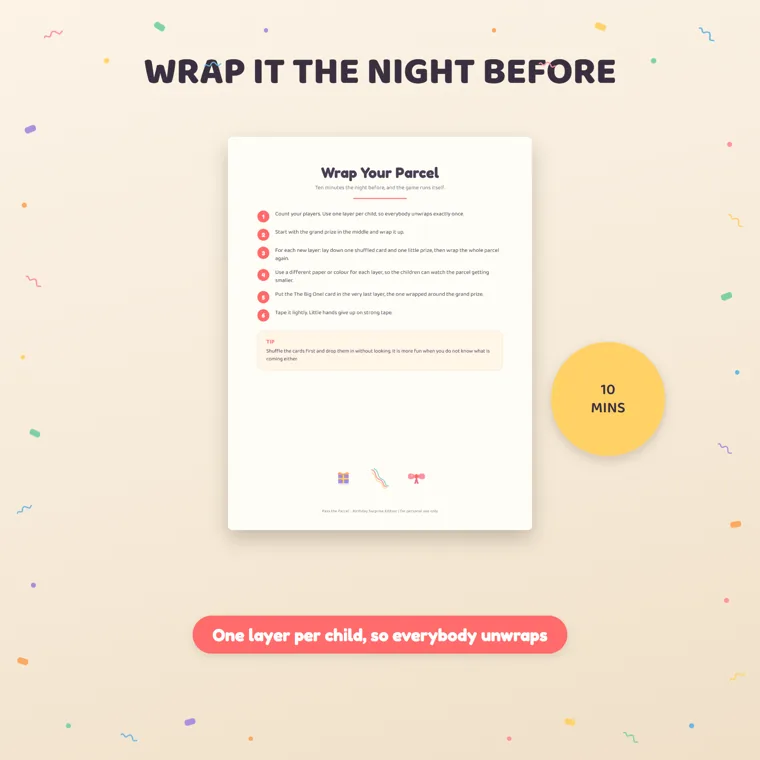
Wrap the parcel the night before, once the RSVPs are in, since the layer count comes straight from the headcount. The page budgets about ten minutes for it. The page builds it from the inside out: the grand prize goes in the middle, then each new layer gets one card and one small prize before you wrap again. It also suggests a different paper for each layer and light tape, because small hands give up on strong tape.
Running the music takes one trick. The music page says to turn away from the circle before you stop it, aim for a stop every 20 to 40 seconds, and keep a tally of who has unwrapped. Use the tally to steer the last few stops toward kids who haven’t had a turn.

For the active slot in the middle, pick from the age-sorted games guide linked in the budget section. Plan one more game than you think you need, and decide which one you’ll drop if the food runs late.
Food and cake
The time of the party decides the menu. A party that runs across lunch or dinner needs a real meal, while an early-afternoon party can stick to snacks, drinks and cake. Say which one it is on the invitation so parents know whether to feed their kids first.
Keep the kids’ food simple and easy to eat with one hand: pizza, sandwiches cut small, fruit, crackers and cheese. Put out water as well as juice. If any guest has a food allergy, label each dish and keep the cake’s ingredient list on hand, or ask that parent what their child can safely eat.
The cake has its own small kit that’s easy to leave behind at a park: candles, a lighter, a knife, a cake server, plates, forks and napkins. Pack it in one bag the night before. Cupcakes skip the cutting and serving entirely, which helps when you’re short on adult hands.
What to do when things go wrong
Most party problems are predictable. A plan for each one takes a few minutes and saves the hour.
It rains on an outdoor party
Choose a backup room before the invitations go out, and pick at least one game that works indoors. Bingo and pass the parcel both run seated in a small room. If there’s no indoor space at all, add a rain date to the invitation.
Half the guests arrive late
Don’t hold the first game for latecomers. That’s why the arrival game should be one kids can join mid-round. Start the active games at the planned time even if a few kids are still coming.
The birthday child melts down
Big feelings at a child’s own party are common, especially during presents and when a game is lost. Give the birthday child a small job, like calling the bingo pictures, and agree on a quiet spot they can go to for a few minutes. Many hosts also save gift opening for after the party, which takes away the comparison between presents and keeps the schedule short.
A guest is under three
Small prizes, game markers and hard candy are choking hazards for toddlers. The prize page in our pass the parcel set says to leave out small parts and hard candy when children under three are playing. The bingo rules suggest candy, buttons or coins as markers, so use the printed paper markers instead if toddlers are at the table.
RSVPs never come back
Send one short reminder the day after the RSVP date, then plan for everyone who hasn’t replied as a likely yes for food and favors. A few extra favors cost little and cover unexpected siblings too.
Party-day supply checklist
Lay these out the day before so nothing depends on a last-minute store run:
- Printed game sheets, cut and sorted, plus a pen for keeping score
- Bingo cards, calling cards in a bowl, and markers
- The wrapped parcel and the playlist on a charged phone or speaker
- Cake kit: candles, lighter, knife, server, plates, forks, napkins
- Drinks, cups, ice and a trash bag for each room
- Favors, counted to the final headcount plus a few spares
- A first-aid kit, wet wipes and paper towels
- A list of guests with each parent’s phone number
With these four decisions made, the countdown underway, and a rain plan and a game for latecomers ready, the day mostly runs itself. What’s left is lighting the candles on time.
Printables from this article
Related articles
Printable Party Games
How to Plan a Baby Shower: Timeline, Food & 2-Hour Schedule
A baby shower plan from the first talk with the parents-to-be to the last gift: timing, guest list, budget, venue, a two-hour schedule, safe food and backup plans.
Printable Party Games
How to Plan a Bridal Shower: Timeline, Budget and Schedule
A host's plan for a bridal shower, from the first talk with the bride and co-hosts to the guest list, invitations, a timed party schedule, the gift opening and what to do when something slips.
Printable Party Games
35th Birthday Ideas: Party, Trip, Theme and Gift Ideas
Ways to celebrate turning 35, sorted by how many people the birthday star wants around, with group size, time, prep and the snag to plan for in each.