Morning Meeting Questions for Kids: Monday, Friday, Check-In
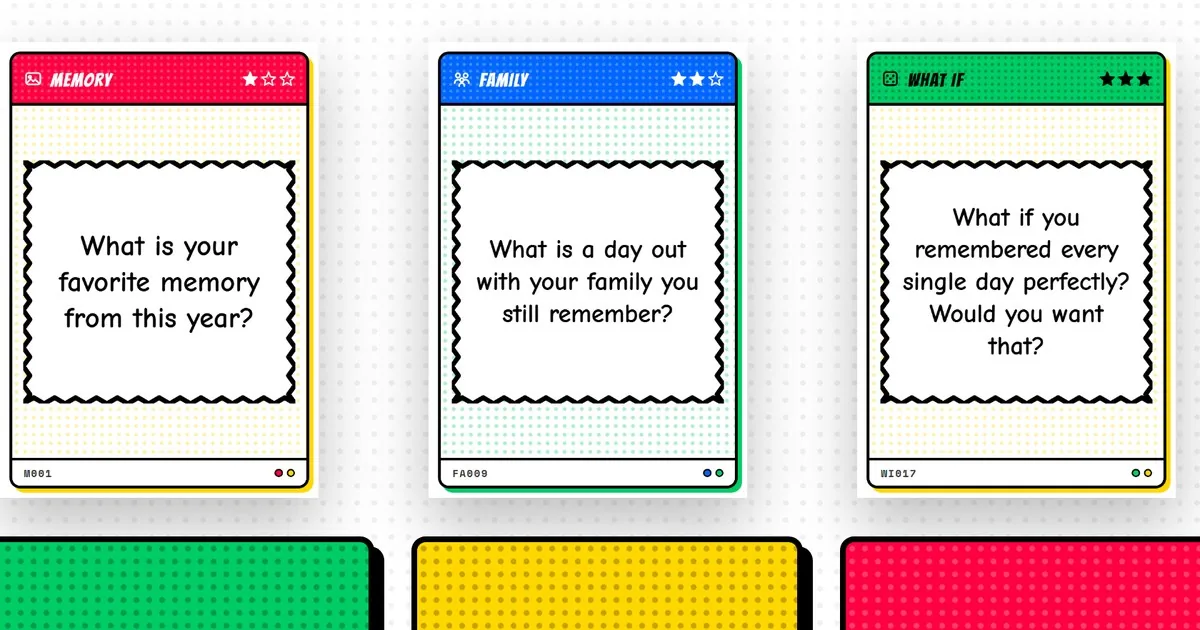
A good morning meeting question is one every child in the circle can answer in a sentence, without needing money, a trip or a particular kind of family to have an answer. “What’s one small thing that made you smile this weekend?” works for everyone. “Where did you go this weekend?” quietly sorts the room into kids who went somewhere and kids who didn’t.
The 101 questions below are written to be read straight off the page. They’re grouped the way a K–5 teacher actually reaches for them: by the day of the week, by grade band, by topic, and by season. After the lists you’ll find how long the question part of the circle takes, when to switch to partner sharing, what to do for the child who freezes, and the topics to keep out of a whole-class circle.
| If you need | Go to | Format that fits |
|---|---|---|
| A start to the week | Monday questions | Whole circle, one answer each |
| A wrap-up before the weekend | Friday questions | Whole circle or partners |
| Questions a kindergartner can answer | K–2 questions | Whole circle with a sentence frame |
| Questions that need a reason | Grades 3–5 questions | Partners first, then a few share out |
| A read on how the room is doing | Feelings check-in | Fingers, colors or a quick word |
| A fast, light warm-up | Favorites or imagination | Popcorn-style or around the circle |
| Something to build the class | Community questions | Whole circle, then act on an answer |
| A question that fits the calendar | Seasonal questions | Any format |
Where the question goes in a morning meeting
Morning Meeting, as the Responsive Classroom approach describes it on its own site, is a circle of students and teachers that meets each morning for twenty to thirty minutes. It has four parts: a greeting where everyone greets one another by name, sharing about events in students’ lives, a short group activity such as a song or a game, and a morning message the teacher writes for the class to read.
Most of the questions on this page belong in the sharing part. A few work better elsewhere. A feelings check-in can sit inside the greeting (“Good morning, Maya, thumbs or fist?”). A community question makes a good morning message, with a space under it for sticky notes. If you don’t follow the full four-part structure, a single question of the day at the carpet still does the same job: every voice gets heard once before the work starts. For the group activity slot, the brain breaks in games to play at school take five to ten minutes, and most need nothing but space to stand.
Monday morning meeting questions
Monday questions should let a child talk about the weekend without making the weekend the test. Some children had a birthday party; some spent two days at a relative’s apartment watching a younger sibling. Ask about something small enough that both children have an answer.
- What is one small thing that made you smile over the weekend?
- Did you build, draw, read or play something new since Friday? Tell us about it.
- If your weekend were a song, would it be fast or slow? Why?
- What’s a sound, smell or sight you noticed on your way to school this morning?
- What are you most curious about in today’s schedule?
- What is one thing you’d like to get better at this week?
- What’s one kind thing you could do for a classmate before Friday?
- What would make this a good week for you?
- How much energy did you bring today, from one to five?
- What’s one word that describes how Monday feels so far?
The energy question works well as the greeting itself. Each child says good morning to the next person and holds up fingers. You learn who is running on empty before the first lesson.
Friday morning meeting questions
Friday questions look back. They give children a chance to name what they learned and who helped them, which tends to be the part of the week nobody says out loud.
- What is one thing you learned this week that you could teach someone else?
- What was the hardest moment of your week, and what helped?
- Who in our class helped you this week, and how?
- What’s one word for this week?
- What did you finish this week that you’re glad you stuck with?
- If you could give Monday-you one piece of advice, what would it be?
- What’s one thing you want to try again next week?
- What made you laugh at school this week?
- Which part of our week should we do again?
- What’s one thing you hope to do this weekend, big or small?
The “who helped you” question has a trap. A few students get named every week and a few never do. Keep a quiet tally, and if a name hasn’t come up in a month, notice something that child did and name it yourself.
Morning meeting questions for kindergarten through second grade
Children in K–2 answer best when the question is concrete, about something they can see or do, and short enough to hold in their heads while they wait their turn. Give them a sentence frame on the board, such as “My favorite ___ is ___ because ___,” so the answer has a shape.
- What animal moves the way you feel this morning? Show us.
- Which recess game should we teach the whole class?
- What is something you can do all by yourself now?
- Find a shape in our room. What is it?
- What letter does your name start with? What else starts with it?
- How many pockets are you wearing today?
- What’s your favorite sound?
- What do you like to build?
- If our class could have any pet, what should it be?
- What crunchy food do you like?
- What’s one thing a good friend does at recess?
- What’s your favorite part of the morning?
- What color would you paint our classroom door?
The pockets and letter questions sneak in a bit of math and phonics. Count the pockets around the circle together, or write the letters on the board as children answer and see which one wins.
Morning meeting questions for grades 3 to 5
Older students can handle a question that asks for a reason or an opinion, and they get bored by questions they could answer in one word. Ask them to give a “because” every time, and let them disagree with each other politely.
- What is a skill you’d like to learn that school doesn’t teach?
- Should kids get a vote on class rules? Why or why not?
- What’s a book, show or game you’d recommend to this class, and who here would like it most?
- What seemed hard at the start of the year and feels easier now?
- If you could invent a new school subject, what would it be called?
- What’s a mistake you made this year that you’re glad you made?
- What’s a question you’ve wondered about that nobody has answered yet?
- What makes a group project go well, and what makes it fall apart?
- What job at school would you like to try for a day, and why?
- What’s one rule in a game you’d change to make it fairer?
- What does a good listener do with their eyes, hands and mouth?
- What’s the most interesting thing you’ve learned outside school lately?
These questions run long in a whole circle of 25. Have partners answer each other first for a minute, then call on three or four pairs to share. Everyone talks, and the circle stays under ten minutes.
Feelings check-in questions
A check-in gives you a quick read of the room, so most of these can be answered without a long story. Several can be answered with fingers or a single word, which helps on mornings when a child doesn’t want to talk.
- How ready are you to learn today? Show me one to five fingers.
- What kind of weather matches your mood this morning?
- If your mood today were a color, which one would it be?
- What is one thing that helps you calm down when you’re upset?
- What does your body do when you feel nervous?
- When was a time you were brave, even a little bit?
- What can you do when a friend looks sad?
- What can someone say to you that helps when you’re frustrated?
- What is one thing you need from our class today?
- What’s a feeling word you know that not everyone knows?
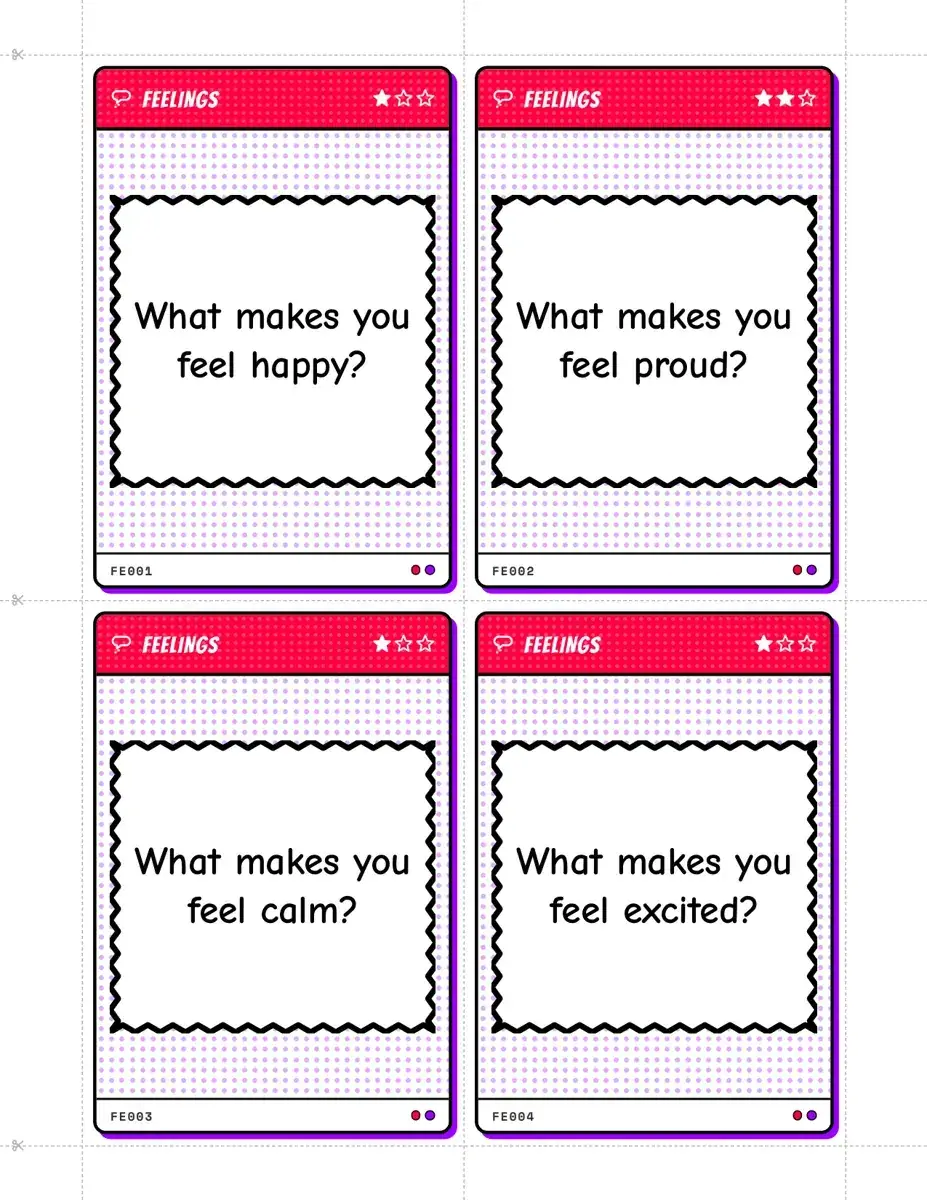
If you’d rather draw a card than read from a list, the Feelings theme in our Family Conversation Cards runs from page 48 to page 53 of the PDF, cards FE001 to FE021. Every one follows the same pattern, “What makes you feel ___?”, with a different feeling word, so a class can work through one feeling a day. For a whole circle, start with the comfortable ones (happy, proud, calm, safe). Save sad, lonely and frustrated for a journal or a one-on-one talk, where a child isn’t answering in front of 24 classmates.
A check-in is not counseling. If a child says something that worries you, don’t follow up in the circle. Thank them, move on, talk with them privately afterward, and follow your school’s procedure for bringing in the counselor.
Favorite things questions
Favorites are the easiest questions in the list, which makes them the right choice for the first weeks of school, for a substitute day, or for the morning after a hard day.
- Picture a rainy Saturday at home. What are you doing?
- What’s a smell you love?
- What’s your favorite way to move: running, dancing, climbing, swimming or something else?
- What’s the best snack to bring on a field trip?
- What do you like to draw most?
- What song gets stuck in your head?
- What’s your favorite thing in our classroom?
- What’s a game you could play forever?
- What’s your favorite time of day?
- If you could eat lunch anywhere at school, where would you sit?
For a faster round, try popcorn style: whoever has an answer says it, and the next child pops in. It suits favorites because nobody has to wait for a turn. Go back to the usual circle for the other topics, since popcorn style lets the same five children answer every time.
Imagination questions
Imagination questions loosen up a quiet room, and they’re the safest topic in this list because nobody’s answer depends on their real life.
- If our classroom had a secret door, where would it lead?
- If you invented a robot to help at school, what job would it do?
- If animals could come to school, which one would be the worst student?
- What would you put in a time capsule for kids fifty years from now?
- If you were as tall as the school for one day, what would you see?
- If our playground could get one new thing, what should it be?
- If your shoes could talk, what would they say about your morning?
- If your superpower were very small, like always finding a sharp pencil, what would it be?
- If you could invent a new day for our class to celebrate, what would we celebrate?
- If clouds were made of a food, which food should it be?
Would you rather questions fit here too, and a lot of teachers use them as the warm-up. We keep those on their own page: would you rather questions for kids sorts them by age and has a section for elementary students.
Classroom community questions
Community questions are about the class itself. They pay off when you actually use an answer: name the class, try the new freeze signal, or post the advice for new students by the door.
- What makes our class a good place to learn?
- What should a new student know on their first day in our class?
- Which class job would you like to try next?
- How could we make lining up quicker?
- What should we name our class?
- What’s something kind you noticed someone do this week? Don’t use their name.
- What’s one goal our whole class could work on this month?
- What should we do when someone feels left out at recess?
- Who are the helpers at our school we don’t thank enough?
- What signal should our class use for “stop and listen”?
The “don’t use their name” rule on the kindness question keeps it from turning into a popularity count. Children still describe the act, and the child who did it usually knows.
Seasonal morning meeting questions
Seasonal questions keep a year of meetings from sounding the same. They’re written about weather and the school year, not about holidays, so every family’s December fits.
Fall
- What’s one sign of fall you’ve noticed outside?
- What changes about getting ready for school when it gets colder?
- What’s something at school you’re thankful for?
- What should we play on an indoor recess day?
Winter
- What’s the best way to warm up after recess?
- What does winter look like where you live?
- What’s one thing you want to do better after winter break?
- If you could build a snow sculpture of anything, what would it be?
Spring
- What’s growing near your home or our school?
- What’s something new you want to try when it’s warm out?
- Which bug would you invite to class for a day?
- What has changed about you since the fall?
End of the school year
- What advice would you give next year’s class?
- Which day of this school year would you replay?
- What are you ready for in the next grade?
- What will you remember about this class?
How to run the question part of the circle
The format matters as much as the question. A great question asked the wrong way leaves 20 children waiting while one child talks for three minutes.
Around the circle, one answer each
With a class of about 22 and roughly 15 to 20 seconds per child, a full round takes about five to seven minutes. That leaves room for the other parts of a 20- to 30-minute meeting. Pass a talking object (a small ball or a beanbag) so everyone can see whose turn it is. If answers start running long, model the length you want by answering first yourself in one sentence. The adult guide in our School Would You Rather cards puts it plainly: “Children copy the length of the answer they hear.”
Partners first, then a few share out
For the grades 3–5 questions and anything that needs a reason, turn-and-talk is faster. Partner A answers for one minute, partner B answers for one minute, then call on a few pairs. A version that builds listening: each child tells the circle what their partner said instead of their own answer.
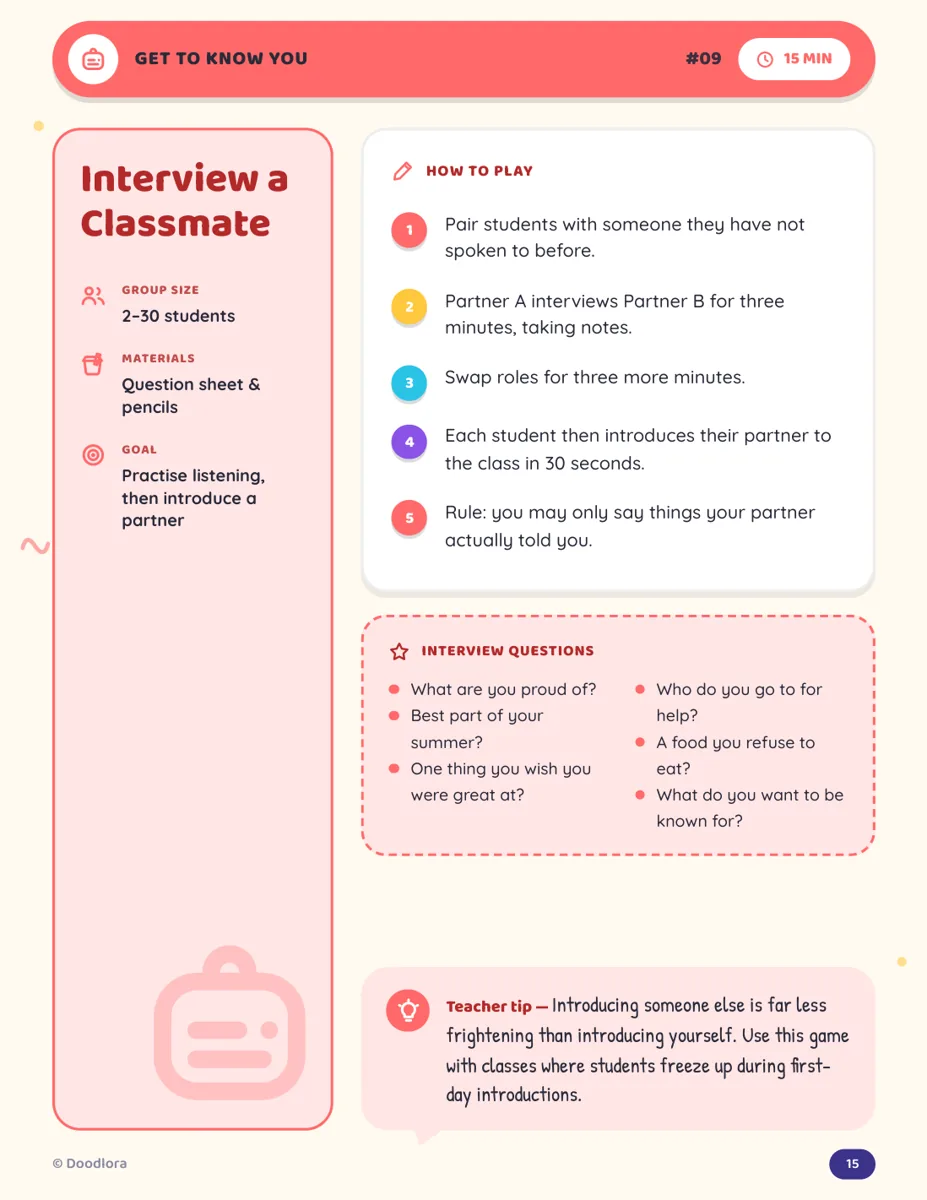
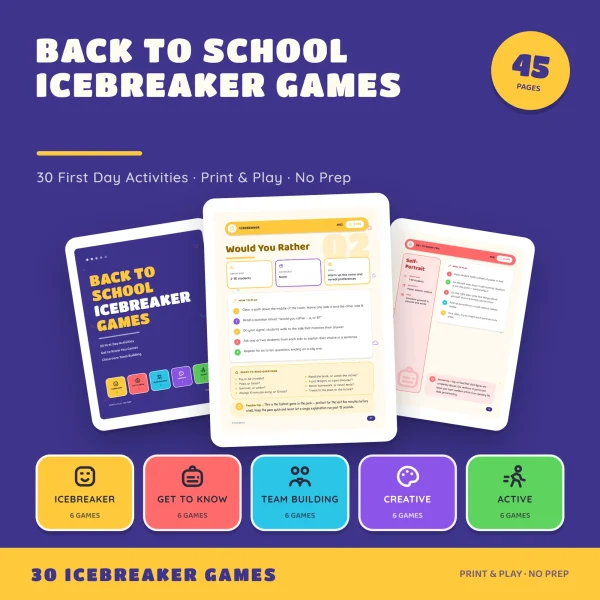
That’s game #09, Interview a Classmate, on page 15 of our First Day of School Icebreaker Games pack. As a first-week game it runs 15 minutes: three minutes of interviewing each way, then 30 seconds to introduce your partner, and you may only say what your partner actually told you. For a morning meeting, cut it to one minute each way and have just four or five pairs introduce each other. The page’s teacher tip is worth keeping in mind for shy classes. Introducing someone else is less frightening than introducing yourself.
The child who won’t answer
Make passing allowed and say so before the first question. A child who passes isn’t refusing. They’re often still deciding, and pressure in front of the whole class makes the next morning harder. Then come back to everyone who passed at the end of the round, with no comment. Some will have an answer by then, and the rest can pass again.
Other ways in for quiet children:
- Offer two choices instead of an open question. Picking between two things is much easier than inventing an answer from nothing.
- Let them answer with fingers, a thumbs-up or a color card for the check-in questions.
- Tell them the question the afternoon before, so they can plan an answer overnight.
- Let them whisper the answer to you or a partner, who says it to the circle.
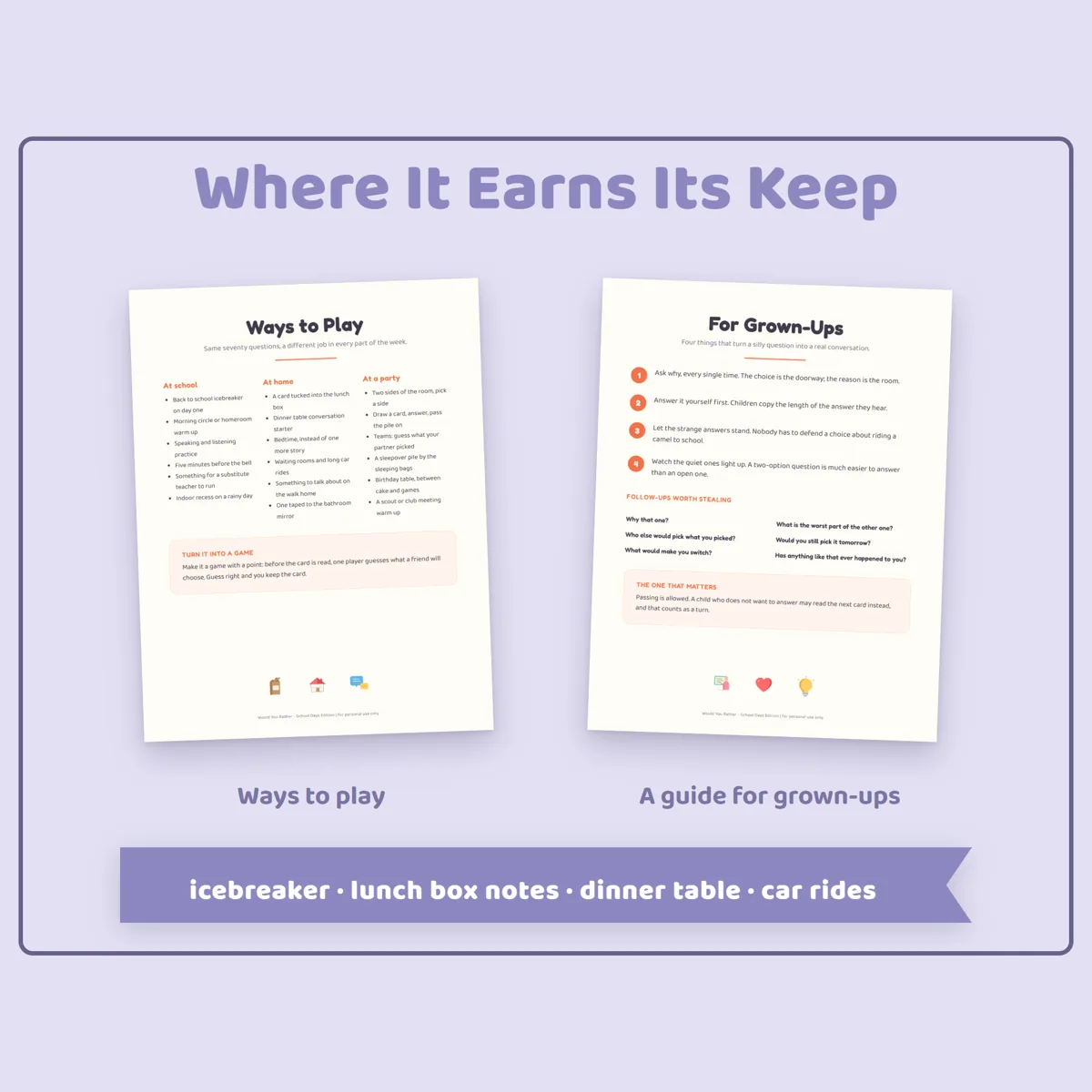
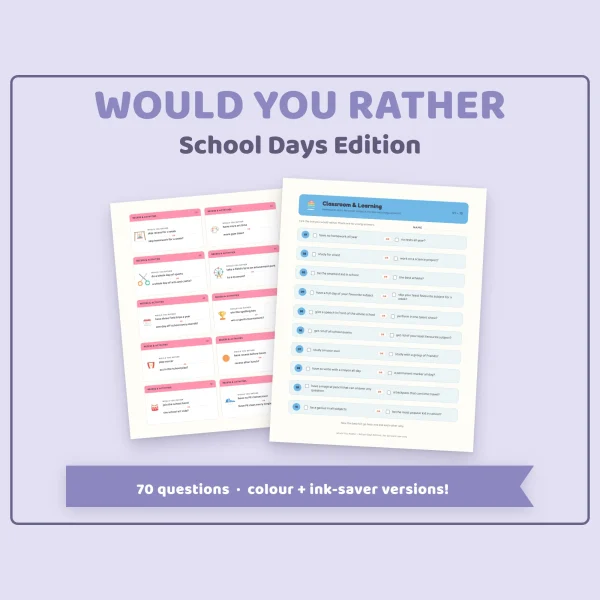
Our School Would You Rather cards put the pass rule on two of their four guide pages. The rule says a child who doesn’t want to answer may read the next card instead, and that counts as a turn. The Ways to Play page lists a morning circle or homeroom warm-up among its school uses. The deck holds 70 questions in seven topics, as cut-apart cards or as whole list pages you read straight down.
Questions to keep out of the whole circle
Some questions seem friendly and still put a child on the spot in front of everyone. The pattern is the same each time: the question assumes money, a religion, or a family that looks a certain way.
| Skip in the whole circle | Why it goes wrong | Ask this instead |
|---|---|---|
| Where did you go over break? | Sorts kids by who could afford a trip | What’s one thing you did over break that you’d do again? |
| What did you get for your birthday or the holidays? | Turns into a list of prices, and some children got nothing | What’s a gift you’d like to give someone? |
| How does your family celebrate Christmas? | Not every family is Christian, and some celebrate nothing in December | What’s a tradition you like? It can be as small as Friday pancakes. |
| What does your mom or dad do for work? | Assumes two parents, and a parent may be out of work or not around | What job would you like to try for a day? |
| Who do you live with? | Hard for a child in foster care or after a divorce, a move or a death | What’s something that makes you feel at home? |
| Who is your best friend in class? | Leaves some children named by nobody | What’s something a friend did that made your day better? |
Family change deserves extra care. A child whose parents just separated, whose grandparent died, or who recently moved may be fine with a question about recess and not fine with one about home. If you know something has happened, keep that week’s questions about school, imagination and favorites.
Printable question cards for morning meeting
A printed deck stops you from reaching for the same five questions every week. The family conversation starters page has more questions to read aloud at home. For the classroom, here is how each of our three packs fits the meeting:
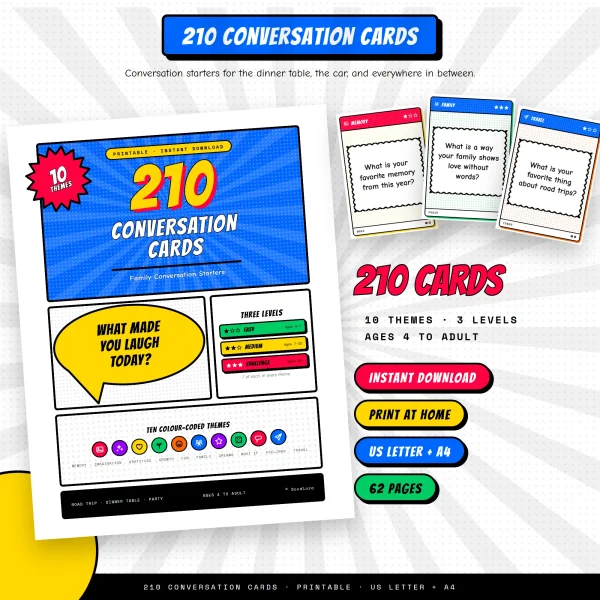
- Family Conversation Cards for the sharing part. The deck has 210 cards in ten themes, and every theme has seven Easy (ages 4–7), seven Medium (ages 7–12) and seven Challenge (ages 12+) cards, marked with one, two or three stars. A K–2 class can draw from the one-star cards; grades 3–5 can add the two-star ones. Before you bring it to school, pull out the Family theme (pages 32 to 37) and the Travel theme (pages 53 to 58). Family asks about the grown-ups and siblings at home, and Travel asks about the best place you’ve visited, which run into the problems in the table above. The cards are 3.5 x 5 inches, four to a sheet; print at actual size on card stock.
- School Would You Rather cards for the group activity or a two-minute warm-up. Print the list pages if you’d rather read down a sheet than cut 70 cards, and punch a hole in a corner of each card to keep one ring per topic.
- First Day of School Icebreaker Games for the first weeks, when the class doesn’t know each other’s names yet. Page 42 is a student reflection sheet with four sentence starters, including “Something I want my teacher to know is …”, which works as a written Friday check-in for children who won’t say much in the circle.
For more classroom ideas, icebreaker games for kids covers name games and first-week games in full, and fun Friday activities picks up where the Friday questions leave off.
Printables from this article
Related articles
Printable Party Games
Princess Party Ideas: Games, Crafts, Food & a 2-Hour Plan
A fairy-tale princess birthday at home, sorted by party stage, with guest counts, timing, supplies and the snags to plan around for kids 3 to 8.
Printable Party Games
Games for a Couples Shower: Icebreakers and Team Games
Fourteen couples shower games sorted by when you need them: mixing two friend groups, getting the whole room playing, his side against hers, quizzing the couple and winding down.
Printable Party Games
100 Fun Facts About Me Examples for Kids, School and Work
One hundred fun facts about me you can copy and change, sorted by where you need them, with a quick way to make each one yours and a list of details to keep private.