 1 / 4
Spy Games for Kids
Thirty secret agent missions, each a complete game on its own page, from Morse code and pigpen ciphers to a string laser maze in the hallway. Play them in any order, one after school or a handful at a spy party.
$6.99
Buy any 3 or more printables and save 20% at checkout.
- Download right after payment — link works for 30 days, up to 5 downloads
- Files arrive as a ZIP with your license PDF inside
- Secure checkout by Stripe · Refund policy
Spy Games for Kids is a 48-page printable manual of 30 secret agent missions. There’s no single storyline to follow: every mission is a complete game on its own page, and the training protocol says they can be played in any order.
Five kinds of mission
- Code breaking, missions 1 to 8. A number cipher, Morse code, a symbol alphabet, a Polybius grid, pigpen, a mirrored alphabet, a keyword alphabet and a double-locked message that needs two of them. Each page prints its own key.
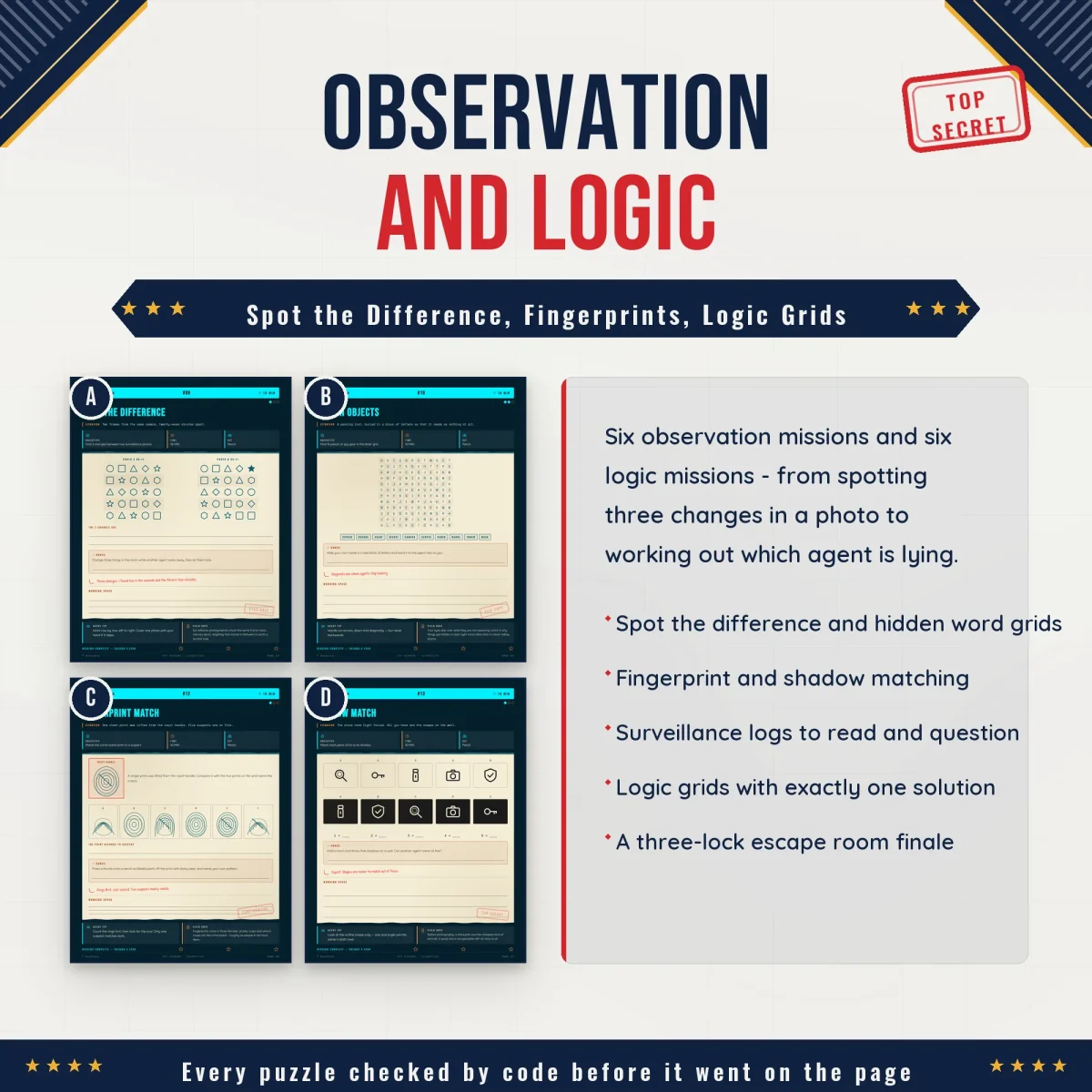
- Observation, 9 to 14. Three changes between two surveillance photos, ten pieces of spy gear hidden in a letter grid, a 60-second memory test, a fingerprint to match against five suspects, shadows to match to their gadgets, and a lobby camera log to question.
- Logic, 15 to 20. A logic grid, a whodunit about the missing HQ mascot, a timeline to put back in order, an alibi that can’t be true, witness reports to match to files, and an escape room where three locks each give one digit of the exit code.
- Physical, 21 to 25. These need a room or a hallway: a laser maze of string or tape, a four-station obstacle course with cushions and rope, sneaking up on a blindfolded guard to take the keys, throwing paper balls into three bowls, and one-minute speed drills.
- Team, 26 to 30. These need two or more agents: a whispered relay, a cipher split across two cut-out cards so neither half can solve it alone, a four-station escape for pairs, a relay through five earlier missions, and a final message in three fragments using three different codes.
What’s on each mission page
Every page gives the time it takes (10 to 30 minutes), the kit needed, and a difficulty mark from one diamond for a warm-up to three for real thinking. There’s also a bonus task and a short field note, like the 2,000-year-old history of the grid cipher. Kids color a star when they finish and record it in the mission log, where one star means finished, two means finished fast and three means no hints. All 30 lead to the certificate.
Running a spy party
The party planner is a 90-minute schedule: ID cards and code names on arrival, three table missions, two missions that need space, a snack break, Mission 20 or 28 as the finale, then certificates. It also lists decorating and party bag ideas, and there are invitations to cut out and fill in. The gear checklist sticks to things most homes have, such as string, cushions, three bowls and a scarf for a blindfold.
Printing
Print at Actual size, or the cut-out cards won’t line up. No puzzle depends on color, so the guide suggests grayscale to save ink. The answers are on pages 46 and 47, so leave those out when printing for the agents.