Secret Agent Activities for Kids: Spy Codes, Clues & Party
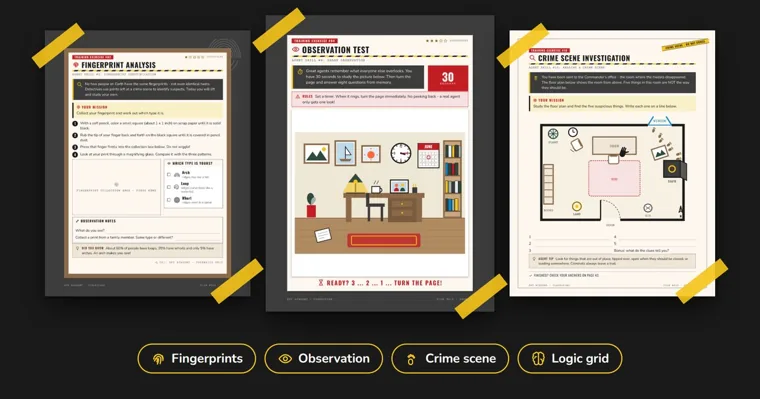
Secret agent activities for kids work best as a short training course: crack a code, test a memory, sneak past a guard, then solve a case. Pick one activity from each group below and you have a rainy afternoon, a classroom hour or the backbone of a spy party. Every activity lists the number of players, the time, what to set out and how it ends.
Player counts and times are our planning suggestions unless a page in our files gives them. Children who can’t read yet can join every memory and movement game here. Save the codes for kids who can already write letters on their own.
Pick a secret agent activity by situation
| Activity | Players | Time | Reading needed? | Set out |
|---|---|---|---|---|
| Caesar shift code | 1 or more | 10–15 min | Yes | Pencil, alphabet strip |
| Morse code tapping | 2 or more | 10 min | Yes, with a chart | Morse chart, flashlight |
| Mirror alphabet | 1 or more | 10 min | Yes | Pencil, A–Z key |
| First-letter hidden message | 1 or more | 10 min | Yes | Pencil, paper |
| Lemon-juice invisible ink | 1 or more | 20 min plus drying | Writing only | Lemon juice, swab, hair dryer, an adult |
| Kim’s Game | 2 to 10 | 5–10 min | No | Tray, 10–15 small objects, a towel |
| 30-second room test | 1 or more | 5 min | No | A room, or a printed picture |
| Fingerprint lifting | 1 or more | 10 min | No | Soft pencil, clear tape, magnifying glass |
| String laser maze | 2 to 8 | 15 min | No | String or yarn, masking tape, timer |
| Silent sneak | 3 or more | 10 min | No | Blindfold, a set of keys |
| Whisper relay | 6 or more | 15 min | One writer per team | Paper, pencil |
| String telephone | 2 | 15 min | No | 2 paper cups, about 15 feet of string |
| Solve a case | 1 to 4 | 30–45 min | Yes | Printed case file and cards |
One child on a rainy afternoon can start with the codes and finish with a case. Six kids in a living room need something moving first, so open with Kim’s Game and the laser maze, then sit everyone down for a code.
Code-breaking activities for kids who can read
Codes suit children who can write letters without help. Give each agent a pencil, a printed alphabet and a message that decodes into something they can actually go and do, such as “look under the mat.” A decoded order feels like a real mission. A decoded joke is over in a second.
Caesar shift code
A Caesar code moves every letter the same number of places along the alphabet. It is named after Julius Caesar, who used a shift of three, so A becomes D and B becomes E. One child or a pair can play, and a round takes 10 to 15 minutes.
Write the alphabet across the top of a page and the shifted alphabet underneath. Encode a short order, hand it over, and the receiving agent shifts each letter back three places. Try this one: ORRN XQGHU WKH PDW. It reads LOOK UNDER THE MAT, and the round ends when someone lifts the mat.
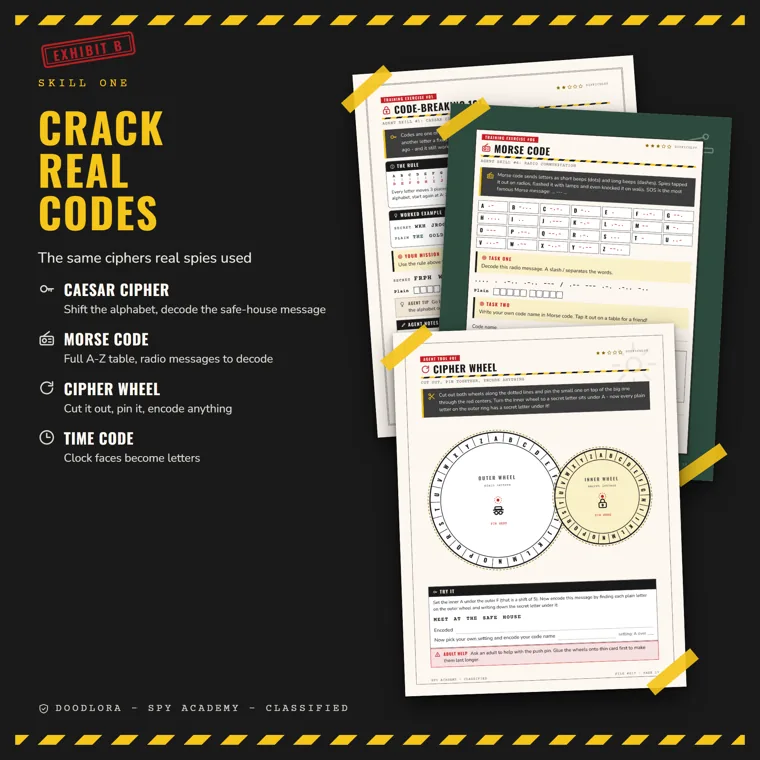
The snag is the end of the alphabet. With a shift of three, X, Y and Z wrap round to A, B and C, and a child who forgets the wrap stalls on the last letters. Page 7 of our Spy Academy book spells the wrap out in its rule box. Page 17 has a cut-out cipher wheel that turns the shift into a dial. An adult should handle the push pin that holds the two wheels together.
Morse code tapping
Morse code turns each letter into short and long signals, and it works best with two or more players and about 10 minutes. Print or copy an A–Z Morse chart first. SOS is the easiest start: three short, three long, three short.
With a flashlight, a short flash is a dot and a long flash is a dash. On a tabletop, a light tap can stand for a dot and a heavier knock for a dash. One agent signals a code name, and the partner writes the letters down and reads the name back. The round ends when the name is right.
Gaps cause most of the trouble. Without a pause between letters, three dots could be S or three Es. Pause for one beat between letters and longer between words, and keep code names to three to five letters while everyone learns.
Mirror alphabet
The mirror alphabet flips A to Z, B to Y and C to X all the way through. Its old name is Atbash, and it was first used with the Hebrew alphabet. One key both codes and decodes, which makes it the kindest cipher for a younger reader. A message takes about 10 minutes.
Write A to M along a line and Z to N underneath, so each letter sits above its partner. GSV PVB is THE KEY, which makes a good first test. The trap is the middle of the alphabet: M swaps with N, and kids often leave both letters unchanged.
First-letter hidden message
A hidden message can sit inside a normal-looking sentence. Take the first letter of each word, put them together, and the secret appears. This needs one writer, a pencil and about 10 minutes.
Choose a secret of one or two short words, then build a friendly sentence around it. “Grandma Often Naps On Wednesdays” hides GO NOW. The reader ends the round by underlining the first letters and doing what the message says. Long secrets produce strange sentences that give themselves away, so keep it under five words, as page 32 of the Spy Academy book suggests.
For a longer game, hide several coded notes around the house and let each one point to the next. Our indoor scavenger hunt guide covers setting room limits and writing a chain of clues.
Invisible ink with lemon juice (an adult handles the heat)
Lemon-juice ink is the spy activity children remember, and it needs an adult for the last step. Lemon, orange or apple juice and milk all count as heat-developed inks. They dry clear on paper and turn brown when warmed. Plan on 20 minutes plus drying time, and one or more writers.
Set out a small bowl of lemon juice, cotton swabs, plain white paper and a hair dryer. Write the message with a damp swab and let the page dry completely, until the words vanish. An adult then warms the paper with the hair dryer until the writing shows. Page 12 of our Spy Academy book runs the same steps and gives the warming to a grown-up. An iron, a radiator or an oven also brings the writing out, but keep those for adults. Held near a 100-watt light bulb, the paper is less likely to get damaged.
The usual giveaway is too much juice. A soaked swab leaves the paper wrinkled or shiny where the letters were, and a sharp-eyed agent spots the message without any heat. Blot the swab on a paper towel before writing.
Observation and memory games for younger agents
Memory games need no reading, so they work for preschoolers and mixed-age groups. They also take the least preparation of anything on this page.
Kim’s Game
Kim’s Game comes from Rudyard Kipling’s 1901 novel Kim, in which a teenager plays it while training as a spy. Scouts still play it. Two to ten players fit around one tray, and a round takes 5 to 10 minutes.
Put 10 to 15 small objects on a tray, such as a spoon, a pencil, a stone and a button, and cover them with a towel. Uncover the tray for one minute, cover it again, and ask each player to list or say everything they saw. The player who remembers the most wins.
The written version stops working with children who can’t write. For ages 5 and 6, take one object away while eyes are closed, uncover the tray and ask what is missing. Start with fewer objects and add more each round.
30-second room test
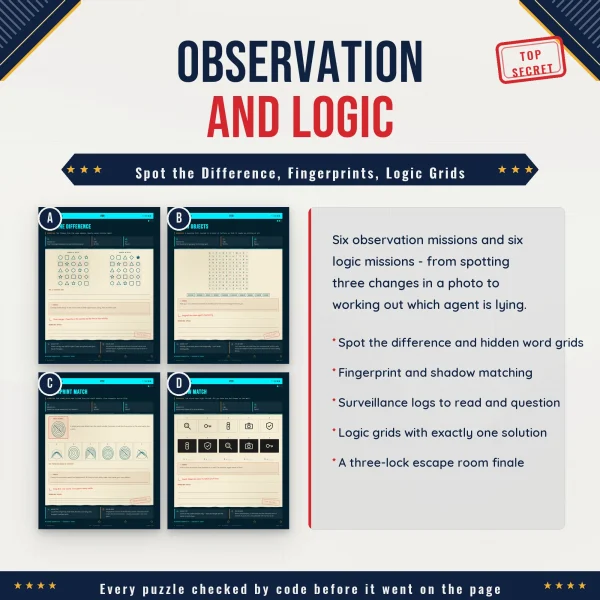
This test trains agents to notice details in a room. Each agent studies a room for 30 seconds and then steps outside. Someone changes three things, such as moving a cup or opening a drawer, and the agent comes back to find them. One child can play with an adult, or a group can take turns. Each turn takes about five minutes.
Pages 10 and 11 of the Spy Academy book have a paper version. Players study a drawn office for 30 seconds, then answer eight questions from memory. A score card rates them from Rookie to Elite agent. Print those two pages single-sided and hand over the questions only after the picture is face down, or someone will peek.
Fingerprint lifting
Fingerprint lifting is messy and hands-on, and it suits one child or a whole table for about 10 minutes. Set out a soft pencil, scrap paper, clear tape and a magnifying glass.
Shade a square about 1 inch across until it is solid black. Rub a fingertip across the square, then press it onto clear tape or straight onto paper. Look through the magnifying glass and decide whether the print shows an arch, a loop or a whorl, as page 8 of the Spy Academy book shows. The round ends when everyone has named their own pattern and matched a “crime scene” print to the right family member.
Smudged prints come from wiggling. Press once, firmly, and lift straight up. Wash graphite-covered fingers before anyone touches the next game’s paper.
Active secret agent missions for a group with some space
Movement games break up the sitting and are the ones kids replay. These four ideas come from our 30 Spy Games pack and the Spy Academy book. Each needs a clear hallway, a yard or a living room with the furniture pushed back.
String laser maze
A string laser maze turns a hallway into a vault. It suits two to eight players and runs about 15 minutes, plus about 10 minutes of setup before the kids arrive. Tape string or yarn across the hallway at different heights, some near the floor so agents must crawl.
Agents cross one at a time from start to finish while someone times them. Each touch of a beam adds five seconds, and the fastest total wins. For a second round, run the course backward.
Tape the string ends with masking tape instead of tying them to furniture. A snagged foot then pulls the string loose instead of dragging a chair over.
Silent sneak
The silent sneak is a stealth game for three or more players and about 10 minutes. One agent is the guard and sits blindfolded with a set of keys on the floor in front. The others start at the far wall in socks and creep forward.
Whoever takes the keys without being caught wins and becomes the next guard. If the guard points straight at a sneaking agent, that agent goes back to the wall. Arguments start over whether the point was “straight at” someone, so name a referee before the first round.
Whisper relay
The whisper relay tests whether a message survives being passed down a line. It needs at least six players split into two teams and takes about 15 minutes. Each team stands in a line, and only the last agent reads the message.
The message is whispered forward once, with no repeats and no questions. The agent at the front writes down what arrived, and the team closest to the original wins. Numbers get lost faster than words, so put one number in the message to make it harder.
String telephone
A string telephone gives two agents a private line between two rooms. Gather two paper cups, about 15 feet of string and a sharp pencil, and allow about 15 minutes.
An adult pokes a small hole in the bottom of each cup with the pencil. Thread one end of the string through each hole and tie a fat knot inside so it can’t slip out. Walk apart until the string is tight and straight, then one agent speaks into a cup while the other listens.
If no sound comes through, the string is usually slack or rubbing against a doorframe. Pull it tight and keep it clear of corners.
Case-solving missions for a quiet finish
A case to solve brings an excited group back to the table and gives the session an ending. Run it last, after the code activities, so the agents already know the tools.
The missing medals case
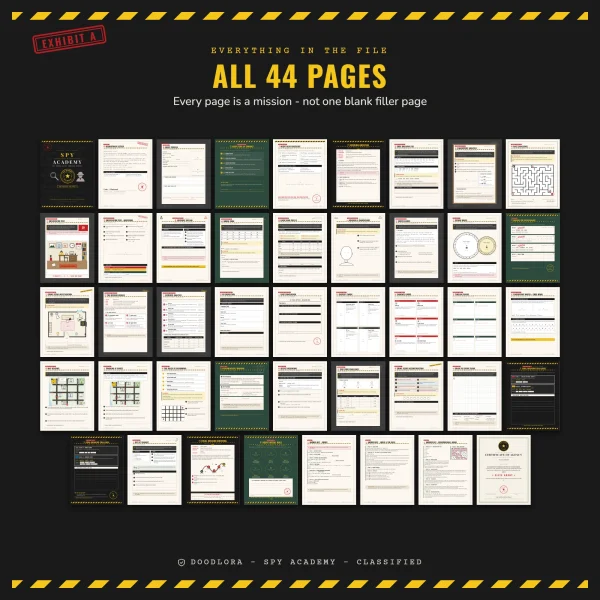
The Spy Academy book builds its case over pages 20 to 27. Three medals have vanished from a safe, and four suspects were in the building. Agents read six pieces of evidence and sort the real clues from the red herrings. They rule suspects out one by one and write a final report. The book estimates 30 to 45 minutes for the case. One to four children can share the cut-out suspect, evidence and timeline cards.
In a group, one fast reader often blurts out the answer. Have every agent write a suspect’s name on paper before anyone speaks. Then compare reasons, and check the solution on page 42 together.
Escape room mission
An escape room mission makes a strong finale for pairs or a small team. The Escape Room page in our 30 Spy Games pack has three locks. A number code, a logic question about real and fake keys, and a grid of stars each give one digit of the exit code. The page allows 30 minutes. Another page in the pack splits four stations between four pairs, so nobody can finish without swapping answers.
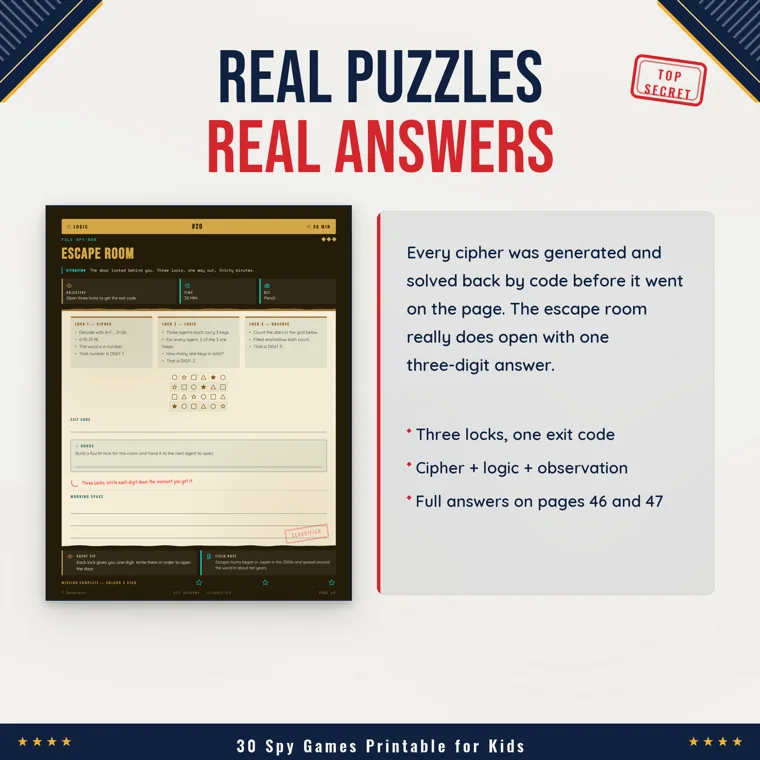
The answer pages, 46 and 47, say “Grown-ups only” across the top. Print the pack without them and keep one copy for yourself. To build a whole room with hidden clues and real locks, use our DIY escape room guide.
A 90-minute secret agent party plan
A spy party runs smoothly when the quiet table games and the loud running games take turns. The party planner on page 43 of our 30 Spy Games pack uses this order, and it suits six to ten guests:
| Time | What happens |
|---|---|
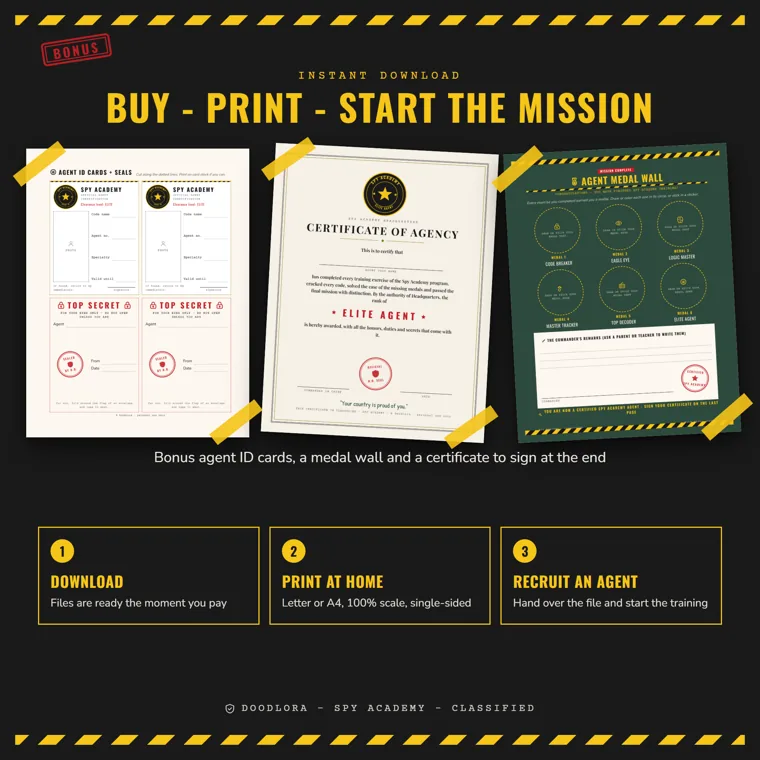
| 0–10 min | Arrival: hand out agent ID cards and pick code names |
| 10–20 min | Basic training: a number code, a symbol code and spot the difference at the table |
| 20–40 min | Field work: the laser maze and the silent sneak, outside if you can |
| 40–50 min | Refuel: snacks at the “supply station” |
| 50–75 min | The big one: an escape room mission as the finale |
| 75–90 min | Ceremony: hand out certificates |
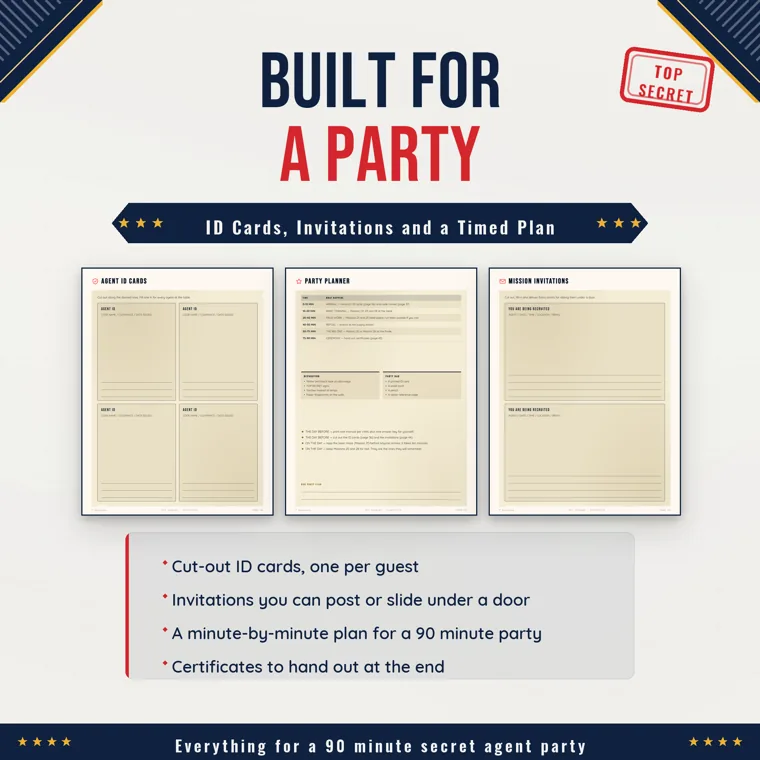
The printing is easy to overdo. The planner suggests one manual per child, but each manual runs 48 pages. For a party, print only the pages for the missions on your plan, plus the ID cards and certificates. The ID card page holds four cards, so eight guests need two sheets. Tape the laser maze before anyone arrives. The planner allows ten minutes for it.
For decorations, the planner lists yellow and black tape on doorways, TOP SECRET signs, flashlights instead of lamps and paper fingerprints on the walls. A party bag with an ID card, a small flashlight, a pencil and a code chart lets the games continue at home.
When a secret agent mission stalls
Most spy sessions stall at the same few points, and each one has a quick fix.
- Stuck on a code. Give the first letter, then the first word, before you give the whole answer. The 30 Spy Games pack has a rule for this: a stuck agent asks a teammate, not the answer key.
- Readers and non-readers together. Pair them up. The reader decodes, and the younger agent works the flashlight, finds the hidden note or carries the message.
- Fights about who is out. Name one referee for the movement games and rotate the job each round.
- Running long. Every activity above has its own ending, so stop after any of them. A certificate or a medal at that point makes a short session feel finished.
Printables from this article
Related articles
Kids Activity Books
Math Puzzles for Kids With Answers, Sorted by Grade
Ready-to-use math puzzles from kindergarten to middle school, each with its answer, plus how to run them as a home warm-up or a classroom center.
Kids Activity Books
Quiet Time Activities for Kids: Bin and Quiet Book Ideas
How to swap a dropped nap for an hour of quiet time, with a starting length, a timer, a rotating bin and solo activities sorted by age, from board books to build-and-play mats.
Kids Activity Books
Winter Activities for Kids: Snow, Indoor & Quiet Ideas
Fifteen winter activities sorted by the day you actually have: fresh snow, cold without snow, energy stuck indoors or a quiet table, plus when to call everyone in.