Bedtime Routine for Kids: Steps, Times and a Chart by Age
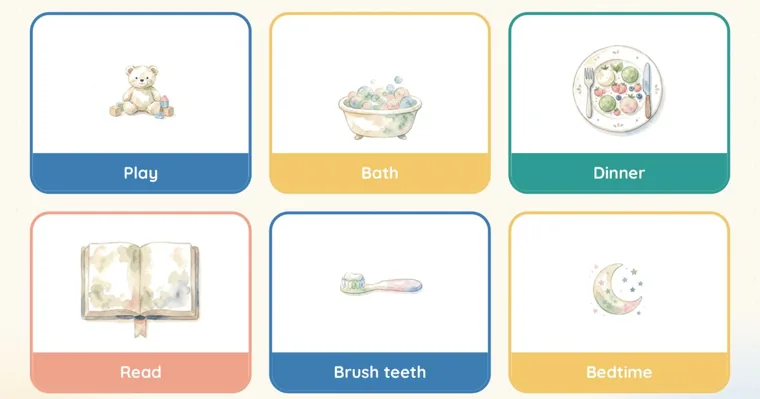
A bedtime routine for kids is a short run of the same steps in the same order every night, ending at a fixed lights-out time. Pick lights-out by counting back from the time your child has to wake up, then start the routine about 35 minutes before it, or 45 on bath nights. Five steps cover most families: wash or bath, toilet and pajamas, brush teeth, a book, then lights out.
The American Academy of Pediatrics boils the core down to three words, brush, book, bed. Everything below builds on that: how many hours to plan for at each age, how long each step really takes, what changes between a toddler and a fifth grader, and what to do about the glass of water, the extra hug and the late nights of winter break.
How to set a bedtime for kids from their wake-up time
Start with the morning, because that end of the night is usually fixed by school or daycare. Then take off the hours of sleep your child needs, and you have lights-out.
For the hours, the American Academy of Sleep Medicine published consensus recommendations in 2016, after an expert panel reviewed 864 published articles, and the AAP says it supports them. The figures are total sleep in 24 hours, so for younger children a daytime nap counts toward the number.
| Age | AASM recommendation per 24 hours | Example: wakes at 6:45 a.m. | Lights out | Routine starts |
|---|---|---|---|---|
| 1 to 2 years | 11 to 14 hours, naps included | 11½ hours at night, plus a nap | 7:15 p.m. | 6:40 p.m. |
| 3 to 5 years | 10 to 13 hours, naps included | 11 hours at night, no nap | 7:45 p.m. | 7:10 p.m. |
| 6 to 12 years | 9 to 12 hours | 10 hours at night | 8:45 p.m. | 8:10 p.m. |
The example column is one choice inside each range, not a target. We’d pick a number from the middle rather than the bottom, because lights-out isn’t the moment a child falls asleep. If your child still naps, a long nap leaves fewer hours to cover at night, so a toddler back from a two-hour afternoon nap may need a later lights-out than the table shows.
The AAP also recommends the same waking time on weekdays and weekends. A wake-up that slides two hours later every Saturday drags the next bedtime with it, and Sunday night becomes the hard one.
The steps of a bedtime routine and how long each one takes
A child who can see the next step coming has less to argue about, so keep the order fixed even when a step changes. Picture cards make that order visible, and a visual schedule for kids built from them works for evenings as well as mornings. The minutes below are our estimates for a child who needs some help; add a few for a toddler and take a few off for a 10-year-old.
| Step | Time to allow | What to watch for |
|---|---|---|
| Wash face and hands, or a bath | 5 minutes, or about 15 for a bath | Bath nights push the start 10 minutes earlier |
| Toilet and pajamas | 5 minutes | Put the toilet trip here, not after the story |
| Brush teeth | About 5 minutes | Last thing to touch the teeth before bed |
| A book | 15 minutes | Read in the bed or right beside it |
| Lights out | About 5 minutes | Same words, same song, every night |
Screens come before all of this. The AAP recommends turning screens off at least an hour before bedtime and keeping TVs, tablets and phones out of children’s bedrooms, especially at night. With a 7:45 lights-out, that means the tablet goes back on the kitchen counter by 6:45. The same AAP page suggests dimming the lights before bedtime and keeping home temperatures between 68°F and 72°F (20°C to 22°C) for infants and children.
Brush teeth after the last snack, then read
The AAP’s Brush, Book, Bed program puts brushing before the story for a reason it states plainly: the last thing to touch the teeth before bed should be the toothbrush. Any milk, juice or snack belongs before brushing. Water is the drink to keep for afterward.
Reading comes next. The AAP suggests even 15 minutes a day of reading aloud together, and the end of a bedtime routine is an easy place to find those minutes.
Bath nights and wash nights
A bath doesn’t have to happen every night for the routine to hold. On nights without one, a quick wash of face and hands takes the same slot, so the order never changes and the child doesn’t have to ask what’s next.
A bedtime routine by age: toddlers, preschoolers and school-age kids
The five steps stay the same from age 1 to 12. What changes is who does the work, how many choices the child gets, and how much reading happens alone.
Toddlers, ages 1 to 2
Keep a toddler’s routine short and fully run by an adult, with three or four steps and the same words at each one. A toddler can’t follow a chart yet, but pointing at the next picture card (“bath, then pajamas”) gives the steps a shape. At this age, consistency in the words and the order counts for more than the length of the routine. For children under 3, the AAP says to use a smear of fluoride toothpaste about the size of a grain of rice, and young children need an adult’s help with the brushing.
Preschoolers, ages 3 to 5
At 3 to 5, a picture strip on the wall starts to work, and small choices help more than lectures: the blue pajamas or the striped ones, this book or that one. Offer two options, not an open question. The AAP’s amount for ages 3 to 6 is a pea-sized dab of fluoride toothpaste, and it’s fine to let the child practice with the brush as long as you take a turn too.
School-age kids, ages 6 to 12
From about 6, children can run most of the routine from a checklist while you check in at the end. Two things change at this age. Homework and packing the backpack creep into the evening, so finish them before the routine starts rather than squeezing them in between brushing and the book. And reading can turn into reading alone in bed, with a set time for the light to go off, which gives an older child some independence without moving lights-out.
The AAP also warns against overscheduling. Evening sports, lessons and appointments squeeze the time before bed, so on practice nights we’d shorten the book rather than push lights-out later.
Two children at different ages
Sharing one bathroom and two bedtimes works better with staggered starts. Run the younger child’s routine first, while the older one gets 20 quiet minutes, then swap. The older child’s later lights-out can be part of growing up rather than a fight, as long as it’s stated in minutes, not “a bit later.”
Building a bedtime routine chart from printed cards
A picture chart helps a child who can’t yet read the steps, and it lets you point at the card instead of repeating yourself. In our under the sea routine charts, two pages hold twelve routine cards each, one with dashed cutting lines and one with thick colored frames. Five of the twelve belong to the evening: Dinner, Bath, Brush teeth, Read and Bedtime.
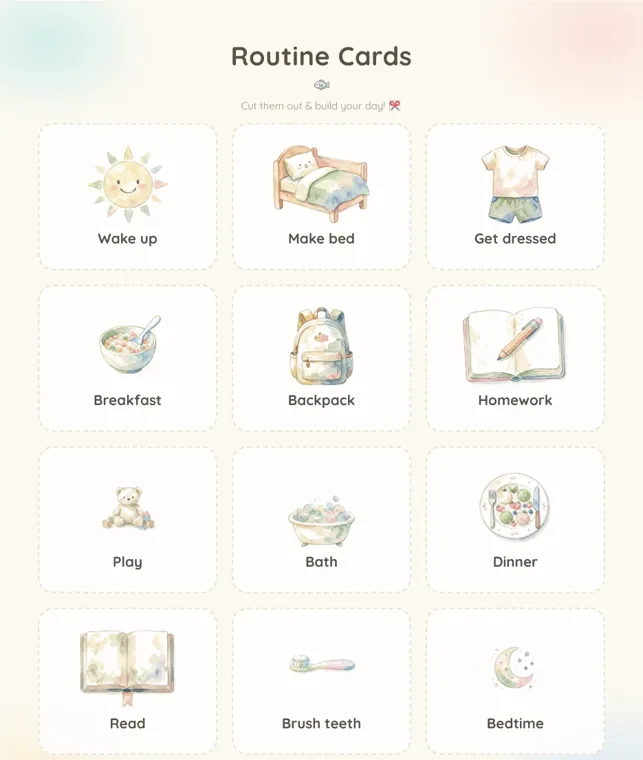
Two steps from the list above have no card at all: pajamas and the toilet trip. Draw them on the back of a spare card such as Homework, or write them on a sticky note in the strip. Then lay the cards out left to right in your family’s order and hang the strip at the child’s eye level, near the bathroom or the bed.
The other pages in the set need a quick fix before they work for bedtime. The Daily Routine page groups ten picture steps under Morning, Afternoon and Evening, and its Evening row has only three tiles: Bath time, Read a book and Bedtime.
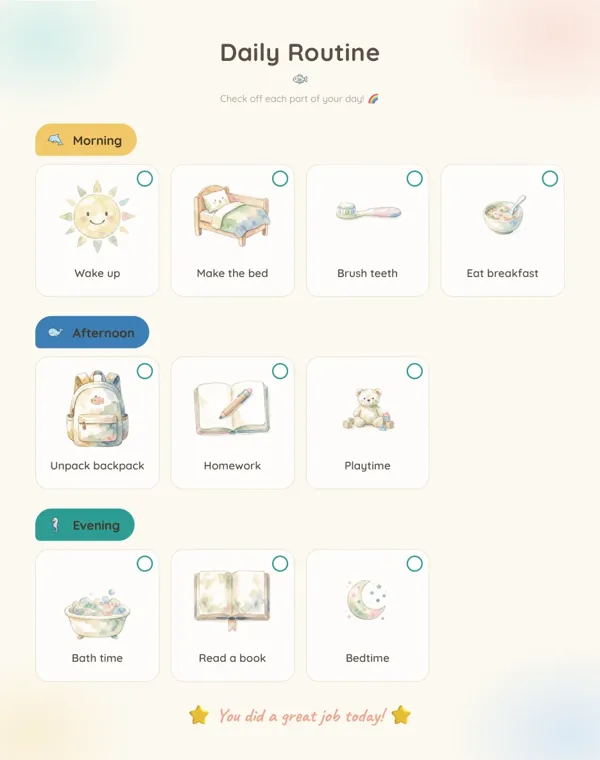
The US Letter file of the My Day page has a related gap. It lists the steps top to bottom and stops at Read a book, with no Bedtime row, while the A4 version includes Bedtime as its last row. Write Bedtime in under the last row before you hang it up. If your family prefers flat, simple pictures to watercolor, the picture visual schedule set has the same steps and the same twelve cards, and it needs the same fixes.
When kids stall, cry or ask for one more glass of water
A lot of bedtime trouble starts after the light goes off: one more drink, one more hug, one more question. The simplest fix is to move every predictable request into the routine itself, before lights out.
Requests for water, a hug or the toilet
Make each one a step. Water goes on the nightstand after brushing, the toilet trip is the step right before pajamas, and the last hug happens at the door. After that, use one short line every night, such as “It’s sleep time, I’ll see you in the morning,” and leave. A request you’ve already met has an easy answer: “You had your water, it’s right there.”
Stalling at every step
When pajamas take 15 minutes, point at the card instead of arguing, and keep lights-out at the same time even if the book gets shorter that night. Say it calmly and once: “We used up some story time, so it’s one book tonight.” The lost minutes come out of the part your child likes best, without a lecture.
Crying or calling out after lights out
Go back briefly, say the same goodnight line and leave again, with little talk and the light kept off. The AAP lists stalling and resisting going to bed among the most common sleep problems in children, along with snoring and loud or heavy breathing during sleep. If bedtime fights go on for weeks, or you notice snoring, bring it up with your child’s pediatrician, as the AAP recommends for sleep problems.
Reward charts and bedtime
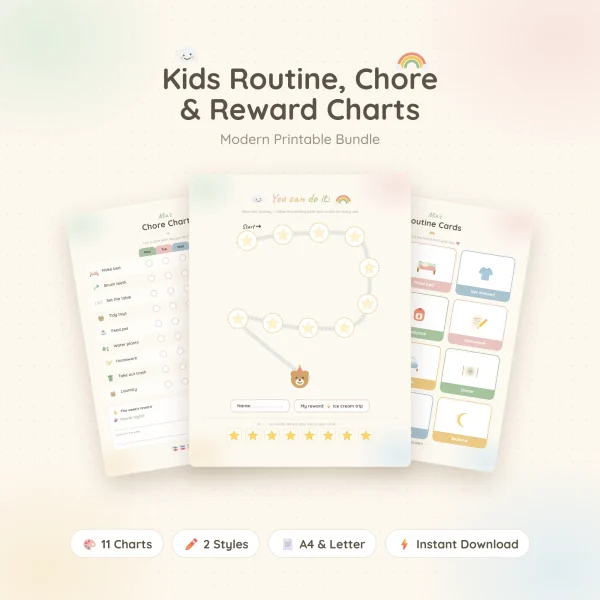
A sticker for a smooth bedtime can help a child who’s learning the steps, as long as the chart rewards one or two things the child controls, such as staying in bed after the goodnight line. Keep it separate from the picture schedule. Before you set one up, the steps for how to use a behavior chart help you decide the number of stars and when the chart comes down.
Getting back on a bedtime routine after winter break
Two weeks of late nights, visiting relatives and New Year’s Eve can push bedtime an hour later by early January. Start pulling it back four or five nights before school starts, not the night before.
Move bedtime earlier in 15-minute steps
Move lights-out 15 minutes earlier each night until you reach the school-night time; an hour takes four nights. The AAP notes that putting a child to bed even 15 to 20 minutes earlier can make a big difference. Move the wake-up time back at the same pace, since a child who sleeps until 9 a.m. won’t be tired at 7:45 p.m.
Keep the routine at grandparents’ houses
The AAP suggests choosing sleep routines you can use anywhere. If you’re traveling over the holidays, take the card strip in a zip-top bag and keep the same order in a different room. Keeping the order on the road leaves less to rebuild when you get home.
New Year’s Eve and the morning after
If younger children want a countdown, an early one lets them celebrate and still get to bed. London’s midnight arrives at 7 p.m. Eastern, and the countdown section of our New Year’s Eve games shows how to use it, with an option for West Coast families too. On January 1, wake them close to the usual time rather than letting them sleep in, so the routine starts again that night.
Start a fresh week on a tracker
A weekly tracker gives the first school week a clear start. The Routine Tracker page in our ocean set lists ten steps from Wake up to Bedtime, with seven columns of circles headed Mon through Sun, and a dashed box at the bottom promising a special treat for a full week.
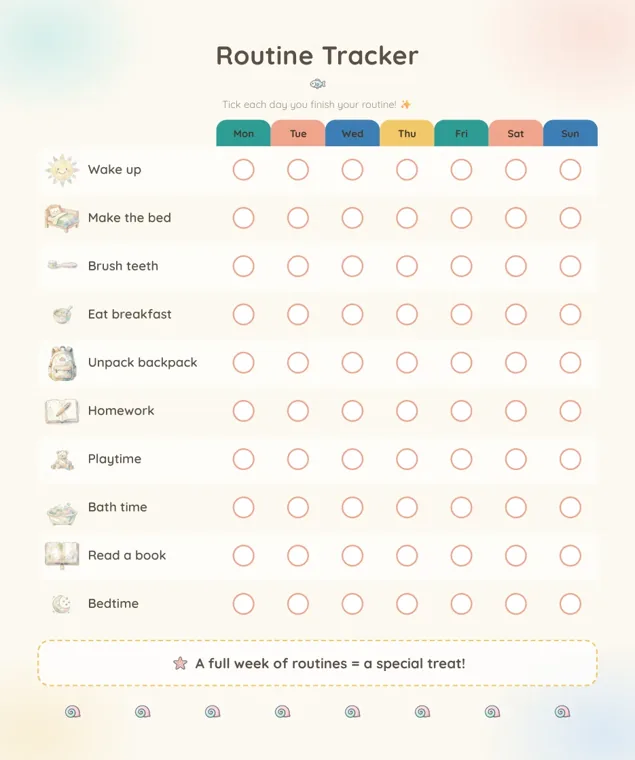
Use only the bottom three rows, Bath time, Read a book and Bedtime, if bedtime is the part you’re fixing. One catch: a family that bathes every other night will leave blank circles in the Bath time row, and a child may read those as failures. Cross the row out on non-bath nights or rename it “Wash” before the week starts.
A bedtime routine for the rest of the evening
The bedtime routine is only the last 35 to 45 minutes, and the hour before it shapes how it goes. Laying out tomorrow’s clothes and backpack before the routine starts takes a step off the next morning too. That night-before setup has its own section in our morning routine ideas, along with the parent’s side of a school morning.
Once the children are asleep, your own evening starts. Our night routine guide picks up from there, with routines for parents after the kids’ lights go out.
Printables from this article

Related articles
Reward & Chore Charts
Morning Routine for Kids: School-Day Steps and Times by Age
How to set a wake-up time from the time you leave, which steps a school morning needs and how long each takes, how it changes from preschool to age 12, and fixes for the usual hold-ups.
Reward & Chore Charts
Age Appropriate Chores: Chores for Kids by Age, 2 to Teens
Chores for kids by age, from toddlers carrying napkins to teens clearing snow, with how to teach each job, how to check it, and what to do when it comes back half done.
Reward & Chore Charts
How to Use a Behavior Chart: Reward System for Kids by Age
A step-by-step plan for setting up a behavior chart at home, from picking one to three goals and wording them for your child to choosing rewards and phasing the chart out.