25 Christmas Party Games for Adults, Families and Kids

A Christmas party for family and friends needs about three games, not ten. Pick one seated game for when everyone has a plate, one that gets people out of their chairs after dinner, and a gift exchange to close the night. The exchange goes last because it decides what everyone carries home.
Headcount and the youngest guest decide the rest. Twelve adults on two couches can play trivia or Who Am I? A room with grandparents and five-year-olds needs games nobody gets knocked out of. A crowd of thirty needs games where everyone plays at once.
| Your party | Players | Start with | Have ready |
|---|---|---|---|
| Adults in the living room after dinner | 6–16 | Christmas trivia, two truths and a lie, Who Am I? | Pens, paper, sticky notes |
| Mixed ages, grandparents to grade-schoolers | 6–20 | Santa Says, Christmas challenge cards, pin the nose on Rudolph | Printed cards, a poster, tape |
| Adults with open floor space | 8–20 | Candy cane relay, one-handed wrap race, Christmas limbo | Candy canes, wrapping supplies, a broom handle |
| A big crowd that’s mingling | 20+ | Bingo, ugly sweater contest, ornament count, Mafia | Bingo cards, ballots, the decorated tree |
| Kids at their own table | 2–10 | Sweater coloring contest, junior dice round | Printed pages, crayons, one die |
| The last game of the night | 6–20 per circle | A gift exchange | One wrapped gift per guest |
Seated Christmas party games for the living room
Seated games work best right after the meal, when people have plates on their laps and nobody wants to move. All seven need little more than paper or a printed deck. Most run in teams, so quieter guests can lean on louder ones.
1. Christmas trivia in teams
Split the room into teams of three to five and give each team one answer sheet. Read ten questions, let each team write one answer per question, then have the teams swap sheets and mark each other’s while you read the answers. The team with the most points wins, and a tie goes to one sudden-death question.
Five questions with answers you can check: Which department store published the first Rudolph story in 1939? (Montgomery Ward.) Under what title did “Jingle Bells” first come out in 1857? (“The One Horse Open Sleigh.”) The poinsettia is named after Joel Roberts Poinsett, the first US minister to which country? (Mexico.) Ugly Christmas sweater parties took off after a 2002 party near which Canadian city? (Vancouver.) Name the eight reindeer in “A Visit from St. Nicholas.” (Dasher, Dancer, Prancer, Vixen, Comet, Cupid, Donner and Blitzen.)
Decide how strict to be before you read that last answer. When the poem was first printed in 1823, the final two reindeer were Dunder and Blixem, so a guest who knows the original text has a fair claim to the point.
2. Christmas charades
Charades suits 8 to 20 people in two teams, and the only prep is a bowl of slips with Christmas song, movie and book titles. One player acts out a title in silence while their team guesses against a one-minute timer, then the other team takes a turn. Play until the slips run out and count the titles each team got.
Agree on the hand signals before the first turn. House rules vary, and the common ones include holding up fingers for the number of syllables and a “come on” wave when a guess gets close. A grandparent who always shows the number of words first will argue with a cousin who never learned it. For picture cards that help children who can’t read yet, see charades with kids.
3. Draw-and-guess
Draw-and-guess is charades with a pen, and it suits guests who’d rather not perform. Use the same bowl of slips, a large pad or whiteboard and a timer. The drawer gets one minute to sketch a clue for their team, with no letters, no numbers and no talking, the same limits the best-known boxed version uses. Each correct guess scores a point, and the game ends when the slips are gone.
Words like “tinsel” or “Christmas Eve” are hard to draw in a minute. Mix in easy objects such as a stocking, a snowman or a candy cane, and keep a few easy slips aside for younger players.
4. Who Am I? with sticky notes
Who Am I? needs a pad of sticky notes and works for 6 to 20 guests, sitting in a circle or mingling. Before people arrive, write one Christmas character per note, such as Santa, Mrs. Claus, an elf, a snowman, Rudolph, the Nutcracker or Ebenezer Scrooge. Each guest wears a note on their back without seeing it and asks other guests yes-or-no questions until they guess who they are.
It’s the old parlor game Twenty Questions turned around, and the same rule holds: whoever answers can’t lie. The game ends when everyone has guessed, so give the last two or three guests a hint each. Choose characters every guest knows, because a visitor from abroad may never have seen the TV special your family quotes.
5. Two truths and a lie, Christmas edition
Each player tells three short stories about Christmases past, two true and one made up, and the rest of the room votes on the lie. Go around the circle once and score a point for every guest you fool. A turn takes a minute or two, so a circle of ten fills about a quarter of an hour.
This is the pick when a new partner or a neighbor joins a family that has known each other for decades. The snag is that relatives already know each other’s stories. Let family members sit out the vote on their own siblings, or seat each household beside guests they know less well. When most of the room are strangers, open with one of these icebreaker games for adults before the Christmas rounds.
6. Santa Says
Santa Says is Simon Says with a Christmas name, and it’s the safest game for a mixed-age room because it can be played sitting down. The host calls actions, like ringing an imaginary bell, and players do them only when the call starts with “Santa says.” In the playground game, anyone who moves on the wrong call is out.
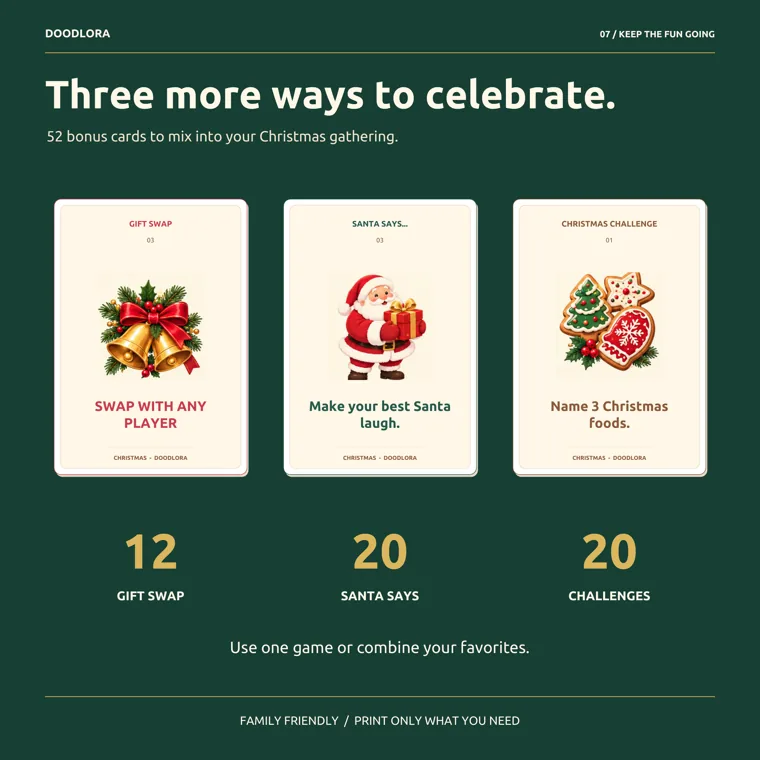
The seated version in our Christmas left right game keeps everyone in, so the youngest child and the oldest grandparent both last to the end. Its deck has 20 action cards, and the host guide calls participation optional. Play ten or so calls, then hand the deck to a new host. Read slowly for older relatives, because rapid calls catch out the people with the least hearing, not the least attention.
7. Christmas challenge cards
For a table game with no winner, stack Christmas challenge cards in the middle. Each player draws one and does what it says, like naming three Christmas foods, humming a Christmas tune or inventing a new Christmas cookie. The round ends when the stack runs out or dessert arrives.
Our left right kit includes 20 of these cards. Its guide says to play without a timer, to let anyone skip a card and to let players ask the table for help. That skip rule keeps the game friendly, because a shy guest can pass without explaining and the next player carries on.
Christmas party games that get adults up and moving
Once dinner is cleared, push the coffee table against the wall. These seven games need floor space more than printables, and most of the props are already in the house in December: candy canes, wrapping paper, a broom, chairs and the tree.
8. Candy cane relay
Teams of four to six line up, and each player holds a candy cane in their mouth by the straight end. The first player uses the hook to lift a loose cane out of a cup, then the cane passes hook to hook down the line with no hands. The first team to get it to the last player wins a round, and three rounds make a game.
Give every player their own cane and keep a box of spares, because unwrapped canes snap. Nobody should be asked to take a cane that’s been in someone else’s mouth.
9. One-handed gift wrap race
The wrap race is played in pairs, and each partner may use only one hand, so the two have to share the tape, scissors and paper. Give every pair the same awkward empty box and the same roll of paper, then start a three-minute timer. The first pair to finish a fully wrapped box wins, and neatness breaks a tie.
It’s harder than it looks, mostly because of the tape. Stick a few precut strips along the table edge before you start, so the round isn’t spent fighting the dispenser. Use empty boxes, never the real presents.
10. Christmas limbo
Limbo needs two people holding a broom handle or a long wrapping paper tube, plus a carol playlist. Each player passes under the bar facing up and bending backward. No part of the body may touch the bar, and nothing but the feet may touch the floor. Anyone who knocks the bar or falls is out.
After everyone has passed, lower the bar a little and go again, until only one person can make it under. Not everyone’s back is up for this, so give guests who sit out the job of holding the bar. Clear rugs and ornaments from the landing zone before the first pass.
11. Pin the nose on Rudolph
This is pin the tail on the donkey with a Christmas target, and it suits every age in the room. Draw or print a large Rudolph on poster paper and tape it to a wall. Each player gets a red paper circle, is blindfolded, turned around a few times and sent to stick the nose on. The closest nose wins, and a round ends when everyone has had a turn.
The traditional game uses a push pin. Put a loop of tape or a sticky dot on each nose instead, and keep the spinning area well away from the tree.
12. Hide the pickle ornament
The Christmas pickle is a German-American tradition: a pickle-shaped ornament is hidden on the tree, and the first person to find it gets a reward or good luck for the year. Turn it into a round of hunt the thimble. One player hides the pickle while the others wait outside the room, then everyone comes back and searches. The first finder wins and hides it next time.
A green pickle among green branches is hard to spot, which is the point, so let younger players use “hot” and “cold” calls as hints. Agree that the pickle stays on the outer branches. If a guest insists the custom comes from Germany, the German origin story is probably a myth.
13. Sardines
Sardines is hide-and-seek in reverse, and it’s a favorite once the adults have had dessert. One player hides while everyone else counts, then the seekers spread out. Each seeker who finds the hider squeezes into the hiding spot in silence. The last seeker to find the group loses and hides in the next round.
A round lasts as long as your house is big. Close off the rooms that aren’t in play before the first count, such as the bedroom with the coats, a sleeping baby’s room and the garage. If you play with the lights low, leave the stairs lit.
14. Musical chairs to Christmas music
Musical chairs grew up as a Victorian parlor game played at Christmas gatherings, so it belongs at this party. Set a circle of chairs with one fewer chair than players. Everyone walks around the circle while the music plays, and when it stops, each player grabs a seat. Whoever is left standing is out, one chair comes away, and the last player seated wins.
Adults collide harder than children, so use sturdy chairs without arms. When the room mixes toddlers and grandparents, play freeze dance instead. Players dance while the music plays and freeze when it stops, and anyone who moves is out.
Christmas party games for large groups
When the guest list passes twenty, choose games where everyone plays at once and nobody waits for a turn. These six scale because each guest plays their own card, ballot or vote. For a crowd of coworkers, the office Christmas party games list is sorted into 30-, 60- and 90-minute parties.
15. Christmas bingo
Bingo is the easiest game to scale, because every guest marks their own card and the caller does the rest. Hand out Christmas picture or word cards, call one square at a time and let the first full line win a small prize. Play three or four games so more than one guest goes home with something.
The usual dispute is a false claim, so read back every square on a winning card before you hand over the prize. Our picture bingo rules cover calling for a room of 30 and checking a claim.
16. Ugly sweater contest
The ugly sweater contest needs a line on the invitation and a stack of paper ballots. The modern ugly sweater trend began in the early 2000s, and parties and contests were common by the late 2000s. Guests often dig their entries out of thrift stores or family closets. Set a few categories, like best thrift store find and best homemade sweater, so more people win something. Collect ballots before the gift exchange and announce the winners then.
Some guests will forget or refuse to wear one. Add a last-minute category for anything built from tinsel and tape at the party. If children are there, their paper sweater designs from the kids’ table can be judged at the same time.
17. Guess the ornament count
Guess the ornament count is the quietest contest of the night. Count the ornaments while you decorate the tree, have each guest write a guess on a slip as they arrive, and read out the closest guess before the exchange.
Decide before you count whether the star and the lights count as ornaments. When you announce the winner, read out the middle guess as well. At a 1906 country fair, 800 people guessed the weight of an ox, and the middle guess came within 1% of the real figure, so the room’s middle guess is worth hearing.
18. Gingerbread house contest
A gingerbread house contest works for teams of three or four, one house per team. Gingerbread houses are usually put together from baked pieces held with melted sugar, so have them assembled before guests arrive. Set out bowls of candy and icing, give the teams thirty minutes, and let the room vote for a winner.
Point teams toward the classic finishes: candy or frosting roof tiles and an icing yard that looks like snow. The snag is time. A decorating round stalls while walls are still sliding, which is why the building happens before the party.
19. Christmas photo scavenger hunt
A photo scavenger hunt runs for teams of three to five with a phone each. Give every team the same list of ten shots, such as the whole team in Santa hats, someone hugging the tree or a stocking with a name on it. The first team back with every photo wins, or the team with the most photos when time runs out.
Set a return time and the boundaries before anyone leaves the room. On a dark December evening, keep the hunt inside the house and yard.
20. Mafia
Mafia, also called Werewolf, suits a room of ten or more adults and a moderator who doesn’t play. The moderator secretly gives out roles. The original rules make about a third of the players mafia, and a popular later version uses exactly two. At night, everyone closes their eyes and the mafia silently pick a victim. By day, the room discusses, and any player can call a vote, with over half the room needed to eliminate someone.
The game ends when the mafia are all out or equal the townspeople in number. Days run longer than nights, so the moderator should cap each day’s debate. Eliminated players may watch but can’t hint, and at a family party that rule needs saying out loud.
The kids’ table at a Christmas party
Children at a mostly adult party need a game that runs at a table without a referee. Pin the nose on Rudolph and freeze dance above both work for them too. For a longer list built around children, see our Christmas games for kids.
21. Sweater coloring contest
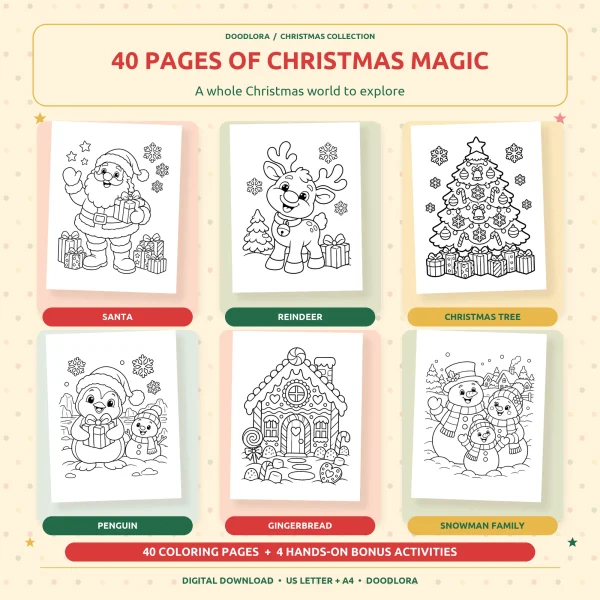
A coloring contest works best when it copies whatever the adults are judging that night. Our Christmas Magic coloring set has a page titled Design Your Christmas Sweater, a blank sweater with Santa and a reindeer peeking over it. Hand one to every child during the adults’ sweater contest and judge both at once.
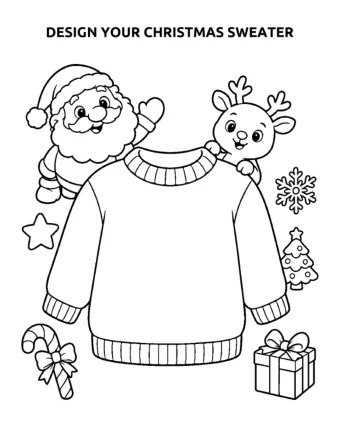
The same set has a Decorate Your Christmas Tree page for a second round and a Christmas Coloring Superstar certificate with a line for each winner’s name. Every page also comes as its own one-page PDF, so ten sweaters don’t mean printing the whole book. Before printing ten copies, check the scale: printing coloring pages explains why 100% beats Fit.
22. Junior dice round
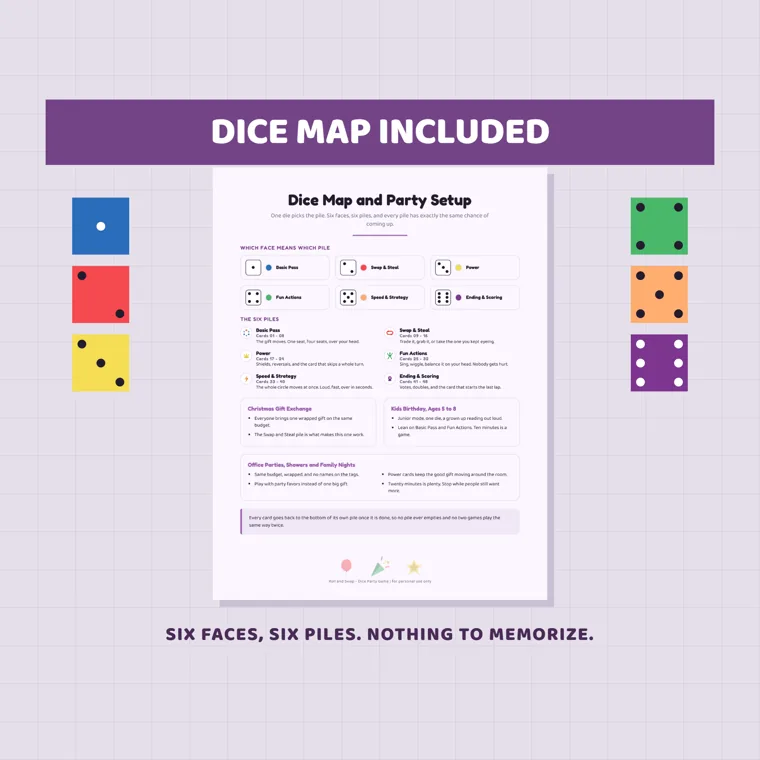
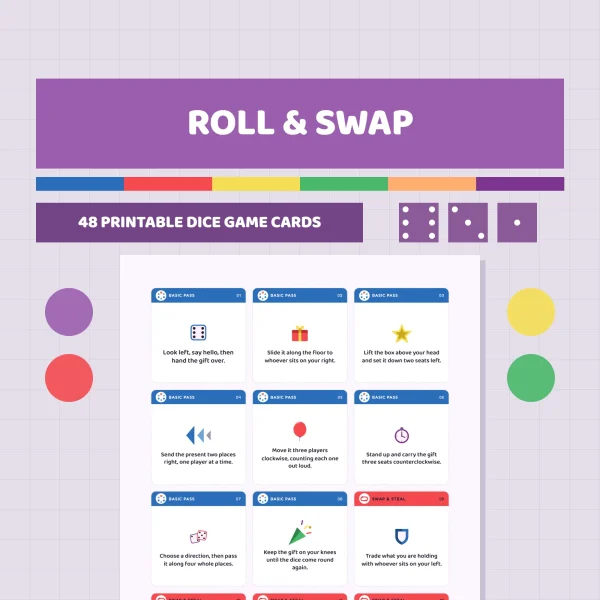
Kids who’d rather roll dice can play the Junior Mode of our Roll & Swap game, written for ages 5 to 8. They use one die, its number picks the pile, and every card is worth one point. A grown-up reads each card aloud, and the Ending pile stays back until the last five minutes.
The guide counts ten minutes as a full game at this age. That means a junior round can finish while the adults bring their wrapped gifts to the circle, and the children still join the exchange.
Christmas gift exchange games to end the party
Play the gift exchange last and ask for one wrapped gift per guest on the same budget. Three formats suit a family party, and each decides differently who ends up with which present.
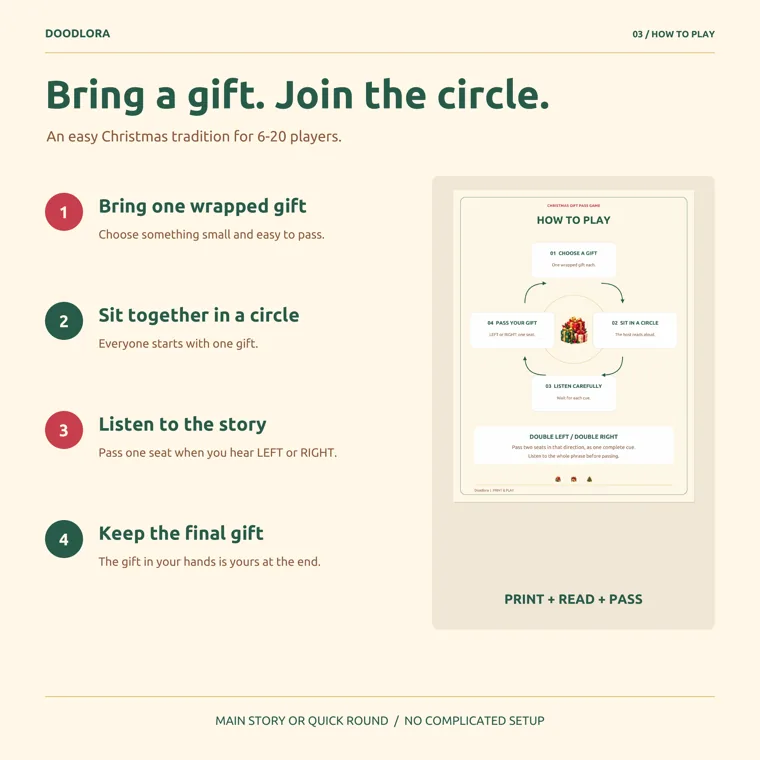
23. Left-right story. Everyone sits in a circle holding a gift while one reader tells a Christmas story. At every LEFT or RIGHT, all the gifts move one seat that way, and the gift you hold at “The end” is yours. Our printable story handles a circle of 6 to 20 and one reader. Practice one left pass and one right pass before the real story, and keep gifts small and light so they pass easily.
24. Dice gift exchange. Our Roll & Swap game uses two ordinary dice and a deck of action cards to move the gifts. The guide ends the exchange after twelve rounds or a timer and says twenty minutes is plenty.
25. White elephant. Each player opens a new gift or steals one already opened, so it’s the loudest of the three. Agree how many times one gift can be stolen before the first number is drawn. The white elephant rules cover steal limits and who gets the last pick.
For Secret Santa, a cookie exchange and other formats, see our full list of gift exchange games.
Printables from this article

Related articles
Printable Party Games
How to Plan a Baby Shower: Timeline, Food & 2-Hour Schedule
A baby shower plan from the first talk with the parents-to-be to the last gift: timing, guest list, budget, venue, a two-hour schedule, safe food and backup plans.
Printable Party Games
How to Plan a Bridal Shower: Timeline, Budget and Schedule
A host's plan for a bridal shower, from the first talk with the bride and co-hosts to the guest list, invitations, a timed party schedule, the gift opening and what to do when something slips.
Printable Party Games
35th Birthday Ideas: Party, Trip, Theme and Gift Ideas
Ways to celebrate turning 35, sorted by how many people the birthday star wants around, with group size, time, prep and the snag to plan for in each.