 1 / 6
Which Came First? Timeline Trivia Cards
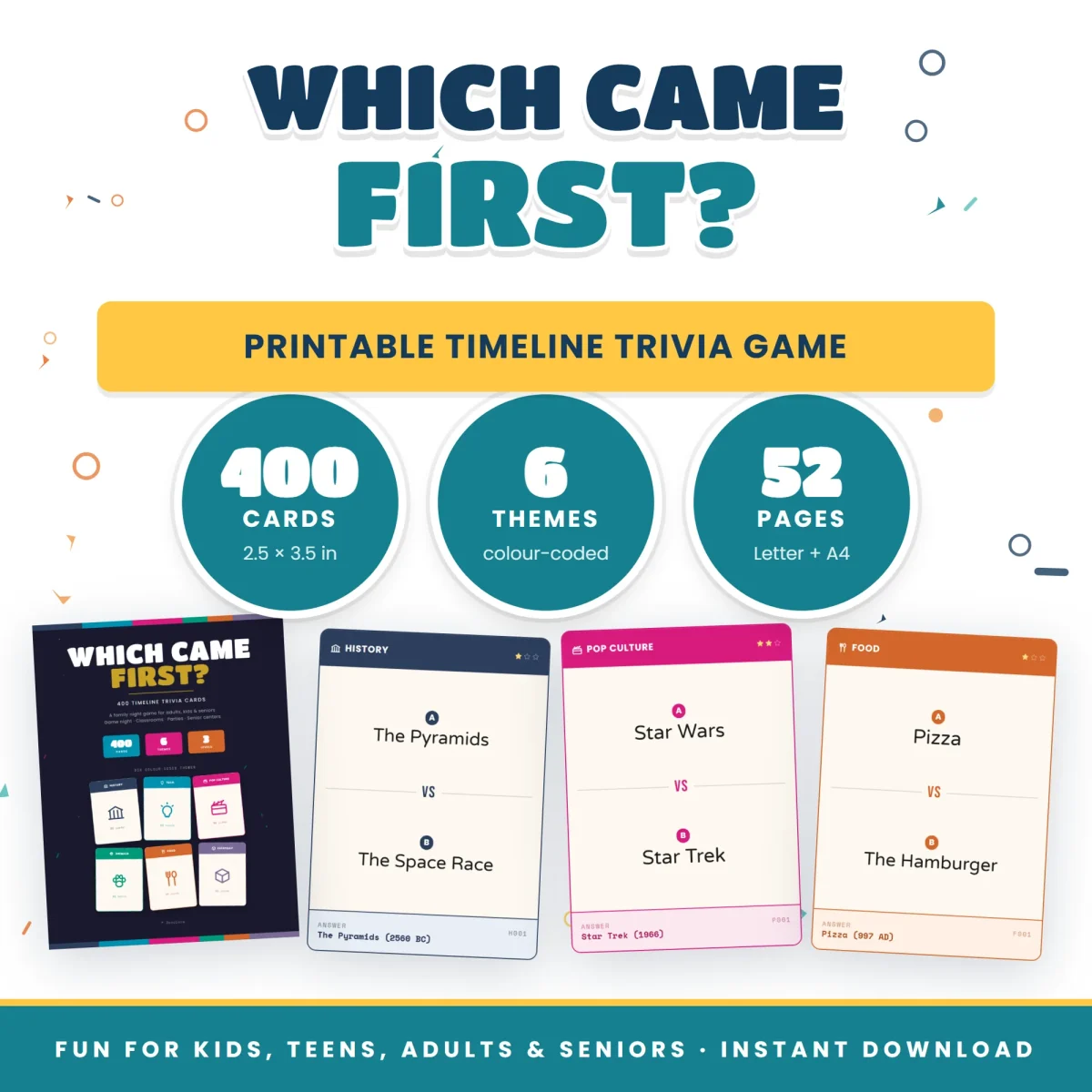
Each card pairs two things, like the Pyramids and the Space Race or Star Wars and Star Trek, and players call out which one came first. The answer and its date sit in a strip at the bottom of the card, so whoever reads can check without a separate key.
$4.99
Buy any 3 or more printables and save 20% at checkout.
- Download right after payment — link works for 30 days, up to 5 downloads
- Files arrive as a ZIP with your license PDF inside
- Secure checkout by Stripe · Refund policy
Which Came First? is played with 400 printable cards. Each one names two things, A and B, and asks which happened first. No one needs to know exact dates to play, but the answer strip at the bottom of each card gives the date for anyone who wants to argue.
Six themes, three levels
History, Tech, Pop Culture and Everyday Objects each have 80 cards, and Animals and Food have 40 each. Pairs run from the Magna Carta and the printing press to Netflix and YouTube, Superman and Batman, tea and coffee, or the toothbrush and toilet paper. Each theme prints in its own color with its own icon, so a mixed deck sorts back into piles quickly. One to three stars on each card mark the difficulty. The rules suggest dealing one-star cards to younger players and three-star cards to the family trivia expert, so everyone stays in the game.
Some Animals cards compare things that go back millions of years (sharks or dinosaurs). The notes that come with the file explain that these dates are ranges scholars still debate, and in Points Race a year guess counts within 20 years.
Four ways to play
- Basic play. Draw a card, read both options aloud, name the earlier one, and keep the card if you’re right.
- Team challenge. A neutral reader calls out each card, and the first team to answer takes the point. Best of 20 cards wins the round.
- Points race. One point for the right option, plus three more for naming the year within 20 years. First to 25 wins.
- Lightning round. One player answers as many cards as they can in 60 seconds, passing to skip.
Printing and cutting
Print on 120–250 gsm card stock (65–110 lb cover) at 100%, and cut along the dashed guides with a paper trimmer or scissors. Plain paper is fine for a one-off game, but the answer strip can show through. To check your printer settings before running all 46 card sheets, print one sheet and measure a card. For double-sided cards, run the card-back page on the reverse. A corner-rounder punch is a nice extra.
Questions
- What size are the cards?
- 2.5 × 3.5 inches, standard playing-card size, as long as you print at 100%. "Fit to page" shrinks them slightly, and then they no longer fit card sleeves.
- Do I have to print all 400?
- No. Print the rules, the score sheet and whichever theme you want to play. History alone is 80 cards on nine sheets.