Halloween Party Games for Adults: Wink Murder and Trivia
Pick one hidden-killer game as the centerpiece of your Halloween party games for adults. With six or more players and one host willing to sit out, run Mafia with werewolves. With four or five players, or kids in the room, play Wink Murder, which needs no props and restarts every few minutes.
Fit the smaller games around it. Put would you rather cards out while guests arrive, play trivia after the food, start a mummy race when the energy dips, and end the night with a costume vote and prizes.
Opening the Halloween party: a would you rather vote at the door
Start with something nobody has to learn. A would you rather question needs one reader and a show of hands, so early guests can play while the doorbell rings.
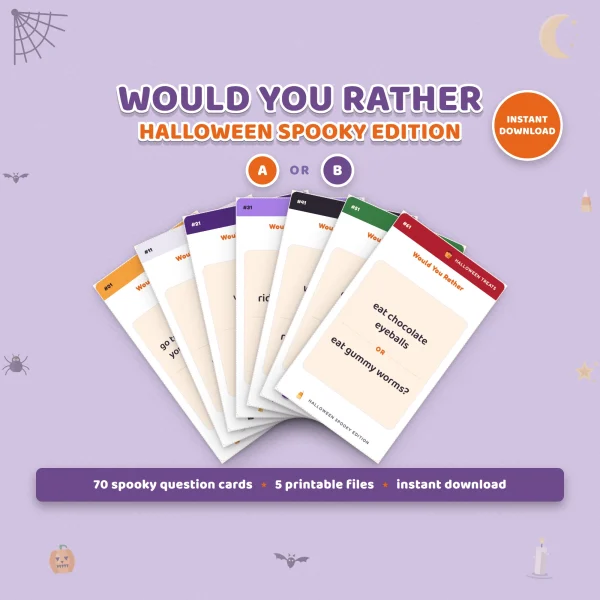
Print the would you rather deck from the Halloween printables ahead of time and put the cards in a bowl. It plays with two to ten people, or more. If it runs out before the guests do, read on from the Halloween would you rather questions, which go from silly to spooky.
If half the guests have never met, a round from our icebreaker games for a big party can come even before the first card.
Save the main game until everyone’s arrived. Wink Murder and Mafia both hand out roles once, at the start, so they fall apart if people keep wandering in halfway through.
After that, alternate a seated game with a standing one. Trivia and the story chain keep people in their chairs, and the mummy race and the mystery box get them up again.
Halloween murder games for adults: Wink Murder and Mafia
Both are hidden-killer games, and the secret killer fits the night’s theme. Wink Murder needs no props and plays in a few minutes. Mafia needs a host and runs much longer, so make it the centerpiece.
Wink Murder
Wink Murder needs at least four players, and it’s better with six or more. Everyone sits in a circle. Before each round, one player is secretly made the murderer and another the detective.
An easy way to deal those two roles is folded slips drawn from a bowl, one marked X for the murderer and one marked D for the detective. The detective steps out of the room, then comes back and stands in the circle, turning slowly to watch faces.
The murderer kills by winking at a player, who waits a moment and then dies as dramatically as the party allows. The detective has three guesses to name the murderer.
In the version written up on Wikipedia, a wrong guess means the innocent player who was named dies too. A careless detective can clear the circle almost as fast as the murderer.
A round ends when the murderer is caught or the guesses run out, and new slips go round straight away. The murderer’s best cover is to look around the circle like everyone else, because staring at one victim draws attention.
Mafia with Halloween roles
Mafia is the longer version of the same idea. Dmitry Davidoff, a psychology student at Moscow State University, created it in the 1980s. In 1997 Andrew Plotkin gave it a werewolf theme, which makes the killers werewolves at a Halloween party.
You’ll need at least six players plus a host who doesn’t play. The host hands out roles on folded slips: a few werewolves, one doctor, one detective, and villagers for everyone else.
Plotkin’s rules use two werewolves. Davidoff’s original made about a third of the players killers, so a big table can take three or four.
At night the host says “everyone close your eyes.” The werewolves open theirs, silently point at a victim and close them again. The doctor then picks one player to protect for the night.
The detective goes last. They point at one player and get a silent nod or shake from the host. In the morning the host announces who died in the night, unless the doctor picked the same player.
Then the village argues. Anyone can make an accusation, and if more than half the players vote against the accused, that player is out and night falls again.
The village wins when every werewolf is gone, and the werewolves win when they equal the villagers left. Players who are out stay in the room and keep quiet, since watching the liars from outside is half the fun.
Seated Halloween party games: trivia rounds and a story chain
Trivia and a story chain suit the guests who don’t enjoy Mafia. That game rewards a good liar and knocks players out early, while these two hold a whole table from their chairs once the food is out.
For trivia, seat guests in teams of three or four, with one pen and one answer sheet per team. Read questions in rounds of five and mark them between rounds, so a team that falls behind still has a reason to keep going.
Here’s a starter round of six Halloween questions with answers, all checked against Wikipedia:
- Before pumpkins, what did people in Ireland and Scotland hollow out to make Halloween lanterns? Turnips, or mangel wurzels, a beet grown for animal feed.
- In what year does the Oxford English Dictionary first record “jack-o’-lantern” for a carved lantern? 1837.
- In what country was the shout “Trick or treat!” first recorded? Canada, in Ontario in 1917.
- Who invented candy corn? George Renninger, of the Wunderle Candy Company in Philadelphia, in the 1880s.
- What was candy corn first sold as? Chicken Feed.
- What theme did Andrew Plotkin give the party game Mafia in 1997? Werewolves.
A story chain needs only a flashlight and the lights turned down. Whoever holds the flashlight tells the story, and it moves one seat to the left about once a minute, so the tale changes voice with every pass.
Each new teller has to keep everything already said, and that rule makes the game. A haunted house that has picked up a talking cat and a broken elevator keeps both, so the last few tellers end up explaining all of it.
Active Halloween party games: a mummy race, a mystery box and a costume contest
After two seated rounds, get people on their feet. These games need floor space more than printing. Set the teams before the timer starts and each one works for a mixed group.
A mummy wrap race takes a roll of toilet paper per team, in teams of two or three. Clear a strip of floor and move drinks off nearby tables first, since the wrappers circle their mummy and won’t watch their feet.
A scavenger hunt keeps a big group busy while you reset the room. Hide a dozen Halloween items around the house, the way you’d set up an indoor scavenger hunt, then hand each team a list and set a time limit.
The mystery box asks guests to reach into a covered box and name what they touch without looking. Cold spaghetti is the classic, but a sponge or a hair scrunchie can stump a table just as well.
Don’t put anything edible in the box until you’ve asked about food allergies, and keep a towel beside it for sticky hands.
Give the costume contest categories such as scariest, funniest, best homemade and best group, so more than one guest wins. A group counts as one entry. Stickers make easy ballots, and you can count them while the next game is set up.
Halloween party games when kids come too
Swap the main game when children are at the party; most of the others need only small changes. Mafia asks young kids to lie, sit out early and stay silent.
So when the room is mixed, make Wink Murder the main event instead. A round is short, and a player who dies is back in the next one.
Children too young for either game can act instead. In charades for kids, a grown-up whispers each prompt to any child who isn’t reading yet, and the child acts it out.
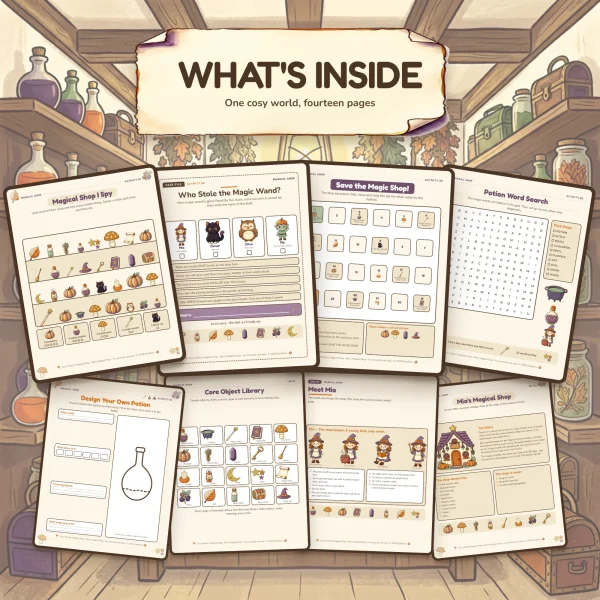
While the adults play Mafia, give the younger kids a table of their own, stocked with the Witch Shop Halloween Activity Pack we make: fourteen pages set in one witch’s shop, with a whodunit, a word search, an I spy and a board game.
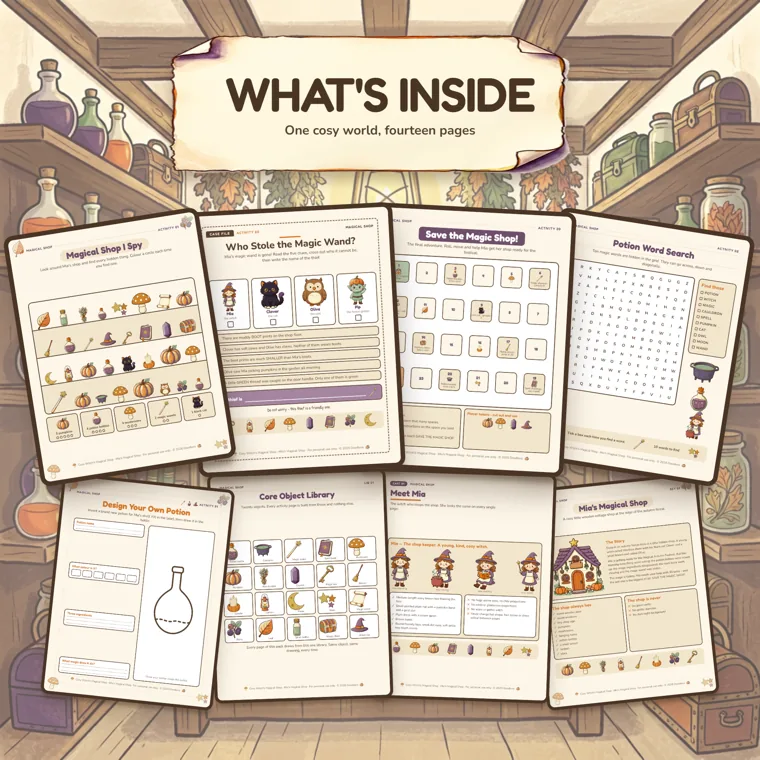
Put that table where the adults can still hear it, so someone between Mafia rounds can settle a puzzle answer. Leave scissors and a die there too, because the board game page needs both.
Halloween party prizes and a quiet table from fuse bead patterns
Plan the prizes before the party, since several of these games end with a winner. Small beaded Halloween shapes make prizes guests can actually take home.
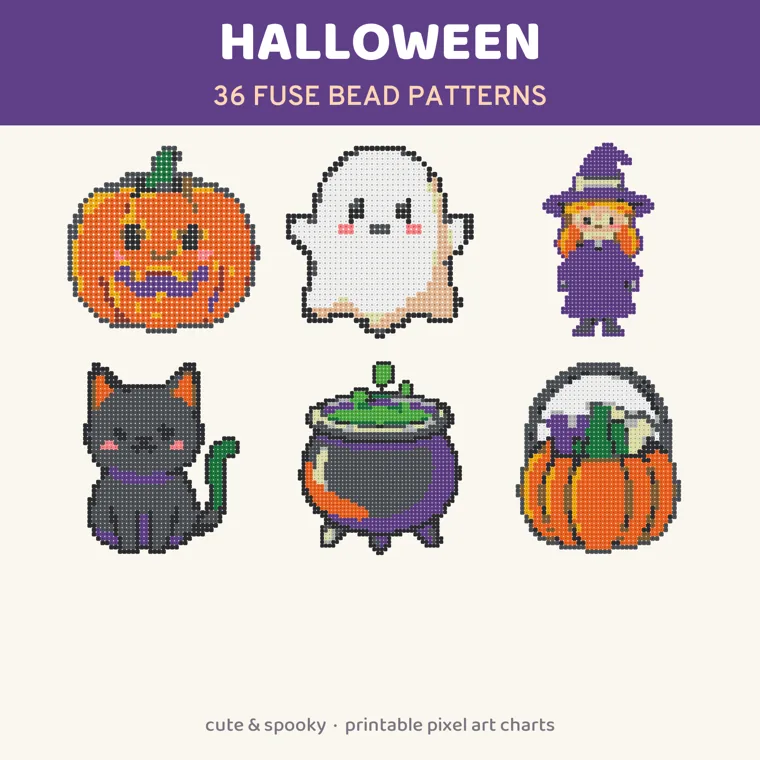
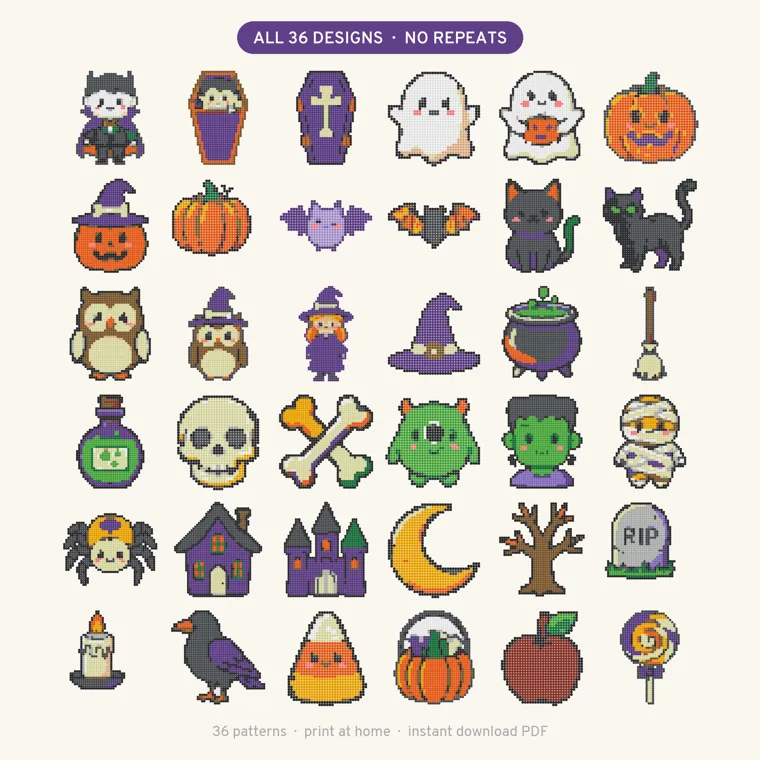
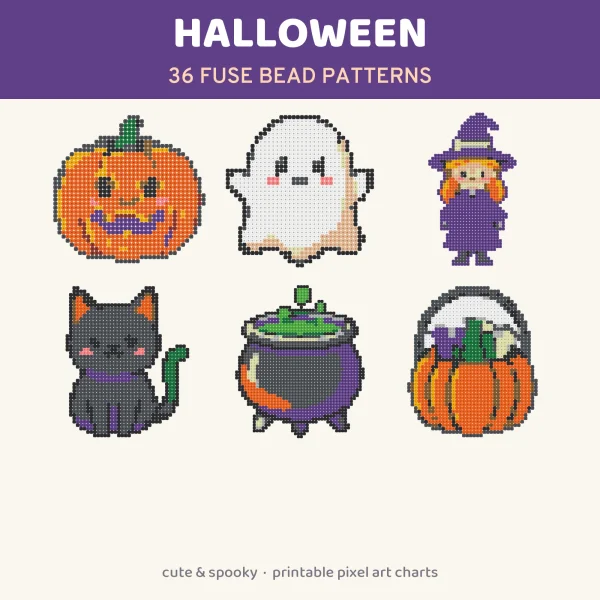
The smallest designs in the Halloween Fuse Bead Patterns set, the broomstick and the two bats, take only about 300 to 400 beads each, so one evening at the pegboard turns out several prizes. The how-to page suggests gluing a magnet on the back for the fridge, or adding a jump ring to make a keyring.
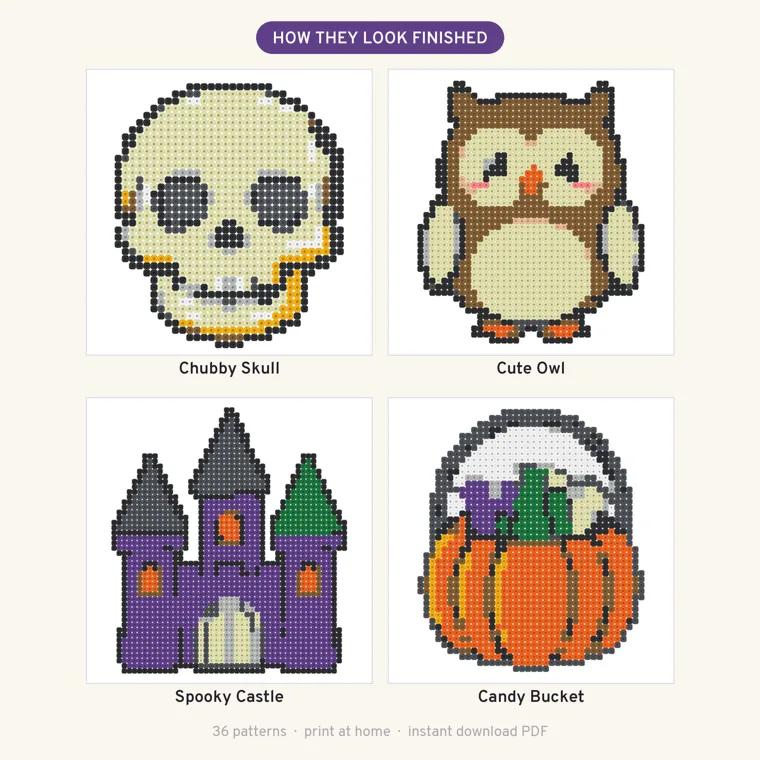
The same patterns can run a quiet table for guests who’d rather not play. Set out pegboards, beads and a few printed charts, and let people bead at their own pace while the louder games go on nearby.
Keep the iron with one adult who knows how to iron fuse beads, and bring finished boards to them, since the beads won’t fuse until they’re ironed through paper.
The set also includes 36 single-page PDFs, one per chart, so the table can print just the bats or just the candy corn. Pieces finished there go home that night as favors from the Doodlora Studio charts.
Younger children can join the Halloween craft table with paper monster faces or a draw-your-own potion while an adult keeps the bead supplies separate.
Printables from this article
Related articles
Printable Party Games
How to Plan a Baby Shower: Timeline, Food & 2-Hour Schedule
A baby shower plan from the first talk with the parents-to-be to the last gift: timing, guest list, budget, venue, a two-hour schedule, safe food and backup plans.
Printable Party Games
How to Plan a Bridal Shower: Timeline, Budget and Schedule
A host's plan for a bridal shower, from the first talk with the bride and co-hosts to the guest list, invitations, a timed party schedule, the gift opening and what to do when something slips.
Printable Party Games
35th Birthday Ideas: Party, Trip, Theme and Gift Ideas
Ways to celebrate turning 35, sorted by how many people the birthday star wants around, with group size, time, prep and the snag to plan for in each.