14 New Year’s Eve Games for Kids, Adults and the Countdown
New Year’s Eve games work best when they follow the clock instead of filling one long block. Start with something guests can pick up the moment they walk in, then an early countdown for children who won’t last until 12, a seated game for adults after that, a look back at the year around 10:30, and quick one-minute challenges in the last ten minutes.
That shape fits a family evening at home and an adult party alike. The 14 games below are sorted into those stretches, and most need nothing more than paper, pens and a phone timer. Each one says how many people it suits, how long it runs, what to gather, how a round ends and where it tends to go wrong.
A New Year’s Eve game plan from 7 p.m. to midnight
Guests on December 31 arrive at different times, children fade around bedtime, and everyone wants to be paying attention at 11:59. A plan that changes games every hour or so handles all three. The times and lengths below are our planning suggestions, not rules from any game, so slide the whole plan earlier for a young crowd. You won’t need all 14. Two from each stretch is plenty.
| Time | Game | Players | Plan on | What to set out |
|---|---|---|---|---|
| 7:00–8:00 p.m. | Emoji puzzle pages | Any number, alone or in pairs | Drop in and out | Printed pages, pens |
| 7:00–8:00 p.m. | Party hats and noisemakers | Any age, adult nearby for little ones | About 15 minutes each | Card stock, tape, elastic, paper cups, dried beans |
| 8:00 p.m. to midnight | A balloon to pop every hour | Children take turns | A minute per hour | One balloon per hour, paper slips |
| 8:00–9:00 p.m. | Riddles about time | 2 to 20 or more, about age 6 up | A 20-card round | Riddle and answer cards |
| 8:00–9:00 p.m. | Countdown freeze dance | 3 or more children, 1 adult on music | About 10 minutes | A speaker, floor space |
| 8:00–9:00 p.m. | The early countdown | The whole family | Ten seconds and the cheering | A clock or live stream, something to bang |
| 9:00–10:30 p.m. | Riddle team challenge | Two teams | To 15 points | Score sheet, 60-second timer |
| 9:00 p.m. to midnight | New Year’s Eve bingo | Any number | Runs in the background | A grid and pen per guest |
| 9:00–10:30 p.m. | “This year I…” | 4 to 12 | About 2 minutes a turn | Nothing |
| 10:30–11:40 p.m. | Which came first? cards | Two teams and a reader | Best of 20 cards | Timeline cards |
| 10:30–11:40 p.m. | Which came first, your own year | Everyone | One card per guest | Index cards, pens |
| 10:30–11:40 p.m. | Whose resolution is it? | 6 or more | About a minute a slip | Slips, a bowl |
| 10:30–11:40 p.m. | Prediction cards for a time capsule | Everyone | About 10 minutes | Index cards, an envelope or jar |
| 11:45–11:58 p.m. | One-minute challenges | The whole room | About 6 turns | Cards that need almost nothing, a phone timer |
The quiet games go first because they don’t need everyone present to start. The loud ones wait for the end on purpose: a one-minute challenge, with the room counting down the last ten seconds, is a rehearsal for the countdown at midnight. Our one-minute party game ideas sort those challenges by the space they need and explain the scoring.
New Year’s Eve games for the first hour, while guests arrive
The first hour needs games with no start time. Guests should be able to join the moment their coats are off and leave mid-game when the next car pulls in. Put a bowl and a stack of paper slips by the door as well, because the resolution game later in the night starts here.
Emoji puzzle pages
Printed emoji puzzles work for an arrival table: lay the pages on a side table, and each guest takes one and works on it alone or with whoever is standing nearby. Any number can play, and nobody has to wait for a round to start.
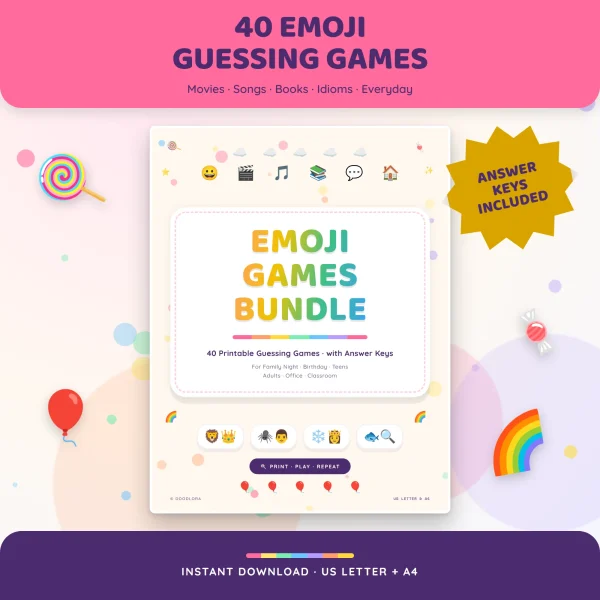
Our emoji set has 40 puzzles, one per page, where two to four large emoji stand for a title or a saying. They come in five rounds: 10 movies, 10 songs, 10 books, 5 idioms and 5 everyday moments. Every page has a line to write the guess on and a hint underneath, and the answer is printed upside down at the bottom.
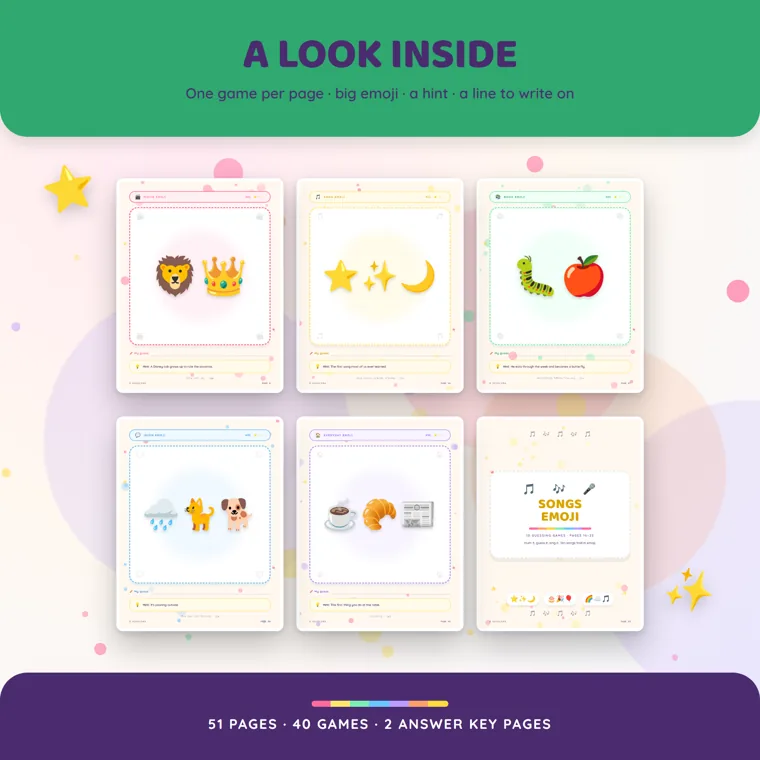
Sort the pages before guests come. The songs round puts nursery songs such as Twinkle Twinkle Little Star and The Wheels on the Bus next to Dancing Queen, Purple Rain and Ring of Fire. Hand the first kind to children and the second to adults, and nobody spends ten minutes on a song they’ve never heard.
Scoring is one point per correct answer. If you want a winner by 8 o’clock, the answer key on pages 49 and 50 has a score guide running from “under 15” to “35–40” for anyone who tries all 40.
Party hats and noisemakers to wear at midnight
A craft table gives early arrivals something to do with their hands, and everything they make gets used at midnight. Any age can join, with an adult beside the youngest. Plan on about 15 minutes for a hat and a shaker.
A party hat is usually a cone of thin card with a length of elastic running under the chin, from one side of the base to the other. Trace around a large dinner plate on card stock, cut the circle in half, and roll each half into a cone with the seam taped. Punch a hole on each side of the base and knot the elastic through. Guests can write the new year on the front in marker.
For a noisemaker, put a spoonful of dried beans or uncooked rice in a paper cup. Tape a second cup on top, mouth to mouth, and wrap tape all the way around the seam. The hats and shakers then wait on a shelf until 11:59.
Watch the shaker filling when toddlers are around. Children younger than three are especially at risk of choking because they put things in their mouths as they explore, and toys are among the most common causes of choking in children. Keep the bag of beans off the table once the shakers are sealed, check every seam, and give a toddler the pot and wooden spoon instead.
New Year’s Eve games for kids who won’t make it to midnight
Children usually fade somewhere between 8 and 9, so their games come first and finish with a countdown of their own. Four ideas fit this stretch, and the balloon one keeps running for the rest of the night.
A balloon to pop every hour
A balloon for each hour turns the evening itself into a countdown. Before guests arrive, write the name of each hour’s game on a slip of paper, roll it up, push it into a balloon and blow the balloon up. Mark the hour on the outside in marker. A 7 p.m. start with an hour-by-hour plan needs five or six.
At the top of each hour, a child pops that hour’s balloon by sitting on it and reads the slip out loud. The slip says what happens next, so the plan in the table above runs itself. The last balloon goes at the children’s countdown, or at midnight if they’re still up.
Let an adult do all the blowing up. The U.S. Consumer Product Safety Commission (CPSC) says some balloon accidents happen when a child trying to inflate a balloon breathes in and draws it back into the mouth. CPSC also advises collecting the pieces of a broken balloon right away and keeping them out of reach of young children, so sweep up each burst balloon before the next game starts.
Riddles that fit a night about time
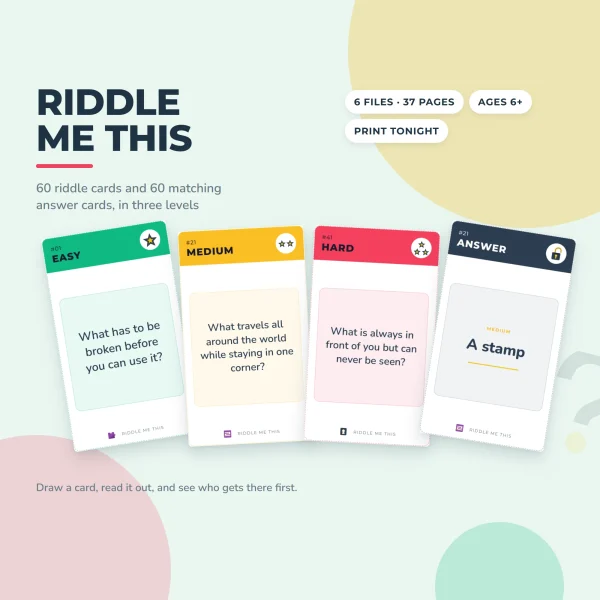
Riddles fill the hour before an early countdown well, because one person reads and everyone else can shout. Our riddle deck has 60 riddles on 3 × 5 inch cards, with a separate numbered answer card for each one, and the guide puts the players at 2 to 20 or more, from about age six.
Two of the Easy riddles could have been written for December 31: “What has hands but cannot clap?” (a clock) and “What is always coming but never arrives?” (tomorrow). Save those two for the last round before the children’s countdown.
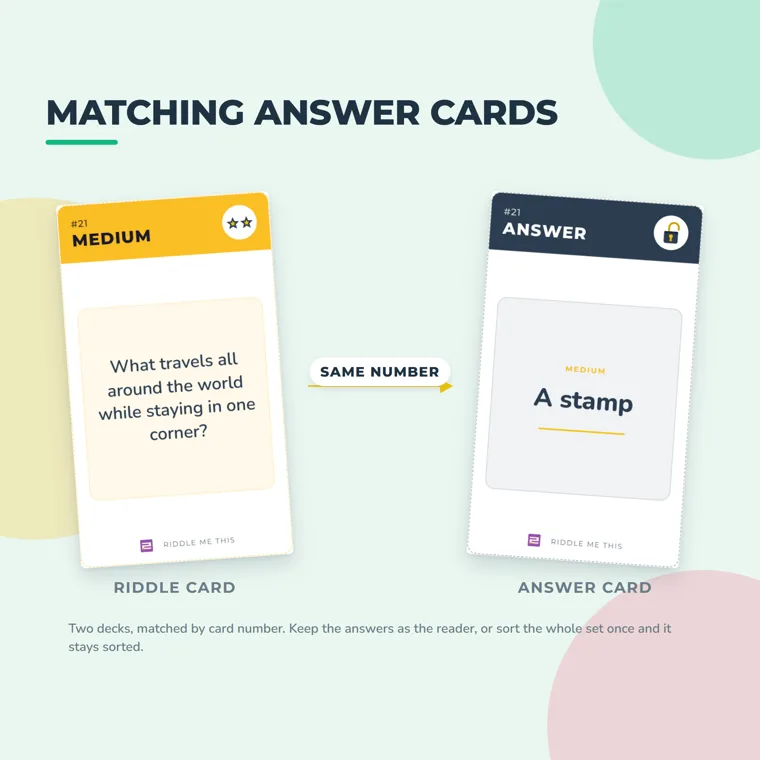
The host tips in the deck set up a children’s round this way: deal only the Easy cards (numbers 1 to 20), drop the timer and let the kids read the cards aloud themselves. The round ends when those 20 cards run out. Keep the Hard cards, 41 to 60, out of a young round. Several of them turn on spelling, such as “What begins with an E but has only one letter inside it?”, and that stalls a seven-year-old who is still sounding words out.
Countdown freeze dance
Freeze dance, called musical statues in Britain, burns off energy before bed and needs only a speaker and some floor space. Three or more children can play, with one adult running the music, and a game takes about 10 minutes.
Everyone dances while the music plays and freezes the moment it stops. Anyone who moves or laughs during the pause is out, and the last dancer still in wins. For New Year’s Eve, the adult stops the music on a shouted count, “3, 2, 1, freeze!”, which is good practice for the real countdown.
The usual problem is the first child out, who then has nothing to do. Make the players who are out into judges who watch for wobbles, and they’ll stay in the game until the end.
The early countdown
An early countdown keeps the big moment while letting children get to bed. The simplest version borrows a real midnight from somewhere else. London runs on Greenwich Mean Time in winter, so its New Year arrives at 7 p.m. Eastern, 6 p.m. Central, 5 p.m. Mountain and 4 p.m. Pacific.
West Coast families have another option. The Times Square ball begins its drop at 11:59 p.m. Eastern and lands at midnight, which is 8:59 p.m. Pacific. Children there can watch a live stream of the New York countdown and still be asleep before 10.
Pick a number everyone can manage, from ten down, and let the children use their shakers from the craft table. A pot and a wooden spoon is louder than most party noisemakers. If the youngest can’t read the riddle cards yet, act-it-out games fill the time before the countdown better. Our guide to charades for kids who can’t read the card yet explains how an adult whispers the prompt so a non-reader can still take a turn.
New Year’s Eve party games for adults in the long middle of the night
Between 9 and 10:30, adults usually want a game that runs at the table while people eat and talk. All three games here need no floor space, and each can stop at any point without spoiling anything.
Riddle team challenge
A riddle team challenge suits two teams around a table. The Team Challenge rules in our riddle deck go like this. Split into two teams and take turns drawing. The drawing team gets 60 seconds to answer together, and a right answer is worth 2 points. If they miss, the other team may steal it for 1 point. For a crowd that likes a harder round, the host tips suggest the Hard cards with a 30-second timer.
Set an end point before you start. The deck’s own suggestion for family night is to play to 15 points instead of to the end of the deck, and the same limit stops an adult game from running into the countdown. Another rule from the guide is worth adopting: a card nobody solves goes back into the deck instead of being retired.
New Year’s Eve bingo
Bingo works as a background game. Hand out the cards at 9 and let it run until midnight while everything else goes on. Any number can play, and children who are still up can join with an adult’s help.
Before the party, write a list of 30 to 40 things that might happen tonight: someone checks the time, a firework goes off nearby, someone says “this year went so fast”, a relative calls from another time zone, someone dozes on the couch. Each guest draws a 5 × 5 grid, writes FREE in the center square and fills the other 24 squares from the list in any order they like.
When something on the list happens, everyone who has it marks it off. The first player to complete a row, a column or a diagonal calls “Bingo!”, and the host checks the card. Then keep going for a blackout, all 24 squares plus the free one, as the last prize before midnight.
The trap is the list. If every item is certain, like “someone says Happy New Year”, the whole room wins together at 12:00. If every item is rare, nobody finishes a line. Mix a few sure things into a list of maybes. Letting each guest arrange their own grid matters too, since one card copied for everybody means everybody wins at once.
“This year I…”
This is two truths and a lie, pointed at the year that’s ending. It works for 4 to 12 players, needs nothing printed, and takes about two minutes a turn.
Each player says three sentences that start with “This year I…”. Two are true and one is made up, and everyone else guesses which one is the lie. Score a point for each guest who spots it, and give the teller a point for each guest fooled. The game ends when everyone has had a turn.
A lie that is much bigger than the truths gives itself away. “This year I met the president” next to “This year I repainted the kitchen” won’t fool anyone, so keep all three about the same size. If half the guests have never met, this doubles as an introduction, and our icebreaker games for adults have more ideas sorted by group size, from a table of four to a large party.
Year-in-review games for the hour before midnight
The hour before midnight is the natural time to look back at the old year and ahead to the new one. Four games fit here, and two of them are enough for one evening.
Which came first? cards
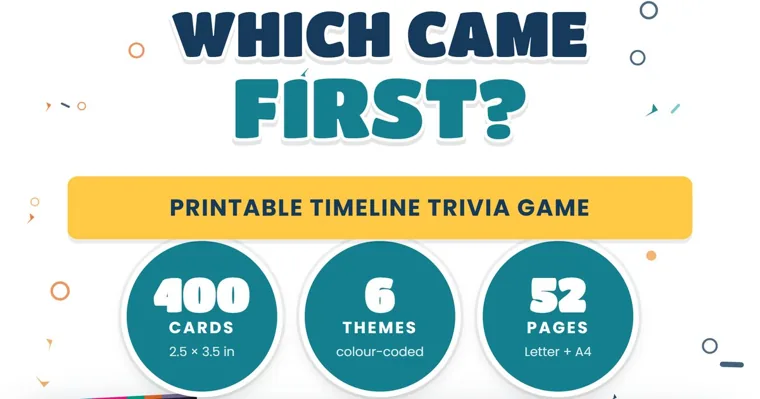
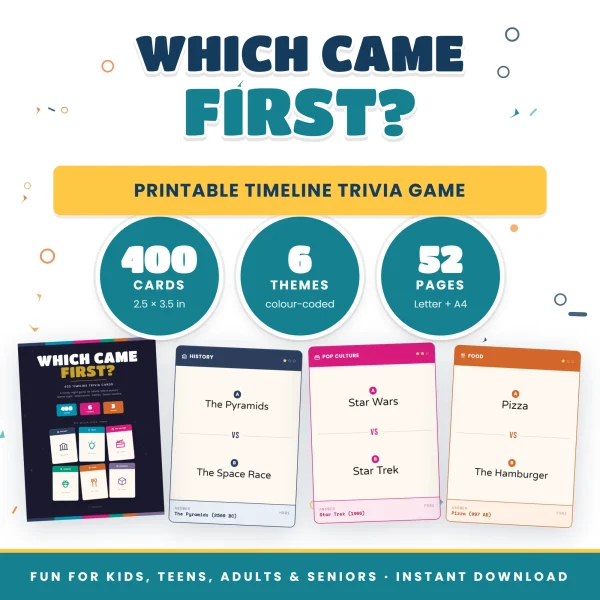
A timeline game turns looking back into something people can win. Which Came First? cards show two things, such as Star Wars and Star Trek, and players name the one that came earlier.
The deck has 400 cards in six themes: history, tech, pop culture and everyday objects with 80 each, plus animals and food with 40 each. One to three stars on each card mark the difficulty, and the rules suggest dealing one-star cards to the youngest and oldest players. That keeps a grandparent and a ten-year-old in the same round.
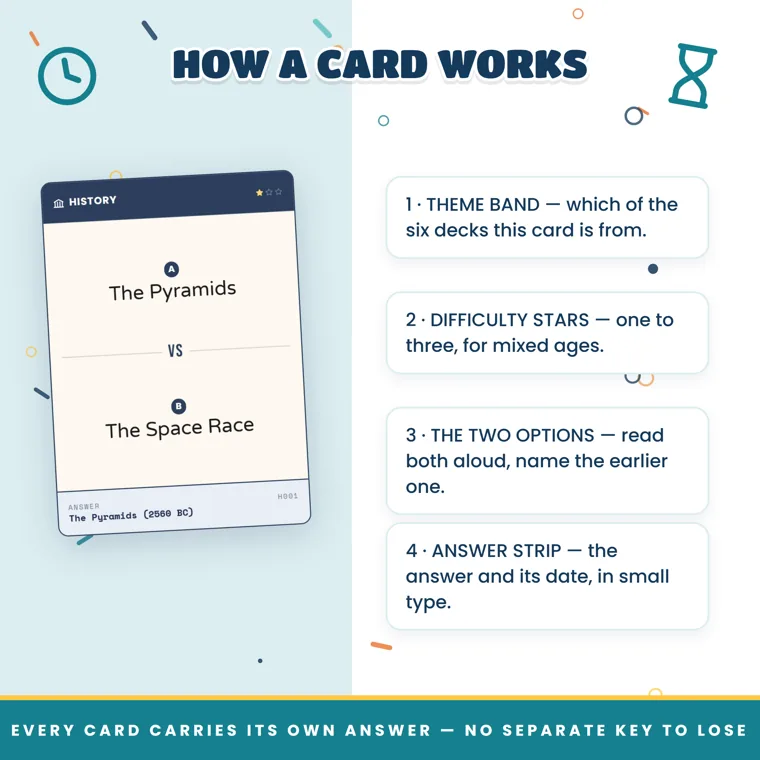
For a group, use the Team Challenge rules on the how-to-play page. A neutral reader draws and reads each card, the first team to call out an answer wins the point, and the best of 20 cards takes the round.
A which-came-first round made from your own year
After a few printed cards, switch to the year you’re actually saying goodbye to. Hand each guest two index cards. On each one, they write two things from their own year, such as a new job and a broken arm, or the camping trip and the new puppy. The writer keeps the card and acts as the answer key while someone else guesses. The round ends when every card has been read.
The trap in this round is a question only one person can answer. Ask people to pick events the rest of the room knew about, or the round becomes a quiz about one guest. Some guests may also have had a hard year. Make it clear that anyone can write about something small, like a favorite meal, or skip the round. Our guide to letting family members pass covers the same idea at the dinner table.
Whose resolution is it?
This one starts at the door. As guests arrive, each writes one New Year’s resolution on a slip without a name, folds it and drops it in the bowl. It works best with six or more people, because a smaller group can guess too easily.
Around 10:30, the host reads the slips out one at a time and the room guesses who wrote each one. The writer owns up after the guesses are in. Each correct guess scores a point, and the game ends when the bowl is empty. Allow about a minute a slip.
Say out loud when you hand out the slips that every one will be read to the room, so nobody writes something private. It also helps to ask for resolutions you could check next December. A 2007 study of 3,000 people led by Richard Wiseman at the University of Bristol found that 88% of those who set resolutions failed. The men in it did better when their goals were small and measurable, such as “lose a pound a week” rather than “lose weight”. A checkable resolution also makes a better slip for the time capsule below.
Prediction cards for a time capsule
A time capsule closes the look back by looking forward. Everyone can take part, including children who draw instead of write, and the writing takes about 10 minutes.
Give each guest an index card for three predictions about the coming year. They can be about the household, the news or each other, and each card gets a name and the date. Add a photo from tonight and the resolution slips, seal everything in an envelope or jar, and write “Open on December 31” with next year’s date on the front. Next New Year’s Eve, open it before the games and award a point for each prediction that came true.
The idea has a long New Year’s history. Detroit’s Century Box was created on December 31, 1900, holding photographs and letters from 56 residents that described life then and made predictions for the future. It was set to be opened 100 years later.
The real risk is losing it. Many buried time capsules are lost because interest fades and the exact spot is forgotten, and an envelope in a closet can go the same way. Store yours with the holiday decorations you’ll unpack next December. Ask each guest to add one ordinary detail too, like what was for dinner. Historians say personal notes about the daily lives of the people who made a capsule are what give it value later.
Countdown games for the last ten minutes before midnight
By 11:45, the room needs something short and loud that ends exactly on time. One-minute challenges do that: one player, one challenge, one minute, while the rest of the room counts down the last ten seconds.
One-minute challenges
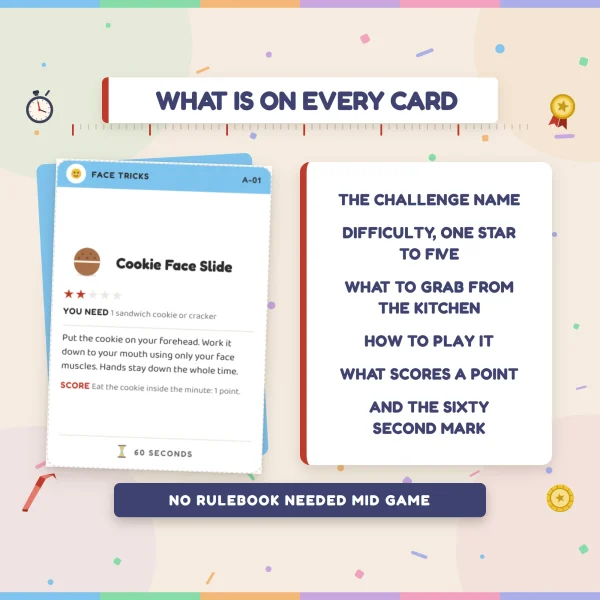
Our One Minute Challenge deck has 60 cards in six groups of ten, and each card lists what it needs, the rules and what earns a point. The rules call six players the sweet spot and say twenty still works. Most cards are worth 1 point, and beating the harder target on the same card makes it 2.
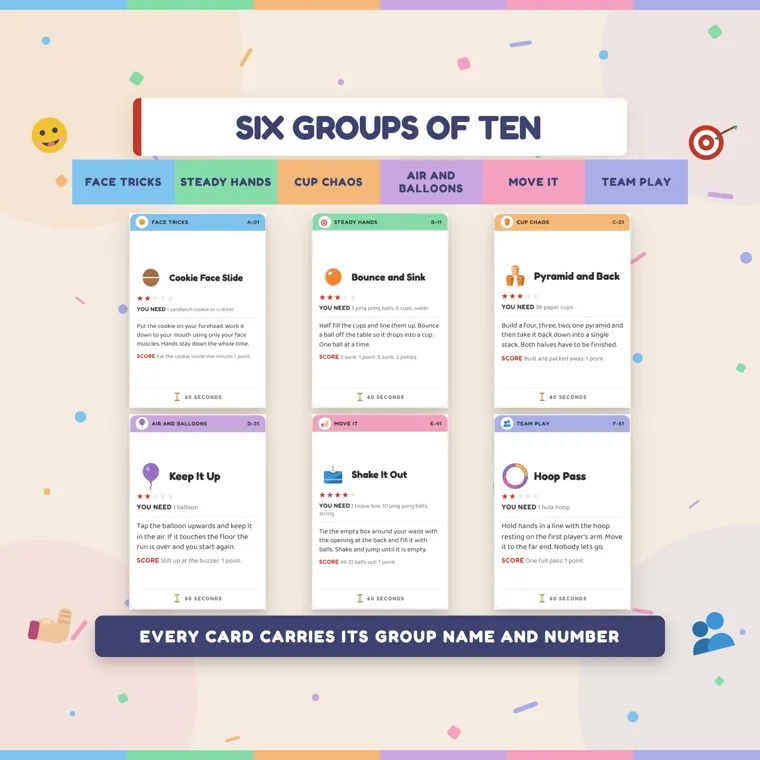
Before the party, pull out the cards that need almost nothing. Pen on the Nose needs one pen balanced across the nose for 10 seconds (20 seconds earns 2 points). Sticky Note Face needs one pad of notes, and Book Walk needs one hardback book carried on your head for about 16 feet (5 m) and back. Leave Pyramid and Back (36 paper cups) and the water cards for an afternoon party.
Allow about one card per minute and a half once you count reading and setup. That’s roughly six turns between 11:45 and 11:58. Then everybody stops, puts on the hats from the craft table and watches the clock. The ball in Times Square starts down at 11:59 Eastern, which gives the room a full minute to find the shakers. The deck’s Get Ready page lists every supply, so check it against your kitchen before December 31.
Be careful with the balloon cards when children are still up. Sit and Pop uses up to 20 balloons, and CPSC recommends that children under eight not play with uninflated balloons without supervision. For players under eight, the deck also has its own adjustment: let them stand closer, use bigger targets and count a near miss as a hit.
Fixes for the usual New Year’s Eve game problems
Most problems on the night come from timing and energy, not from the rules.
- Nobody can answer. In the riddle deck’s Classic rules, if no one gets a riddle in 30 seconds, the reader gives the answer and moves on.
- A game runs long. Set a points target before it starts, such as 15 points for riddles, or best of 20 cards for the timeline game.
- Someone keeps losing. Deal by difficulty: one-star timeline cards and Easy riddles go to younger and less confident players.
- A one-minute card can’t be set up. The deck’s rule is to put it back and draw another.
- Nobody is close to a bingo by 11. Let everyone mark one extra square of their choice.
- The kids are fading early. Move the early countdown forward, even if it no longer matches anyone’s real midnight.
Printing New Year’s Eve games before December 31
Print everything a day or two ahead, and print one page of cards first to check the size. All four printed games come as PDFs in US Letter and A4. The three card decks all say to print at 100% or Actual size with Fit to page turned off, or the cards come out small.
Card stock makes cards that shuffle, though plain paper works for one night. Print riddles and their answer cards on separate sheets, since the reader holds the answers. Bingo grids, resolution slips and prediction cards are fine on plain paper or index cards. The one-minute deck suggests laminating the cards if you want to play again next year, and a sandwich bag holds the whole deck. More games for holidays and family nights are in the Doodlora Studio shop.
Printables from this article
Related articles
Printable Party Games
How to Plan a Baby Shower: Timeline, Food & 2-Hour Schedule
A baby shower plan from the first talk with the parents-to-be to the last gift: timing, guest list, budget, venue, a two-hour schedule, safe food and backup plans.
Printable Party Games
How to Plan a Bridal Shower: Timeline, Budget and Schedule
A host's plan for a bridal shower, from the first talk with the bride and co-hosts to the guest list, invitations, a timed party schedule, the gift opening and what to do when something slips.
Printable Party Games
35th Birthday Ideas: Party, Trip, Theme and Gift Ideas
Ways to celebrate turning 35, sorted by how many people the birthday star wants around, with group size, time, prep and the snag to plan for in each.