Ladybug Life Cycle: Eggs, Larva, Pupa and What Ladybugs Eat
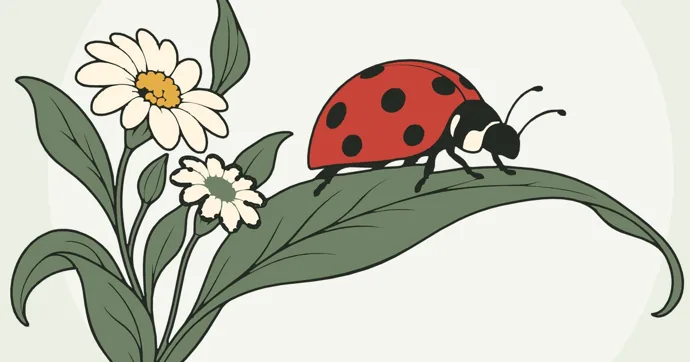
A ladybug goes through four stages: egg, larva, pupa and adult. The San Diego Zoo puts the whole ladybug life cycle at three to seven weeks, and warm weather sits at the fast end of that range. The stage that surprises kids is the larva, a bristly black-and-orange crawler that looks nothing like the round, spotted beetle it turns into. Most ladybugs eat aphids and other small soft-bodied insects, but a few kinds eat plant leaves or the white mildew on them. Below, each stage gets a description, a time range and a place to look for it, followed by ways to explain it to kids of different ages.
Ladybug life cycle stages at a glance
The table puts the four stages side by side. The day counts come from the University of Florida’s lab rearing of the convergent lady beetle at 77°F (25°C), with the San Diego Zoo’s broader figures in parentheses where they differ.
| Stage | What it looks like | How long at 77°F | What it eats |
|---|---|---|---|
| Egg | Yellow, spindle-shaped, about 1/20 inch long, standing upright in a cluster of 10–30 | About 3.5 days (“just a few days”) | Nothing |
| Larva | Long, bristly, black with orange spots; “a small alligator” | About 11 days over four growth stages (about 2 weeks) | Aphids, and sometimes unhatched eggs |
| Pupa | A hump glued to a leaf or stem, orange and black | About 5.4 days | Nothing |
| Adult | Round, domed beetle; soft and pale for the first few hours | Lives a few months, up to about a year | Aphids and other small insects, plus pollen and nectar |
Those numbers belong to one species in one lab. Other ladybugs and other weather shift every row, which is why the section on temperature further down matters more than any single day count.
Ladybug eggs and larvae: the stages kids walk past
Kids know the adult, so the first two stages are where a ladybug lesson gets interesting. Both live on the same leaves as the aphids, because a mother ladybug lays where her young will find food.
Ladybug eggs
The San Diego Zoo describes the eggs as tiny and golden, laid on the underside of leaves, usually near an aphid colony. UF/IFAS gives the details for the convergent lady beetle: clusters of 10 to 30 yellow eggs, each spindle-shaped, about 1–1.5 mm (around 1/20 inch) long and standing on end. Picture a tight bundle of yellow rice grains pointing up from the leaf.
Not every egg in a cluster hatches into a new larva. Wikipedia’s ladybird article notes that newly hatched larvae start eating, including other eggs in their own clutch, and that some species lay extra infertile eggs as backup food. If a child asks why a cluster of eggs turned into only a few larvae, that’s the plain answer.
Ladybug larvae
Wikipedia’s ladybird article describes the larva as long, with a square head and a covering of small hairs. The convergent lady beetle larva is black with orange spots, and UF/IFAS compares it to a small alligator. It grows through four stages, shedding its skin between them, and reaches about 1/4 inch (7 mm) before it changes into a pupa.
The larva is the hungry stage. The San Diego Zoo says a larva eats about 350 to 400 aphids in the two weeks it takes to grow, shedding its skin several times on the way. Once kids can tell a larva from an adult, the paper plate ladybug and the count-the-spots template in our bug crafts guide make a quick follow-up for ages 2 to 6.
Ladybug pupae and adults: from a still hump to a spotted beetle
When a larva is fully grown, it stops eating and fastens itself to a leaf or stem. The San Diego Zoo calls this next stage the pupa, and the adult beetle comes out of it.
The ladybug pupa
UC IPM describes ladybug pupae as glued openly to plant parts, and UF/IFAS describes the convergent lady beetle pupa as a dome of orange and black. In some species the old larval skin stays bunched around the pupa, partly or fully covering it. A pupa looks lifeless, but Wikipedia notes its head end can still move if something bothers it. That twitch is a good thing for kids to know about, so nobody thinks they’ve found a dead bug.
A new adult ladybug
An adult ladybug climbs out of the pupa soft and pale. Wikipedia says the wing covers start out lighter in color with no pattern. The San Diego Zoo says it takes the beetle several hours for its shell to harden and darken. Most of the final color shows up within hours, though full darkening can take weeks or months.
So a ladybug doesn’t add spots as it ages. Spot count is a clue to the kind of ladybug, which is why species carry names like two-spot and seven-spot. The San Diego Zoo also points out that some species are striped and some have no spots at all.
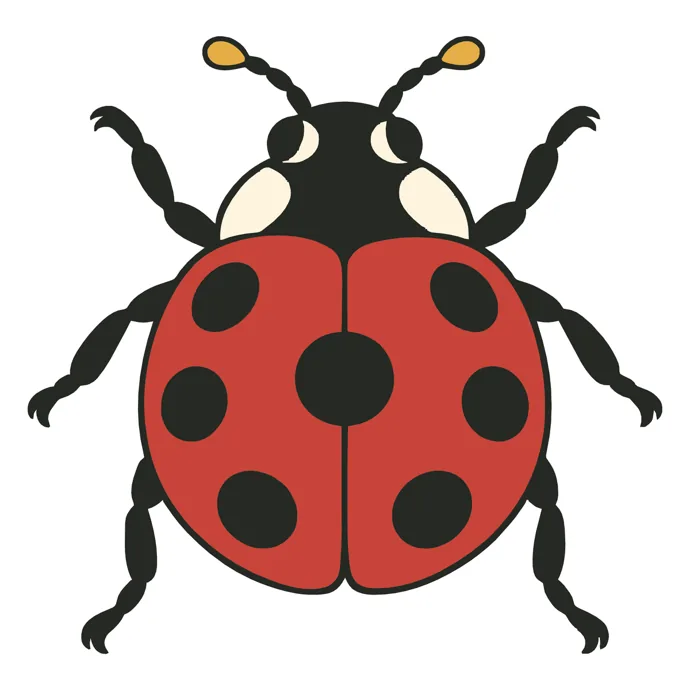
Adults are the long-lived stage. UC IPM gives the pink spotted lady beetle a life span of one to three months, and Wikipedia says an adult can live up to a year. In cold months many adults rest in groups; the San Diego Zoo says they can last up to nine months on stored reserves and become active again once it warms to about 55°F (13°C).
How long the life cycle of a ladybug takes: temperature sets the pace
The life cycle of a ladybug has no fixed length because insects develop faster when it’s warm. UC IPM shows this with Psyllobora vigintimaculata, a small mildew-eating ladybug: egg to egg-laying adult takes about three weeks when temperatures average 77°F (25°C), and about four weeks at 68°F (20°C).
The same pattern runs through other species. UC IPM gives about three weeks in warm weather for the twospotted lady beetle and three to four weeks for the pink spotted lady beetle. For the two-spot ladybug, Wikipedia lists eggs hatching after four to eight days, about three weeks as a larva and seven to ten days as a pupa. The San Diego Zoo’s three-to-seven-week span covers all of these.
For a kids’ explanation, keep two numbers: about three weeks on a warm summer stretch, closer to seven when it’s cool. If an egg cluster you’re watching takes longer than the table above during a cool spell, the weather is the likely reason.
What do ladybugs eat? Aphids for most, plants or mildew for a few
Most ladybugs are predators. Wikipedia says most species eat insects such as aphids and scale insects, and others eat plants or fungi. The answer to “what do ladybugs eat” depends on which ladybug you’re asking about.
Aphid and soft-insect hunters
The familiar red garden ladybugs hunt small, slow, soft-bodied insects. The San Diego Zoo says an adult may eat up to 75 aphids a day, along with insects such as fruit flies, thrips and mites. UF/IFAS lists aphids, scales, thrips and other soft-bodied insects for the convergent lady beetle. Some species specialize: Wikipedia notes that ladybugs in the genus Stethorus feed on spider mites.
Predatory ladybugs eat other foods too. UF/IFAS says convergent lady beetle adults eat honeydew, nectar and pollen when prey runs short, but females need aphids or other live prey to lay eggs. Cornell Small Farms reports research from Cornell’s entomology lab finding that aphid-eating ladybugs also seek out sterol-rich leaves, and that beetles eating both aphids and leafy greens had more offspring hatch.
Plant eaters and mildew eaters
A few ladybugs skip insects. Wikipedia names the Mexican bean beetle, a ladybug that mainly eats plants, especially legumes such as beans, and counts it as a crop pest. Species in the genera Epilachna and Henosepilachna are mostly plant eaters too.
Psyllobora ladybugs eat a fungus instead. UC IPM says these won’t feed on insects at all. They eat powdery mildew, the white coating that grows on some leaves, and a single larva clears the mildew from about one square inch of leaf as it grows. The adults are cream, pale gray or yellowish with dark spots, so they don’t look like the red ladybugs in picture books.
Explaining the ladybug life cycle to kids by age
The four stages are the same at every age; what changes is how many words and details a child can hold. These are our suggestions for pitching it, using only the facts above.
Ages 3 to 5. Use four short labels and one action for each: egg (waits), larva (crawls and eats), pupa (rests), adult (flies). Let the child put four drawings in order, then mix them up and do it again. Skip the day counts. The one fact to land is that baby ladybugs don’t look like little ladybugs.
Ages 5 to 8. Add the food chain: the larva eats aphids, the aphids eat plant sap. Kids this age like a number, so give them “a larva eats about 350 to 400 aphids while it grows” and let them count spots on an adult card. Spot counting doubles as early math.
Ages 8 and up. Bring in the temperature range and ask why the same insect takes three weeks one month and seven the next. Kids this age can also compare insects: butterflies go through the same four stages, as egg, caterpillar, chrysalis and adult. The butterfly life cycle plate in our butterfly crafts guide makes a good second card set to line up beside the ladybug one.
If you have older kids following real ladybugs over several days, the five-line notebook page in our science activities for kids works well: date, time, a sketch, one measurement and one “I wonder” question.
Finding ladybug eggs, larvae and pupae in your yard
Every stage shows up on the same plants, so the trick is knowing where and when to look. In temperate climates, Wikipedia says, ladybugs usually breed from late spring to early summer, which is the best window to find eggs, larvae and pupae together.
Where to look. Start with any plant that has aphids on it. UC IPM says twospotted lady beetles turn up on almost any aphid-infested plant, mostly laying eggs on the undersides of those leaves. Turn a leaf over gently rather than pulling it off. For the pale Psyllobora ladybugs, check leaves with white powdery mildew.
What each stage looks like up close. Eggs are a cluster of tiny yellow upright ovals. Larvae are moving, bristly and patterned, usually right in the aphids. Pupae sit still, stuck to a leaf or a stem. A pale, unspotted ladybug next to an empty pupa case has just come out.
Fall finds. Ladybugs on a sunny wall in autumn are often the multicolored Asian lady beetle. Wikipedia says this species heads toward buildings to spend the winter, swarming onto sunlit walls when afternoons warm to the mid-60s °F (about 18°C).
Look-only rules for a ladybug hunt
Keep every stage where you found it. Use a magnifying glass or a phone photo instead of a jar, and let kids count, sketch and move on. A pupa is glued to its leaf, so leave the leaf on the plant too.
Adults have their own reason to stay unhandled. The San Diego Zoo says a disturbed ladybug can release a foul-smelling chemical from its “knees.” It’s a defense, and one more reason to watch instead of hold.
Skip pesticide sprays on plants where you’re watching ladybugs. UC IPM advises against broad-spectrum, persistent insecticides because they’re toxic to natural enemies like lady beetles. The same leave-it-there habit carries over to the rest of the yard, and the nature scavenger hunt lists add a look-only list and a photo-hunt version.
Making ladybug life cycle cards from clipart
A four-card set (egg, larva, pupa, adult) is the simplest way to teach the sequence, and kids learn more if they draw some of the cards themselves. Our ladybug sets only show adult ladybugs, so use them for the adult card and have kids draw the other three from the descriptions above.
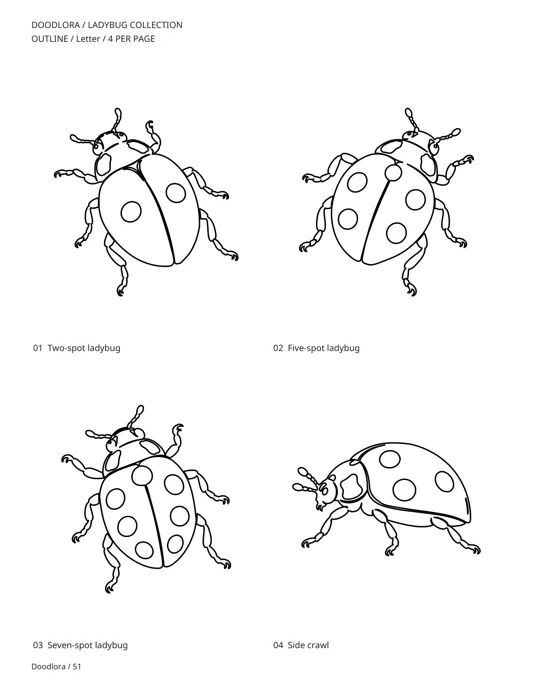
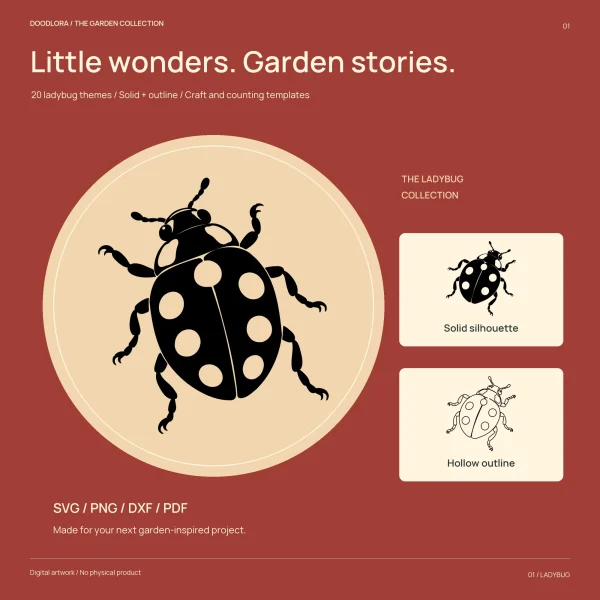
The ladybug outline set comes as a 59-page Letter PDF and a matching A4 PDF. The outline drawings run one per page on pages 31 to 50 and four per page on pages 51 to 55. Pages 51 and 31 to 33 hold the two-, five- and seven-spot ladybugs, which make the most realistic adult cards.
For the other three cards, give kids these drawing cues. Egg: a bunch of small yellow ovals standing up on a green leaf. Larva: a long body in sections, black with orange dots and short legs at the front. Pupa: a rounded orange-and-black bump stuck to a leaf.
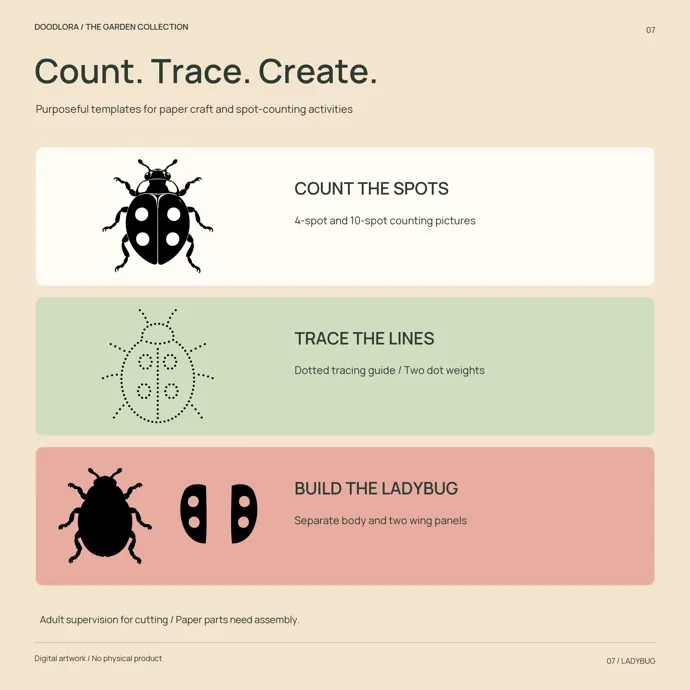
Three templates in the same set suit the lesson. The four-spot and ten-spot counting ladybugs (outline pages 45 and 46) work for the spot-math activity. The dotted tracing ladybug (page 49) suits ages 3 to 5. The body with two separate wing pieces (page 50) shows how the hard wing covers, which the San Diego Zoo says protect the flying wings underneath, open before take-off. Cutting the wing pieces is a job for an adult or an older child with safety scissors.
Which ladybug pictures to leave out of a science lesson
Two outline designs look like a lesson but aren’t. Design 11, “Parent and young,” and design 12, “Family parade,” show small adult-shaped ladybugs walking beside bigger ones. Real young ladybugs are larvae, so save those pages for decoration, or use them as a “what’s wrong with this picture?” question for kids 6 and up.
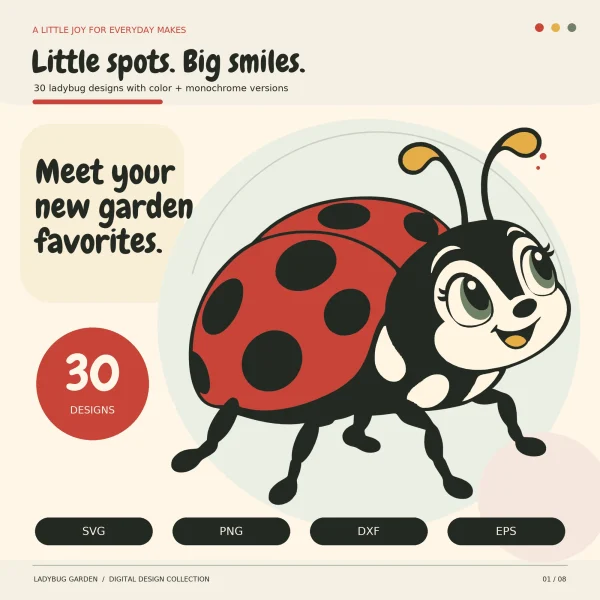
Cartoon ladybugs are fine for party favors, less so for a science card. In the ladybug SVG set, most of designs 1 to 12 have big glossy eyes, smiling faces and curly mustard-tipped antennae. Designs 13 to 15 drop the cartoon face: a seven-spot seen from above, a side profile and one taking off.
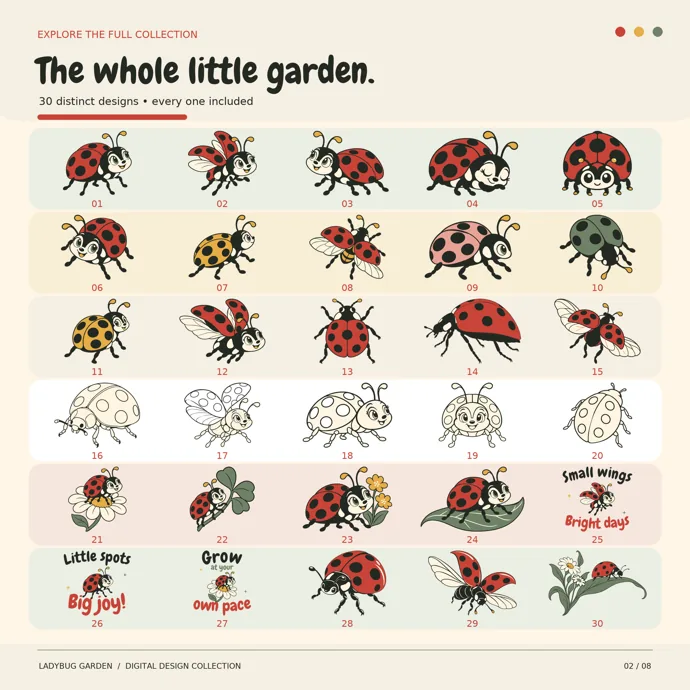
The SVG set’s PNG files have transparent backgrounds, so they drop cleanly onto a card template in a word processor or Canva. Sizing a PNG so it prints sharp on a small card is worked through in how to use clipart, using a 5 x 3 inch name card as the example. Both sets carry the personal license, which covers printing cards for your own students or inside one school. Selling the cards or posting the files online isn’t covered.
Printables from this article
Related articles
Clipart & SVG Cut Files
How to Draw a Truck: Easy Pickup, Big Rig and Cartoon
Split a pickup into three parts before you draw a single wheel: a bed, a cab and a hood. Keep the roof about 2.2 wheels tall and the bed rail level with the hood, and the truck looks right even before the details go on.
Clipart & SVG Cut Files
How to Draw a Train: Steam Engine, Cars and Tracks
Split the page into a 10-square grid, lay a long boiler tube across the middle, set a box cab at the back and a tall stack at the front, hang two big driving wheels under the cab end, then couple cars behind and run the rails to a vanishing point.
Clipart & SVG Cut Files
Hawk vs Falcon: Wings, Size, Hunting Style and Eagles
A falcon has long, narrow wings that taper to sharp points and flies on steady, quick wingbeats; a hawk has broader wings with rounded tips and either soars in slow circles or flaps hard and glides. Falcons kill with a notched beak and hawks with their talons, and eagles are the largest, heaviest-billed members of the hawk family.