Brain Teasers for Kids With Answers: Easy, Math and Logic
Here are 50 brain teasers for kids, each followed by its answer and a short reason no other answer fits. They’re organized by what a puzzle asks a child to do, from spoken puzzles a 4-year-old can answer on their fingers to math and logic traps for kids 11 and up.
A teaser with two good answers doesn’t end in an “aha.” It ends in an argument about whose answer counts, so every answer here was double-checked for an alternative before the teaser went in.
The age bands are suggestions, not limits. An independent reader can move up a band, and a younger child can manage the harder ones with you reading the clues aloud. Pick a band from the table, ask a few at a time, and stop while kids still want more.
| Ages | What the child has to do | Teasers | How to present them |
|---|---|---|---|
| 4 to 6 | Listen, compare, count to 10 | 1–11 | Read aloud; counting on fingers and pointing are allowed |
| 6 to 8 | Spell short words, use two meanings of a word | 12–24 | Out loud, with the hidden-word ones written down |
| 7 to 10 | Two-step math with coins, clocks and doubling | 25–35 | Scrap paper, real coins, a real clock |
| 8 to 10 | Hold three or more clues at once | 36–44 | A yes-and-no grid on scrap paper |
| 11 and up | Spot the trap answer and prove the right one | 45–50 | Paper, plus a “why” for every answer |
Easy brain teasers for kids ages 4 to 6
These eleven are for preschoolers and kindergartners, and they’re meant to be read out loud at the table or in the car. None needs reading, and none needs counting past 10, so a child can answer on their fingers or by pointing. Most contain one small twist: an irrelevant detail to ignore, or two comparisons to combine.
- Ben is taller than Ava, and Ava is taller than Max. Who’s the shortest? Answer: Max, since Ben stands above Ava and Ava stands above Max, which leaves nobody in the story shorter than him.
- A cat, a dog and a chicken walk into the kitchen. How many legs walked in? Answer: 10, which is four for the cat, four for the dog and two for the chicken.
- Two ducks stand next to one dog. Which side has more legs? Answer: neither. Each duck has 2 legs and the dog has 4, so both sides have 4 legs.
- I’m a number. Add 1 to me and you get 5. What number am I? Answer: 4, the only number that makes 5 when you add 1 to it.
- I’m the opposite of up, and I rhyme with clown. What am I? Answer: down, because brown, crown and town rhyme with clown too, but only down is the opposite of up.
- Ella has three red balloons and one blue balloon. The blue one floats away. What color are all of Ella’s balloons now? Answer: red, since the three balloons she’s still holding are all red ones.
- Theo has five crackers. He eats two, and then his dad gives him two more. How many crackers does Theo have now? Answer: 5, because he lost two and got two back, so the subtraction and the addition cancel out.
- Clap, stomp, clap, stomp, clap. What comes next? Answer: stomp, because the pattern repeats in pairs and a stomp has followed every single clap so far.
- Red, blue, blue, red, blue, blue, red. What color comes next? Answer: blue. The colors repeat in groups of three, one red and then two blues, and every red so far has had a blue right after it.
- Four birds sit on a branch and two sit on the grass. One bird flies down from the branch to the grass. How many birds are there now? Answer: 6, because a bird that moves is still a bird, and only the numbers on the branch and on the grass change.
- Mia is first in line and Leo is last. Two kids stand between them. How many kids are in the line? Answer: 4, which is Mia, the two kids in the middle and Leo.
For a child who isn’t reading yet, a picture puzzle works the same way. On the page below from our Brain Adventure worksheets, six things changed between the left box and the right one.
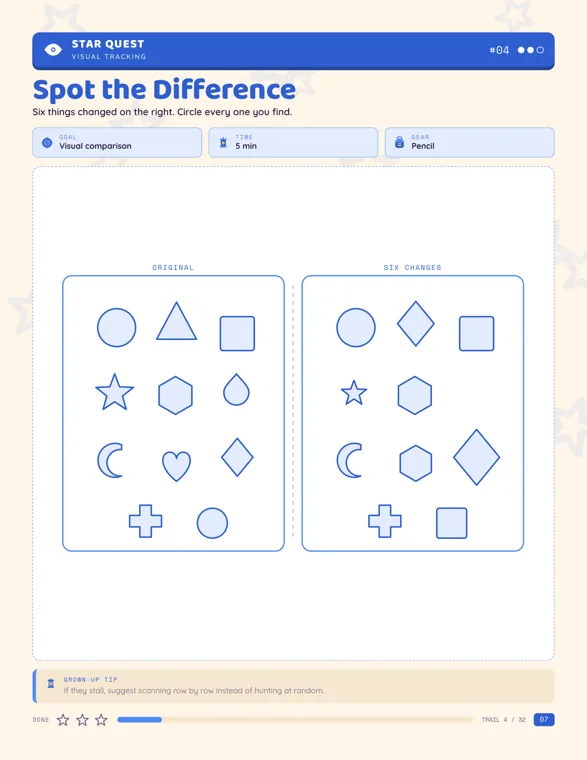
Answer: the triangle became a diamond, the star got smaller, the drop disappeared, the heart turned into a hexagon, the diamond got bigger and the bottom circle became a square. Memory is another picture game for the same age, where the puzzle is remembering where a card lies rather than spotting what changed, and our memory game rules begin a three-year-old with just six pairs.
Riddles and word brain teasers for kids 6 to 8
These thirteen suit 6- to 8-year-olds who can confidently spell short words. They play with letters and with words that carry two different meanings, so solving them means spelling in your head or knowing more than one definition, a step above the spoken set. Most work read aloud, but numbers 17, 18 and 20 are much easier on paper, since a hidden word becomes obvious once the letters are written down.
- I’m a pet that says meow. Change my first letter and you can wear me on your head. What am I, and what do I turn into? Answer: a cat that turns into a hat, since other first letters make bat, mat, rat and more, but a hat is the only one you wear.
- Change one letter in COLD to get a shiny yellow metal. Answer: gold. Changing one letter also gives bold, fold, hold, sold, told and cord, but gold is the only metal in the bunch.
- I read the same forward and backward, and a baby wears me at mealtime to catch the drips. What am I? Answer: a bib, because B-I-B spelled backward is still B-I-B.
- I have a bill, but nobody ever pays it. I swim on ponds, and I say quack. What am I? Answer: a duck. “Bill” alone could be a bird’s beak or a piece of paper asking for money, and a platypus has a bill too, so the riddle keeps adding clues until only one animal fits.
- I rhyme with cake. Fish live in me, and you can swim in me. What am I? Answer: a lake. Bake, rake, snake and shake rhyme with cake too, but a lake is the only one with fish in it.
- Find the animal hiding in each word: bowl, pigment, pirate. Answer: an owl in b-OWL, a pig in PIG-ment and a rat in pi-RAT-e, and each word hides only that one animal.
- Find the number hiding in each word: often, stone, weight. Answer: ten in of-TEN, one in st-ONE and eight in w-EIGHT. Searching each word for every number name up to one hundred turns up no second match.
- What word comes after “rain” and before “tie”? Answer: bow, for rainbow and bow tie, because raincoat, raindrop and rainfall all start right, but nobody wears a coat tie or a drop tie.
- Spell STAR backward. What animals do you get? Answer: rats, since reading the letters from the end gives R-A-T-S.
- Unscramble T-A-O-B to find something that floats. Answer: a boat, the only everyday word those four letters spell.
- Mix up the letters of LISTEN to make a word that means very quiet. Answer: silent. The same six letters also spell enlist, tinsel and inlets, but only silent means quiet.
- Add one letter to the front of RANGE to make a fruit. Answer: an orange. A G in front makes grange, an old word for a farm, but no other letter makes a fruit.
- Which letter comes right after the letter that comes right after B? Answer: D, because right after B comes C, and right after C comes D.
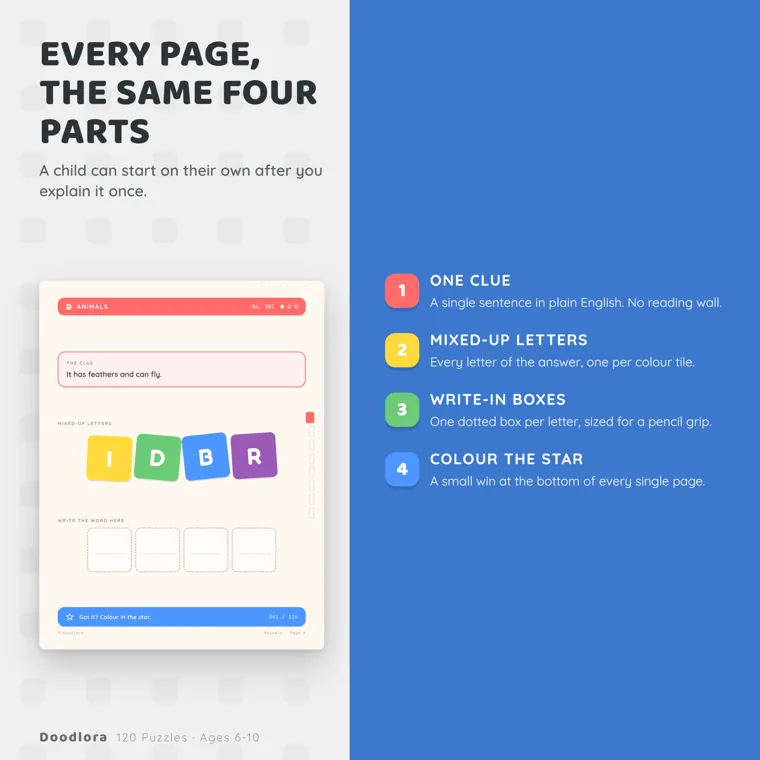
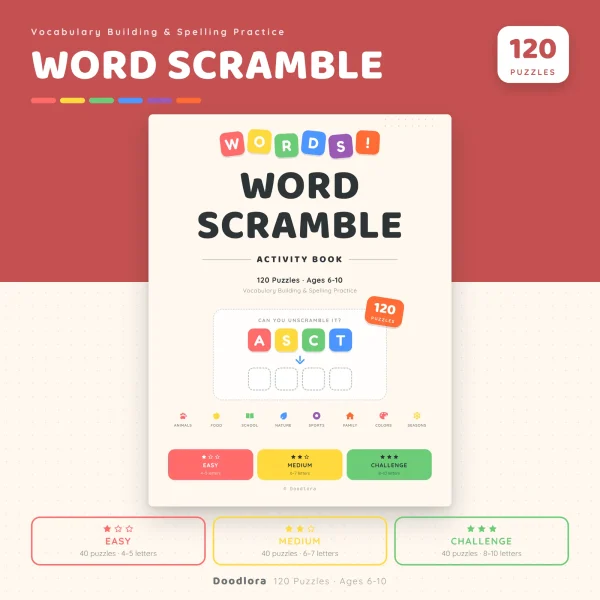
Number 21 is the one to keep going with if it lands. Word Scramble Puzzles for Kids gives each of its 120 puzzles a page of its own, with a one-line clue and a box for every letter. Inside each theme the words grow from four letters to as many as ten, and one of its clues, “It carries its house on its back,” unscrambles to TURTLE.
Math brain teasers for kids 7 to 10
These eleven are for kids who know two-digit numbers, coins, a clock face and doubling. Most take two steps, so a quick guess after the first calculation usually misses. Keep scrap paper nearby: number 27 is much easier to check by writing out the twenty numbers than by remembering them, and a handful of real coins or a real clock turns numbers 28 to 30 into something physical a child can move around on the table.
- I’m a two-digit number. My digits add up to 5, and my tens digit is 3 more than my ones digit. What number am I? Answer: 41, because four plus one makes 5 and 4 is 3 more than 1, while 50, 32 or 23 each break one of the two clues.
- Maya is 4. Her brother is twice her age. How old will her brother be when Maya is 10? Answer: 14. He’s 8 now, which makes him 4 years older than Maya, and he stays 4 years older forever, so the tempting answer of 20 is wrong.
- How many times do you write the digit 1 when you write the numbers from 1 to 20? Answer: 12, with one each in 1, 10 and 12 through 19, which makes 10, plus two more in 11.
- Make 25 cents with exactly four coins, using only nickels and dimes. Answer: three nickels and one dime, since two dimes and a nickel is only three coins and five nickels is five.
- Using quarters, dimes and nickels, what’s the fewest coins that make 40 cents? Answer: 3, a quarter, a dime and a nickel. No combination of two coins works, because the closest pairs make 35 cents and 50 cents.
- The hour hand on a clock points to 10. Where will it point 5 hours later? Answer: 3, counting on from 10 through 11, 12, 1 and 2. Adding 10 and 5 gives 15, and there’s no 15 anywhere on a clock face.
- The day after tomorrow is Saturday. What day was yesterday? Answer: Wednesday. Two days before Saturday makes today Thursday, and the day before Thursday is Wednesday.
- A box holds 12 cookies. You eat half, then give away half of what’s left. How many cookies are still in the box? Answer: 3. Eating half leaves 6, and giving away half of those 6 leaves 3. The tempting answer of 0 treats both halves as halves of 12.
- Rosa reads 5 pages on Monday. Every day after that, she reads 2 more pages than the day before. How many pages does she read on Thursday? Answer: 11, from 5 on Monday, 7 on Tuesday, 9 on Wednesday and 11 on Thursday.
- What comes next: 3, 6, 12, 24? Answer: 48. Adding the same number each time doesn’t work, since the jumps are 3, 6 and 12, but doubling fits every step.
- A frog sits at the bottom of a staircase with 6 steps. Each turn it hops up 2 steps and then slips back 1, unless it has just landed on the top step. How many turns does it take to reach the top? Answer: 5. After four turns it’s on step 4, and the fifth hop lands it on step 6, where it stops. Counting one step per turn gives 6, which ignores the fact that the final hop has no slip.
Logic puzzles for kids 8 to 10
Logic puzzles give a child a few clues and ask them to rule out possibilities until one arrangement is left. Holding three clues simultaneously is the hard part, so these nine suit 8- to 10-year-olds on their own, or younger kids with a grown-up reading each clue and waiting. The ordering and matching puzzles were checked by listing every possible arrangement, and each has exactly one that fits.
- Four friends line up for the slide. Di is first. Bo is right behind Ada. Cy isn’t last. What order are they in? Answer: Di, Cy, Ada, Bo. With Di first, Ada and Bo can stand second and third or third and fourth, and the first choice would put Cy last.
- Four kids sit in a row of four chairs. Ivy sits on the far left. Jay sits next to Ivy. Lou doesn’t sit next to Jay. Who sits where, from left to right? Answer: Ivy, Jay, Kim, Lou. Jay can only take the second chair, and the third chair is next to Jay, so Lou takes the fourth and Kim the third.
- Leo, Nia and Omar each have one pet: a dog, a fish or a rabbit. Omar has the rabbit. Nia doesn’t have the dog. Who has which pet? Answer: Leo has the dog, Nia has the fish and Omar has the rabbit, because once the rabbit is taken Nia can only have the fish.
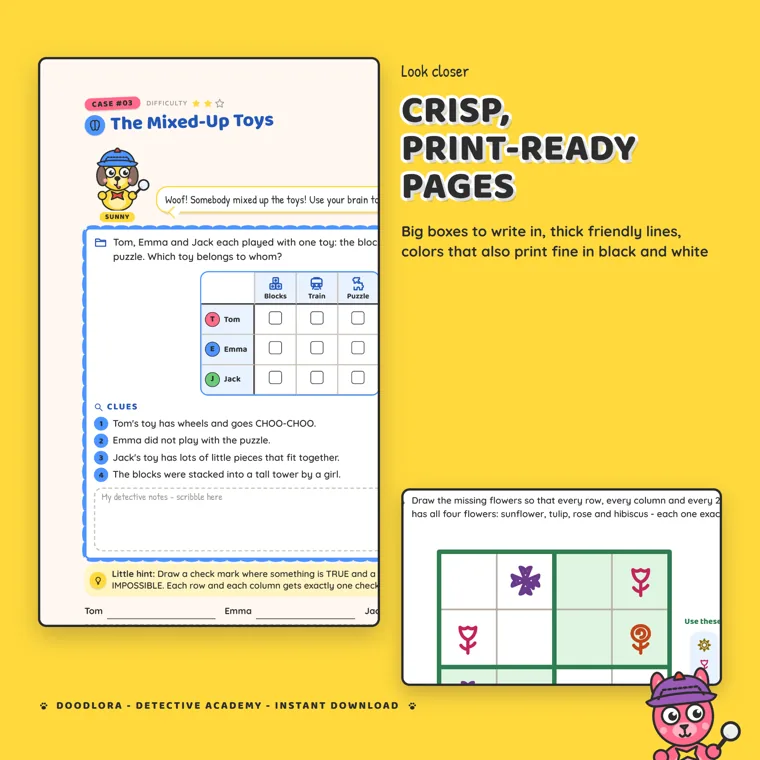
For number 38, a grid on scrap paper helps: names down the side, pets across the top, a check for yes and an X for no. The logic grids in Detective Academy use the same layout.
- Zoe, Kai or Lu ate the last cookie. Zoe says, “Kai ate it.” Kai says, “I didn’t.” Lu says, “I didn’t.” Only one of them is telling the truth. Who ate it? Answer: Lu. If Zoe or Kai had eaten it, two people would be telling the truth, and only with Lu as the cookie thief is Kai the one honest speaker.
- A prize is hidden in one of three boxes. Box A’s sign says, “The prize is in here.” Box B’s sign says, “The prize is not in here.” Box C’s sign says, “The prize is in box A.” Only one sign tells the truth. Where’s the prize? Answer: box C. With the prize in A, all three signs are true, and with it in B, none of them are. Only with the prize in C is exactly one sign, B’s, telling the truth.
- Four friends each shake hands with every other friend once. How many handshakes is that? Answer: 6. The first friend shakes three hands, the second has two new ones left, the third has one, and the last has already shaken everybody’s: 3 + 2 + 1.
- A drawer holds 10 black socks and 10 white socks. In the dark, how many socks do you have to pull out to be sure of a matching pair? Answer: 3. Two socks could be one of each color, but three socks in only two colors means at least two of them match.
- Nora has 3 brothers. Each of her brothers has 2 sisters. How many girls are in the family? Answer: 2. Every brother has the same two sisters, so Nora is one of them and there’s one more girl. Multiplying 3 by 2 counts the same two girls three times.
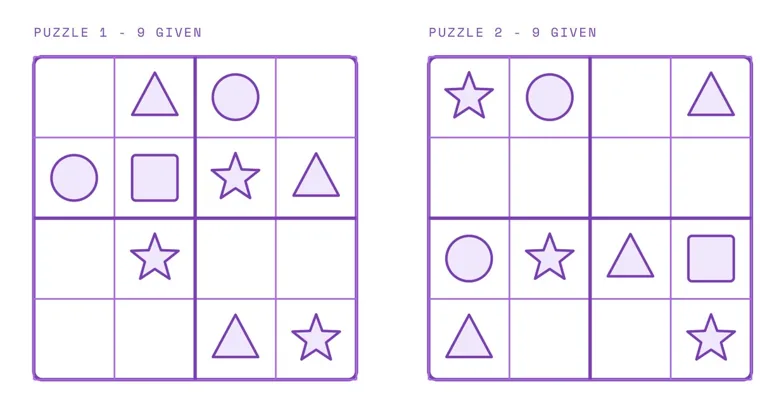
- Fill the grid so every row, every column and every 2 x 2 corner box has 1, 2, 3 and 4 once each.
2 . 1 3

. . 2 .

. 1 . .

. . 3 1
Answer, row by row: 2 4 1 3, then 1 3 2 4, then 3 1 4 2, then 4 2 3 1. Start with the top row, which is missing only the 4.
Detective Academy builds 40 puzzles like these into one continuous mystery. Its logic grids start with three children and move up to four, the sudoku goes from 4 x 4 to 6 x 6, and each section ends with a clue that crosses one suspect off the list. The book is marked for ages 6 to 10, its printing guide says six-year-olds may need help reading the logic clues, and the answers are on pages 43 and 44.
Harder brain teasers for kids 11 and up
These six are for kids 11 and up, and for younger ones who’ve breezed through everything above. Each has an instinctive answer that’s wrong, so ask for an explanation along with the answer and hand over paper. Numbers 47 and 48 are far easier with a drawing.
- On a make-believe island, every person either always tells the truth or always lies. Ana says, “Ben and I are both liars.” Who’s telling the truth? Answer: Ben tells the truth and Ana lies. A truth-teller calling herself a liar would be a contradiction, so Ana is lying, and since her sentence is false, the two of them can’t both be liars. That leaves Ben as the honest one.
- A sandwich and a juice cost $5.50 together. The sandwich costs $4.00 more than the juice. How much is the juice? Answer: 75 cents. The sandwich is then $4.75, and $4.75 plus 75 cents makes $5.50. The automatic answer of $1.50 would make the sandwich $5.50 and the total $7.00.
- What’s the angle between the hands of a clock at 3:30? Answer: 75 degrees. The hour marks sit 30 degrees apart, and the minute hand is on the 6, but by 3:30 the hour hand has moved halfway from the 3 to the 4. That puts the hands two and a half marks apart, and 2.5 times 30 is 75. The tempting answer of 90 overlooks the hour hand’s movement.
- Draw a big square and split it into a 3 by 3 grid of small squares, like a tic-tac-toe board with a border around it. How many squares of any size can you find? Answer: 14, made of nine small squares, four 2 by 2 squares and the big square itself. No other size of square fits inside a 3 by 3 grid.
- You have 9 marbles that look the same, but one is a little heavier. With a balance scale, what’s the fewest weighings that always finds the heavy one? Answer: 2. Put 3 marbles on each side, and the heavy one is in the pan that drops, or among the 3 left out if the pans balance, then weigh 2 of those 3 the same way. One weighing can’t be enough, because a scale has only three results (left down, right down or level) and there are nine possibilities to separate.
- In 5 years, Sam will be twice as old as he was 5 years ago. How old is Sam now? Answer: 15. In 5 years he’ll be 20, and 5 years ago he was 10, which is half of 20. Those two ages are always 10 years apart, so the younger one has to be 10 for the older to be double it.
Brain teaser worksheets kids solve with a pencil
Spoken teasers disappear once they’re answered, but a printed worksheet stays on the table, and a child can return to it tomorrow. Brain Adventure, our set of 32 brain teaser worksheets, is marked for ages 4 to 8 on its cover. The activities come in four zones of eight, and only two of those zones are puzzles in the sense of this list.
Magic Castle is the logic zone. It has what comes next, odd one out, sorting by size, a four-shape sudoku, a small logic grid about three kids and what they packed, and a symbol code to turn back into words. Star Quest has the picture puzzles, among them a maze, spot the difference and a page of hidden keys. The other two zones are hand work: Forest Trek has two-handed tracing, drawing and clapping, and Volcano Dash has tracing, cutting and folding.
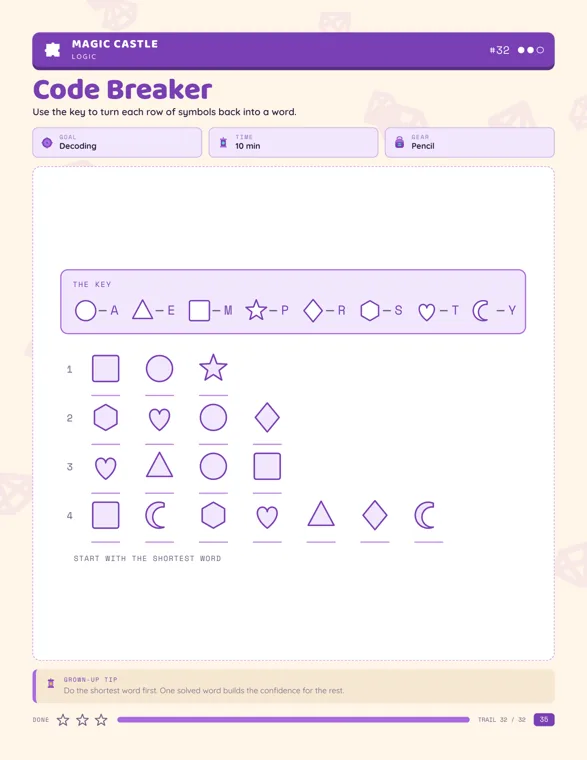
Every worksheet names its goal, a time of 5, 10 or 15 minutes, and the gear it needs, which for most pages is only a pencil. There’s no answer key in the book. The logic pages check themselves, though: a finished sudoku has every shape once in each row and column, and a decoded row either spells a word or it doesn’t.
How to tell if a brain teaser has only one answer
Before you read a teaser to a child, try answering it incorrectly on purpose. If you find a second answer that fits everything the question says, the child may find it too, and they’ll be right. Try it on this one: “I read the same forward and backward, and I’m a name for a father.” Dad fits, and so does pop, so number 14 asks for something a baby wears at mealtime instead.
Riddles slip easily, because so many everyday words have several meanings. “What has a bill?” could be a duck, a platypus or an envelope from the power company. Number 15 keeps the bill, then adds a pond and a quack until only the duck is left, and number 5 does the same thing with two clues, a rhyme and an opposite, neither of which would be enough alone.
“What comes next” puzzles need enough steps shown to rule out alternatives. From 2 and 4, the next number could be 6 if you add 2, or 8 if you double, and only a third step like 2, 4, 8 settles it.
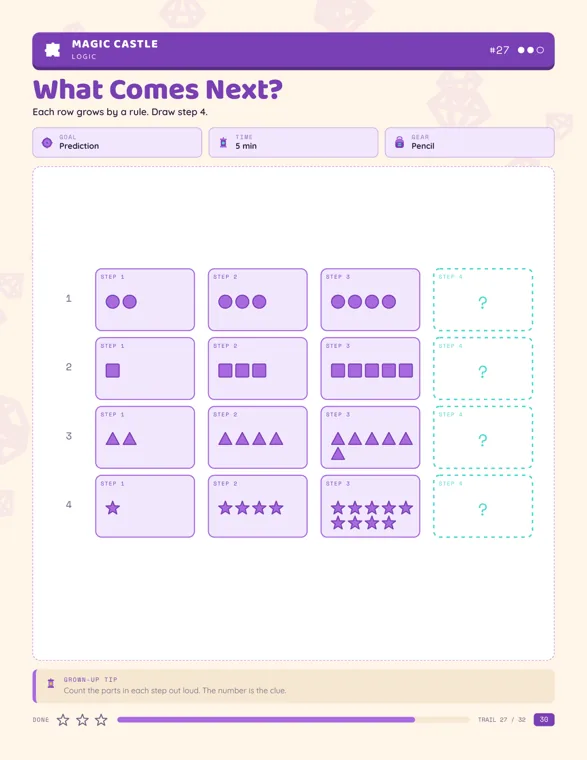
The page above shows three steps in every row before the blank. Its tip for the grown-up is to count the parts in each step out loud, because the number is the clue.
Some puzzles are deliberately open-ended. The grown-up tip on Brain Adventure’s Sort It Out page says some items could fit two baskets, and suggests asking kids to defend their choice. That’s a fine puzzle, just a different category, so decide which kind you’re asking before starting, and a well-argued answer won’t get marked wrong.
Also watch for riddles that are really trivia questions in disguise: if the answer depends on information the child hasn’t come across yet, no amount of thinking gets them there.
How to ask brain teasers without giving the answer away
Read the teaser twice, then wait longer than feels comfortable. If a child is stuck, point to the overlooked clue before revealing anything else. In number 39, the clue that’s easy to skip is the rule that only one person is telling the truth. Next, try a yes-or-no question, and save the first letter of the answer for last.
Picture puzzles work the same way. With a tangram silhouette, name one piece first, then show where the two large triangles go, and only then hand over the answer card. The same ladder of hints is laid out piece by piece in tangram puzzles for beginners.
Ask for an explanation, even when the answer is right. The tip on Brain Adventure’s Odd One Out page puts it plainly: “A wrong answer with a good reason is worth more than a lucky right one.” Keep each sitting short, too. The how-to page in the same set suggests one or two pages a day, fifteen minutes at most, and stopping while kids still want more.
Then hand the job over. A child who’s solved number 12 can make a riddle of their own: pick a short word, change the first letter, and write two clues so only one answer fits. Checking their riddle for a second answer is a brain teaser all by itself.
Printables from this article
Related articles
Kids Activity Books
Secret Agent Activities for Kids: Spy Codes, Clues & Party
Spy codes, invisible ink, Kim's Game, a string laser maze and a case to solve, with player counts, timings, supplies and the snags to plan around.
Kids Activity Books
Math Puzzles for Kids With Answers, Sorted by Grade
Ready-to-use math puzzles from kindergarten to middle school, each with its answer, plus how to run them as a home warm-up or a classroom center.
Kids Activity Books
Quiet Time Activities for Kids: Bin and Quiet Book Ideas
How to swap a dropped nap for an hour of quiet time, with a starting length, a timer, a rotating bin and solo activities sorted by age, from board books to build-and-play mats.