How to Make Bingo Cards by Hand or in a Spreadsheet
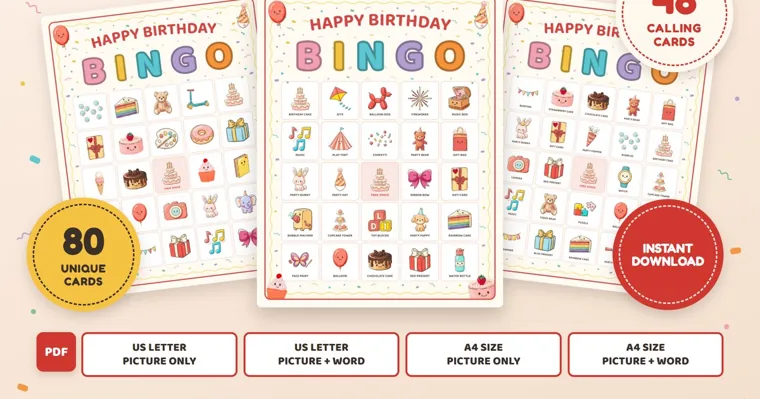
To make bingo cards, draw a five-by-five grid, mark the middle square FREE, and fill the other 24 squares from a word list that’s longer than 24 items. Shuffle the list again for every card, so no two players hold the same layout. Then make one calling card for each word on the list.
That’s the whole recipe. You need paper, a ruler, a pencil and a marker, or a spreadsheet and a printer, plus something to cover the squares with. A handful of cards for a family game is quick to draw by hand. For a classroom of thirty, a spreadsheet saves the most time.
The steps below follow the order you’ll actually work in. The two places homemade sets usually go wrong are the length of the word list and the cards that turn out identical, and both get their own section.
Before you start: who’s playing and how many cards you need
Count your players first, because every player needs a card of their own. Two people holding the same card finish on the same call every round, so a tie is built in before anyone sits down. How the game runs once the cards exist, from calling to checking a winner, is covered in printable bingo rules.
Then think about who’s reading the cards. That choice decides whether you write words, draw pictures, or do both.
| Your group | Grid | What goes in the squares |
|---|---|---|
| Toddlers and pre-readers, with an adult at the table | 3 × 3 or 5 × 5 | Pictures only, very different from each other |
| Early readers, ages about 5 to 7 | 5 × 5 | A picture with its word underneath |
| A class practicing vocabulary | 5 × 5 | The word only, while the caller reads a definition |
| Teens and adults at a party | 5 × 5 | Words, inside jokes, or things that might happen at the party |
The ages here are our suggestion for picking a format, not a rule from anywhere. Adjust them to the readers you actually have.
Step 1: Pick the grid and place the FREE square
Draw a five-by-five grid unless you have a reason not to. It’s the standard card for 75-ball bingo, the version mostly played in the U.S., where the middle square is a FREE space and every other square holds a number (Wikipedia: Bingo card). That leaves 24 squares to fill.
The FREE square is worth keeping in the center. A five-by-five card has 12 possible lines: five rows, five columns and two diagonals. The center square sits on four of them, the middle row, the middle column and both diagonals. So a player can finish any of those four lines with only four calls, which gets the first bingo of the game moving.
A smaller grid suits short attention spans. A three-by-three card has a true center for the FREE square and only eight squares to fill. A four-by-four card doesn’t have a middle square at all. Put a FREE square anywhere on it and it only helps the lines that happen to pass through that square, so skip the FREE square on a four-by-four card.
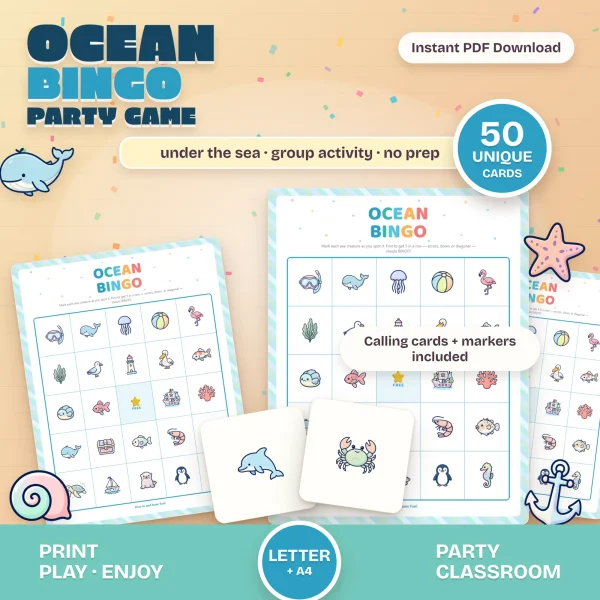
Here’s what a filled five-by-five picture card looks like, written out as words:
| B | I | N | G | O |
|---|---|---|---|---|
| snorkel | whale | jellyfish | beach ball | flamingo |
| seaweed | seagull | lighthouse | pelican | fish |
| seal | goldfish | FREE | pirate ship | coral |
| whale | treasure chest | fish | shrimp | pufferfish |
| sea turtle | sailboat | sea otter | penguin | seahorse |
The letters across the top are just the word BINGO. On a number card they mark the number ranges, B for 1 to 15, I for 16 to 30, and so on up to O for 61 to 75, according to the same Wikipedia article. On a word or picture card, they’re decoration. You can leave them off.
That table also holds a mistake on purpose. “Whale” sits in the top row and again in the fourth row, and “fish” shows up twice as well. A repeated word on one card covers two squares on a single call, which hands that player an unfair head start. Read every card once for repeats before you print.
Step 2: Write a word list longer than the grid
Write at least 25 words for a five-by-five card, and usually more. The length of the list decides how the game plays, so pick it on purpose.
With exactly 24 words, every card holds the same 24 words in a different order. A one-line game still works, because the order decides who completes a row first. A full-card game doesn’t, because every player covers the last square on the same call.
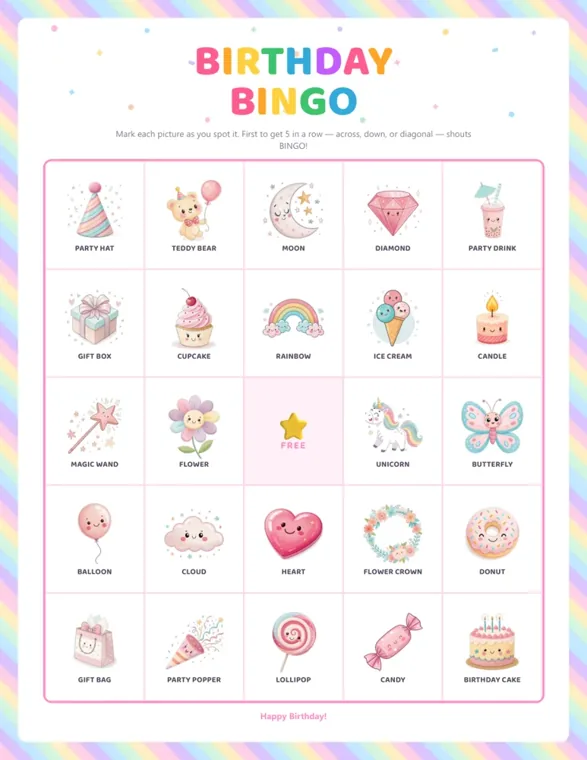
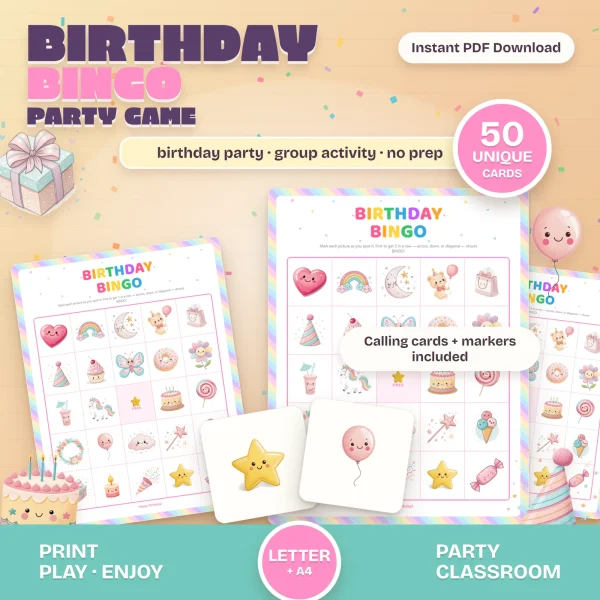
With 25 words, each card leaves out just one. Our Birthday Bingo is built that way. In its 30-card file, each picture appears on 26 to 30 of the 30 cards, so nearly every call covers a square for nearly everyone. Rounds are short and loud, which suits a birthday party with a cake waiting.
There’s a catch with a 25-word list. It only allows 25 different sets of 24 words, one for each word you leave out. Across those 30 cards we count just 14 different sets, each shuffled into its own layout. That’s fine for line games. For a full-card round, two players holding the same 24 words will finish together.
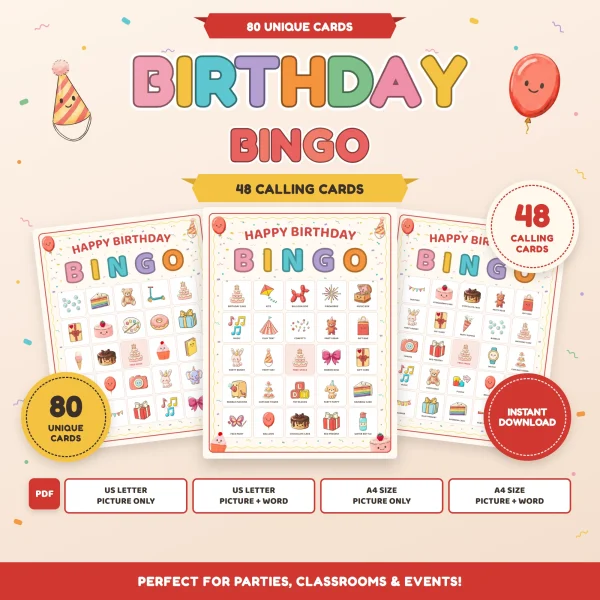
A longer list spreads the words out. Our Birthday Party Bingo uses 48 pictures, and in its 30-card file each one lands on 10 to 20 cards. The Ocean Animal Bingo set uses 42, and in its 50-card file each picture appears on 21 to 36 cards. A call often misses your card in those sets, so a game takes more draws and the winners come one at a time.
Pick the length by the game you want:
| Word list for a 24-square card | How the game plays |
|---|---|
| 24 words | Every card has the same words. Lines only, never a full card |
| 25 to 30 words | Fast rounds and lots of near-misses. Good for young kids and short parties |
| About 40 to 50 words | Longer games, fewer ties, good for a full-card final round |
| 75 numbers (classic bingo) | Each column draws 5 numbers from its own 15 |
The last row comes straight from the standard 75-ball card. B uses 1 to 15, I uses 16 to 30, and so on, with five numbers per column and four in the N column because of the FREE square.
Choosing words that work when called out loud
Each word on the list has to be easy to tell apart when the caller says it once. “Cupcake” and “cake” on the same list will start arguments. So will “seal” and “sea lion” with a room of seven-year-olds.
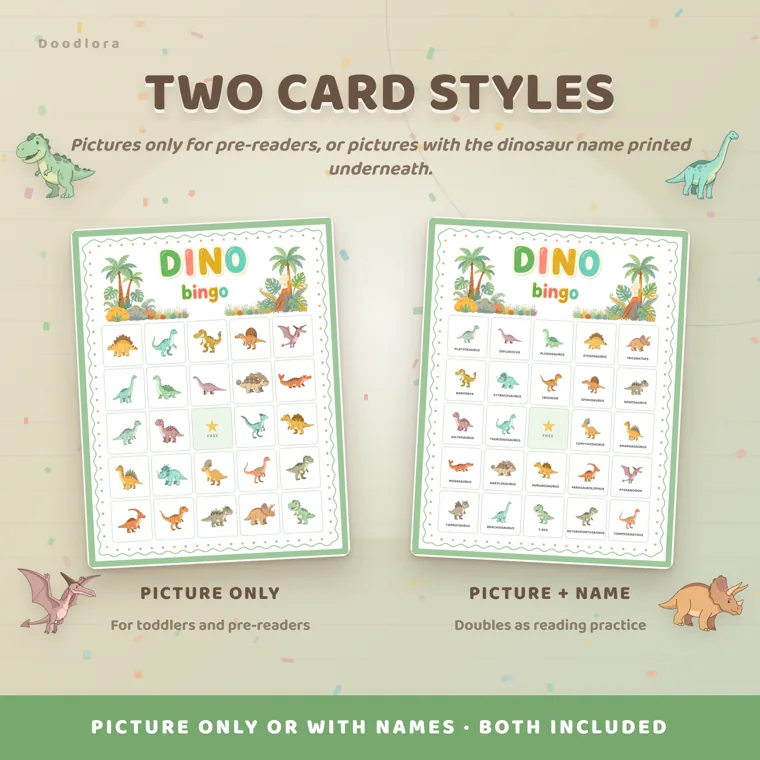
Look-alike pictures cause the same trouble for kids who can’t read yet. Our birthday party set has six cakes, among them a chocolate cake, a strawberry cake and a rainbow cake. On the picture-only cards a four-year-old has to compare colors to tell them apart. For the youngest group, keep the cakes and drop most of the near-twins from your own list, or print the version with the names.
For a classroom, the list can be anything you’re practicing. Write sight words, vocabulary words or numbers on the cards. Then the caller reads a definition, a math fact or a sentence with a blank, and players hunt for the answer instead of a match.
Step 3: Make every card different
Shuffle the list again for each card, then copy the first 24 words into the grid row by row. Picking squares by eye always drifts toward the same favorites, and neighboring players end up with near-copies.
By hand: slips in a bowl
- Write each word from the list on its own slip of paper and fold it.
- Mix the slips in a bowl and draw one at a time.
- Write the first word you draw in the top-left square, the next one beside it, and keep going across each row. Skip the center square and write FREE.
- Stop after 24 words. Put every slip back, mix again and start the next card.
- Number each card in a corner as you finish it.
The slips do double duty. Once the cards are done, the same slips become your calling deck, which keeps the call list and the card list identical.
The card numbers help later. If a player calls bingo, you can find the card fast, and if two cards turn out to match, you’ll spot which ones.
In a spreadsheet: a random column and a sort
- Type the word list into column A, one word per row.
- In column B, enter
=RAND()next to every word. Both Excel and Google Sheets have this function, and it gives a random number between 0 and 1. - Sort both columns by column B. The first 24 words are one card.
- Copy those 24 words into a five-by-five grid on a second sheet, leaving the center square for FREE.
- Re-sort for the next card.
Watch for one trap. RAND() recalculates every time the sheet changes, so the grid you liked can reshuffle itself the moment you type somewhere else. Paste each finished card as values only before you move on. That freezes it.
For a class set, a free online bingo generator does the shuffling in one go. The same checks still apply: a list longer than 24 words, no repeats on a card, and a printed copy of the word list for the caller.
How many different cards are possible
Plenty, as long as the list is longer than the grid. The number of ways to choose 24 words out of a list is a combination, written C(n, 24), and it ignores the order (Wikipedia’s “Combination” article has the formula). With 25 words that’s only 25 sets. With 30 words it’s 593,775 sets, before you even count the different ways to arrange each set on the grid.
Classic number bingo goes much further. A single B column alone can be filled 360,360 ways (15 × 14 × 13 × 12 × 11). Counting every arrangement, Wikipedia puts the number of possible 75-ball cards at about 552 septillion. No group needs that many. The useful part for a homemade set is the first number: a 25-word list runs out of truly different cards fast.
Step 4: Make the calling cards
Make exactly one calling card for every word on the list, no more and no fewer. A word that’s on the cards but missing from the calling deck can never be called, so any line that needs it never finishes.
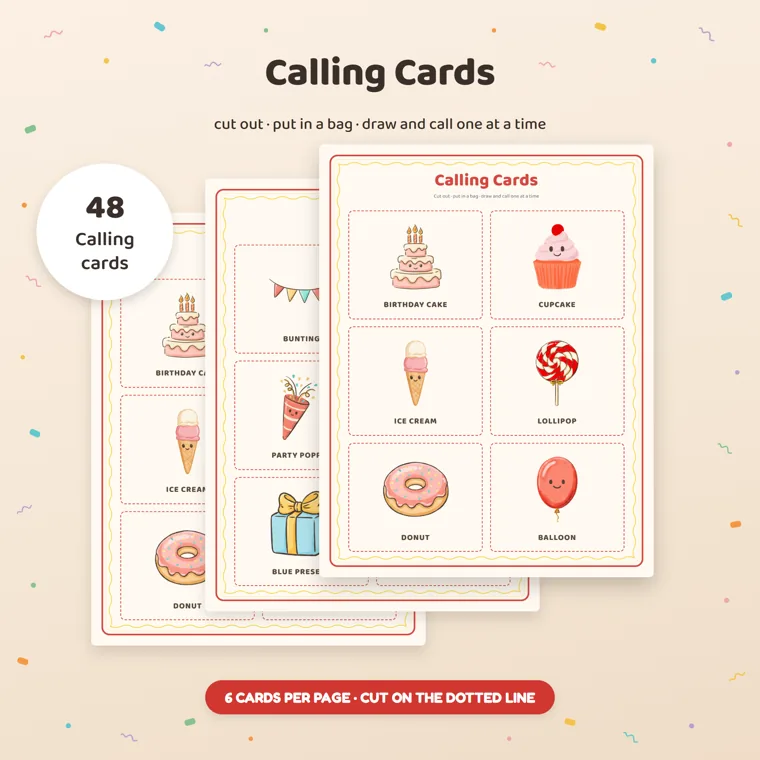
Index cards cut in half work well for a hand-drawn set, or the folded slips from Step 3. In a spreadsheet, print the sorted word list on its own page, then cut it into strips or keep it whole as the caller’s checklist.
The caller also needs a record of what’s been drawn. Keep the drawn cards in a separate pile or tick each word off the printed list. That record is how you check a claimed bingo and settle a tie.
Six-to-a-page sheets have one easy miss. A 25-word deck fills four pages and leaves a single card alone on the fifth. Our Birthday Bingo calling cards end that way, with the teddy bear by itself on the last page. Count the deck against the word list before the first game.
Step 5: Print, cut and test the set
Print the player cards on cardstock if you plan to reuse them. Regular paper is fine for a one-time party, and a sheet protector turns any card into a dry-erase card. Check whether your printer tray holds US Letter or A4 before you set the grid size; the Letter vs A4 guide shows how to tell.
Markers can be anything flat. Paper circles, coins, buttons and dried beans all work. Small pieces need an adult watching whenever a toddler is at the table, because they’re a choking risk.
Play one silent test game before the players arrive. Draw every calling card in turn and check three things:
- Every word on the cards came up at least once.
- No calling card names a word that’s on none of the cards.
- No card repeats a word.
A spelling mismatch counts as a missing word. “Sea horse” on the cards and “seahorse” in the deck look like the same word to you, and a young reader will see them as different.
Then decide which shape wins before the first call. One line suits a first round; a full card works only when your list is long enough to separate the players. The bingo patterns guide has twelve shapes, from four corners to a picture frame, with notes on which ones run long.
When a ready-made set is the faster route
Homemade cards are best when the words are yours, like a class vocabulary list or the names of family members at a reunion. For a theme that already exists, a printable set skips the shuffling and the test game.
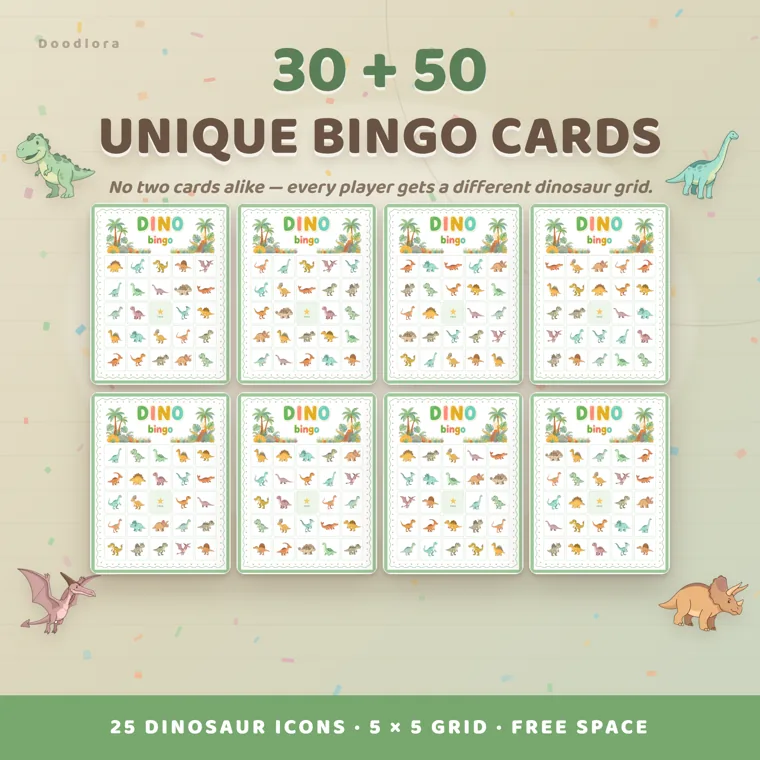
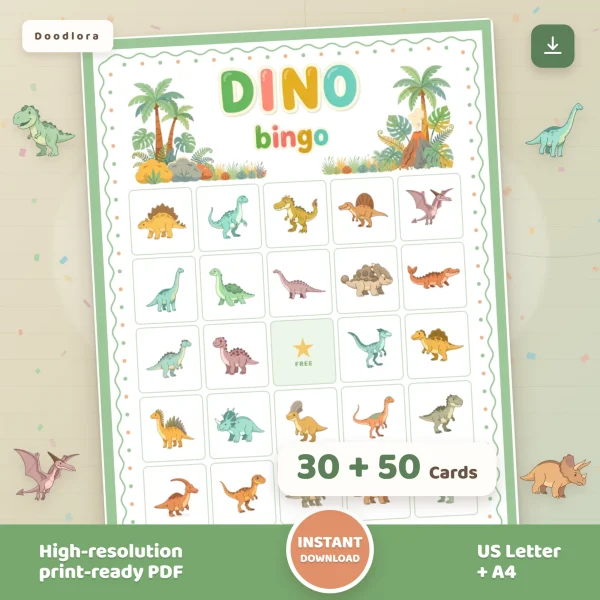
Our bingo sets each come as a 30-card file and a 50-card file with no layouts shared between them, plus calling cards and a sheet of paper markers. The Dinosaur Bingo set uses 25 dinosaurs, so it plays fast. The birthday party set uses 48 pictures, and its cover page is marked for ages 3 to 10.
Either way, a homemade set works on the same three rules: a longer word list than the grid, a fresh shuffle for every card, and one calling card for each word. Get those right and the rest is just picking the prize.
Printables from this article
Related articles
Printable Bingo Cards
Space Activities for Preschoolers: Games, Hunts & Moon Watch
Eleven hands-on space activities for three- to five-year-olds, sorted by situation, with group size, prep, how to start and finish, plus a five-day plan.
Printable Bingo Cards
Space Facts for Kids: Our Solar System, Moon and Stars
The Sun, Mercury to Neptune, the Moon, the stars and life on the space station, with NASA's numbers and simpler lines for preschoolers and early readers.
Printable Bingo Cards
Dinosaur Activities for Preschool: Games, Crafts & Fossils
Thirteen dinosaur activities for three- to five-year-olds, from ice eggs and sand digs to circle-time games, plus dinosaur facts that hold up and fixes for the usual snags.