Bingo Patterns: 12 Shapes and Types of Bingo Games
A bingo pattern is the shape a player has to cover to win, and the caller announces it before the first picture is drawn. One line ends a round fastest. Four corners, two lines, an X, the letters T and L, a picture frame and a full card each need more calls.
On a five-by-five card, the number of squares matters more than the shape. An X, a plus sign and a letter T all need eight pictures, so they finish at almost the same call. The shape doesn’t change the length.
The table below sorts the twelve patterns from quick to long for a party or a classroom. After it come the patterns one by one, with instructions for showing and checking each, then the main types of bingo games and how they differ.
Pick a bingo pattern by group size and time
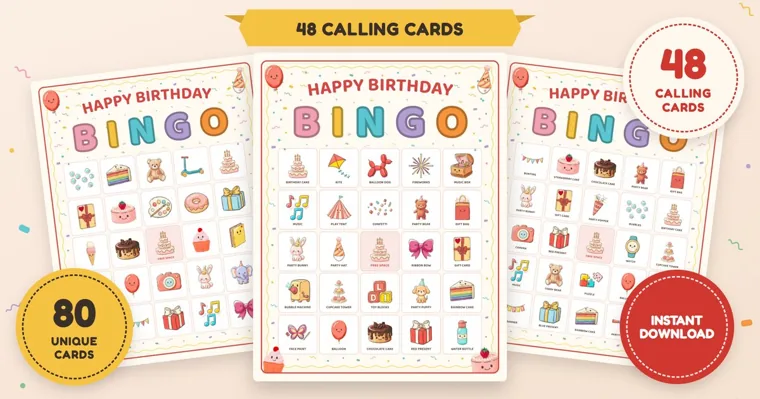
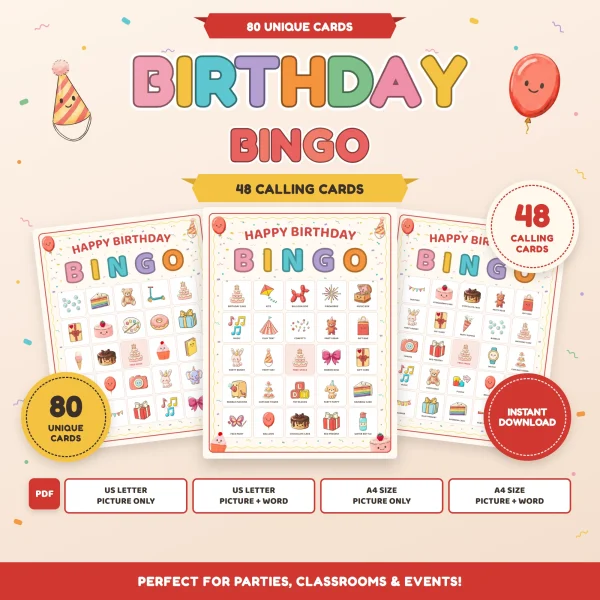
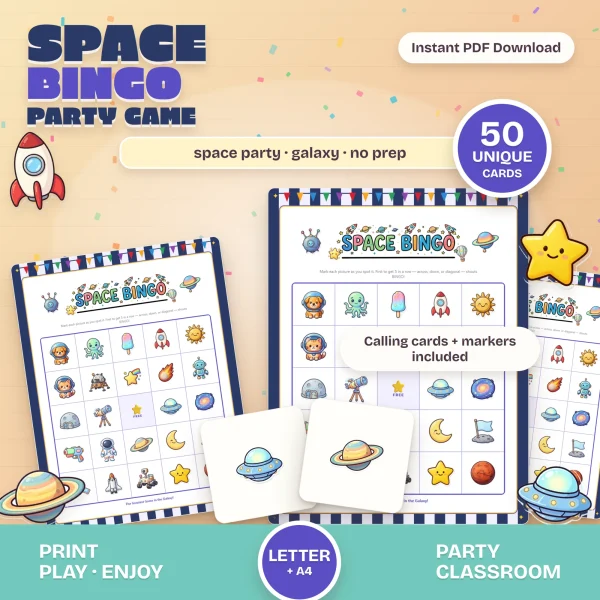
Start with how many rounds you want to fit in and how big the picture deck is. The two middle columns show the call that usually ends a round with ten players. We got them from a computer simulation, 20,000 rounds of each pattern against real card layouts from two of our sets. Space Bingo draws from 25 pictures, and Birthday Party Bingo draws from 48.
| Pattern | Pictures to call | Uses FREE? | 25-picture deck, 10 players | 48-picture deck, 10 players | Good for |
|---|---|---|---|---|---|
| One line | 4 or 5 | Sometimes | Call 10 | Call 17 | A first round, preschoolers |
| Hard-way line | 5 | Never | Call 11 | Call 20 | A second round with the same kids |
| Postage stamp | 4 | No | Call 11 | Call 19 | A quick change from lines |
| Four corners | 4 | No | Call 14 | Call 25 | One prize, fewest shared wins |
| Two lines | 8 to 10 | Sometimes | Call 14 | Call 25 | A bigger prize round |
| X | 8 | Yes | Call 19 | Call 36 | Kids who can follow a diagonal |
| Plus | 8 | Yes | Call 19 | Call 36 | The same length as X, easier to see |
| Letter T | 8 | Yes | Call 19 | Call 36 | Kids who know their letters |
| Letter L | 9 | No | Call 20 | Call 37 | Kids who know their letters |
| Inside square | 8 | Yes | Call 19 | Call 36 | Mixed ages at one table |
| Picture frame | 16 | No | Call 23 | Call 42 | The last round, big decks only |
| Full card | 24 | Yes | Call 25 | Call 45 | The last round, big decks only |
With 25 players, every row ends a few calls sooner. One line drops to about call 8 on the small deck and call 14 on the big one, and an X to calls 18 and 32. How that converts into minutes depends on the caller’s pace. Time the first five calls and multiply.
Whichever pattern you pick, the calling itself doesn’t change. Drawing, calling and settling a tie are all in our printable bingo rules, so this page sticks to the shapes.
Why the same bingo pattern runs short on a 25-picture deck
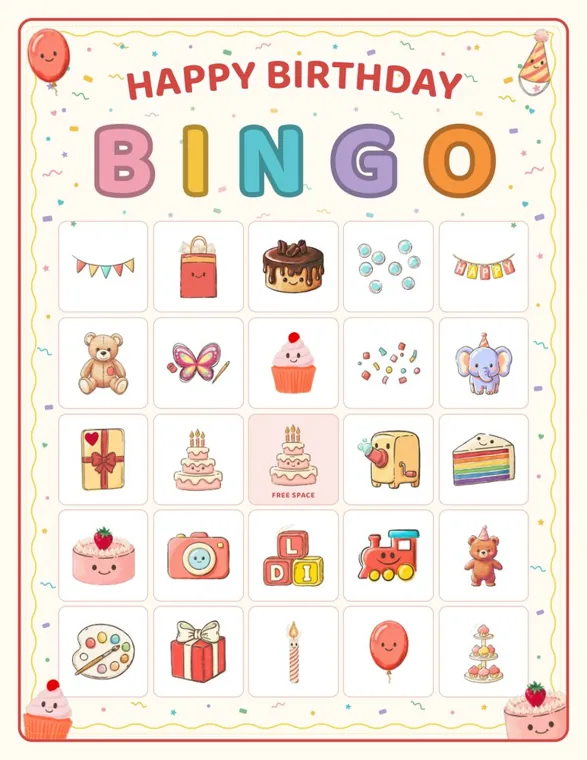
Deck size explains the difference between the two columns. Each Space Bingo card shows 24 of the deck’s 25 pictures, so nearly every call covers a square on every card in the room. Each Birthday Party Bingo card also shows 24 pictures, but they come from a deck of 48. About half the calls miss any one card.
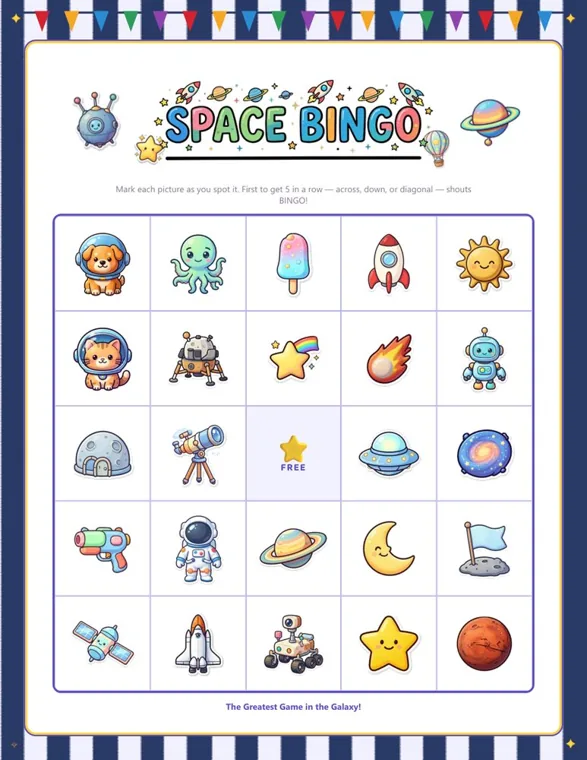
That small deck is great for a line with little kids. Everyone covers something on almost every call, and the excitement stays high. It’s a poor fit for long ones. A picture frame on Space Bingo usually ends at call 23 of 25. A full card usually ends on the last calling card. In our simulation with ten players on the first ten labeled Space Bingo cards, two or more finished together in about two games out of three. That share depends on which cards are in play. The rules page counts eight players on a safari set and gets closer to nine in ten.
On the 48-picture deck, the long shapes have room to build. An X takes about 36 calls, and shared wins stay around one game in ten for everything short of the frame and the full card.
So match the pattern to the set. A 25-picture deck comfortably handles lines, corners and the eight-picture shapes. Save the frame and the full card for a deck of 40 pictures or more.
Quick bingo patterns for young kids and a first round
These three are the quickest patterns in the table, so a group of four-year-olds can finish a round before their attention drifts. They also leave time for a second and third round with a small prize each.
One line
Cover five squares in a row: a horizontal row, a vertical column or a diagonal from corner to corner. A five-by-five card has twelve lines, and the four that run through FREE need only four pictures called. A round usually ends around call 10 on a 25-picture deck and call 17 on a 48-picture deck.
To check a claim, have the player point to each picture in the line and match it against the called cards. Diagonals are the hardest line for preschoolers to spot. For them, announce “across or down only” before the first draw.
Postage stamp
Cover a two-by-two block in a corner of the card. The version on Wikipedia uses the upper-right corner, and letting any of the four corners count makes the round faster. With any corner allowed, it ends around call 11 on the small deck and call 19 on the big one.
Kids sometimes cover four squares around FREE and call it a stamp. Show the four corner blocks on a spare card first, especially for younger players. FREE never touches a stamp, so it’s no help here.
Four corners
Cover the four corner squares. Nothing else counts. It needs just four pictures, but they have to be those particular four, so it runs longer than a line: about call 14 on the small deck and call 25 on the big one. Wikipedia lists it as a commonly valid pattern in American bingo.
Four corners had the fewest shared wins of any pattern in our simulation, about one game in twenty with ten players on the 48-picture deck. That makes it the pick when there’s only one prize. Checking is straightforward. There are only four squares to read back, so the celebration starts immediately.
Bingo patterns for a second round: hard-way line and two lines
Once the group knows how to cover a line, these two stretch the round without introducing a new shape. Both end around the halfway point of a 48-picture deck or sooner.
Hard-way line
A hard-way bingo is a straight line that doesn’t use the FREE square. Only eight of the twelve lines count: the four rows and four columns that miss the center. Each needs five pictures, so the round runs a call or three longer than a plain line. Expect about call 11 on the small deck and call 20 on the big one.
The usual slip is a player claiming the middle row. Before the draw, tell everyone that the middle row, the middle column and both diagonals don’t count this round. Leaving FREE uncovered throughout the round helps young players see which lines are still live.
Two lines
Cover any two complete lines on the same card. They may cross, and two lines that cross share one square. Depending on where they run and whether one uses FREE, that’s eight to ten pictures. A round ends around call 14 on the small deck and call 25 on the big one.
Two lines produces the most shared wins of the short patterns. On Space Bingo, about three games in ten with ten players end with two winners on the same call, so decide your tie rule beforehand. It’s also one of the standard prizes in 90-ball bingo, so anyone who knows the British game will recognize it.
Bingo shapes built around the FREE square: X, plus and inside square
All three need eight pictures and all three use FREE, which is why they end together: about call 19 on a 25-picture deck and call 36 on a 48-picture deck. Choose among them by what the players can see on their cards, not by speed.
X
Cover both diagonals, corner to corner each way, crossing at FREE. That’s nine squares: all four corners, the four squares diagonally next to FREE, and FREE itself.
| B | I | N | G | O |
|---|---|---|---|---|
| ■ | □ | □ | □ | ■ |
| □ | ■ | □ | ■ | □ |
| □ | □ | ■ | □ | □ |
| □ | ■ | □ | ■ | □ |
| ■ | □ | □ | □ | ■ |
The trap is a player who completes one diagonal and shouts. That’s a normal line win in every other round, so the confusion is understandable. Say “both diagonals” when you announce it and hold up a spare card with the X marked. To check, read the four pictures on each diagonal.
Plus
Cover the whole middle row and the whole middle column, which is the N column. They cross at FREE, so it’s nine squares and eight pictures.
| B | I | N | G | O |
|---|---|---|---|---|
| □ | □ | ■ | □ | □ |
| □ | □ | ■ | □ | □ |
| ■ | ■ | ■ | ■ | ■ |
| □ | □ | ■ | □ | □ |
| □ | □ | ■ | □ | □ |
It’s the same length as an X, but it’s easier for young kids to see. The shape follows the rows and columns they already know, and everything sits in the middle of the card. Checking means reading eight pictures, four on each arm.
Inside square
Cover the eight squares that ring FREE, and leave the outer edge completely alone. Players sometimes cover the outer ring by mistake. That’s a different pattern, the picture frame. Show it on a spare card and point to the middle. It suits a table of mixed ages, since the block is easy to find even when a small child can’t track a diagonal.
Letter bingo patterns: T and L
Letters suit early readers, and they make a good kindergarten or first-grade round, since a teacher can draw the letter on the board. On Birthday Party Bingo, the big B, I, N, G and O letters above the grid sit over the five columns. That makes “the B column” easy to point to.
Letter T
Cover the top row and the middle column below it. That’s eight pictures, because the middle column passes through FREE.
| B | I | N | G | O |
|---|---|---|---|---|
| ■ | ■ | ■ | ■ | ■ |
| □ | □ | ■ | □ | □ |
| □ | □ | ■ | □ | □ |
| □ | □ | ■ | □ | □ |
| □ | □ | ■ | □ | □ |
It ends with the X and the plus, about call 19 on the small deck and call 36 on the big one. Checking means reading five across the top and three down the stem.
Letter L
Cover the left column and the bottom row. It’s nine pictures and doesn’t use FREE, so it runs about a call longer than the T. Wikipedia describes a roving L that covers all the B’s plus either the top or the bottom row. Allowing either one shortens the round only slightly.
For kids still learning letters, draw the L the way it faces on the card. A backward L on the board leads to a round of wrong claims.
Long bingo patterns for the last round: picture frame and full card
These two use up most of the deck, so play them last and only with a big deck. On a 25-picture set, the round is almost over before anyone can win.
Picture frame
Cover all sixteen squares around the outside edge. FREE plays no part. It’s the only long pattern with no head start. It ends around call 42 of 48 on Birthday Party Bingo, with two or more winners in about one game in five. On Space Bingo it ends around call 23 of 25, and shared wins climb past one game in three.
Full card
Cover every square, also called a blackout or cover-all. That’s all 24 pictures, with FREE already covered. On a 48-picture deck it ends around call 45, and about one game in three still finishes with a shared win. On a 25-picture deck it usually ends on the very last calling card. The printable bingo rules page explains why that happens and how to break the tie.
Types of bingo games: 75-ball, 90-ball and picture bingo
When people ask about types of bingo games, they often mean the card. The patterns above were drawn for one kind of card, and only some of them carry over to the others.
75-ball bingo
The American game uses the numbers 1 through 75 on a five-by-five card. Columns are labeled B, I, N, G and O, running from 1 to 15 under B up to 61 to 75 under O. The center square is free. Every pattern in this article comes from this card, so all twelve work on it as drawn.
90-ball bingo
The British ticket has three horizontal rows and nine columns. Each row holds five numbers and four blanks, fifteen numbers in all. The prizes go to one line, two lines and a full house, meaning all fifteen numbers. Four corners exists there too, as the end numbers of the top and bottom lines. Shapes like the X, plus and letters don’t fit a three-row ticket.
Picture bingo and homemade cards
Picture bingo swaps the numbers for pictures. That makes it accessible to kids who can’t read numbers yet. Both our Birthday Party Bingo and Space Bingo cards use the 75-ball grid with a free center, so all twelve patterns fit. The difference is the deck, 25 or 48 pictures instead of 75 numbers. That’s why rounds end sooner and ties come more often.
Homemade cards are often three-by-three for young kids, like the Christmas bingo in our Christmas games for kids. On that grid, a line is three squares, the X, plus, T and L each need five, and there’s no inside square. A picture frame covers eight of the nine squares, so call it a full card instead.
One game, several prizes
Wikipedia notes that a single game often has more than one bingo. The British order of line, two lines and full house works on any card. Keep the markers on after each win and play on toward the next pattern. On a 48-picture deck, one bag gives a line around call 17, two lines around call 25 and a full card near the end. That’s three prizes from one round for a competitive holiday crowd like the ones in our Christmas party games.
Announcing a bingo pattern and checking a claim
Announce the pattern before every round, even when it hasn’t changed. Show it rather than only saying it. A spare card with markers on the shape, the letter on a whiteboard or the pattern sheet above all work.
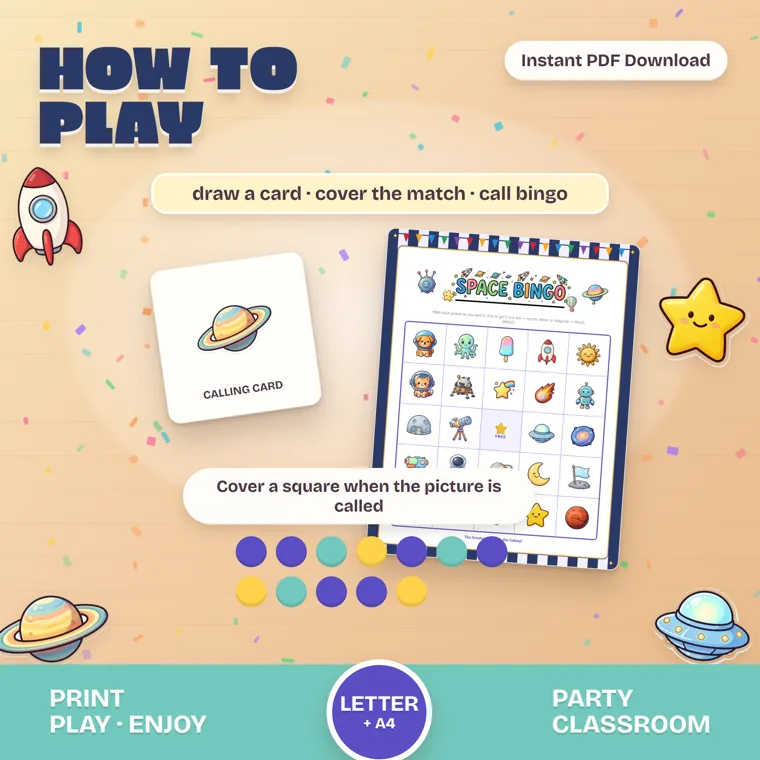
Watch the instructions printed on the card itself. Each Space Bingo card says to get five in a row across, down or diagonal. The how-to-play page in both sets lists only a line, four corners or a full card. A child who reads the card will shout on a line during an X round. Tell the group the card shows the everyday rule, and today’s announcement replaces it.
To check a claim, count the squares in the shape. The table at the top gives the number of pictures each pattern needs, and FREE counts only where the table says yes or sometimes. If any picture in the shape hasn’t been called, the marker comes off and play goes on. When two players shout on the same call, check each card individually before anyone draws again.
More picture decks, including bigger ones for the long patterns, are in our bingo sets. The rest of the Doodlora Studio printables are on the home page.
Printables from this article
Related articles
Printable Bingo Cards
Space Activities for Preschoolers: Games, Hunts & Moon Watch
Eleven hands-on space activities for three- to five-year-olds, sorted by situation, with group size, prep, how to start and finish, plus a five-day plan.
Printable Bingo Cards
Space Facts for Kids: Our Solar System, Moon and Stars
The Sun, Mercury to Neptune, the Moon, the stars and life on the space station, with NASA's numbers and simpler lines for preschoolers and early readers.
Printable Bingo Cards
Dinosaur Activities for Preschool: Games, Crafts & Fossils
Thirteen dinosaur activities for three- to five-year-olds, from ice eggs and sand digs to circle-time games, plus dinosaur facts that hold up and fixes for the usual snags.