Forest Animals: Woodland Animals List With Facts
The forest animals most kids in the United States and Canada can actually meet are white-tailed deer, black bears, red foxes, raccoons, striped skunks, gray squirrels, chipmunks, cottontail rabbits, opossums, owls, woodpeckers, wild turkeys, blue jays, wood frogs, salamanders, box turtles and fireflies.
They share the same temperate woodland, a forest of trees that drop their leaves each winter, but they don’t share the same spot in it. Some live high in the treetops, some in the shrubs, and many on or under the forest floor. Most of them are also out at dawn, dusk or night, which is why a daytime walk in the woods can feel empty.
The list below covers 31 woodland animals. Each entry says what the animal looks like, where it lives, what it eats and when it is active, so a child can write a fact card or you can answer the next question at the trail head. The facts come from each species’ Wikipedia page, and the safety rules come from the National Park Service.
Woodland animals list at a glance
Start here if you only need a quick answer. The table sorts each animal by where in the forest you’d look and when it is usually active.
| Animal | Group | Where to look | Active |
|---|---|---|---|
| White-tailed deer | Mammal | Forest floor and edges | Dawn and dusk |
| American black bear | Mammal | Forest floor | Any time, forages mostly at night |
| Red fox | Mammal | Forest floor and edges | Hunts mostly at night |
| Raccoon | Mammal | Forest floor, trees near water | Night |
| Striped skunk | Mammal | Forest floor | Night |
| Eastern gray squirrel | Mammal | Canopy and forest floor | Day, plus dawn and dusk |
| Eastern chipmunk | Mammal | Forest floor | Day |
| Eastern cottontail | Mammal | Edges and shrubs | Dawn and dusk |
| Virginia opossum | Mammal | Forest floor and low trees | Night |
| North American porcupine | Mammal | Trees and forest floor | Night |
| Bobcat | Mammal | Forest floor | Dawn and dusk |
| North American beaver | Mammal | Streams and ponds | Night |
| North American river otter | Mammal | Rivers and ponds | Varies |
| Moose | Mammal | Northern forests, wet areas | Varies |
| Gray wolf | Mammal | Northern and western forests | Varies |
| Great horned owl | Bird | Canopy | Night |
| Barred owl | Bird | Canopy | Night |
| Pileated woodpecker | Bird | Tree trunks | Day |
| Wild turkey | Bird | Forest floor, roosts in trees | Day |
| Blue jay | Bird | Canopy and shrubs | Day |
| Black-capped chickadee | Bird | Shrubs and canopy | Day |
| Wood frog | Amphibian | Forest floor, spring pools | Day |
| Spotted salamander | Amphibian | Underground burrows, spring pools | After rain |
| Eastern box turtle | Reptile | Forest floor | Day |
| Common garter snake | Reptile | Forest floor and edges | Day |
| Luna moth | Insect | Canopy | Night |
| Firefly | Insect | Shrubs and grass at the edge | Twilight |
| Millipede | Other invertebrate | Under leaf litter | Mostly hidden |
| European hedgehog | Mammal (not in North America) | Woodland floor and gardens | Night |
| European badger | Mammal (not in North America) | Burrows in woodland | Night |
| Hazel dormouse | Mammal (not in North America) | Shrubs and branches | Night |
“Varies” means the species page doesn’t give one simple daily pattern, so the table leaves it open rather than guess.
The three forest layers
A temperate forest has three layers that matter for finding animals. The canopy is the roof of leaves formed by the tallest trees, and in summer it shades nearly everything below. Under it is a shrub layer, or understory, of young trees and bushes. The forest floor is the bottom layer of leaf litter, logs and soil. Wikipedia’s page on temperate deciduous forests notes that many animal species hibernate or migrate in winter, so the same patch of woods holds fewer active animals in January than in June.
The forest floor is also where kids can collect leaves, acorns and pinecones without bothering any animal, and our nature crafts turn those finds into projects.
Forest mammals
Mammals are the animals kids name first, and most of the ones below live across the eastern half of North America. The cartoon versions in picture books make them look small and friendly, but several are large, and all of them are wild.
White-tailed deer
The white-tailed deer has a reddish-brown coat in spring and summer that turns gray-brown in fall and winter, and a tail that is white underneath. It is the most widely distributed hoofed plant-eater in the Americas. Deer eat leaves, twigs, acorns, fruit and farm crops such as corn. They are crepuscular, which means most active at dawn and dusk, and they rest on and off through the day and night.
American black bear
The black bear is the smallest and most widespread bear in North America, and it lives mainly in forests. Despite the name, its coat can be brown or cinnamon as well as black. It is an omnivore whose diet changes with the season and the place, from plants and nuts to insects and meat. Black bears can be active at any time of day or night, but they mostly forage at night.
Red fox
The red fox has a rusty-red coat and a bushy tail, and it is found across the whole Northern Hemisphere, including most of North America. It feeds mainly on small rodents but also catches rabbits, squirrels, birds and insects, and it eats fruit. Red foxes do much of their hunting at night. They have also settled into many suburbs and cities, so a fox crossing a backyard at dusk is not unusual.
Raccoon
A raccoon has a black mask across its eyes and a ringed tail, and its body is about 16 to 28 inches (40 to 70 cm) long. It is usually nocturnal and eats almost anything. Wikipedia breaks its diet down as about 40% invertebrates, 33% plants and 27% vertebrates. In the woods, raccoons stay near water and trees, and they climb well.
Striped skunk
The striped skunk is black with white stripes down its back, and it lives across southern Canada, the United States and northern Mexico. It is mostly nocturnal. It eats mainly insects but adds small animals and plants when it can. Few predators bother a skunk except birds of prey, and the great horned owl is one of the few that hunt it regularly.
Eastern gray squirrel
The eastern gray squirrel is the gray, bushy-tailed squirrel of eastern North America. It builds round leaf nests called dreys, about 12 to 24 inches (30 to 60 cm) across, high in the trees and lines them with moss, grass and feathers. It buries nuts and forgets some of them, which makes it one of the forest’s most important tree planters. Gray squirrels are active by day or at dawn and dusk depending on the season, and they avoid the midday heat in summer.
Eastern chipmunk
The eastern chipmunk is a small ground squirrel with stripes along its back and face, found in eastern North America. It spends most of its day foraging on the forest floor for nuts and seeds. Chipmunks are mainly active during the day. In winter they may go into long periods of hibernation.
Eastern cottontail
The eastern cottontail is the most widespread rabbit in North America, a brown rabbit with a fluffy white tail. It eats grasses, herbs, twigs and bark, and it likes places where it can feed in the open and dash back to cover. It is crepuscular and active year-round because it does not hibernate. Foxes, hawks and owls all hunt it.
Virginia opossum
The Virginia opossum is about the size of a house cat and is the northernmost marsupial in the world, which means females carry their young in a pouch. It is solitary, nocturnal and an opportunist that eats whatever it finds. “Playing possum,” going limp when threatened, is the behavior it is known for.
North American porcupine
The porcupine is a large rodent covered in quills, and it is the second-largest rodent in North America after the beaver. It is a plant-eater. In summer it eats twigs, roots, stems, fruits and leaves. Porcupines are nocturnal and do not hibernate, but they stay close to their dens through the winter.
Bobcat
The bobcat is a wild cat with black bars on its front legs and a short, black-tipped “bobbed” tail that gives it its name. It ranges from southern Canada through most of the lower 48 states to Mexico. It prefers rabbits and hares but also hunts birds, insects and other small animals. It is crepuscular, active mostly at twilight, which makes it one of the hardest forest animals to spot.
North American beaver
The beaver has a broad, flat tail and large front teeth for gnawing through trees. It lives along streams and ponds in the forest, where it builds a lodge of sticks with underwater entrances. Beavers eat bark and woody plants, and their gut is built to digest them. They are active mainly at night, so you are more likely to see a chewed stump than the beaver itself.
North American river otter
The river otter is a sleek, semiaquatic mammal that lives along rivers, lakes and coastal marshes across most of Canada and the United States. It uses its long whiskers to find prey in dark water. It hunts in the water and eats fish and other aquatic animals.
Moose
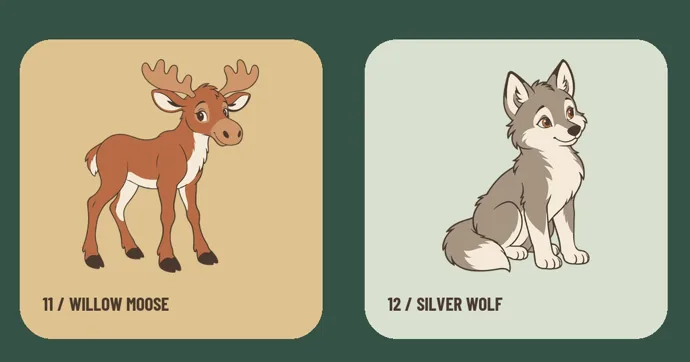
The moose is the tallest and heaviest deer in the world, and most adult males grow broad, flat antlers. It lives in northern forests, often near water. A moose is a browser. It eats land and water plants in summer, and branches and twigs make up much of its winter diet.
Gray wolf
The gray wolf is the largest wild member of the dog family, and in North America it lives mainly in northern and western forests. It is a carnivore and top predator that hunts large hoofed animals such as deer and moose, as well as smaller animals. A pack of wolves is one of the few threats to a moose, especially to a mother with a calf.
Forest birds
Birds are the forest animals you are most likely to hear before you see. Listen at dawn on a spring morning and the canopy is full of calls.
Great horned owl
The great horned owl is a large owl with two feather tufts on its head that look like horns. It is the most widely distributed true owl in the Americas. It eats mostly rabbits, hares, rats, mice and voles, and it is one of the few regular predators of skunks. It hunts at night. Its ear openings sit at slightly different heights on each side of its head, which helps it pinpoint prey by sound in the dark.
Barred owl
The barred owl is a large gray-brown owl of North American forests, nicknamed the “hoot owl.” It eats mainly small mammals but will also take birds, reptiles, amphibians and insects. Like the great horned owl, it hunts at night, usually from a perch with a short flight down to its prey.
Pileated woodpecker
The pileated woodpecker is a crow-sized woodpecker with a bright red crest, a white stripe down its neck and a mostly black body. It is the largest woodpecker in North America and lives in deciduous forests in the east, the Great Lakes, Canada’s northern forests and parts of the Pacific Coast. It eats insects that live inside trees. Its nearly rectangular holes in dead trunks are easier to find than the bird.
Wild turkey
The wild turkey is the heaviest bird of its group and the ancestor of the farm turkey. It forages on the ground and climbs into shrubs and small trees to feed, eating seeds, nuts, grasses, insects and small animals. Turkeys feed during the day and fly up into trees to roost at night.
Blue jay
The blue jay is a bright blue bird with a crest, native to eastern North America. It eats mainly seeds and nuts, especially acorns, and hides some to eat later. It also eats soft fruit and insects. Blue jays are active during the day and are loud, so you’ll often hear one first.
Black-capped chickadee
The black-capped chickadee is a small bird with a black cap, a black bib and white cheeks. It lives year-round in deciduous and mixed forests and does not migrate. It eats insects and seeds and stores food to eat in winter. Its “chick-a-dee-dee-dee” call is a warning, and more “dee” notes mean a bigger threat nearby.
Forest amphibians and reptiles
These animals live low, close to damp leaves and water. Kids find them by spotting a frog on the path, not by looking up.
Wood frog
The wood frog is a small brown, tan or rust-colored frog with a dark mask across its eyes, found from the northern forests of Canada down to the southern Appalachians. It breeds in spring pools, called vernal pools, and spends the rest of the year on the forest floor. It is mostly active during the day. It is also famous among biologists because it can survive being frozen through the winter and thaw out in spring.
Spotted salamander
The spotted salamander is a dark salamander with two rows of yellow spots, native to the eastern United States and Canada. It eats earthworms, slugs, snails, spiders, millipedes and insects. It spends most of the year underground, often in burrows dug by small mammals, and rarely comes up except after rain. In spring, after rain and once temperatures rise above 40°F (4°C), spotted salamanders come out together and cross to vernal pools to breed, an event known as the Big Night.
Eastern box turtle
The eastern box turtle is a land turtle with a hinged shell that it can close tight. It lives in the eastern United States. It is an omnivore that eats both plants and small animals, and its taste varies from one turtle to the next. Busy roads are one of its biggest threats, so a turtle on a road is a common sight in spring.
Common garter snake
The common garter snake usually has yellow stripes on a black, brown or green body, and it is found across most of North America. It is active during the day and eats mainly amphibians and earthworms. In colder areas, garter snakes spend the winter together in dens. If you see one, watch it from where you are and let it move on.
Forest insects and other small animals
Small animals are the easiest to find in a forest and the most often left off woodland animals lists. Turning over leaf litter with a stick shows a whole community.
Luna moth
The luna moth has lime-green wings with long tails and a white body, and its wingspan is about 4.5 inches (114 mm). It lives in North America east of the Great Plains. Adult luna moths don’t eat at all. They live only 7 to 10 days and fly at night, which is why so few people see one.
Firefly
Fireflies are beetles, not flies, and there are more than 2,400 species. Many make light, mainly at twilight, to attract mates. Their larvae feed through the summer, and most fireflies spend the winter as larvae. Look for them over grass at the edge of a forest on early summer evenings.
Millipede
A millipede is a long, many-segmented animal with two pairs of legs on most body segments. Most millipedes eat decaying leaves and wood on the forest floor, so they help turn fallen leaves back into soil. They live under leaf litter and logs and are easy to find by gently lifting a log and putting it back exactly as it was.
Storybook woodland animals that live in Europe
Many woodland animals in picture books, coloring books and clipart sets aren’t North American at all. Three show up again and again.
European hedgehog
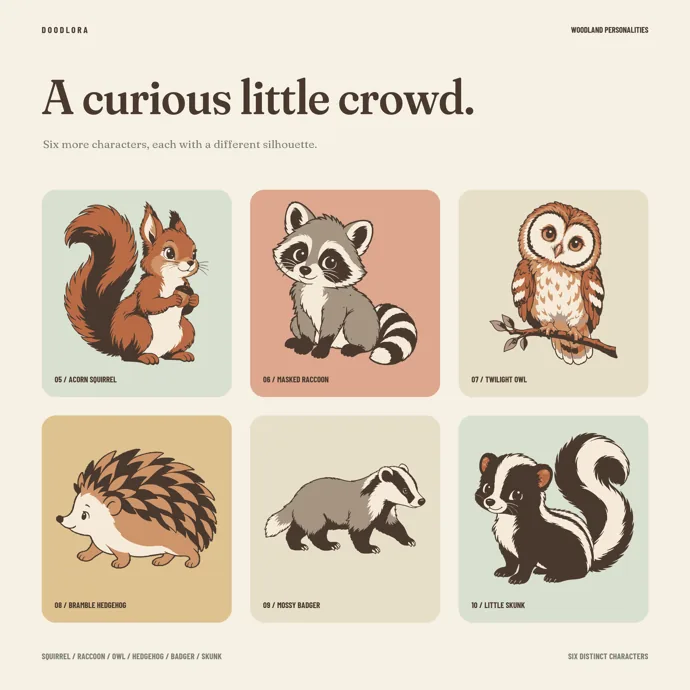
The European hedgehog is a small spiny mammal native to Europe, from Spain and Italy up to Scandinavia. It is largely nocturnal and eats insects. In colder places it may hibernate through the winter. There are no wild hedgehogs in North American forests.
European badger
The European badger has a gray body and a black-and-white striped face, and it is native to Europe and parts of Asia. It is nocturnal and social, living in burrow systems called setts. It eats earthworms, large insects, small mammals and plant foods such as grains and roots.
Hazel dormouse
The hazel dormouse is a small golden-brown rodent native to northern Europe and Asia Minor. It weighs about 17 to 20 grams (0.6 to 0.7 ounces) and nearly doubles that before hibernation. It is nocturnal and spends its waking hours in the branches looking for food. A hazelnut with a neat, round hole in the shell is a sign one has been feeding.
If you teach North American habitats, this is a useful trap to point out. A child who colors a hedgehog for a “forest near us” poster has learned the picture, not the habitat.
How to watch forest animals safely
Watch from a distance and leave them alone. That one rule protects both kids and animals. The National Park Service says many parks require visitors to stay at least 25 yards from most wildlife and 100 yards from predators such as bears and wolves. Some parks set their own distance, and in Great Smoky Mountains National Park it is illegal to approach within 50 yards of a black bear on purpose.
The Park Service also says it is illegal in national parks to feed, touch, tease, frighten or intentionally disturb wildlife. Feeding is the rule kids most often want to break, so explain why: an animal that learns people mean food can become aggressive, and that animal may have to be removed or killed. Keep picnic crumbs and trash packed away for the same reason.
A few habits help on a family walk or a class trip:
- Bring binoculars. If an animal changes what it is doing because of you, you are too close. The Park Service’s line is that if you are close enough for a selfie, you are definitely too close.
- Stay on the trail and keep dogs leashed. Most parks set a 6-foot leash rule.
- Look at small animals where they are. A frog, salamander or turtle stays in its spot; lift a log only to look, then set it back.
- Use photos, not cartoons, to identify animals. The clipart and coloring pages below are cartoon babies with big eyes. They are for coloring and games, not for telling a wolf from a coyote.
For a structured walk, our nature scavenger hunt ideas include a look-only list of finds kids can check off without picking anything up.
Forest animal activities for kids at home and in class
These four activities use the list above plus printable pages. Each one says who it is for, how many kids, how long it takes, what to prepare and how to wrap it up. Times are planning estimates.
| Age | Activity | Kids | Time | You need |
|---|---|---|---|---|
| 3 to 5 | Forest animal coloring chart | 1 to 6 | 15 to 20 min | Coloring pages, crayons |
| 5 to 7 | Day, night or twilight sort | 4 to 6 per group | 20 min | Clipart cards, three labeled mats |
| 8 to 11 | Animal fact cards | 1 per animal, whole class | 40 min | One-color clipart, index cards, this list |
| 10 and up | Fuse bead forest animal | 1 or 2 | Several sessions | Fuse bead chart, beads, pegboards, an adult with an iron |
Ages 3 to 5: a forest animal coloring chart
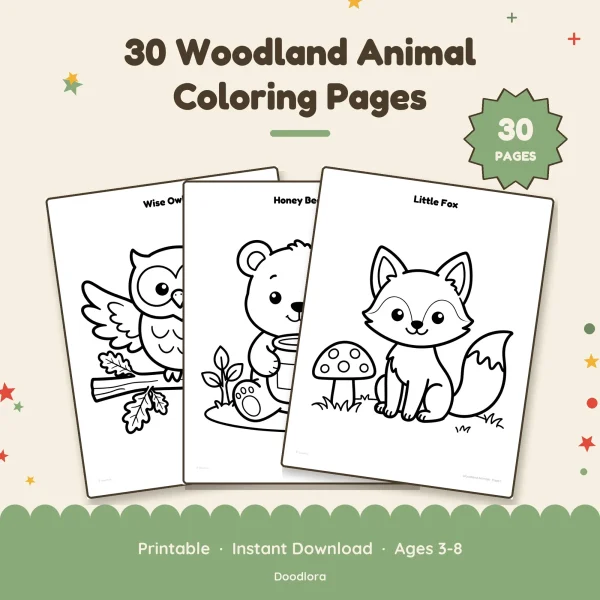
Young kids learn names best one animal at a time. Our woodland animals coloring book gives each of ten animals a page of its own first: a fox, a deer, an owl, a rabbit, a bear, a squirrel, a hedgehog, a raccoon, a badger and a mouse. Later pages put the same animals into bigger forest scenes, from Deer by the Stream to Goodnight, Forest.
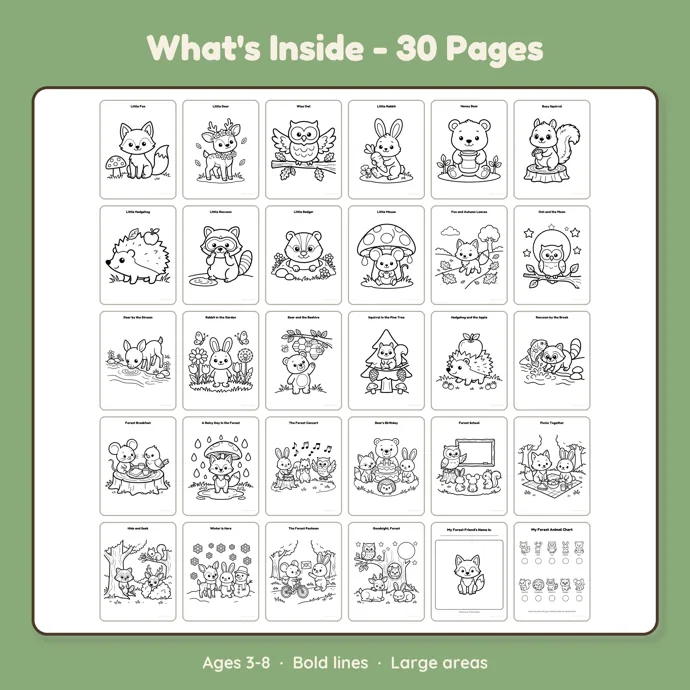
For one child or a group of up to six, print the single-animal pages for the animals you want to talk about and the chart on the last page. Let each child color one animal while you read its entry from the list above, then color its circle on the chart.
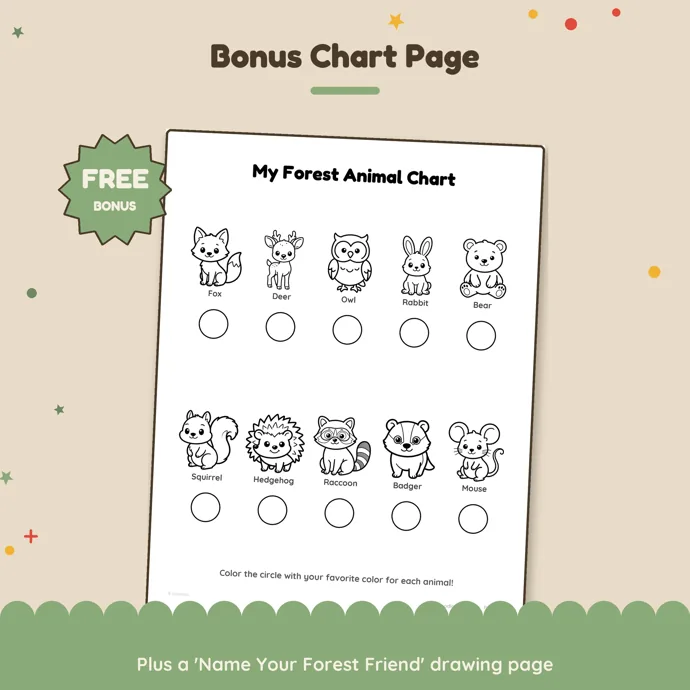
End by asking each child to point to one animal and tell you one thing: where it sleeps, or whether it comes out at night. The catch is the hedgehog and badger on the chart. Use them to explain that some forest animals live far away, in Europe.
Ages 5 to 7: day, night or twilight sort
This sorting game teaches when animals are active, which is the fact kids find most surprising. Print the 16 animals from our woodland animals clipart in color: a red fox, a fawn, a bear cub, a rabbit, a squirrel, a raccoon, an owl, a hedgehog, a badger, a skunk, a moose calf, a wolf pup, a beaver, a chipmunk, a sleeping dormouse and an otter. An adult cuts the cards out ahead of time, or kids use child-safety scissors. Lay out three mats labeled Day, Night and Dawn and Dusk.
Groups of four to six take turns drawing a card and placing it on a mat, then you check it against the table at the top of this page. Plan about 20 minutes. Put the moose, wolf and otter in a fourth “look it up” pile, because their activity doesn’t fit one mat. The bear cub sparks the best argument: black bears can be out any time but forage mostly at night.
End with the hedgehog, badger and dormouse. Ask which ones would you never meet in a forest in the United States. That is the same European-animal trap as above, now as a game.
Ages 8 to 11: write a forest animal fact card
Older kids can make their own woodland animals list. Give each child one of the 16 animals in our woodland animals clipart and an index card. In a bigger class, hand the rest of the kids an animal from the list above that has no clipart, such as the opossum or the wood frog, and have them draw it from a photo instead. Kids with clipart glue or print the one-color version of their animal at the top and write four lines underneath: what it looks like, where it lives, what it eats and when it is active. A library book or the entries above give them enough to fill the card in about 40 minutes.
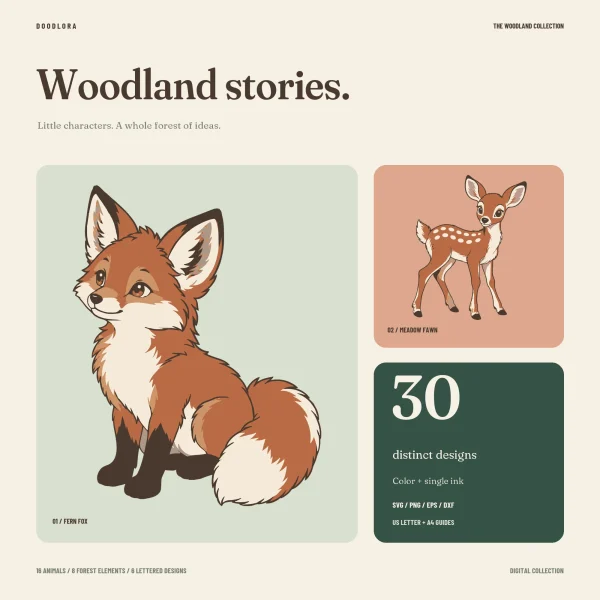
The clipart set has every design in a full-color version and a one-color line version. The one-color version saves ink and leaves room for kids to color it in themselves. Each of the 30 designs comes as PNG, SVG and EPS in both versions, plus one DXF file per design, so the PNG drops straight into a document. If you haven’t worked with clipart files before, our guide on how to use clipart walks through which file to open.
To finish, play Guess Who: one child reads the four lines without the name, and the class guesses the animal. Remind them that the card picture is a cartoon. For “what it looks like,” they should describe the real animal, not the drawing.
The same set also has eight forest pieces (toadstools, pinecones, an oak branch with acorns, a fern, pine trees, a cottage, a berry branch and a mossy stump) and six animals with short phrases such as “Wander softly” and “Stay curious.” Use the forest pieces to make a canopy, shrub layer and forest floor scene, then have kids place each animal card on the right layer.
For a hands-on follow-up, our animal crafts and bird crafts cover simple builds by age, and bug crafts works for the firefly and millipede end of the list.
Ages 10 and up: a fuse bead forest animal
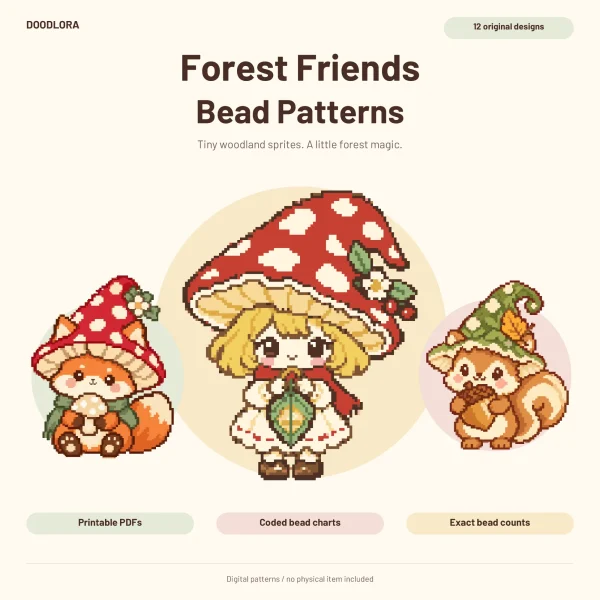
Fuse beads suit kids who can follow a grid for a long stretch, and these patterns are big. Our Forest Friends set has 12 designs. Six are forest sprites in toadstool, acorn and bluebell hats, and six are animals in hats and scarves: the Mushroom Fox, Acorn Squirrel, Berry Hedgehog, Leaf Hood Frog, Moon Owl and Forest Mouse.
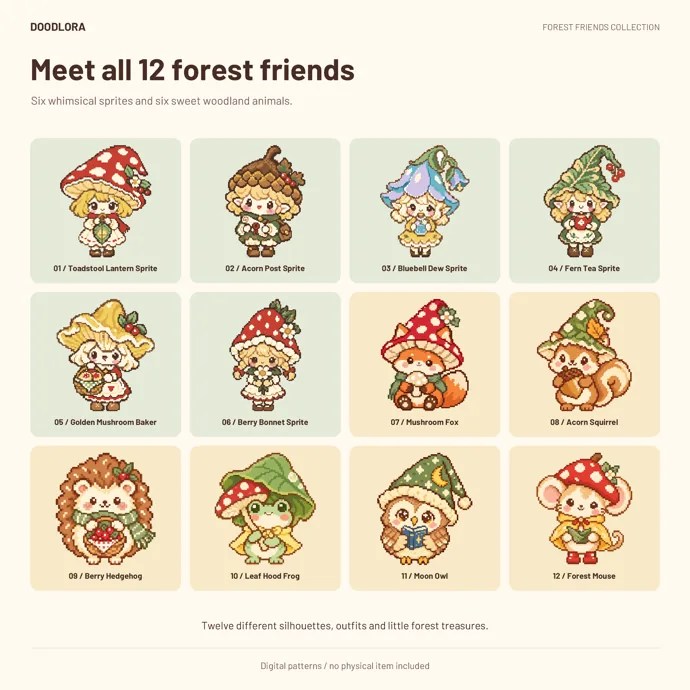
Check the size before you start. Each animal chart is 128 beads wide and uses 11,890 to 14,531 beads in 24 colors, which comes to about 25 inches (64 cm) wide on standard 5 mm beads. That is far wider than one pegboard, so it is a project for one or two people over several sessions. The sprites are 90 beads wide with 5,505 to 8,128 beads in 14 to 17 colors, so start with a sprite.
Ironing is an adult’s job, and a board this size needs care with the heat, so read through how to iron fuse beads before the first pass. Keep the bead tray away from toddlers too. End each session by taking a photo of the board and noting the last row you finished, so the next session starts in the right place.
Forest animals FAQ
What animals live in the forest?
In a North American temperate forest, the common animals are white-tailed deer, black bears, red foxes, raccoons, skunks, gray squirrels, chipmunks, cottontail rabbits, opossums, porcupines, bobcats and beavers. Birds include great horned and barred owls, pileated woodpeckers, wild turkeys, blue jays and chickadees. Wood frogs, spotted salamanders, box turtles, garter snakes, luna moths, fireflies and millipedes live closer to the ground.
What is the difference between forest animals and woodland animals?
In everyday use, they mean the same thing. “Woodland” usually suggests a more open forest, and craft and picture-book sets lean on the word for cute fox, deer, owl and hedgehog designs. For a science lesson, ask which forest, because a temperate woodland in Ohio and a rainforest in Brazil hold very different animals.
Which forest animals come out at night?
Raccoons, skunks, opossums, porcupines, beavers, great horned owls, barred owls and luna moths are nocturnal. Red foxes hunt mostly at night, and black bears forage mostly at night. Deer, cottontails and bobcats are most active at dawn and dusk, and fireflies glow at twilight.
Printables from this article
Related articles
Clipart & SVG Cut Files
How to Draw a Truck: Easy Pickup, Big Rig and Cartoon
Split a pickup into three parts before you draw a single wheel: a bed, a cab and a hood. Keep the roof about 2.2 wheels tall and the bed rail level with the hood, and the truck looks right even before the details go on.
Clipart & SVG Cut Files
How to Draw a Train: Steam Engine, Cars and Tracks
Split the page into a 10-square grid, lay a long boiler tube across the middle, set a box cab at the back and a tall stack at the front, hang two big driving wheels under the cab end, then couple cars behind and run the rails to a vanishing point.
Clipart & SVG Cut Files
Hawk vs Falcon: Wings, Size, Hunting Style and Eagles
A falcon has long, narrow wings that taper to sharp points and flies on steady, quick wingbeats; a hawk has broader wings with rounded tips and either soars in slow circles or flaps hard and glides. Falcons kill with a notched beak and hawks with their talons, and eagles are the largest, heaviest-billed members of the hawk family.