How to Use a Behavior Chart: Reward System for Kids by Age
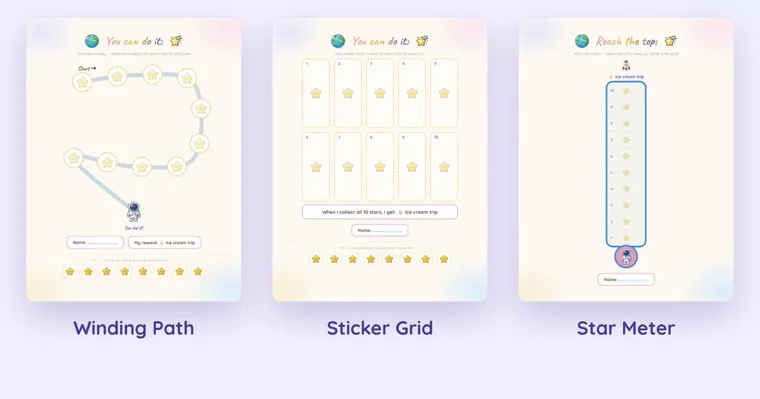
A behavior chart works when it tracks one to three specific things your child can do, adds a sticker or mark right after each one, and trades a set number of marks for a reward your child helped choose. Setting one up takes about 15 minutes: a printed chart, stickers or a marker, a short list of rewards, and a spot at your child’s eye level.
The steps below follow the order you’d actually set it up. Where the advice comes from the CDC’s Essentials for Parenting or the American Academy of Pediatrics’ HealthyChildren.org, we say so. The rest is our own planning advice, so adjust it to your child.
| Decision | A starting point |
|---|---|
| Age | Toddlers and preschoolers do best with pictures and an instant sticker; school-age kids can wait for a weekly total |
| Goals | One to three behaviors, each one you can see happen |
| Count | A first reward your child can reach within a few days |
| Reward | A short list your child helped write, mostly time with you rather than things you buy |
| Review | Five minutes once a week |
| Phasing out | When your child stops asking for the sticker |
What you need before you start
Gather everything before you talk to your child, so the first star can go on the chart the same day.
- One chart per child. A printed page with a name line, a row of spaces to fill and a place to write the reward.
- Stickers, a stamp or a marker. Small star stickers are the classic choice, but a colored-in circle works just as well.
- A sheet protector or lamination if you want to wipe the chart and reuse it. Our guide to printing papers covers which paper holds up to daily handling.
- A list of three to five rewards, written with your child (step 5).
- A spot your child passes every day. The CDC suggests the refrigerator, or anywhere your child will see it and be reminded.
Step 1: Decide whether a chart fits your child’s age
Both sources treat charts as something that changes with age. The CDC’s parenting pages for toddlers and preschoolers say a quick reward right after the behavior is the most effective way to change behavior at that age. They also warn that a goal that suits a four-year-old, like saying “please” and “thank you,” may be too complex for a two-year-old.
HealthyChildren.org, adapting the AAP book Caring for Your School-Age Child, says paper stars and similar tokens tend to work better for early school-age children, while points and contracts work better for older ones.
In practice, that suggests three versions of the same chart:
- Around 2 to 3: one picture goal, a sticker the moment it happens, and a reward after very few stickers.
- Preschool to early elementary: a sticker chart with one to three goals and a reward every few days.
- Older kids: a points tally with a weekly total and a bigger reward that takes longer to earn.
If your child can’t yet connect a sticker to something they did a minute ago, skip the chart for now. Praise the behavior out loud instead and try again in a few months.
Step 2: Pick one to three behaviors to work on
Start small. The CDC’s first step is to “pick a couple of specific behaviors.” HealthyChildren’s chore advice adds that a school-age child taking on new responsibilities should get one new task at a time, because a long list can be overwhelming.
Good first goals are things you can see happen and that happen often. The CDC lists staying in bed after being tucked in, putting dishes on the counter after dinner and using the potty as examples where rewards work well.
A weekly chore chart can tempt you to fill every row. The one in our watercolor set lists nine jobs, from making the bed to laundry, against Monday through Sunday. That’s 63 circles in a week, more than most young children can keep track of.
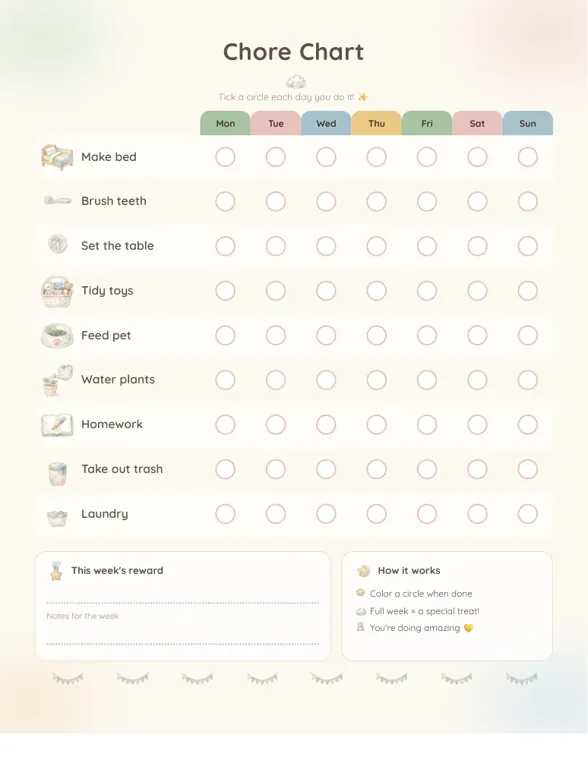
Use that kind of page by crossing out every row except the two or three you picked. Add another row later, once the first ones happen most days without a reminder.
Step 3: Write each goal the way your child will hear it
Each goal on the chart should say what to do, not what to stop. The CDC recommends avoiding “no,” “don’t,” “stop,” “quit” and “not,” and gives the example “Share your toys with your sister” in place of “No hitting your sister.”
| Instead of | Try writing |
|---|---|
| Be good at bedtime | Stay in bed after the light goes off |
| Don’t leave your stuff everywhere | Shoes on the mat by the door |
| Stop whining in the morning | Dressed before breakfast |
| No grabbing | Ask “Can I have a turn?” |
Keep the words short enough for your child to repeat. For children who can’t read yet, the CDC suggests pairing words with a picture, such as “Brush teeth” next to a drawing of a toothbrush.
Ask your child to tell you what the goal means in their own words. The CDC suggests this as a check for older children; if they can’t say it back, the goal isn’t clear yet.
Step 4: Decide how many stars earn the reward
Set the count so the first reward arrives soon. No source we found gives a magic number, so treat this as a starting point: a younger child should reach the first reward in a day or two, a school-age child within a week.
HealthyChildren suggests small rewards for a preset number of points at the end of each day or week, with larger rewards saved for longer stretches. Whatever you pick, both you and your child should know the exact number before the first sticker goes on.
Our reward pages all count to ten. The sticker grid has ten numbered boxes in two rows of five and a line that reads “When I collect all 10 stars, I get:”.
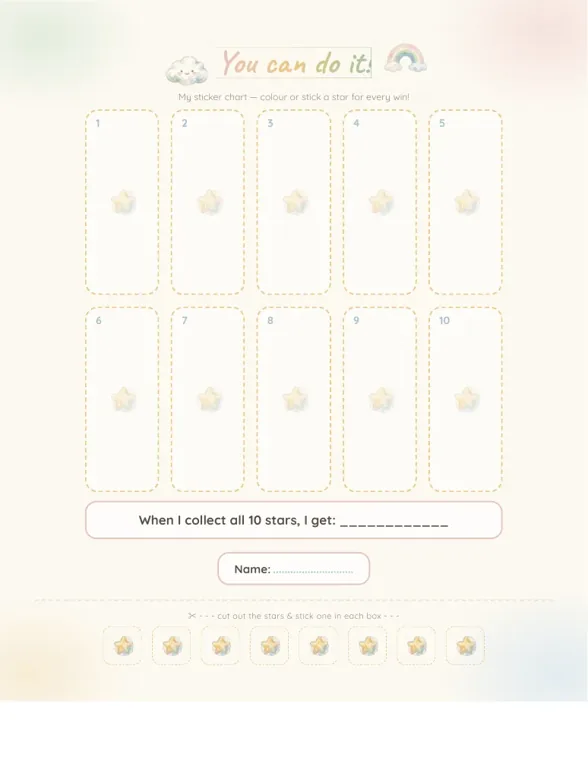
Check one detail before you start. The cut-out strip under the grid holds eight stars, and the star path page has the same eight-star strip for ten circles. Buy a sheet of star stickers or let your child color in the last two boxes, so the chart doesn’t stall at eight.
For a young child, ten can be too far away. Draw a line after box 3 or 5 and give a small reward there, then keep going to ten.
Step 5: Choose rewards that aren’t always things you buy
Rewards don’t have to cost money. The CDC divides them into material rewards, like toys and books, and social rewards: hugs, specific praise, and extra time or a special activity with you. Social rewards are cheap or free, the CDC says, and can be even more powerful than material ones.
The CDC’s own examples of activity rewards include playing a favorite game, reading a story and helping with dinner. A few more in the same spirit:
- Choosing what the family has for dinner one night
- An extra bedtime story
- Fifteen minutes of a game of your child’s choice, with you
- Picking the park or the route for a weekend walk
- Staying up ten minutes later on a Friday
Let your child choose from the list. HealthyChildren says rewards should be meaningful to your child and that children should take an active part in choosing them.
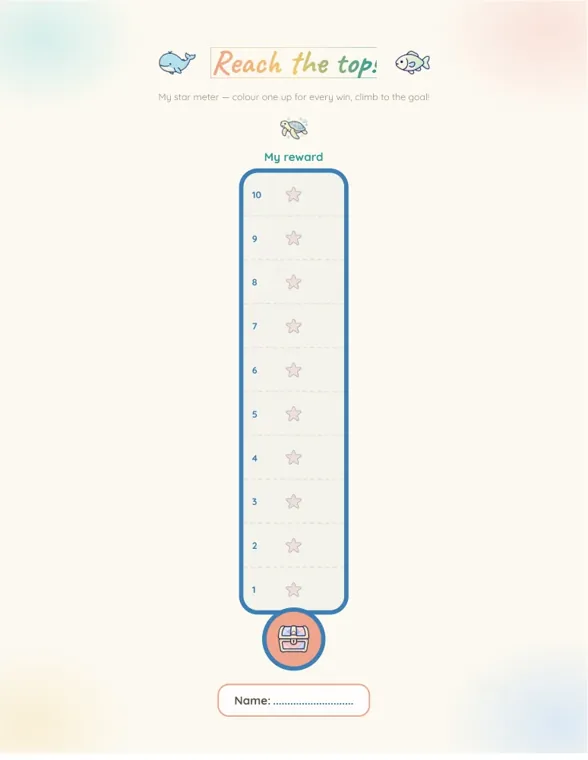
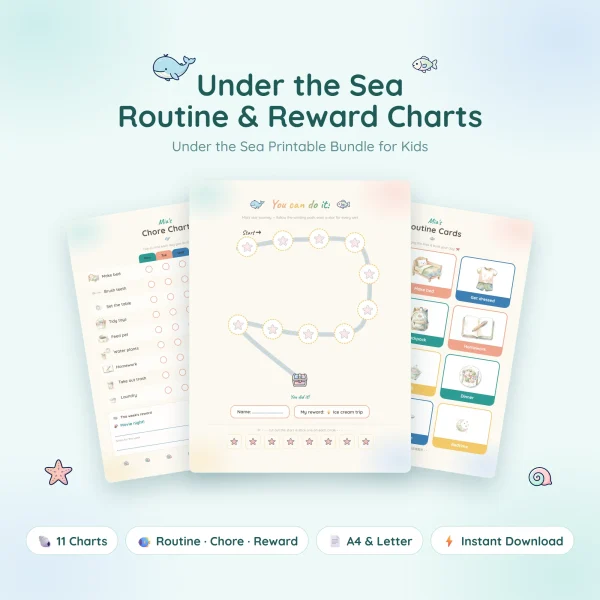
Write the reward on the chart itself. The star meter in our under the sea set puts “My reward” at the top of the bar, so your child can see what the stars are climbing toward.
Step 6: Explain the chart and give the first star right away
Show your child the chart, the stickers and the reward, and say exactly what earns a star. The CDC suggests focusing on the positives when you explain the chart. One way to do that is to start with something your child already does now and then, and offer a sticker each time it happens.
Then give the first star as soon as the behavior happens. The CDC recommends giving the reward immediately, praising your child and saying exactly what they did, and letting them watch you put the sticker on the chart. “You put your plate by the sink, so here’s your star” teaches more than “Good job.”
Plan for a few days before the habit catches on. The CDC says it takes time for behaviors to change and for reward programs to work, and that being patient and consistent matters.
Step 7: Review the chart once a week
Pick a fixed time, such as Sunday after dinner, and spend five minutes looking at the chart together. Count the stars, deliver any reward that’s due, and decide whether anything changes for next week.
If stars aren’t coming in, the CDC suggests three questions:
- Can your child actually do it? If not, reward a smaller part. The CDC’s example is switching from “make your bed” to “help me make the bed.”
- Is the goal clear? A child who doesn’t do the behavior may not understand what you want.
- Is the reward one your child wants? Children get tired of rewards. Keep a running list and add to it.
If stars come easily every day, the goal may be too easy. That’s a good week to raise the count a little or swap in the next behavior on your list.
Step 8: Phase the chart out
A behavior chart is meant to be temporary. HealthyChildren advises phasing the program out gradually as your child internalizes the behavior, and says you can usually tell they’ve reached that point when they lose interest or forget to ask for their points.
The CDC suggests rewarding often at the start and changing the chart as your child grows, rewarding a different behavior you’d like to see more often.
A gradual exit might look like this:
- Move from a star every time to a star per day.
- Stretch the count to the reward a little.
- Retire that goal and start a new one on a fresh chart.
- Keep the specific praise after the chart comes down.
Using behavior charts with two or more children
Give each child a separate chart with goals that fit their own age. A five-year-old and an eight-year-old shouldn’t be working on the same thing, or racing for the same number of stars.
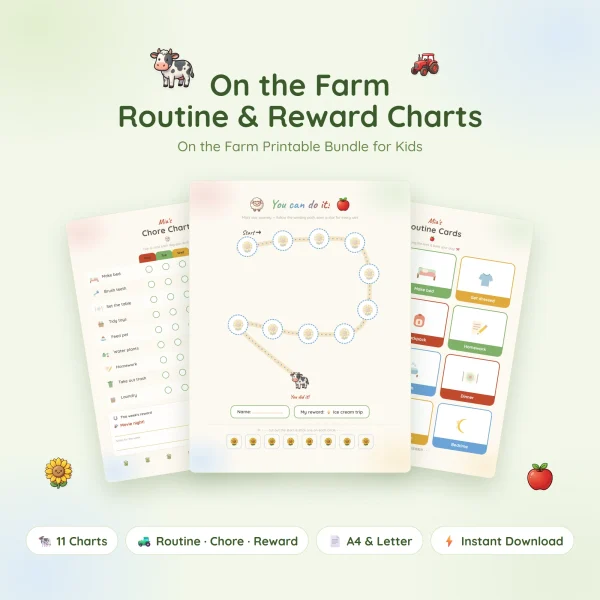
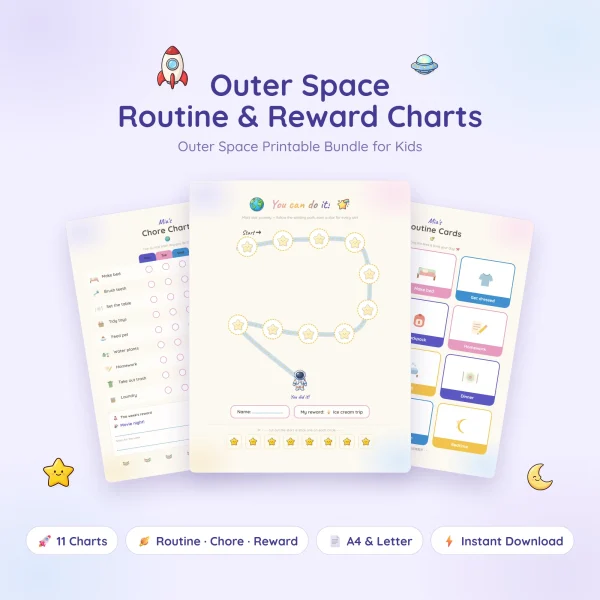
Different designs help children tell their charts apart at a glance. Our reward pages come in several themes, so one child could have the farm star path and the other a space or ocean chart.
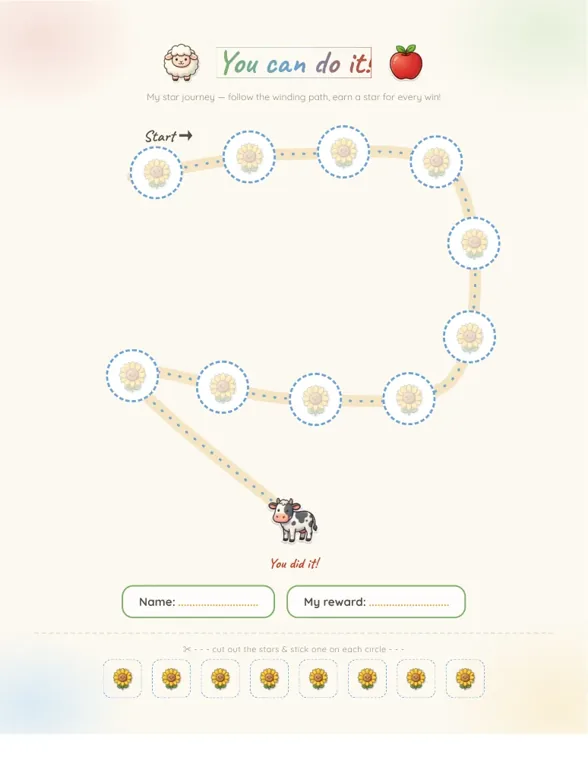
A few rules keep two charts from turning into a contest:
- Never compare charts out loud. Each chart measures progress against that child’s goal.
- Keep rewards in the same range, even if the goals differ, so neither child feels cheated.
- Add a shared family goal if siblings fight over the charts, such as a family movie night when everyone’s charts reach a set number.
The same setup works in a classroom where a few children each have one personal goal. Keep each chart in a folder rather than on the wall if you don’t want other children comparing them.
Common behavior chart mistakes
Most charts that stop working run into one of these.
Too many goals at once. A full chore chart is a list of everything, not a reward system. Start with one to three rows.
Taking stickers away as punishment. The CDC is direct: never take away rewards your child has earned. HealthyChildren warns that penalties and demerits can be humiliating or discourage a child from even trying. Deal with misbehavior separately and leave the chart alone.
Vague goals. “Be good” can’t be seen, so your child can’t tell when they’ve earned a star. Rewrite the goal as an action (step 3).
A star hours later. For toddlers and preschoolers, the CDC says the reward works best right after the behavior. A sticker at bedtime for something done at breakfast loses most of its meaning.
Rewards that keep getting bigger. If each reward has to beat the last one, the chart turns into a shopping list. Rotate rewards from a list that’s mostly time with you.
All-or-nothing weeks. Our weekly chore chart prints “Full week = a special treat!” Decide before Monday what happens after one missed day. A reward for, say, five of seven days keeps a bad Tuesday from ending the week.
Printed jobs at the wrong time of day. Check printed job lists before you hang them. The “My Jobs” page in our sets sorts nine jobs into Morning, After School and Bedtime columns, but it places Homework under Morning, Brush teeth under After School and Set the table under Bedtime. Cross out and rewrite the jobs that don’t match your day, or use the weekly chore chart.
Keep a chart separate from the daily schedule
A behavior chart counts a few behaviors you’re working on; a schedule shows what comes next in the day. If your child needs help with the order of the morning or bedtime, a picture schedule does that job better. Our visual schedule guide explains how to set one up, and morning routine ideas can help you pick one morning step to turn into a chart goal.
If a behavior worries you, or a chart hasn’t helped after several weeks of steady use, talk to your child’s pediatrician. A chart is a home tool for everyday habits and won’t replace that conversation.
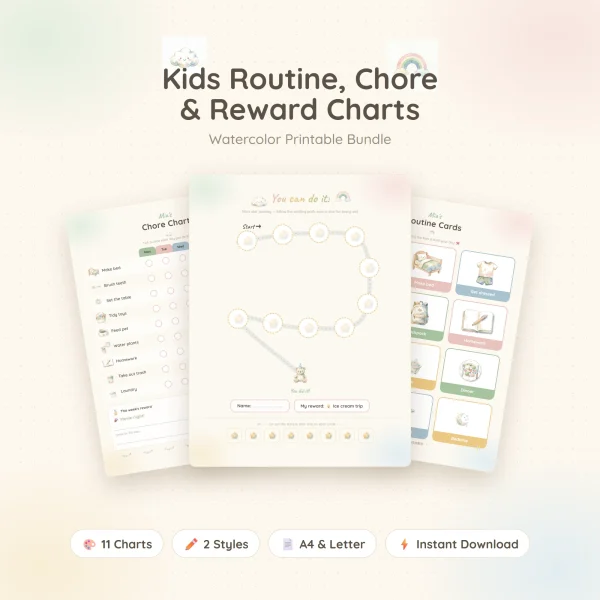
Every chart shown here comes from the reward and chore charts shelf, where each theme has the same chart types.
Printables from this article
Related articles
Reward & Chore Charts
Morning Routine for Kids: School-Day Steps and Times by Age
How to set a wake-up time from the time you leave, which steps a school morning needs and how long each takes, how it changes from preschool to age 12, and fixes for the usual hold-ups.
Reward & Chore Charts
Bedtime Routine for Kids: Steps, Times and a Chart by Age
How to set a bedtime from your child's wake-up time, which steps go in the routine and how long each takes, how it changes from toddlers to age 12, and how to get back on track after the holidays.
Reward & Chore Charts
Age Appropriate Chores: Chores for Kids by Age, 2 to Teens
Chores for kids by age, from toddlers carrying napkins to teens clearing snow, with how to teach each job, how to check it, and what to do when it comes back half done.