21 Christmas Games for Kids: Indoor, Classroom & Preschool
Christmas games for kids go best when the game fits the room the kids are already in. Cousins bouncing off the couch on Christmas Eve need Santa Says or freeze dance, and both run on one adult and a bit of floor. Kids waiting at the table for dinner can play would you rather from a list read aloud.
A class party with 25 children at desks is different again: it needs games the whole room plays at once. Three-year-olds who can’t read yet need games built on looking, listening and finding. That’s four groups of games, 21 in all.
Each game below covers how many kids it suits, roughly how long a round runs, what to set out, how to play and how a round ends. The usual snag is written into the game where it happens. Player counts and times are our estimates for planning, not measurements, so adjust them to the kids in front of you.
Pick a Christmas game for kids by the room you’re in
Read across for the room, the number of kids and what you’ve got on hand. Anything marked “nothing” can start in the next minute.
| Game | Players | Rough time | You’ll need | Works best |
|---|---|---|---|---|
| Santa Says | 3 or more | 5–10 min | a caller | living room, classroom |
| Christmas freeze dance | 4 or more | 10 min | Christmas music | living room, party |
| Reindeer relay | 6 or more, 2 teams | 10 min | 2 Santa hats, 2 chairs | big room, gym, yard |
| Ornament-and-spoon race | 4 or more | 10 min | spoons, plastic ornaments | hallway, yard |
| Pass the reindeer | 5 or more | 5–10 min | a soft toy, music | floor circle |
| Snowball toss | 2 or more | 10 min | scrap paper, a laundry basket | any room |
| Pin the nose on Rudolph | 3 or more | 15 min | poster paper, tape, a blindfold | party |
| Christmas would you rather | 2 or more | 10–20 min | a question list | table, car, classroom |
| Christmas challenge cards | 3 or more | 10–15 min | prompt cards | table |
| Christmas word search race | 2 or more readers | 3 or 5 min a round | one puzzle per player, pencils | table, classroom |
| Christmas draw and guess | 4 or more, 2 teams | 15–20 min | paper, markers, a 1-minute timer | table, classroom |
| North Pole memory chain | 3–8 | 10 min | nothing | table, car |
| What’s in Santa’s sack? | 3 or more | 10 min | nothing | table, car |
| Christmas bingo | 4 or more | 15–20 min | homemade cards, markers | table, classroom |
| Christmas trivia | a class in teams | 10–15 min | the question list below | classroom |
| Christmas telephone | 6 or more | 5–10 min | nothing | classroom |
| Christmas charades | 4 or more, 2 teams | 15 min | slips of paper, a timer | classroom, party |
| Christmas I spy | 2 or more | 5–10 min | a decorated tree or room | preschool, home |
| Reindeer, reindeer, Santa | 6 or more | 10 min | room for a circle | preschool |
| Hide the elf, hot or cold | 2 or more | 10 min | a toy elf | preschool, home |
| Candy cane hunt | 2 or more | 10–15 min | paper candy canes, a bag each | preschool, home |
Christmas games that get kids moving, with little or no prep
Moving games come first because the wait for presents, dinner or the last bell before winter break builds up excitement that has to go somewhere. Most of these need one adult to call or work the music and a clear patch of floor. Move the coffee table and any breakable decorations before the first round.
Santa Says
Santa Says is Simon Says in a Santa hat, for three or more kids and five to ten minutes. The caller gives an action and sometimes starts it with “Santa says.” Kids do the action only when they hear those two words and stay still when they’re missing. In the classic game, anyone who moves on the wrong call is out, and the last player still in wins.
Show the rule before you play by giving the same action twice: “Santa says, touch your nose,” then just “Touch your nose.” Keep the first calls slow enough for every child to hear the whole phrase, then speed up once the group’s got it.
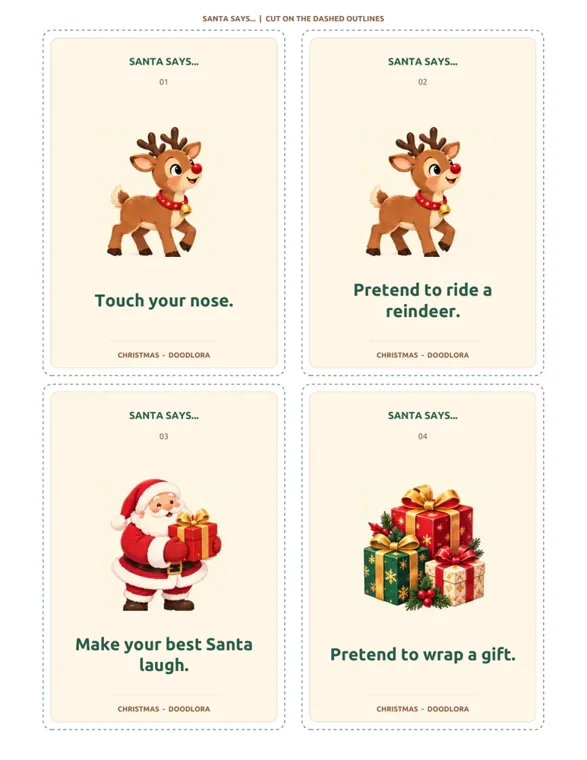
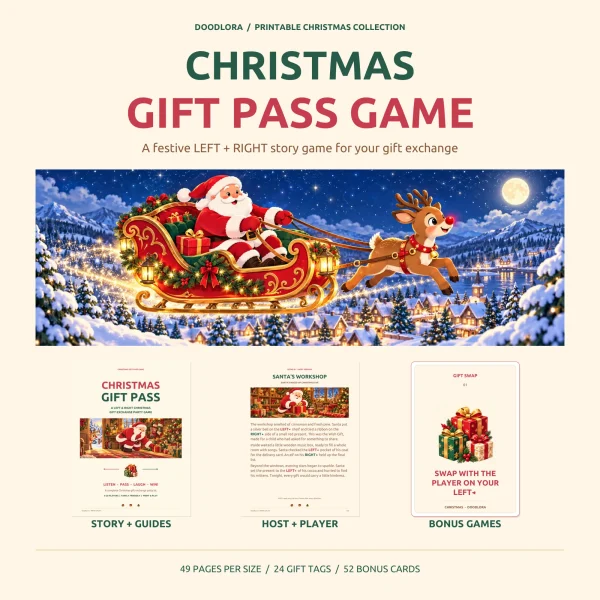
Our Christmas left right kit includes 20 Santa Says cards, and its bonus guide plays the game with seated gestures, imaginary props and no one out. A child who moves on the wrong call just resets and keeps going. That version fits a classroom of desks, since cards like “Ring an imaginary bell” and “Pretend to wrap a gift” don’t need anything in anyone’s hands.
The snag is the out rule. The kids who get excited and move first usually end up on the couch watching for the rest of the game, and that disappointment can sour the whole round. With young players, use the no-out version and end after a set number of cards, such as ten.
Christmas freeze dance
Freeze dance, the American name for musical statues, works for four or more kids and takes about ten minutes. One person runs the music. Kids dance while it plays and freeze the moment it stops, and anyone who moves or laughs during the pause is out. The last dancer still in wins.
Christmas songs do the job, and the pauses should come at unpredictable moments so nobody can time them. For a twist, call out a pose just before you stop the music: “Freeze like a snowman,” “Freeze like a reindeer.”
The adult on the music has to watch the room rather than the phone screen, or the arguments about who moved start fast. If the last two kids won’t budge, call it a shared win and start a new round.
Reindeer relay
The reindeer relay needs six or more kids in two teams and about ten minutes in a big room, a gym or a yard. Line the teams up at one end and put a chair for each team at the far end. The first runner on each team wears a Santa hat, runs around their chair and back, and hands the hat to the next runner. That runner has to put the hat on before setting off.
The first team whose last runner gets back and sits down wins. The hat swap is where the race gets slow and funny. Hold firm on the rule that the hat goes on the head, not in the hand. On a polished floor, kids in socks slide straight into the chairs, so have them run in shoes or bare feet.
Ornament-and-spoon race
This is the egg-and-spoon race with a Christmas ornament, for four or more kids and about ten minutes. Each racer balances a plastic ornament on a spoon and walks to a finish line. If it falls, the racer stops, puts it back on the spoon and carries on from that spot. First across the line wins.
Use shatterproof plastic ornaments only, and take the metal hooks off first. A glass ball breaks on the first drop, and the hooks scratch hands when kids grab for a falling ornament. Bigger ornaments sit better on a spoon than small ones, which keeps the competition fair for younger runners.
Pass the reindeer
Pass the reindeer is hot potato with a stuffed toy, for five or more kids sitting in a circle, five to ten minutes a game. Pass the toy around while the music plays. Whoever’s holding it when the music stops is out in the classic version, and the last player left wins.
With little kids, skip the outs and have the holder do a quick action instead, such as a Santa laugh or a reindeer pose. Set the main rule before the music starts: hand the reindeer to the next person, don’t throw it. As the pace picks up, a tossed toy flies across the circle and hits someone in the face.
Snowball toss
Snowball toss is a house game rather than an old tradition, so set the rules out loud before the first throw. It suits two or more kids for about ten minutes. Crumple scrap paper or old wrapping paper into snowballs, put a laundry basket against a wall and mark a throwing line with tape.
Each child throws three snowballs a turn, and every one that lands in the basket scores a point. Move the line back a step after each round. After three rounds, the most points wins. Pick one fetcher per round to collect the snowballs, or every child crowds the basket and the next thrower doesn’t have a clear shot.
Pin the nose on Rudolph
Pin the nose on Rudolph swaps the donkey’s tail for a reindeer’s red nose and takes about fifteen minutes for three or more kids. Draw a big reindeer face on poster paper and tape it to the wall at the kids’ height. Cut a red paper circle for each child, write the child’s initials on it, and put a loop of tape on the back.
Blindfold one child, turn them around slowly three times, and point them toward the wall. They stick the nose where they think it goes, and the nose closest to the right spot wins once everyone’s had a turn. Tape is safer than the pushpins the original game used. Keep the spins gentle, because young kids who get spun fast tip over before they reach the wall.
Quiet Christmas games for kids at the table
The quiet games are for the times kids need to stay in their seats: before dinner, at classroom desks or in the car on the way to Grandma’s. They run on conversation, pencils and paper. An adult can read anything printed aloud, so children who are still learning to read can play most of them.
For a party where the adults want in too, Christmas party games for mixed ages and big groups has longer games and some made for grown-ups.
Christmas would you rather
Would you rather works for two or more kids and fills ten to twenty minutes. Read a question with two options, and everyone picks one and says why. Passing is allowed. The game ends whenever you stop drawing questions, so for a class it helps to set a number, such as ten.
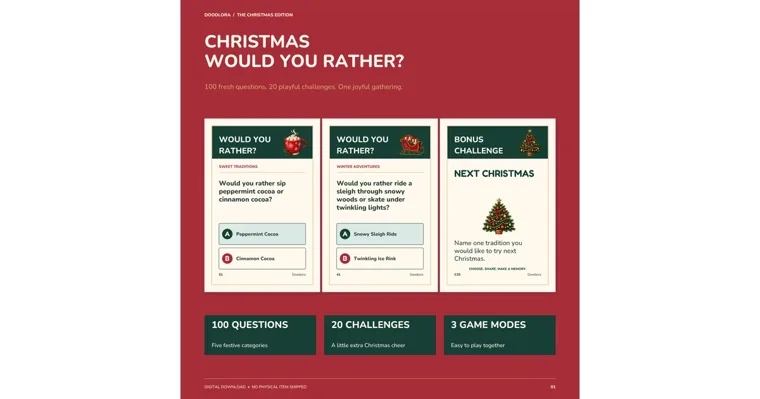
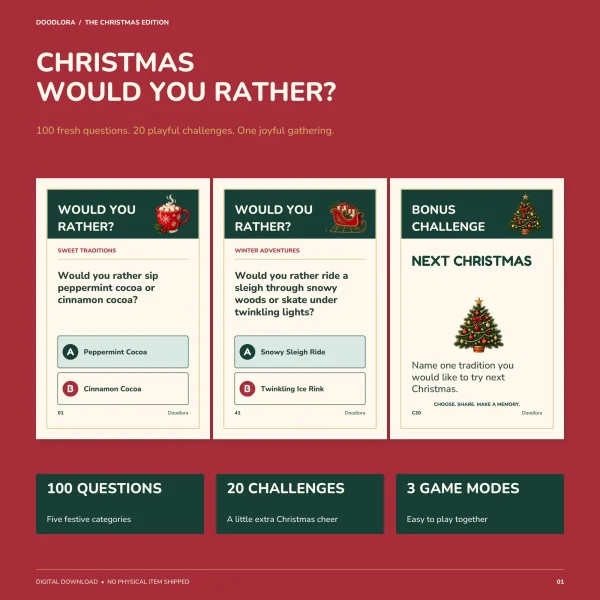
The 100 questions in our Christmas Would You Rather cards sit in five categories of 20: Sweet Traditions, Festive Style, Winter Adventures, Christmas Gatherings and Holiday Magic. A separate deck of 20 challenge cards comes with them. The cover lists family, friends, teens and adults as players, so pick the questions for children before the game starts.
Kids answer best when the question runs on imagination. These four from the deck work well for a first round:
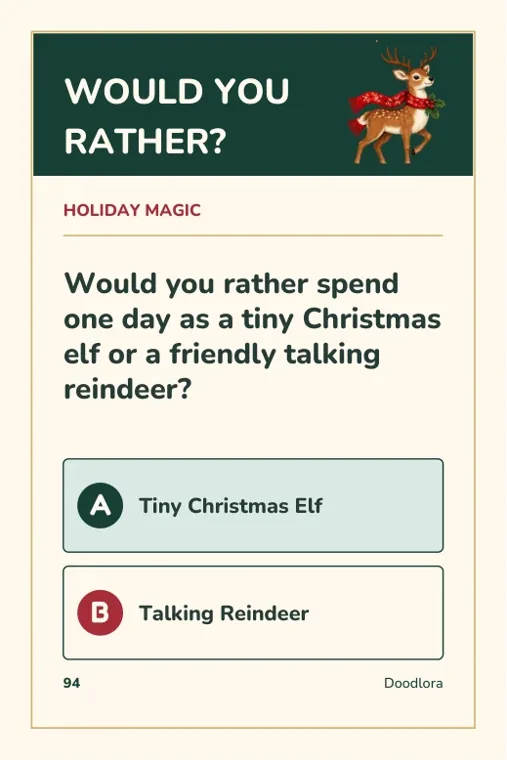
- Would you rather spend one day as a tiny Christmas elf or a friendly talking reindeer?
- Would you rather visit Santa’s toy workshop or a library of Christmas wishes?
- Would you rather wear a Santa hat or a reindeer headband to the party?
- Would you rather prepare a snack for Santa or a snack for the reindeer?
The Christmas Gatherings questions ask about family memories and traditions. Save those for a group that wants to swap stories. The deck’s instructions also list Majority Vote, where the group votes to see which option wins, and Guess My Answer, where someone predicts a player’s choice before the reveal.
The snag is that younger kids copy whoever answers first. Have everyone show their pick at the same moment, one finger for A and two for B, then ask for reasons.
Christmas challenge cards
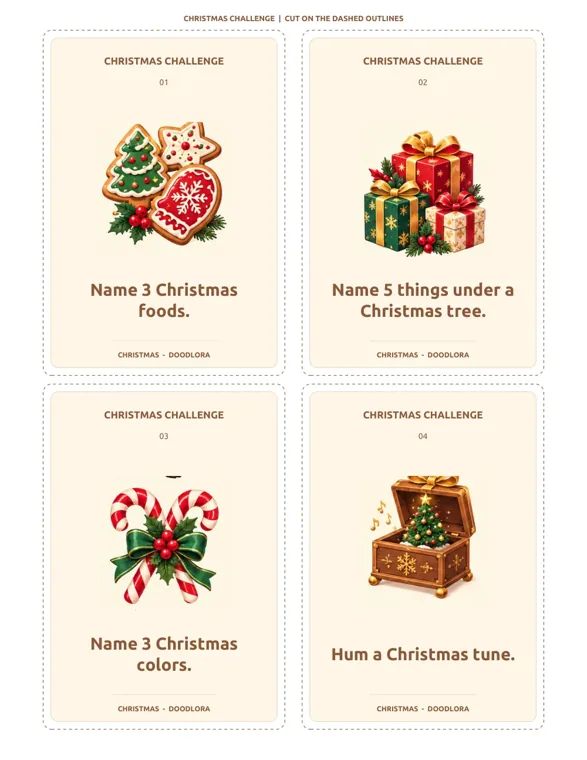
Challenge cards give each child a short task to answer or act out. They suit three or more kids for ten to fifteen minutes, and the round ends when the deck runs out or each child’s had two or three turns. The 20 challenge cards in our Christmas left right kit mix three kinds of task:
- Lists: “Name 3 Christmas colors,” “Name 5 things under a Christmas tree”
- Make-believe: “Invent a new Christmas cookie,” “Make up a name for an elf”
- Acting: “Pretend to build a snowman,” “Act like Santa”
The bonus guide allows about 20 seconds a turn, or no timer at all. A player can ask the group for help or skip a card.
Read the number on a list card before the turn starts. Five things under a tree is a much bigger ask than three colors, and a shy child who stalls at three can feel stuck. Letting the group chip in keeps that turn moving and takes the frustration out of it.
Christmas word search race
A word search race turns a quiet puzzle into two timed rounds for two or more kids who can read. Everyone needs the same printed puzzle and a pencil. The host keeps the answer key.
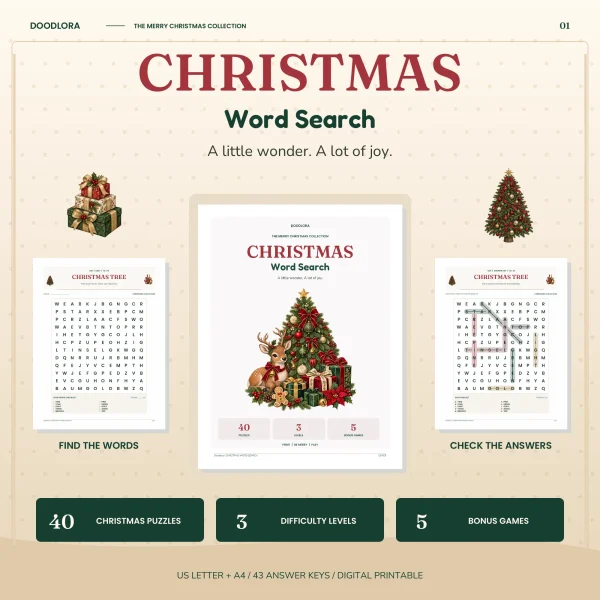
Christmas Word Search prints five bonus games, and two of them make a good pair of races. Jingle Bell Sprint uses any main puzzle: start together, find as many words as you can in three minutes, then stop at the bell. Check every circled word against the key for 1 point each. Most words wins, and a tie is a shared win.
Merry Mix Categories uses its own grid and a five-minute timer. The 16 words come in four groups of four: Decorations, Treats, Gifts and Characters. Each word scores 1 point, and finishing a whole group adds 1 bonus point. A child who finds all four decorations scores 5. A child with four words spread across unfinished groups scores 4.
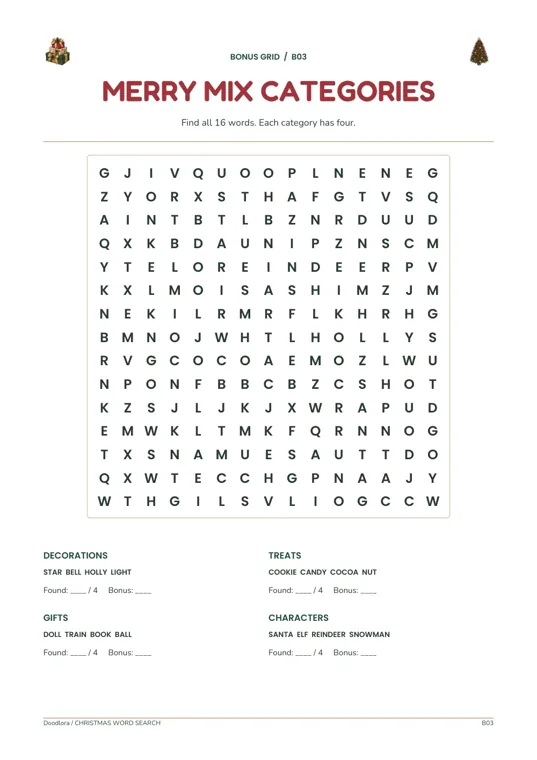
Explain which way the words run before the clock starts. On Easy puzzles, words go right or down, and up to two words per puzzle run diagonally down and to the right. Medium and Hard puzzles use all eight directions, backward included.
Give every racer the same page, too. A child on a different theme has different words to find, and the race stops being fair. Check that the printer’s set to actual size before you copy a class set, because a shrunken grid is hard on young eyes.
Christmas draw and guess
Draw and guess needs four or more kids in two teams and runs fifteen to twenty minutes. One player on a team secretly reads a Christmas word and draws it, and teammates guess before a one-minute timer runs out. A correct guess scores a point, and the turn passes to the other team. Play until everyone’s drawn once.
Write the words on slips ahead of time: snowman, candy cane, sleigh, stocking, reindeer, gingerbread house, star, present, chimney and mittens. Say the main rules out loud: no letters or numbers in the drawing, no talking and no pointing at things in the room. Kids who can spell will try to write “S-A-N-T-A” under a stick figure the first time they get stuck.
North Pole memory chain
The memory chain works for three to eight kids, takes about ten minutes and doesn’t need anything. The first player says, “I went to the North Pole and I brought…” and names something. The next player repeats the whole list and adds one item. In the classic version, a player who forgets an item is out, and the last one left wins.
For older kids, make it alphabetical: angel, bell, candy cane, and so on through the alphabet. With more than eight kids, the wait between turns gets long and the end of the line loses concentration. Split into two smaller circles instead.
What’s in Santa’s sack?
This Christmas version of twenty questions needs three or more players, ten minutes and no supplies. One player thinks of something Christmas, like a toy, a food or a decoration. The others ask questions that can only be answered yes or no. A right guess wins, and that player picks the next thing. If 20 questions go by without a right guess, the thinker wins and goes again.
Young kids tend to skip straight to wild guesses. Give them three starter questions to ask first: “Is it a toy?”, “Can you eat it?” and “Is it bigger than a shoebox?” Keep count with tally marks on a napkin, so nobody argues about whether it was question 19 or 20.
Christmas bingo
Bingo works for four or more kids and takes fifteen to twenty minutes a game. Make cards ahead of time: a three-by-three grid of Christmas words or pictures for young kids, or the standard five-by-five with a free center square for older ones. Write each word on a slip for the caller.
The caller draws a slip and reads it, and kids mark that square. The first to fill a row across, down or corner to corner calls “Bingo!” Then the caller checks the card against the slips already drawn.
Mix up the squares on each card. If every card has the same words in the same spots, everyone wins at once. When you’d like more on calling, winning patterns and checking a card, see how to play printable bingo.
Christmas classroom games for a whole class
A class Christmas party usually means 20 to 30 children, desks and an hour or less. Games that use the whole room at once beat turn-by-turn games where 24 kids sit and watch one. The three below run in teams or in lines, so nobody waits long.
A class gift exchange makes a separate event, and the gift exchange games page covers dice, left right and Secret Santa swaps for that. For a unit on how other places celebrate, the activities in holidays around the world for kids fit better than Santa games.
Christmas trivia
Trivia works with a whole class split into teams of four or five and takes ten to fifteen minutes. Read a question, give the teams thirty seconds, and have each team write its answer on a slip before anyone says it out loud. That rule stops the fastest kid from blurting the answer for every team. Most correct answers wins.
Five starter questions, with answers:
- In the 1823 poem “A Visit from St. Nicholas,” how many reindeer pull Santa’s sleigh? (Eight.)
- Can your team name all eight? (Dasher, Dancer, Prancer, Vixen, Comet, Cupid, Donner and Blitzen.)
- Which reindeer joined the team in a story written in 1939? (Rudolph. Robert L. May wrote it for the Montgomery Ward department store.)
- In the first printing of the poem, the last two reindeer had different names. What were they? (“Dunder” and “Blixem,” from Dutch words for thunder and lightning.)
- Poinsettias grow wild in which country? (Mexico. They also grow in Central America.)
Question 4’s the hard one, so save it for the tiebreaker.
Christmas telephone
Telephone needs six or more kids in a line or circle and takes five to ten minutes. The first player whispers a Christmas sentence to the next, such as “Rudolph ate three gingerbread cookies on the roof.” Each player passes on what they heard. The last player says it out loud, and the first player reads the original. The fun is in how far it drifted.
In a class of 25, one long chain takes forever and most kids sit there doing nothing. Split the class into three lines of about eight, start them with the same sentence and compare the three endings.
Christmas charades
Charades works for four or more kids in two teams and takes about fifteen minutes. A player acts out a Christmas word or scene without speaking, and their team guesses before the timer runs out. Teams take turns until everyone’s acted once. Good classroom prompts are building a snowman, decorating a tree, wrapping a present, ice skating, sledding and hanging a stocking.
Settle the rules before the first turn, because charades rules vary from group to group. Decide whether finger counts for words are allowed and how long each turn lasts. For full rules, more ideas and team play, read charades for kids.
A class party plan in three stations
For a 45-minute party, set up three stations and rotate groups every 12 minutes or so, with a bell for the change. One corner gets would you rather with a parent volunteer reading the questions. An open space gets Santa Says or freeze dance. The third station is a table for the word search race.
Before the kids arrive, copy the same puzzle for every seat at the puzzle table and put the answer key on the teacher’s desk. Leave pencils at each place. Every group plays everything once, and the last few minutes are free for a second round of whichever game the class liked best.
Christmas games for preschoolers who can’t read yet
Three-, four- and five-year-olds do best with games built on looking, listening and finding, with no reading and no one sitting out. Keep rounds short and let every child have a turn at the fun job. For quieter pages to color and simple crafts, see Christmas activities for kids.
Christmas I spy
I spy needs two or more players, five to ten minutes and a decorated tree or room to look at. The spy picks something everyone can see and says, “I spy with my little eye something red.” The others guess, and whoever gets it right is the next spy.
The color version is the easier one for preschoolers, who may not know letter sounds yet. With little ones, pass the spy role around in order so the quickest guesser doesn’t get every turn. Remind the spy not to stare at the ornament they picked, because that gives it away.
Reindeer, reindeer, Santa
This is duck, duck, goose with a Christmas twist, for six or more kids and about ten minutes. Kids sit in a circle facing in. The player who’s “it” walks around the outside, tapping heads and saying “reindeer,” then calls “Santa!” on one child. Santa jumps up and chases “it” around the circle, and “it” tries to sit in Santa’s empty spot before getting tagged.
The usual problem is that the same few kids get picked over and over. Add a rule that “it” has to choose someone who hasn’t been Santa yet. The game ends when every child’s had a turn to chase.
Hide the elf, hot or cold
Hide the elf is hunt the thimble with a toy elf, for two or more players and about ten minutes. Everyone else waits outside the room while one person hides the elf. When they come back, the hider calls “warmer” or “colder” as the seekers move around. The child who finds the elf hides it next.
For preschoolers, hide the elf in plain sight and low enough for them to see. Pick a toy too big to fit in a child’s mouth. The AAP lists toys that can squeeze into a child’s mouth among choking hazards.
Candy cane hunt
A candy cane hunt works like an egg hunt and suits two or more kids for ten to fifteen minutes. Hide paper candy canes around one room and give each child a bag. Kids collect as many as they can, and the hunt ends when every cane’s been found. Count how many you hide, so you’ll know when to stop.
Use paper canes for children under four. The AAP lists hard candy among the foods to keep from children until age 4 or older, and a real candy cane counts. Older kids can trade their paper canes for a treat at the end.
When ages are mixed, hide some canes in plain sight for the little ones and tuck others away for big kids. Another fix is giving each child one color of cane to find, so the fastest kid can’t grab them all.
Printables from this article
Related articles
Printable Party Games
How to Plan a Baby Shower: Timeline, Food & 2-Hour Schedule
A baby shower plan from the first talk with the parents-to-be to the last gift: timing, guest list, budget, venue, a two-hour schedule, safe food and backup plans.
Printable Party Games
How to Plan a Bridal Shower: Timeline, Budget and Schedule
A host's plan for a bridal shower, from the first talk with the bride and co-hosts to the guest list, invitations, a timed party schedule, the gift opening and what to do when something slips.
Printable Party Games
35th Birthday Ideas: Party, Trip, Theme and Gift Ideas
Ways to celebrate turning 35, sorted by how many people the birthday star wants around, with group size, time, prep and the snag to plan for in each.