Holidays Around the World for Kids: Activities by Month
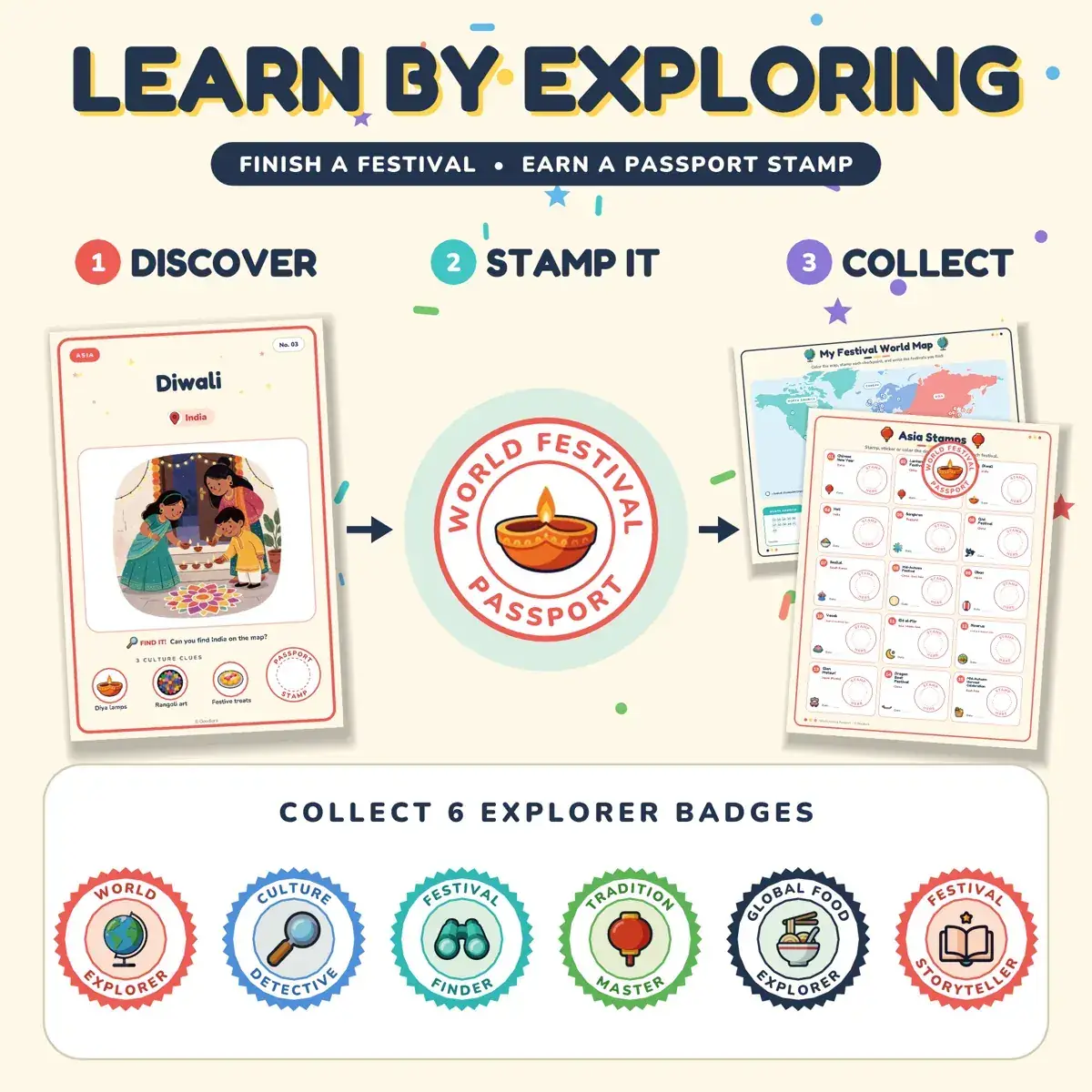
Good holidays around the world for kids include Diwali in India, Hanukkah in Jewish homes everywhere, Songkran in Thailand, Day of the Dead in Mexico and Timkat in Ethiopia. Every month has at least one festival worth a lesson.
Pick a few from different continents and pair each one with something kids can make, eat or play. Most holiday lists teachers find online stop at December, so this one starts with a calendar for the whole year.
After it, the festivals are grouped by what people celebrate: light, a new year, the harvest moon, and the African and Oceanian holidays most lists skip. The last three cover teaching two ages from one card, respectful wording and a passport unit.
Holidays around the world for kids, month by month
This table follows the three-page festival calendar in our World Festival Passport set, sorted by the month each festival usually lands in. Where a date moves from year to year, the row says so.
| Month | Festivals and where they’re celebrated |
|---|---|
| January | Timkat (Ethiopia), Burns Night (Scotland), Australia Day (Australia), Quebec Winter Carnival (Canada) |
| February | Chinese New Year (China) and Seollal (South Korea), late January or February; Waitangi Day (New Zealand); Carnival in Brazil and Mardi Gras in New Orleans, February or March |
| March | Holi (India and Nepal), Nowruz (Iran and Central Asia), St. Patrick’s Day (Ireland), Las Fallas (Spain), Pasifika Festival (New Zealand) |
| April | Songkran (Thailand), King’s Day (Netherlands) |
| May | Vesak (South and Southeast Asia), April or May; Cinco de Mayo (Mexico and the United States) |
| June | Midsummer (Nordic countries), Inti Raymi (Peru), We Tripantu (the Mapuche people of Chile and Argentina), Dragon Boat Festival (China), May or June; Matariki (New Zealand), June or July |
| July | Canada Day, Independence Day (United States), Bastille Day (France), NAIDOC Week (Australia), Gion Matsuri (Kyoto, Japan) |
| August | Obon (Japan), La Tomatina (Spain), Qixi (China), Fiji Hibiscus Festival (Fiji), Homowo (Ghana), August or September |
| September | Enkutatash and Meskel (Ethiopia), Mid-Autumn Festival (China) and Chuseok (South Korea), September or October; Gerewol (Niger), September or October |
| October | Oktoberfest (Germany), which starts in mid-September and ends on the first Sunday in October, or on October 3 if that Sunday comes earlier |
| November | Day of the Dead (Mexico), Diwali (India), October or November; Thanksgiving (United States) |
| December | St. Nicholas Day, Saint Lucia Day, Hanukkah (Jewish communities worldwide), Christmas, Kwanzaa, Hogmanay |
The dates that move follow a lunar, Hebrew or Islamic calendar. Chinese New Year always lands between January 21 and February 20, and the next one starts on February 6, 2027.
Eid al-Fitr, the festival that ends Ramadan, slides about 11 days earlier every year, because the Islamic year runs about 354 days. That’s why it isn’t pinned to a row.
For a short unit, take one festival from each of four regions and spread them over the term. Songkran’s water fights and the Matariki stars then get a turn alongside December’s candles.
Holidays of light for the darkest weeks: Diwali, Hanukkah and Saint Lucia Day
The busiest row in that calendar is December, and much of what fills it is light. With Diwali a few weeks before, festivals from India to Sweden meet the longest nights with lamps and candles.
Diwali, in October or November, is the Hindu festival of lights, and Sikhs and Jains celebrate at the same time. It runs about five days. Many families tell how Prince Rama came home to Ayodhya, welcomed by rows of lamps.
Kids can color a paper diya, the small clay oil lamp that’s lit in rows all through Diwali. A rangoli, the colored pattern families make on the ground at the door, is the other easy one in chalk.
Hanukkah lasts eight nights in November or December, following the Hebrew calendar. It remembers the rededication of the Temple in Jerusalem more than 2,000 years ago, and one day’s oil that burned for eight.
Families light one more candle on the menorah each night and fry latkes and jelly doughnuts. You don’t need more than the four-sided top and a pile of raisins for a dreidel game.
Saint Lucia Day, December 13, falls in Sweden’s darkest weeks. One girl plays Lucia in a white gown, red sash and crown of candles, often battery lights now, and leads a line of singers in white.
Saffron buns called lussekatter, baked in an S shape with raisins, go with the procession. They’re an easy kitchen project for the same morning.
St. Nicholas Day comes a week earlier, on December 6, and it’s kept across Central Europe. In many homes, children polish their boots the evening before and wake up to oranges, nuts and chocolate inside.
Kwanzaa runs from December 26 to January 1. Maulana Karenga created it in 1966 to celebrate African American culture, and each of its seven days is given to one principle, starting with unity.
Families light one candle a day in a holder called a kinara, three red, three green and one black. Each candle stands for one principle, and families share a big feast called karamu on December 31.
Christmas on December 25 is the one most US kids already know, so show them how it moves. Orthodox churches in places such as Ethiopia and Russia keep it on January 7, and in Australia and Brazil it lands in summer.
For the American side of the season at home, our Christmas coloring and party printables hold forty coloring pages and two gift swap games.
New year celebrations around the world that don’t start on January 1
The year in Scotland ends with Hogmanay on December 31. After midnight comes first-footing: the first visitor through the door brings luck, and a small gift such as shortbread.
For much of the world, though, the new year arrives on a different date, set by the moon, the sun or the stars.
Chinese New Year, also called the Spring Festival, begins on a new moon in late January or February. Families sweep the house, hang red paper and give children red envelopes with a little money inside.
An old story says a beast called Nian was scared off by red, light and noise. Each year is named for one of the twelve animals of the Chinese zodiac.
Fifteen days later, the Lantern Festival closes the season under the first full moon. People hang riddles from lanterns and visitors guess the answers. Kids can write their own riddles. A paper lantern with a handle needs one sheet, scissors and glue.
Seollal, Korea’s Lunar New Year, usually falls on the same day. Children in traditional dress bow deeply to their grandparents, a bow called sebae, and get good wishes and sometimes a gift of money.
Everyone eats tteokguk, sliced rice cakes in broth, and people say a bowl makes you a year older. Our Chinese New Year printables add the zodiac animals, with clipart for red envelopes and party signs.
Nowruz, “new day” in Persian, starts at the spring equinox around March 20 or 21. It’s been celebrated for about 3,000 years, from Iran and Afghanistan to Central Asia.
Families in Iran set a haft-sin table with seven things whose names start with the letter sin, such as green sprouts, apples and garlic. A dish of lentil sprouts takes a week or two to grow, so start early.
Songkran, the Thai New Year, runs April 13 to 15, in the hottest part of the year. Young people pour scented water over the hands of parents and grandparents to show respect.
Then the streets turn into a friendly water fight. The gentle pour over a grandparent’s hands is the part kids can copy at home with a small cup.
Enkutatash, the Ethiopian New Year, falls on September 11, or September 12 in some years. Ethiopia’s calendar has twelve months of thirty days plus a short thirteenth month.
The new year comes at the end of the long rains, when yellow Meskel daisies cover the highlands. Girls sing from house to house, and boys hand out flower pictures they’ve painted as New Year wishes.
Matariki is the Māori name for the star cluster also called the Pleiades. When it rises before dawn in June or July, it marks the Māori New Year, a public holiday in New Zealand since 2022.
Families remember loved ones who’ve died, share food cooked in an earth oven, fly kites and go out early to find the stars.
We Tripantu belongs to the Mapuche people of Chile and Argentina. It falls around the winter solstice in June, the longest night south of the equator, and families stay up through it and wash in a river at dawn.
Harvest moon holidays that bring families home
Lunar new years follow the moon, and so does another group: festivals held at the full moon of harvest time. Most of them bring the family home, including relatives who’ve died.
The Mid-Autumn Festival falls on the 15th day of the eighth lunar month, in September or October. Families in China eat mooncakes outdoors and tell the story of Chang’e, who floated up to the moon.
Chuseok, Korea’s harvest festival, lands on the same full moon. Families travel back to their hometowns, visit their ancestors’ graves and make songpyeon, half-moon rice cakes. Japan’s tsukimi is moon viewing with round rice dumplings.
Homowo, in August or September, is the harvest festival of the Ga people of Accra, Ghana’s capital. The name means “hooting at hunger,” after a famine that ended when the rains came back.
Drumming and noise are banned for a stretch beforehand. Then chiefs sprinkle kpokpoi, a corn dish, on the ground for the ancestors, and families share the rest at home.
Thanksgiving on the fourth Thursday of November is the same idea in American clothes: a harvest meal and thanks for food. Many people connect it with the 1621 meal shared by the Plymouth colonists and the Wampanoag.
Set beside Chuseok and Homowo, it shows kids that thanking the harvest is something people do all over the world.
Day of the Dead, November 1 and 2 in Mexico, mixes Indigenous traditions with Catholic ones. Families build an ofrenda, a home altar with photos, candles and favorite foods, covered in orange marigolds.
The marigolds’ scent is said to guide the spirits home. It’s a warm family day of pan de muerto and sugar skulls with names on them, and UNESCO lists it as cultural heritage.
A paper marigold for the ofrenda is the easiest craft here: three flower layers, each smaller than the last, stacked, turned and glued, with the petals curled up.
Obon is Japan’s summer festival for welcoming home the spirits of family members, usually in mid-August, or July in some areas. Families hang lanterns to guide the way and clean the graves.
In the evening, neighbors join bon odori, a circle dance to taiko drums. Some towns end Obon by floating lanterns down a river.
Holidays in Africa and Oceania that most lists leave out
Enkutatash in Ethiopia, Homowo in Ghana and Matariki in New Zealand, all above, come from the two regions popular holiday lists barely touch.
Of seven popular guides that rank for this search, one had a short section on Christmas in summer in Africa, and none had a festival from Australia, New Zealand or the Pacific.
Timkat, on January 19, or January 20 in leap years, is the Ethiopian Orthodox celebration of Epiphany and the baptism of Jesus. UNESCO listed it as cultural heritage in 2019.
Priests carry a tabot, a sacred tablet wrapped in rich cloth, to a pool or river under embroidered umbrellas. Crowds in white shawls camp out overnight, and at dawn the water is blessed and sprinkled over everyone.
Meskel, on September 27, or September 28 in some years, is Ethiopia’s festival of the cross. It remembers Queen Helena, who searched for the cross of Jesus and, the story says, found it by following the smoke of a fire.
Communities build a tall bundle of branches called the demera, decorate it with yellow Meskel daisies and light it on the eve of the festival.
Gerewol is a gathering of the Wodaabe, cattle herders who cross Niger, Chad and their neighbors in the Sahel. It comes at the end of the rainy season, when the grass is green.
Young men paint their faces with yellow clay, outline their eyes and lips in black, add ostrich feathers and dance in a long line. Young women are the judges.
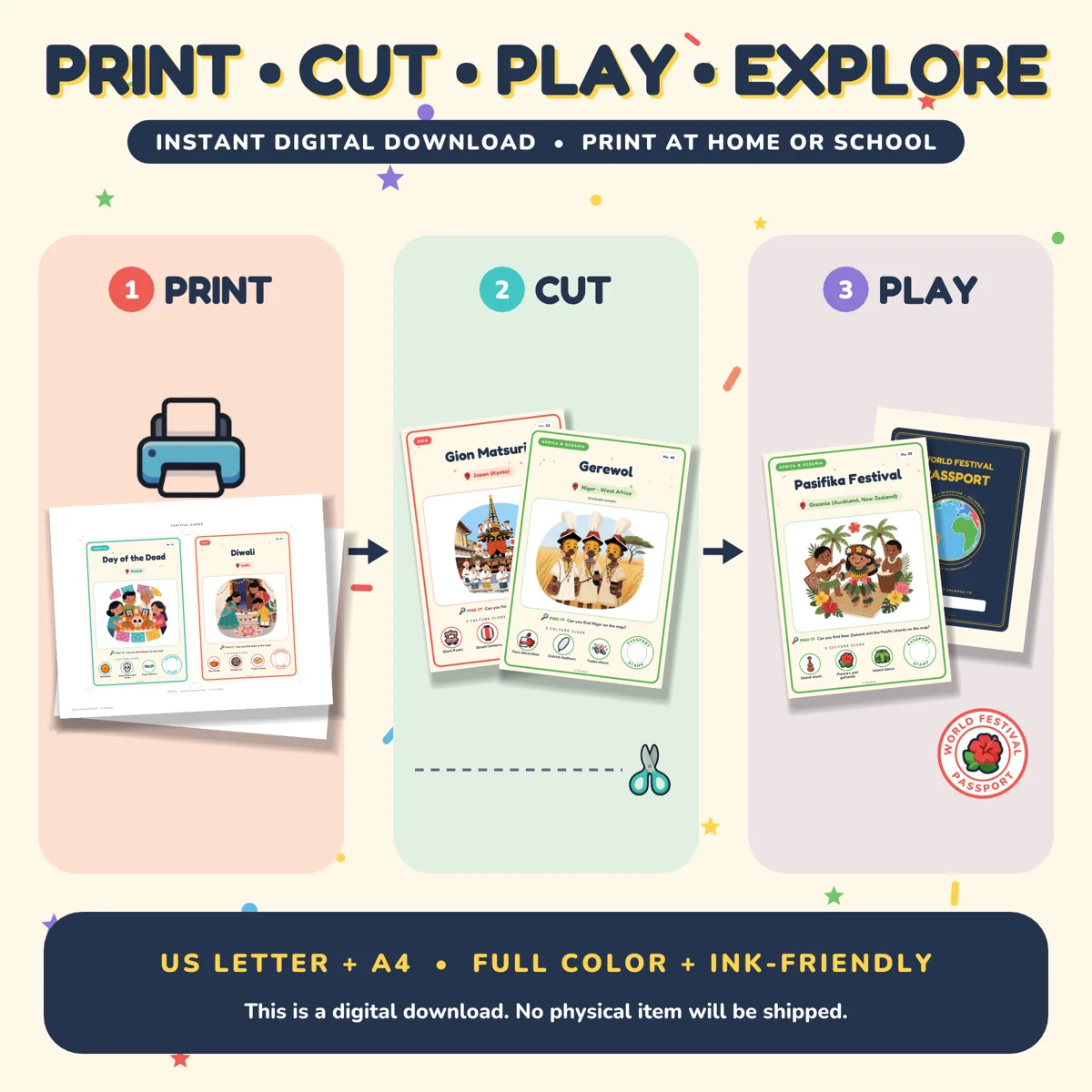
The Durbar Festival in Kano, Katsina and Zaria in northern Nigeria happens during Sallah, the Eid holidays. Horsemen in robes and turbans gallop toward the emir’s palace and stop short to salute him.
NAIDOC Week, in the first week of July, is Australia’s celebration of the history and cultures of Aboriginal and Torres Strait Islander peoples. Its roots go back to the Day of Mourning, a 1938 protest for equal rights held on January 26.
The Pasifika Festival in Auckland, held each March, sets up a “village” for each Pacific nation, from Samoa and Tonga to Niue. Fiji’s Hibiscus Festival in Suva, first held in 1956, fills a week in late August.
How to explain one holiday to a 5-year-old and a 10-year-old
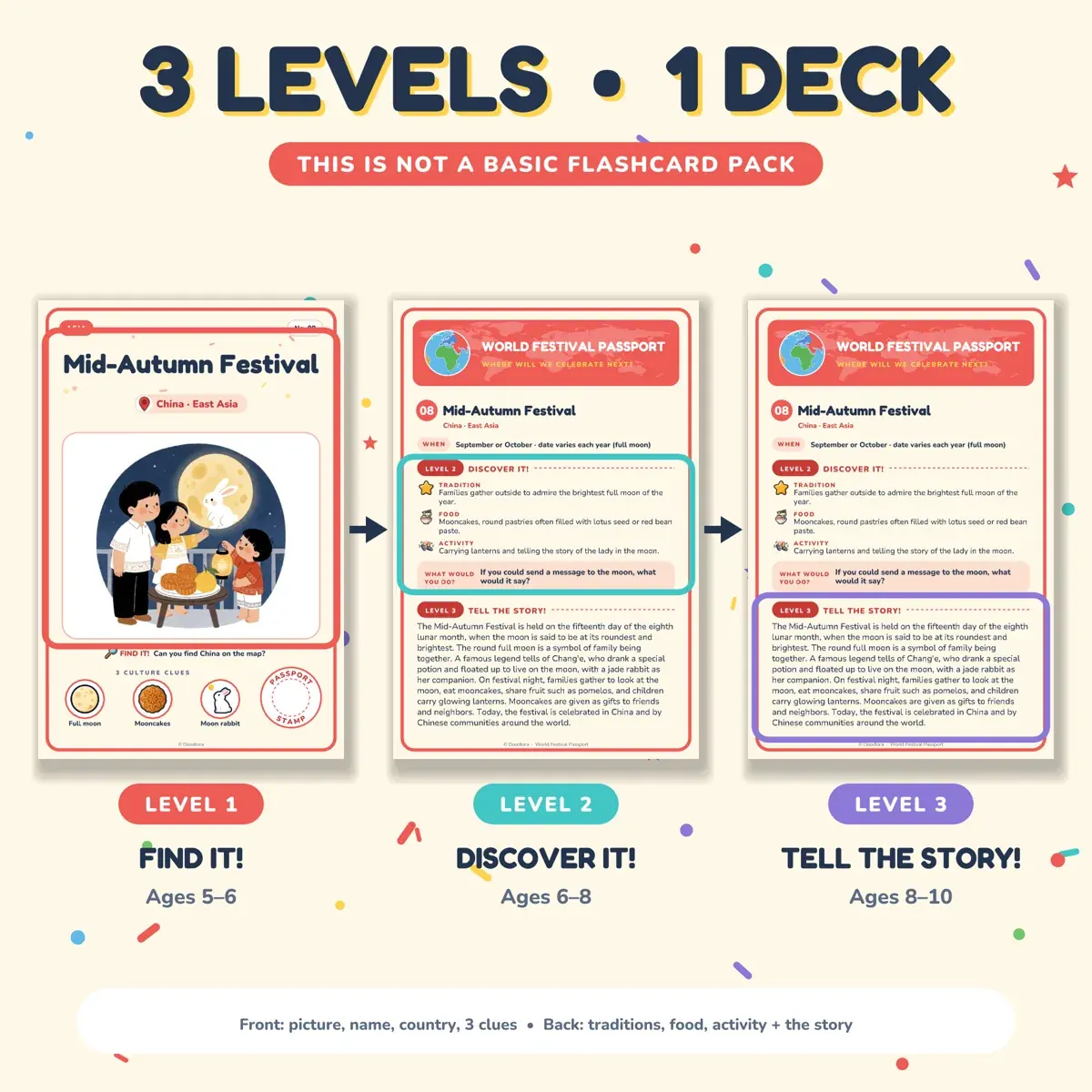
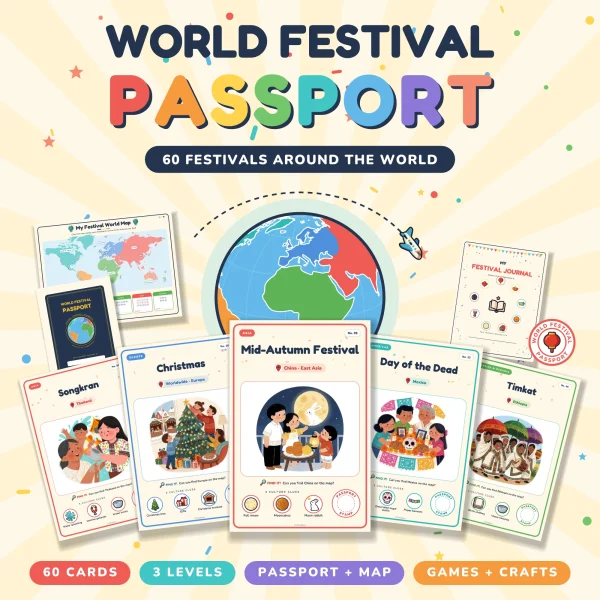
With this many festivals to choose from, the harder part is a mixed group: a kindergartner and a fourth grader looking at the same card. Our World Festival Passport cards print every festival at three reading levels.
Level 1, Find It, is for ages 5 to 6. The front shows a picture, the festival name, the country and three small culture clues, and the child names it and finds the place.
Level 2, Discover It, for ages 6 to 8, gives one line each on a tradition, a food and an activity, plus a “What would you do?” question. Level 3, Tell the Story, is a short paragraph on why it exists.
On the Mid-Autumn card, the five-year-old spots the full moon, a mooncake and a moon rabbit. The seven-year-old reads that families carry lanterns and says what message they’d send to the moon.
The ten-year-old reads about Chang’e and her jade rabbit, and why the round moon stands for a family being together.
The parent and teacher guide pairs a Level 1 reader with a Level 3 reader. The younger child hunts for the clues while the older one reads the story aloud.
For the youngest, it suggests sets of 5 to 10 cards, reading the clues out together and stamping every card they finish.
The same three steps work for a festival you research yourself. Start with one picture and a place on the map, then add one tradition, one food and one activity, and save the reason it exists for the oldest kids.
How to teach holidays from other cultures with respect
Level 3 is where religion and history come in, so wording matters most there. For a religious festival, tell kids who celebrates it, how they celebrate and what the story says.
That’s how our cards handle religious festivals such as Diwali, Hanukkah and Timkat. Kids hear what families believe and do, without being asked to believe or practice it themselves, which keeps all three easy to teach in a mixed classroom.
Say “many families” more than “people in India” or “Mexicans.” Hanukkah belongs to Jewish families in every country, and Diwali is kept by Hindus, Sikhs and Jains far beyond India.
Some dates mean different things to different people. Australia Day on January 26 marks the British First Fleet’s arrival in 1788, and many Aboriginal and Torres Strait Islander people call it Survival Day or Invasion Day.
Waitangi Day, February 6, remembers the 1840 Treaty of Waitangi, whose English and Māori versions say different things. Thanksgiving carries a different history for Native nations, too.
Those three are good practice in listening to more than one point of view. Older kids can read both sides and say in their own words why one date feels different to two families.
The best source in the room is often a classmate’s family. Ask families to share a festival they celebrate, and have kids write their questions ahead of time: what’s eaten, what’s worn, what the youngest child does.
How to run a holidays around the world passport unit
All of this fits into one unit if each festival becomes a stop on a trip, with a passport stamp as proof of the visit. The guide with our set plans a four-week World Tour, one region a week.
Get these ready before the first week:
- a passport for each child, with an explorer ID page, a stamp page for each region and a page for six badges, each with its own goal, such as finishing a whole region
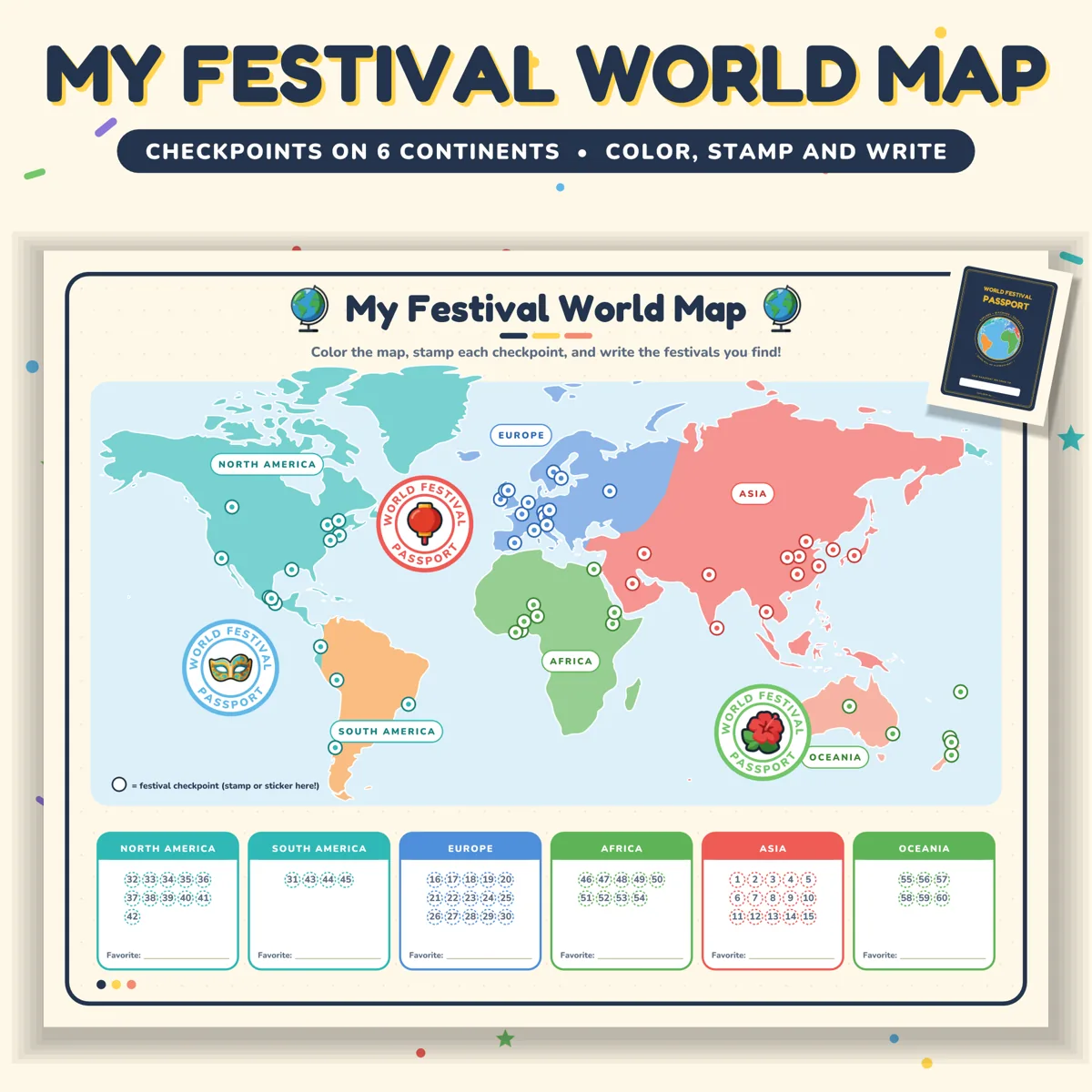
- the festival world map, printed and up on the wall
- the cards on cardstock, since they get handled every day (our guide to paper weight for printed cards covers which to buy)
- a stamp or a sheet of stickers, plus the blank make-your-own card at the end of each region
Taken in deck order, the weeks run Asia, Europe, the Americas, then Africa and Oceania, 15 cards each. A World Tour round takes 15 to 20 minutes: work through a region’s cards and find each place on the map.
On short days, Quick Match fits in 5 to 10 minutes: draw 10 cards and name each festival and its country.
A right answer to a card’s level question earns a passport stamp. Ten stamps earn one badge, 20 earn two and 40 earn four. All 60 stamps make a World Festival Explorer, and that’s when the certificate gets filled in.
Keep the festival calendar on the wall and check at the start of each month which festivals are coming up.
For a change of pace, the World Festival Hunt has ten clues, such as a festival with lanterns or one connected to the moon. The same scavenger hunt rules apply as for a hunt around the house.
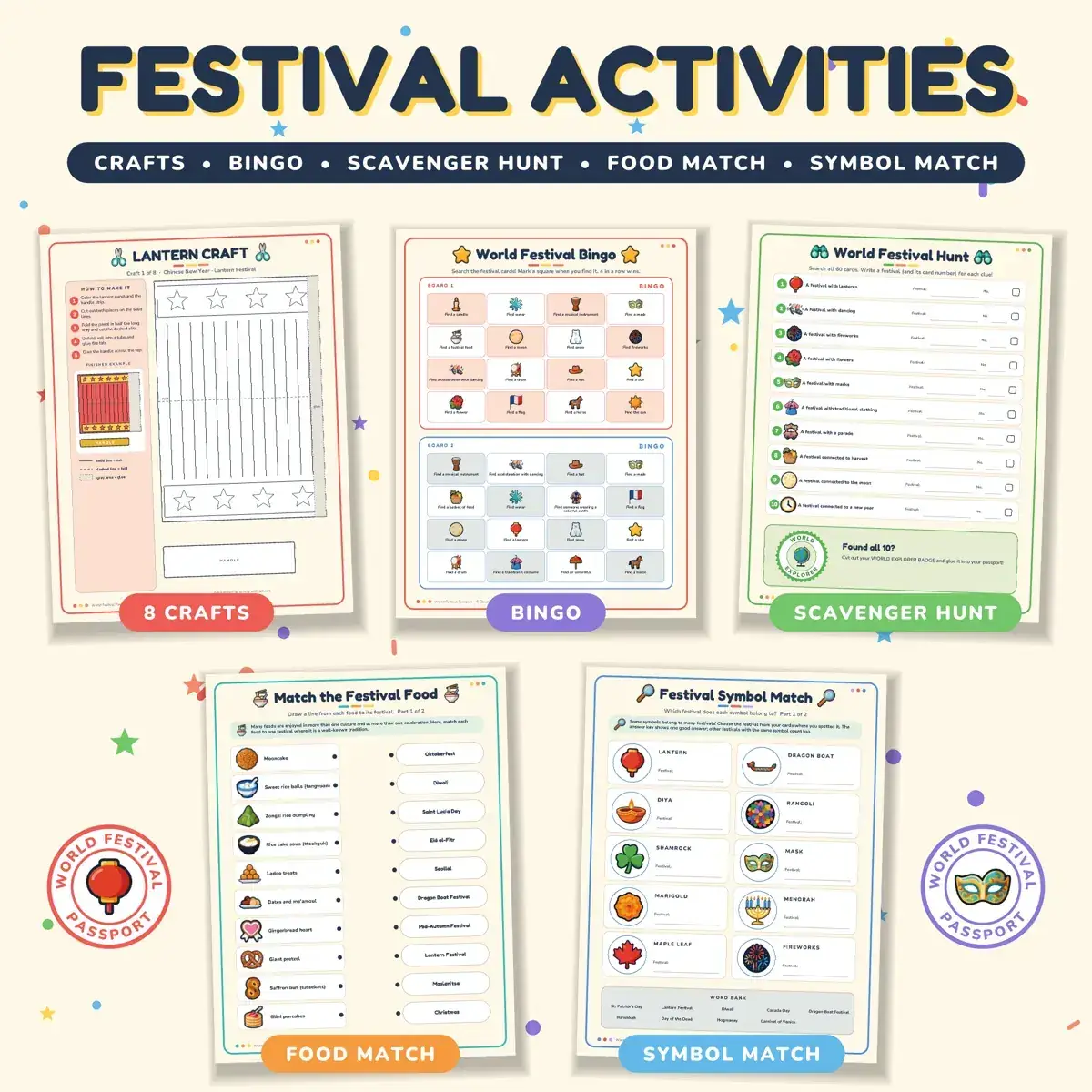
The set prints at home on US Letter or A4, like the rest of our printable kids activities, so a lost passport page is easy to replace mid-unit.
Save the last stop for the families in the room. The blank card at the end of each region takes a festival a classmate’s family celebrates, with its own name, drawing and story, and it earns a stamp like every other card.
Printables from this article
Related articles
Kids Activity Books
Secret Agent Activities for Kids: Spy Codes, Clues & Party
Spy codes, invisible ink, Kim's Game, a string laser maze and a case to solve, with player counts, timings, supplies and the snags to plan around.
Kids Activity Books
Math Puzzles for Kids With Answers, Sorted by Grade
Ready-to-use math puzzles from kindergarten to middle school, each with its answer, plus how to run them as a home warm-up or a classroom center.
Kids Activity Books
Quiet Time Activities for Kids: Bin and Quiet Book Ideas
How to swap a dropped nap for an hour of quiet time, with a starting length, a timer, a rotating bin and solo activities sorted by age, from board books to build-and-play mats.