Christmas Activities for Kids: Crafts for Home and Classroom
A good list of Christmas activities for kids at home mixes four kinds of time: something to make with scissors and glue, a kitchen project, a reason to leave the house, and a quiet job for the evenings when everyone is tired. December has room for all four, and most of the activities below cost little more than paper and an hour.
The 19 ideas are grouped by situation, with a classroom set at the end for the last week before winter break. Each one lists how many kids it suits, what to set out, how it runs, where it ends, and the step that usually goes wrong. Times and group sizes are our planning estimates, not measurements, so stretch them for slow colorers and big groups.
| Your situation | Try these | Rough time |
|---|---|---|
| Twenty minutes, no shopping | Paper snowflakes, one coloring page | 20 to 30 minutes |
| A preschooler at the table | Big-shape coloring pages, gluing a paper chain, decorating baked cookies | 15 to 30 minutes each |
| A long afternoon with older kids | Giant paper snowflake, gingerbread house, coloring bookmarks | 1 to 2 hours |
| Kids who need to get out | Christmas lights walk, mailing a letter to Santa, choosing a toy to donate | 30 to 60 minutes |
| A tired evening | A half-hour TV special, the night’s countdown book | 15 to 30 minutes |
| After December 25 | Thank-you notes, winter coloring pages | 20 to 30 minutes |
| A class of 20 or more | Word search into card writing, the Christmas around the world page | One 60-minute block |
For games rather than crafts, such as relay races and guessing rounds, see our Christmas games for kids.
Christmas crafts for kids to make at home
With crafts, split the work by hand skill. The child folds, colors, glues and writes; a grown-up handles any cut that has to be clean and any fold that has to be sharp. Every craft in this group ends with something that goes on a window, a tree or into someone’s hands.
1. Paper snowflakes from one folded square
Paper snowflakes suit one child or a whole table, take about 20 minutes, and need only printer or scrap paper, scissors and a pencil. To make a square, fold one corner of a sheet down to the opposite edge and trim off the strip below. Fold the square in half diagonally into a triangle, then in half twice more. Draw lines, curves and notches along the edges, cut them out and unfold.
Three folds stack the paper eight layers deep, which is tough going for small hands. A preschooler can stop after two folds and cut through four layers instead. Leave the point where all the folds meet mostly uncut. Trim too much there and the middle of the snowflake drops out. Tape the finished ones to a window, where the cut shapes show best against the light.
2. A giant 3D paper snowflake for older kids
The three-dimensional version is an afternoon project for one or two older kids who can handle a ruler, and it takes around an hour. Set out six sheets of 8.5-by-11-inch paper, scissors, tape, a stapler, a pencil, a ruler and yarn or ribbon for hanging. Each sheet becomes one of the six arms.
For each arm, fold a corner to the opposite edge, cut off the extra and fold the triangle in half again. Draw three lines parallel to the long side, stopping about half an inch from the other side, and cut along them. Open the square, tape the two innermost cut corners into a roll, turn the paper over and tape the next pair. Keep turning and taping out to the corners.
Staple the six arms together at one end, then staple each arm to the next at its widest point so the snowflake holds its shape. The cuts are where it fails: run one all the way through and the square falls apart into strips. Have a grown-up check the half-inch gap before any scissors go in.
3. A paper chain that counts down to Christmas
A paper chain countdown gives the whole family one link to remove each night. One child can build it in about 30 minutes, and a preschooler can do the gluing. Cut construction paper into strips about 1 inch wide; a Letter sheet cut lengthwise gives eight strips. A chain started on December 1 needs 24 links if the last one comes off on Christmas Eve, so three sheets are enough.
Before looping each strip, write a small plan on the inside, such as “make snowflakes” or “mail the Santa letter,” and the chain becomes the calendar for this whole list. Glue stick links pop open until they dry, so use tape or a stapler for younger kids. Hang the chain where children can reach the bottom link without climbing.
4. Paper ornaments instead of salt dough
Salt dough ornaments appear on plenty of Christmas craft lists, but salt dough is a raw flour dough. The FDA’s flour safety guidance says not to let children use raw dough for crafts or play clay, because even children who don’t eat it may put their hands in their mouths afterward. Paper ornaments give the same result without the raw flour.
Have each child draw stars, mittens or gingerbread figures about the size of a palm on cardstock, color them and cut them out. Punch a hole near the top and loop a ribbon through. A child can make five or six in half an hour. Hang them on the lowest branches, which are the ones small children can reach anyway.
5. Coloring bookmarks to give as a gift
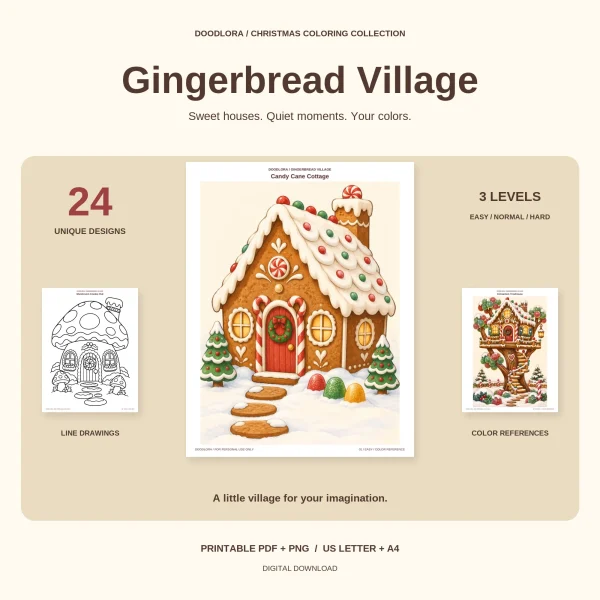
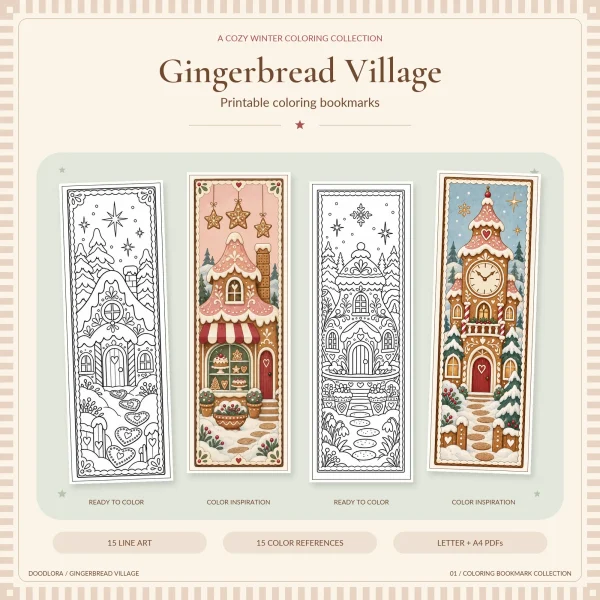
The Gingerbread Village coloring bookmarks print three 2-by-6-inch bookmarks on each Letter sheet, 15 designs across five sheets. Each one is cut along a plain outer rectangle. That makes them a good first scissors job: four straight lines, while the wavy frame drawn inside stays on the bookmark. One bookmark takes 30 to 45 minutes to color.
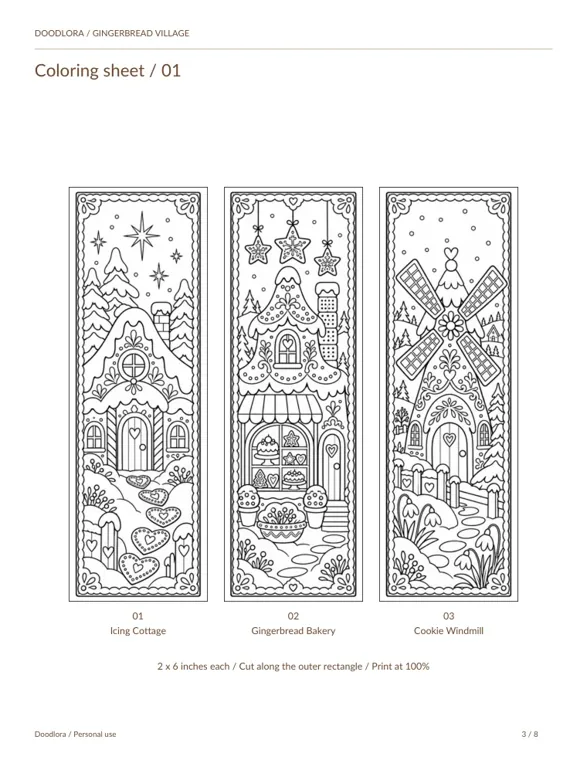
The coloring is the hard part. The file’s own cover calls these adult coloring bookmarks, and the roofs carry rows of icing dots, stars and tiny hearts. Give them to kids who already enjoy sharp colored pencils. A younger child can color just the walls, door and sky and leave the trim white, which still looks finished.
Print single-sided at 100% on cardstock your printer can take, and measure the 1-inch test line on page 2 before printing the rest. If you want to laminate, the printing notes say to do it after the bookmarks are colored and cut. Finish by writing the recipient’s name on the back.
6. A folded Christmas card a child writes inside
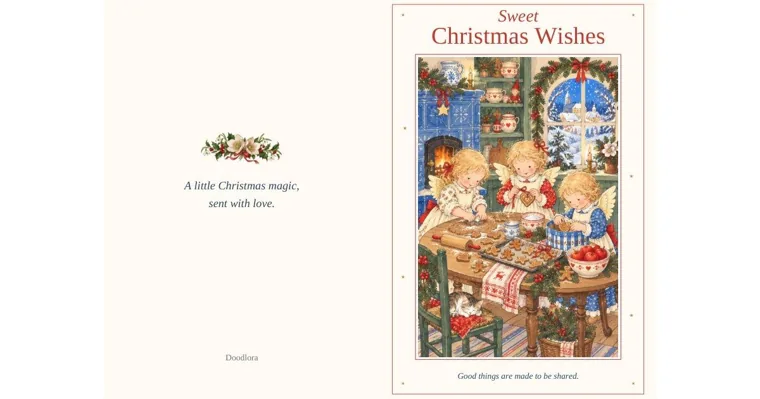
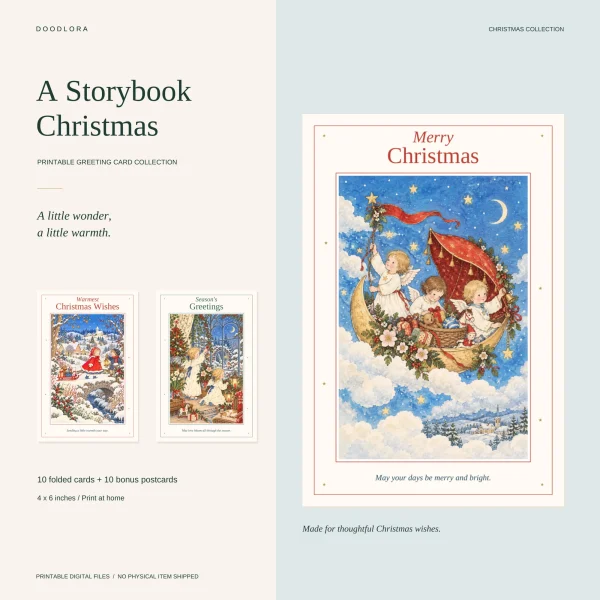
For a card, print only the outside of the sheet and leave the back blank, because that blank side becomes the inside where the child writes. Each landscape page of our printable Christmas cards makes one card, with ten different fronts. Cut at the four corner crop marks for an 8-by-6-inch piece, score down the middle at the small ticks and fold it into a 4-by-6 card.
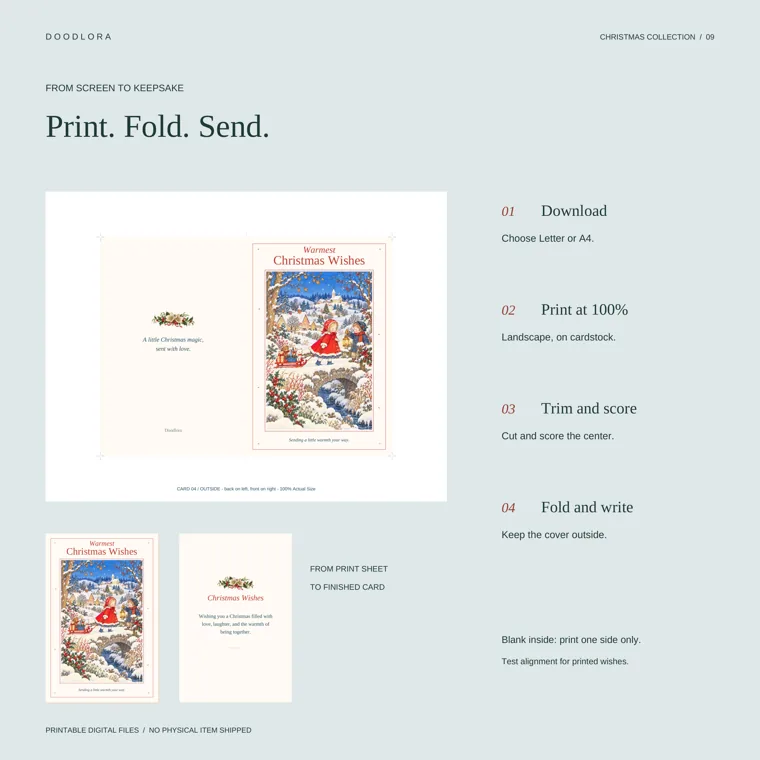
An adult trims and scores; the child writes, which takes 20 to 30 minutes per card. Kids who aren’t writing yet can draw inside and dictate a line for an adult to copy underneath. The download also has ten printed wishes for the inside, but they go on the back before trimming. Printers flip paper differently, so the print guide says to mark a corner on a test sheet first.
Envelopes aren’t included. Buy envelopes made for 4-by-6 folded cards before the day you plan to mail them, since a card cut and folded on December 22 won’t wait for a store run. A card walked over to a neighbor’s door needs no envelope at all. Every set here is made by Doodlora Studio with a US Letter file and an A4 file, so print the one that matches your paper.
Christmas kitchen activities for kids: cookies and gingerbread houses
The kitchen projects follow the same split as the crafts, with one firm rule added. Anything raw stays with the adult, and the children take over once the baking is done. Both projects below run best with two to four kids per adult, because icing travels.
7. Decorating cut-out cookies
Bake and cool the cookies the day before, so the decorating session is only frosting, sprinkles and plastic knives on a covered table. Give each child three or four cookies on a paper plate with their name on it. A session runs about 45 minutes, and it ends when each child eats one cookie and boxes the rest for a teacher, neighbor or grandparent.
If kids help cut out the shapes, the scraps are the risk. FDA guidance says never to eat or taste raw flour, dough or batter, and not to let children eat or play with raw dough before it’s cooked. Keep a damp cloth on the table and wash hands with soap after handling the dough, before anyone starts decorating.
8. A gingerbread house with grown-up glue
A gingerbread house is an afternoon project for one or two children per house. Gingerbread pieces are usually held together with royal icing, which forms a firm bond once it sets. Have an adult assemble the walls and roof ahead of time and let them set, so the children start with a standing house and only add icing snow and candy.
Royal icing is made from beaten egg whites and powdered sugar, and fingers end up in mouths. For recipes where eggs stay raw, the FDA recommends pasteurized eggs or pasteurized egg products. Candy is the second catch. The American Academy of Pediatrics lists hard, gooey or sticky candy and marshmallows among foods to keep from children until age 4 or older, so keep the candy bowl with the adult when toddlers decorate.
Older kids can plan their design first with our gingerbread house coloring pages, choosing a cottage or a clock tower and copying its trim in icing. The house is done when the roof is covered. Set it out on a plate as a decoration until the new year.
Christmas activities outside the house
After a day at the kitchen table, the best fix for restless kids is usually a coat and a reason to go out. The three activities below each take under an hour and give December a few fixed dates: a lights night, a mailing deadline and a toy drive.
9. A Christmas lights walk or drive
A lights walk works for any number of kids and runs 30 to 60 minutes. Pick a route before you leave, either a few lit streets nearby or a drive past a known display, and set out right after dark so little ones are home before bedtime. Pack a thermos of cocoa and let kids go in pajamas under their coats.
Give each child a job, such as counting inflatable snowmen or choosing the house with the best lights, so the trip has a point. The trip ends at home with the cocoa. Small children fade quickly in the cold, so plan a route you can cut short halfway.
10. A letter to Santa through the mail
Writing to Santa takes one child about 20 minutes. The letter can be drawn, written or dictated to an adult. The US Postal Service’s Operation Santa program says the letter goes in an envelope with a postage stamp, addressed to 123 Elf Road, North Pole, 88888. Write the return address clearly on the envelope and on the letter itself.
For 2026, letters must be postmarked by December 5. In the program, letters are posted online with personal details blacked out, and members of the public adopt them and send gifts. The program says plainly that there’s no guarantee a letter will be posted or answered. Don’t promise a child a reply. If you want one to arrive, write it yourself.
11. Choosing a new toy for a donation drive
Choosing a toy for another child makes a good outing for one or two kids and takes about 30 minutes in a store. Set a budget, then let your child pick something for a kid about their own age. Drop it at a local collection box together, so they see where it goes.
Check what your drive accepts before you shop. Toys for Tots, the Marine Corps Reserve program, has accepted only new toys since 1980, partly to avoid passing on recalled items. A well-loved toy from home won’t fit that drive, so look for a local shelter or church collection instead.
Quiet Christmas activities for tired afternoons and evenings
Outings and baking use up energy, and every December has evenings where nobody wants another project. These five need a table or a sofa, little prep and no cleanup beyond putting pencils away.
12. Gingerbread house coloring pages at three levels
A table of children rarely shares one attention span, so choose a level for each child before anything gets printed. Our gingerbread house coloring pages sort 24 houses into three levels of eight. Easy houses put one building in the middle with wide spaces to fill. Normal adds more building, such as a clock tower, and Hard fills the whole page with towers, paths and trees.
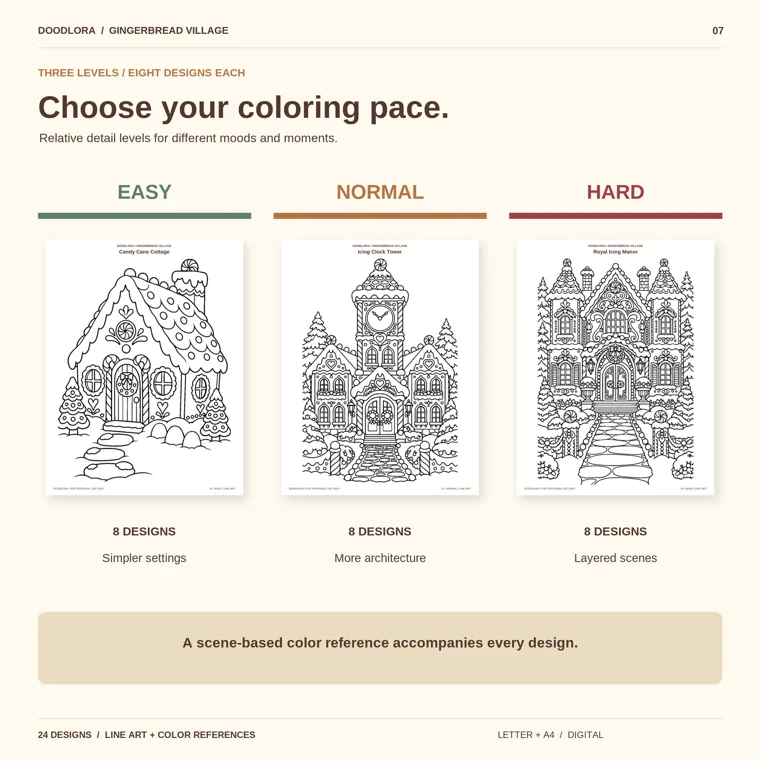
In the 48-page book, every line drawing sits on an odd page with its color version on the even page after it. Print odd pages only and you get all 24 houses in black and white. Each house has its name at the top and its level at the bottom. An Easy house makes a 20 to 30 minute sitting, while a Hard house can stretch across several afternoons of winter break.
13. Big-shape Christmas pages for preschoolers
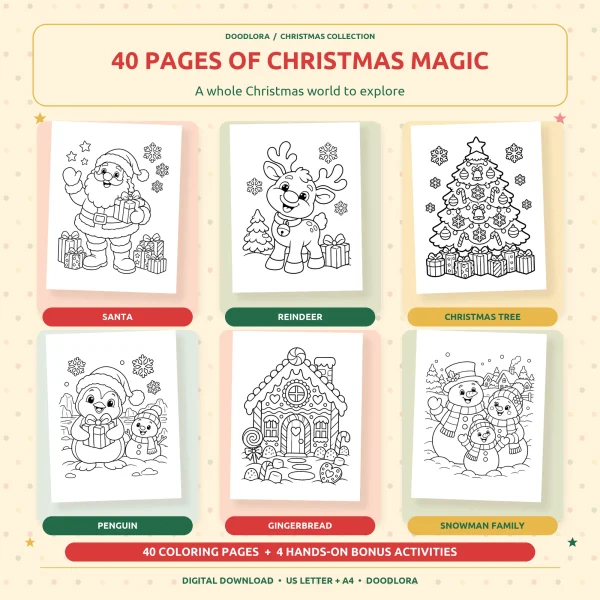
For preschoolers holding fat crayons, even the Easy houses have icing dots to work around. The Christmas Magic coloring pages use thick outlines and big open shapes instead, like two children trimming a tree with one on a stepladder holding the star. Every picture also comes as its own one-page PDF, so five copies of one page don’t mean printing all 44.
A page takes a preschooler 15 to 20 minutes. Ask each child to write or stamp a name and date on the back, then choose where it goes: the fridge or an envelope for a grandparent. Before printing a stack, check which paper suits crayons, markers or pencils in how to print coloring pages.
14. A half-hour Christmas TV special
A short special suits the whole family after dinner. A Charlie Brown Christmas, first aired in 1965, runs 25 minutes, and the 1966 animated How the Grinch Stole Christmas! runs 24. A feature film can run past a young child’s bedtime, while either special ends with time left for teeth and a story.
Make it an event: popcorn for the older kids, blankets and the lights off. Popcorn is on the AAP’s list of foods to keep from children until age 4 or older, so give toddlers a different snack.
15. A book-a-night countdown
Wrap 24 picture books, Christmas ones or simply favorites, and let a child unwrap one each evening in December. Reading takes 10 to 15 minutes, and the book is the bedtime story that night. It pairs well with the paper chain: one link off, one book open.
The books don’t need to be new. Wrap ones you already own, or borrow from the library if the due dates run past Christmas. A child who reads alone can read the book aloud to a younger sibling instead.
After Christmas: thank-you notes and winter pages
The days between Christmas and New Year are long and unplanned, and two quiet activities fill them without bringing Santa back out.
16. Thank-you notes or thank-you drawings
Thank-you notes take 10 to 15 minutes each and work best within a few days of the gift. Kids who write can name the gift and say one thing they did with it. Kids who don’t can draw themselves playing with it, while an adult writes the name underneath. Fold a sheet of printer paper in half, or use any leftover card fronts from the craft section.
The job ends when the envelopes are addressed and stamped.
17. Winter coloring pages without Santa
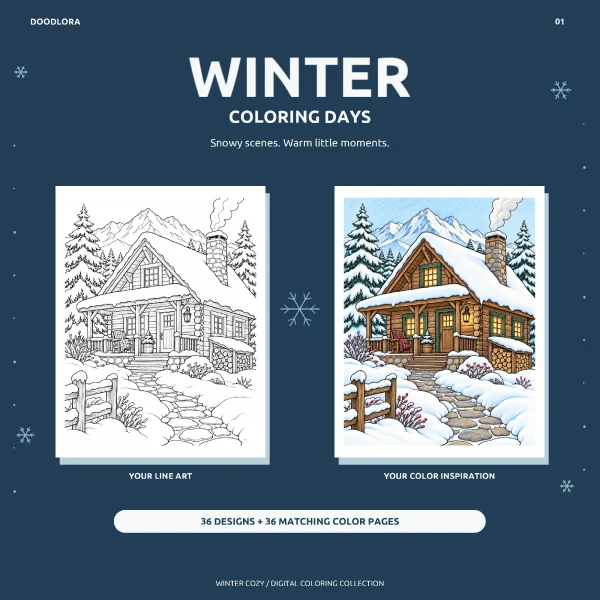
Once Christmas is over, or in a group where not everyone celebrates it, winter scenes keep the season going without Santa. The winter coloring pages set has 36 designs and no Santa among them: a snowman by a stone cottage, a fox among birch trees, an owl under the moon, mugs of cocoa and snowed-in cabins.
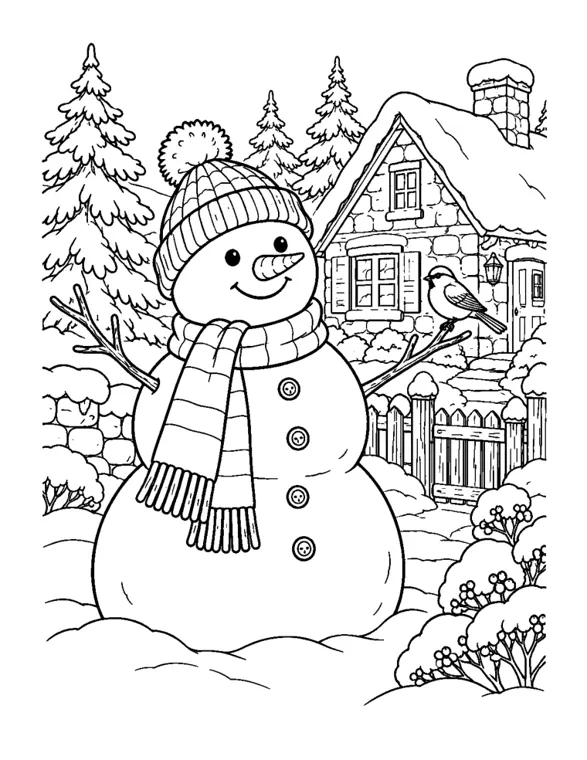
These outlines are finer than the Christmas pages above, with cable knit, wood grain and layered snow. They suit older kids and patient colorers with sharp pencils. A preschooler will do better coloring just the snowman’s body and hat than a full scene. Print the 36-page line-art file, not the 72-page paired file that alternates each outline with its colored version.
Fine lines and markers can bleed into each other, so if your kids prefer markers, our page on coloring with markers covers paper and bleed-through.
Christmas classroom activities for the week before winter break
The last school days before winter break need activities that start without a long explanation and stop cleanly when the bell rings. A word puzzle followed by card writing does both. A geography page then gives a calmer way to talk about how Christmas is kept in other countries.
18. A word search that feeds the card writing
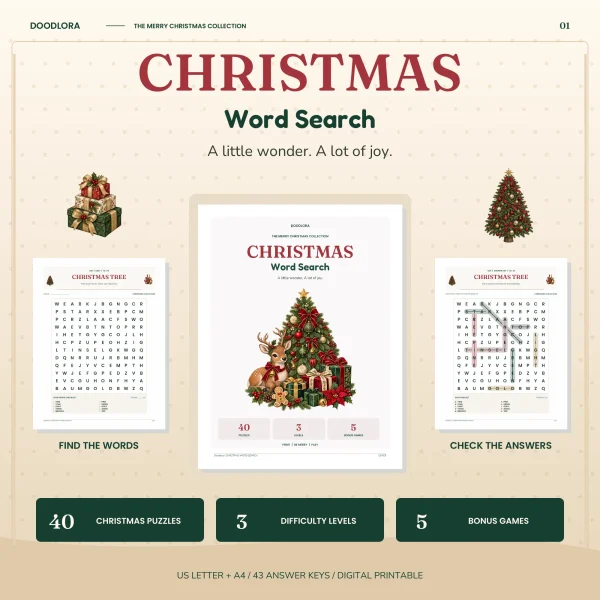
The Christmas Cards puzzle in our Christmas word search book is an Easy 12-by-12 grid with ten words: CARD, NOTE, STAMP, MAIL, WISH, WRITE, SEND, LOVE, FRIEND and SMILE. On Easy, words run right or down, plus up to two that run diagonally down and to the right. When the grid is done, students use three of the ten words in a card of their own.
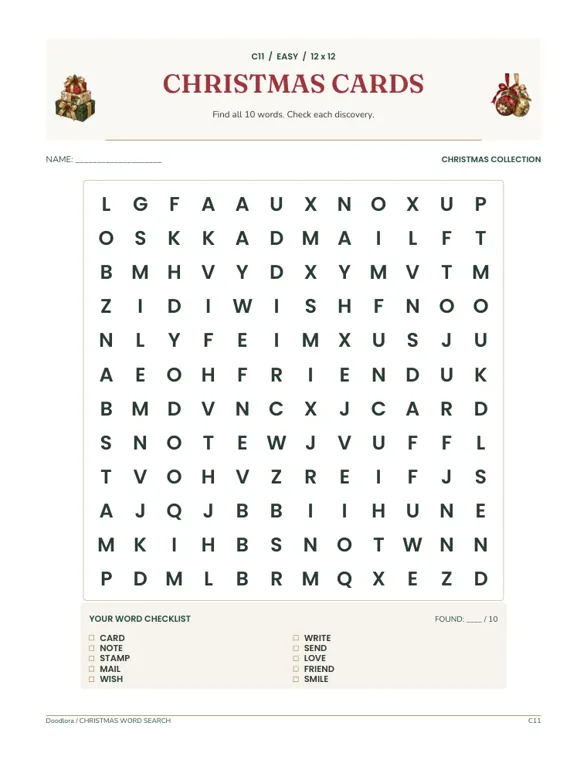
Older students can take Medium puzzles, which are 15 by 15 with twelve words hidden in all eight directions, backward included. Holiday Greeting Cards adds ENVELOPE, ADDRESS and POSTAGE, while Letters to Santa and Christmas Kindness fit a talk about giving. Plain printer paper, a pencil and grayscale printing are enough. Keep the answer key on your desk.
If the class would rather race, the games guide linked near the top of this page turns these grids into two timed rounds. Here the puzzle is a warm-up for writing, so nobody needs a timer.
19. Christmas around the world on one coloring page
The Christmas Magic set includes a globe titled Christmas Around the World, with Santa, a reindeer, a snowman and a gingerbread figure peeking around it. The continents are outlined, so students can color the country they live in first, then one more where a relative lives or where they’d like to spend Christmas.
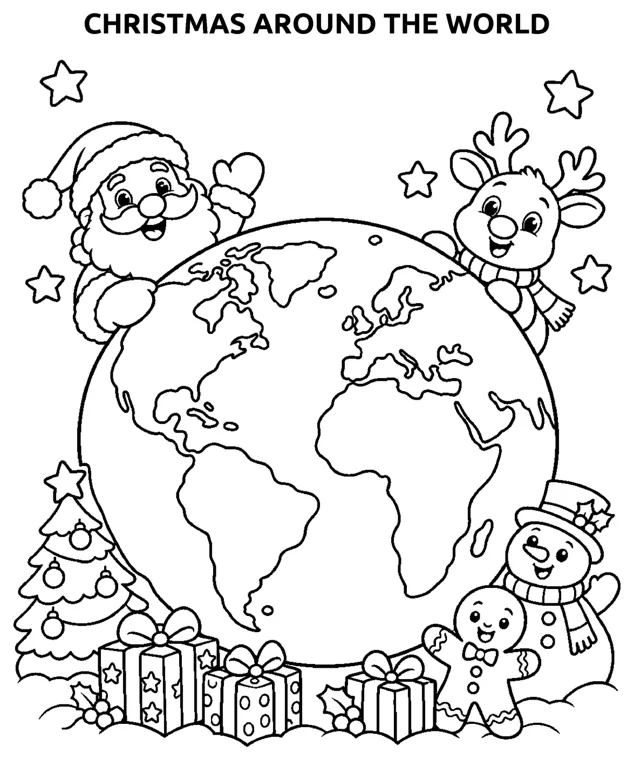
Not every student celebrates Christmas, and this page is still a Christmas page. For a unit that also covers Hanukkah, Saint Lucia Day and other festivals of the season, our holidays around the world for kids guide has a month-by-month plan. The winter pages above suit students who’d rather leave Santa out.
A 60-minute class party plan
A 60-minute party block can open with the word search for 15 minutes and give card writing the next 20 to 25. Coloring fills the rest while cards are collected, and early finishers fold paper snowflakes for the classroom windows.
With 24 students, that’s 24 puzzles on plain paper and 24 card sheets on cardstock, trimmed and scored the night before. If the party also has a gift swap, Christmas party games walks through a left right story and a dice round.
When a Christmas activity goes wrong
Pages that print small or lose their edges usually come from Fit to Page, so switch to actual size and print one test page. Cardstock that jams is often too thick for the printer; the card guide says to check your printer’s limit and test on plain paper first.
A snowflake that falls apart was cut through the center point or past the half-inch line, so fold a fresh square and leave more paper there.
A child who stalls halfway can stop at one house, one bookmark or a signed card, since each activity has a finish line before the whole set. A cookie session that turns into a sugar fight can end early with the plates boxed as gifts, which was the point anyway.
Printables from this article
Related articles
Printable Coloring Pages
Turkey Disguise Ideas: 18 School Project Ideas & Template
Eighteen ways to disguise a paper turkey for the school project, from a ten-minute snowman to a recycled robot, with materials, ages, time and the usual snags.
Printable Coloring Pages
Coloring Tips: Supplies by Age, Shading and Fixing Mistakes
Which coloring tools and pages suit each age, the order to color a page in, simple shading, fixing mistakes and splitting a busy page across a few sittings.
Printable Coloring Pages
Fall Activities for Kids: Toddlers, Preschoolers & Outdoors
Leaf walks, apple and pumpkin play, counting games and rainy-day pages, sorted by age and by where you'll be, with timing and setup for each.