Activities for Seniors: Home, Grandchildren & Group Ideas
Good activities for seniors fit the person’s eyes, hands and energy on that particular day.
That might be a large-print word search at the kitchen table, a deck of trivia cards with a grandchild reading aloud, or a game of seated charades for a whole activity room. The 14 activities below are sorted by who is taking part: one person alone, a family visit, or a group with one leader.
Each one lists how many people it suits, roughly how long it takes, what to print or set out, and the step that tends to go wrong. Most of the printed pages come from our own large-print activity book, our trivia cards and a flower coloring set, so the page numbers and counts below are taken from those files.
Pick an activity by situation
| Situation | People | Time | Start with | You need |
|---|---|---|---|---|
| Alone at the kitchen table | 1 | 5–15 minutes a page | Large-print word search, nostalgia trivia | A felt-tip pen, good light |
| Alone, wants something calm | 1 | No set length | A flower coloring page | Colored pencils or markers |
| Grandchildren visiting | 2 or more | A round of 20 cards | Which Came First? timeline cards | Card stock, scissors |
| One family member visiting | 2 | 20 minutes | A conversation page and the visit plan below | One printed page |
| Activity room | 6–12 and a leader | 30–45 minutes | Think Fast, seated charades | Cards cut out beforehand |
| Eyesight is the problem | Any | Any | Spoken pages: This or That, Think Fast | Someone to read aloud |
| Hands are the problem | Any | Any | Pages with no pen, circling instead of writing | A thick black felt-tip |
The times come from the books themselves. The large-print book says most of its pages take five to fifteen minutes, and its caregiver kit lays out 20-, 30- and 45-minute sessions.
Activities for seniors at home on their own
These work for one person with a table, a pen and good light. The best setup is a short stack: print a few pages at a time, because a thick pile looks like homework.
Large-print word search
One person, five to fifteen minutes. Print one page, set out a black felt-tip or bold gel pen, and put the lamp beside and slightly behind the reader rather than overhead.
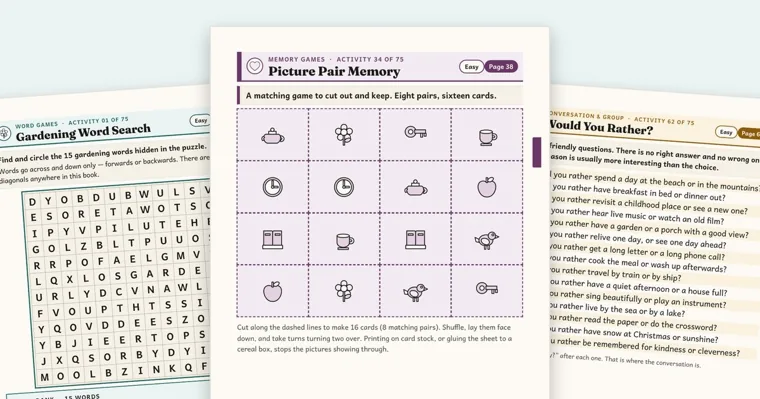
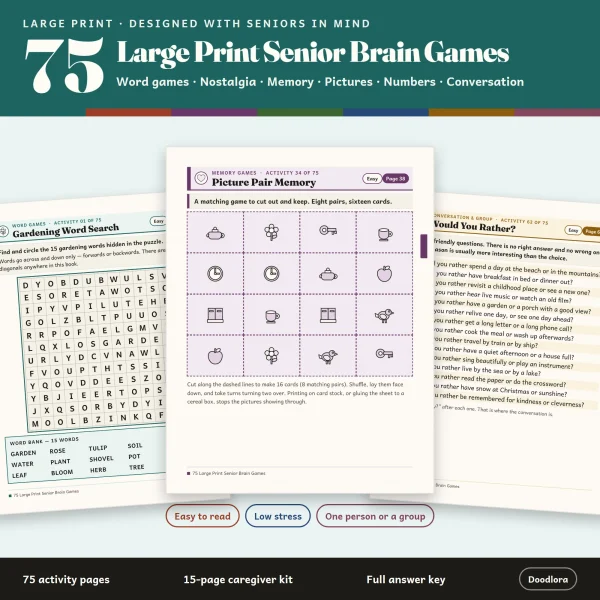
Our large-print book has five word searches on pages 5 to 9: gardening, favorite foods, around the home, travel memories and hobbies. Each hides 15 words listed in a word bank under the grid. Words run across and down only, forwards or backwards, and there are no diagonals anywhere in the book. The grid letters are set at 20 point.
The usual mistake is printing with “fit to page” switched on. That shrinks everything by about 6 percent and quietly undoes the large print, so print at 100 percent. To make a puzzle easier, say that the first word is in the top half. To make it harder, fold the word bank under.
Nostalgia trivia page
One person, or two talking it over, about ten minutes. Pages 20 to 34 of the same book hold the nostalgia section: 1950s, 1960s and 1970s trivia, classic television, classic movies, classic cars, school days, old-time household items and “remember the price.” Classic Television, for example, is ten multiple-choice questions about shows from almost every living room.
Circle an answer, then talk about it. A question about a car or a TV show often leads to a story, and the story is the better part. For someone who finds the choices too easy, cover the three answers and ask the question open.
The answer key has one catch. It lists answers by activity number, not by the page number printed in the corner. Classic Cars is activity 21 on page 25, so look under 21 in the key.
Flower coloring page
One person, with no finish line; a single bloom is a fine place to stop. Use colored pencils or markers and pick a page with large flowers.
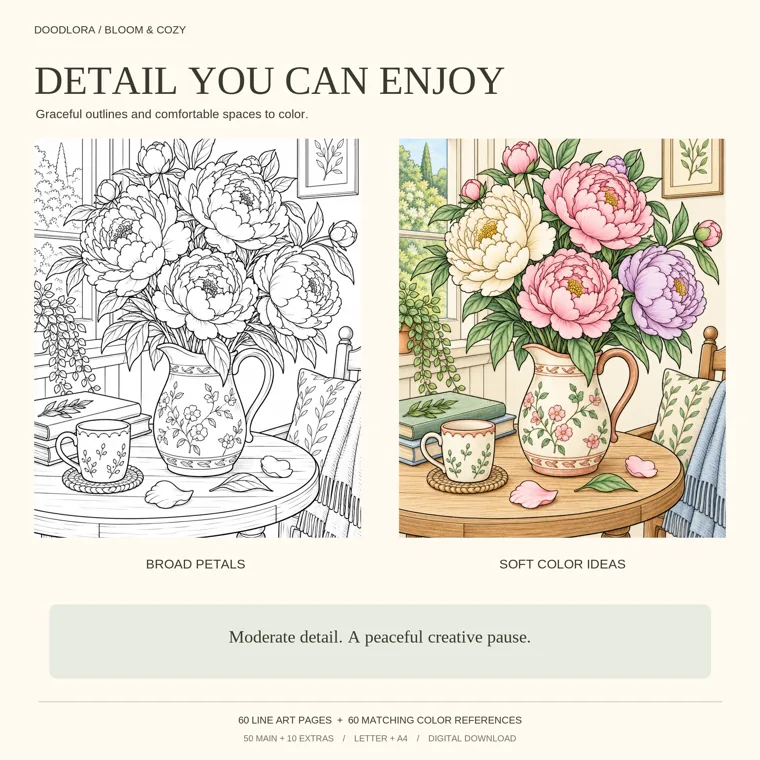
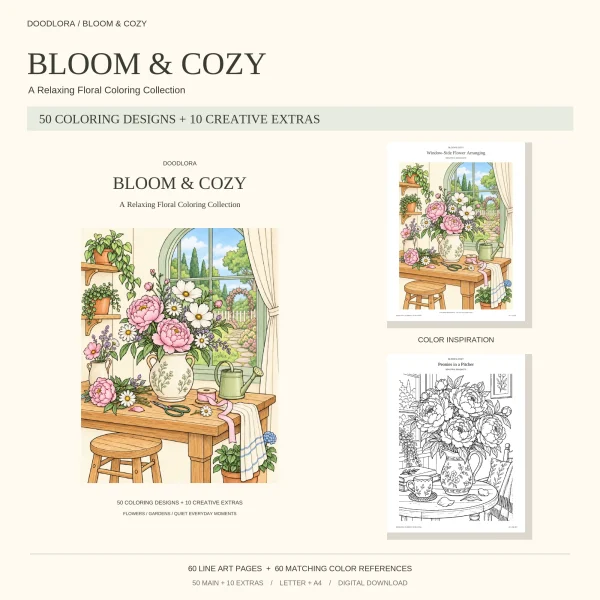
Our Bloom & Cozy set has 50 flower scenes and 10 extra pages, such as a vase to decorate. In the main PDF every outline page is followed by a colored version, marked as a reference with a note to use your own palette freely.
That layout creates the common printing mistake. If you print the whole 120-page file, half the pages come out in full color and use up the color ink. The outline pages are the odd pages (1, 3, 5 and so on), so print odd pages only, or use the separate folder of single line-art files. For more on paper and printer settings, see how to print coloring pages.
Writing pages with no wrong answers
One person, a few minutes at a time, spread over several days if they like. Three Good Things (page 75), My Favorite Memories (page 76) and My Life Favorites (page 79) ask for a few words under each heading: a favorite song, a favorite childhood memory, something I’m proud of.
Long writing pages can tire unsteady hands. The book’s own guide steers people who find writing uncomfortable away from the Alphabet Challenge and A to Z Favorite Things, which ask for a word for every letter from A to M. If writing is hard, someone else can hold the pen while the person answers.
Small number puzzles
One person, five to fifteen minutes. Pages 55 to 64 hold a 4×4 sudoku, a 6×6 sudoku, missing numbers, everyday shopping math (ten small sums of the kind you do at a register) and clock faces to read.
Start with the 4×4 sudoku, which is marked Easy. Every page in the book carries one of three levels: 45 Easy pages, 23 Gentle Challenge and 7 Moderate. The Moderate ones, such as Simple Logic and Mini Logic Challenge, are the busiest pages, so save them for a good day.
Activities for seniors with grandchildren or visiting family
A family visit goes better with one planned thing on the table. These need little setup and work with mixed ages.
Which Came First? timeline cards
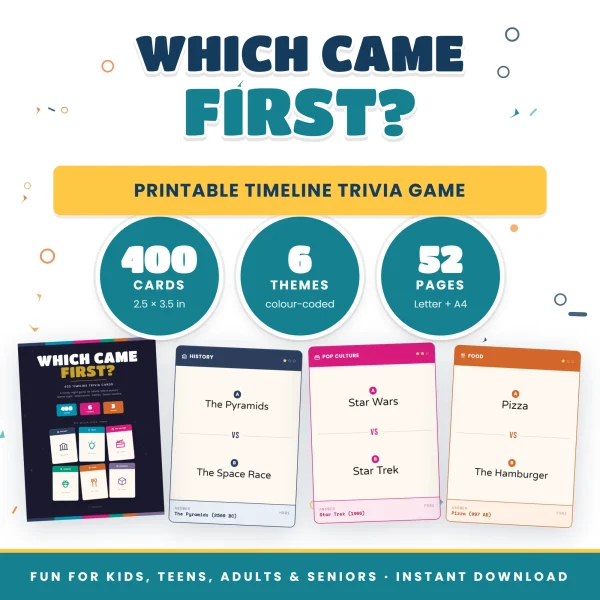
Two or more players, children and grandparents together. Each card names two things, like the Pyramids and the Space Race, and players say which came first. The answer and its date are printed in a strip at the bottom of the card.
To set up, print page 2 (the rules), page 3 (the score sheet) and one theme. History alone is 80 cards on pages 6 to 14, nine cards to a sheet. Print on card stock at 100 percent and cut along the dashed lines.
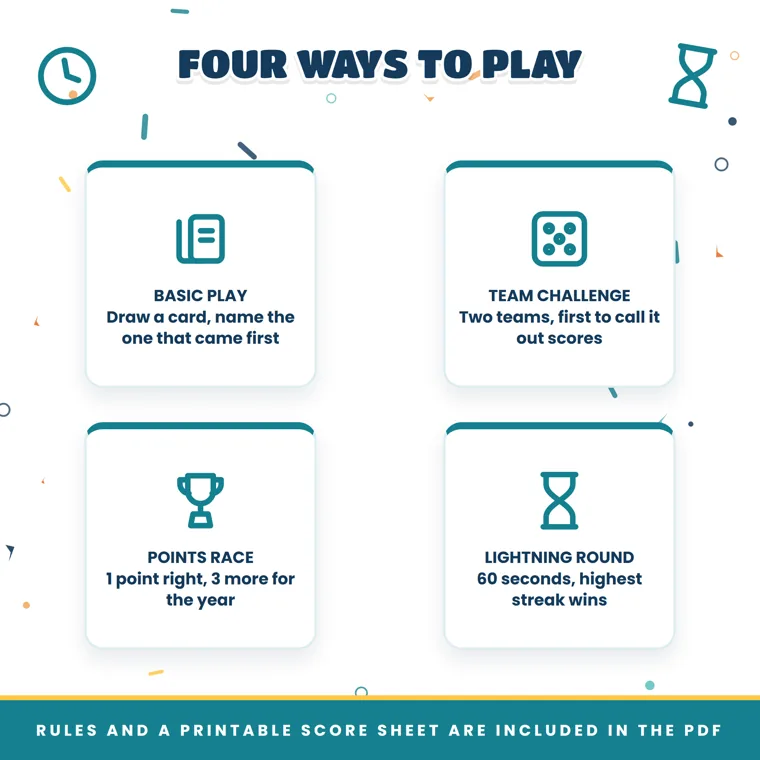
In Basic Play, players take turns drawing a card, reading both options aloud and naming the one that came first; a right answer keeps the card.
In Team Challenge, one person reads and two teams race to call out the answer, best of 20 cards. Each card also has one to three stars, so you can deal easy cards to a young child and hard ones to whoever knows every date.
The answer strip is in small type. Let the player with the sharpest eyes be the reader, and have them hold a thumb over the strip while reading the card aloud.
Picture Pair Memory
A grandparent and one or two grandchildren, for a few rounds of turn-taking. Page 38 of the large-print book is a sheet of 16 picture cards, eight pairs: teapots, clocks, keys, apples, birds and more. Cut them apart, shuffle, lay them face down and take turns turning over two.
Plain printer paper lets the pictures show through from the back, which spoils the game. Print on card stock, or glue the sheet to a cereal box before cutting. The full turn-taking rules and variations are in our memory game rules.
This or That around the table
Any number of people, about five minutes. Page 65 lists 20 pairs, such as coffee or tea, cats or dogs, radio or television and handwritten letter or phone call. Go round the table and let everyone answer, children included.
Nobody needs to read or write, so it works when eyesight varies. Ask “why?” after each choice, because the reason usually says more than the answer.
A 20-minute one-to-one visit
Two people. This plan comes from the visiting page of the book’s caregiver kit and suits an adult child or grandchild visiting alone.
- For the first three minutes, sit down with no page out and ask one question from the childhood or travel conversation pages (pages 67 and 69, fifteen questions each).
- From minute 3 to 12, do one activity page. Sit beside the person, not opposite, because opposite feels like a test.
- From minute 12 to 17, talk about whatever the page brought up. This is usually the best part of the visit.
- In the last three minutes, leave the page with them if they want it and say when you will be back.
The trap is the question “Do you remember…?” It turns a chat into a quiz. Ask “Tell me about…” instead, and if an answer differs from yours, say “That’s a good one” rather than “No.” If they fill in My Life Favorites (page 79), take a photo of the finished page before you leave. More question ideas are in our family conversation starters.
Group activities for seniors in an activity room
The book’s caregiver kit is written for six to twelve people and one leader. These activities keep a mixed group together.
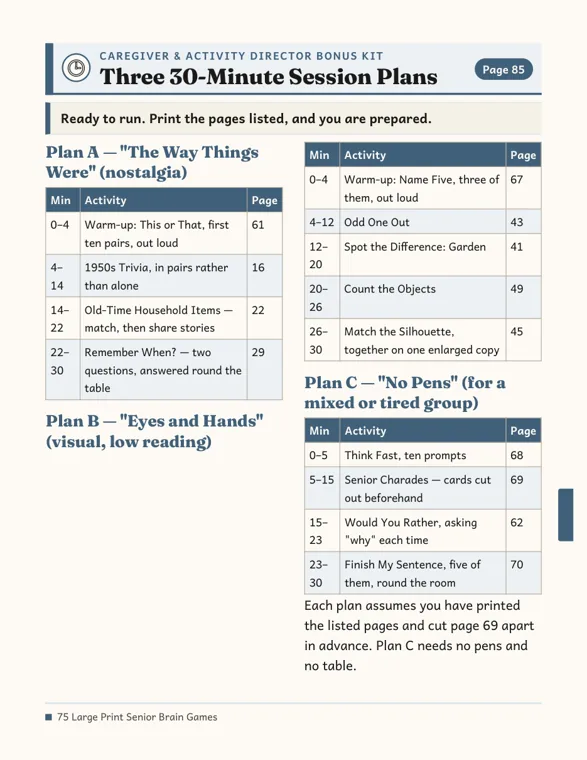
A 45-minute session plan
One leader, six to twelve people. Before people arrive, print one more copy than you expect and set out two more pens. Seat people so nobody has their back to the door or faces a bright window.
- 0–5 minutes: welcome and an easy spoken question, from Think Fast or This or That
- 5–15 minutes: one Easy page each, with help on offer
- 15–25 minutes: go through that page together, out loud
- 25–35 minutes: something social with no pens, such as charades
- 35–45 minutes: wind down with one closing question from Would You Rather
Three things go wrong. Someone finishes in two minutes: quietly hand over a harder page from the same section. Someone hasn’t started: sit beside them and read the first question aloud instead of asking whether they need help. The room goes flat: stop the page and switch to Think Fast for five minutes.
Think Fast
Six to twelve people, five to ten minutes, no paper for the players. The leader reads prompts from page 72, such as “Name something that is yellow” or “Name something with wheels,” and takes the first answer anyone gives. There are 20 prompts.
Speed is not the point. If the group is enjoying it, go round a second time, because second answers tend to be funnier.
Seated charades
Any group size, about ten minutes. Page 73 has 24 charade cards, and every one can be acted sitting down: fishing, knitting, winding a clock, opening an umbrella, packing a suitcase.
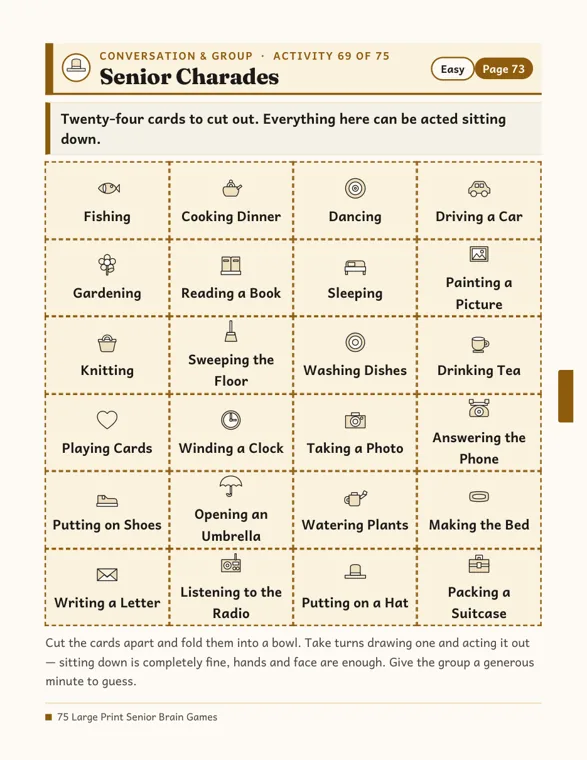
Cut the cards apart before the session, fold them into a bowl, and let each person draw one and act it. Hands and face are enough. Give the group a generous minute to guess before anyone reveals the answer.
A 30-minute reminiscence session
A group with one leader, or one person and a visitor, about 30 minutes. Reminiscence is a conversation with a subject, not a memory test, and the caregiver kit sets it up in five steps:
- Pick one subject only: school, food, work, holidays or music.
- Open with an object or a picture if you have one.
- Ask one open question, then stop talking and let the pause work.
- Follow whatever people offer, even if it leaves the subject.
- Close by naming something specific someone said.
Ask about the experience, not the fact. “What year did you marry?” has a right answer someone can miss; “What did the day feel like?” doesn’t. If a memory turns sad, don’t change the subject briskly. Say plainly that it sounds hard, sit with it a moment, then move to something nearby rather than something cheerful and unrelated. Tell whoever needs to know afterwards.
Picture games on one enlarged copy
A small group around one table, about 30 minutes for the full set. The book’s “Eyes and Hands” plan suits people who don’t want to read: Odd One Out, Spot the Difference in a garden (five changes), Count the Objects, and Match the Silhouette done together.
For the group page, enlarge a Letter page to 11×17 inches on a copier and hold it up. The two spot-the-difference pages are the only pages in the book that can’t be read aloud, so skip them for anyone with very poor eyesight.
Warm-ups that need no printing
Any group, five minutes. In Two Truths, each person says two things about themselves and nobody has to guess anything. In Round the Alphabet, pick a category such as fruit or towns and go round the circle, one answer each; nobody is ever out. For more, see the older-adults section of our icebreaker games for adults.
Avoid opening with today’s date, the day of the week or the season. Those questions are a memory test, and people in the room know it.
Adjusting activities for eyesight and hands
Small changes decide whether a page gets used or set aside.
- Eyesight: read the page aloud and let the person answer aloud. Lay a sheet of paper under the line being read so the eye doesn’t slip to the wrong row.
- Paper and light: use plain white or cream paper, not glossy, which throws light back. A plain dark placemat under the page cuts glare.
- Hands: you hold the pen and they answer. Circling is easier than writing, and drawing a line between two words is easier than circling.
- Pens: a thick black felt-tip beats a pencil because it needs less pressure and makes a darker line.
- No pen at all: This or That, Would You Rather, Name Five, Think Fast and Senior Charades are all spoken.
The page-number trap when printing the large-print book
The large-print book numbers its activities 1 to 75, but the pages are numbered from the cover, so each activity sits four pages later. Senior Charades is activity 69 on page 73. The caregiver kit and the answer key use activity numbers. When the session plan says “cut page 69 apart,” it means Senior Charades on page 73, not the travel conversation page that really is page 69.
The easiest fix is the folder of single-page files in the download. They are named a01 to a75 by activity number, so “69” in the kit matches the file that starts with a69.
Printables from this article
Related articles
Brain Games for Seniors
How to Play Sudoku: Sudoku Rules and Tips for Beginners
Sudoku rules in plain words, a small puzzle solved one move at a time, the scanning and pencil-mark habits that crack a 9×9, and what to do when you get stuck.
Brain Games for Seniors
Word Games for Seniors: 16 Printable and Group Word Games
Sixteen word games for seniors, from large-print scrambles to Ghost and a three-minute word search race, sorted for one person, a family visit or a group.
Brain Games for Seniors
Memory Games for Seniors: 14 Printable and Group Activities
Fourteen memory games for seniors, from look-and-cover pages to picture pairs and I Packed My Bag, sorted for a kitchen-table visit, grandchildren or a group.