Memory Games for Seniors: 14 Printable and Group Activities
The best memory games for seniors are short, sociable and easy to set up: look at a few things, cover them, and see what comes back, with nobody keeping score unless they want to. The 14 games below are sorted by the situation you are in, whether that is a quiet visit at the kitchen table, a holiday afternoon with grandchildren, or an activity room with a dozen people.
Most of them need nothing but paper, a tray of household objects or a deck of picture cards. Each one lists how many people it suits, roughly how long it takes, what to prepare, how to play and how it ends. The player counts and minutes are our estimates, not measurements, and a chatty table will run longer. That is usually the best part.
Pick a memory game by situation
| Game | Players | Time | Eyesight | Hands | You need |
|---|---|---|---|---|---|
| Look, cover and name | 1–2 | 5 minutes | Fine with large print, or read aloud | Say the answers | One printed page |
| What’s Missing? | 1–2 | 5 minutes | Needs to see pictures | Point or say | One printed page |
| Remember the Grocery List | 1–2 | 5 minutes | Can be read aloud | Circling only | One printed page |
| Remember the Room | 1–2 | 10 minutes | Needs to see a picture | Say the answers | One printed page |
| Short Story Memory | 1–3 | 10 minutes | Read it aloud | Say the answers | One printed page |
| Number Memory | 1–2 | 5 minutes | Large digits | Writing, or say them | One printed page |
| Picture pairs | 2–4 | 10–15 minutes | Large cards | Turning cards over | A picture card deck |
| Memory Walk | 2–6 | 5–10 minutes | Large cards | None | A picture card deck |
| Half Match | 1–4 | 10 minutes | Large cards | Sliding cards | Blank cards, a marker |
| Kim’s Game | 2–10 | 10 minutes | Real objects | None | A tray, 8–12 objects, a cloth |
| I Packed My Bag | 3–8 | 10 minutes | None needed | None | Nothing |
| Team picture pairs | 6–12 | 20 minutes | Large cards, close seats | Turning cards over | A picture card deck |
| Read-aloud word list | 6–20 | 10 minutes | None needed | Say “yes” | One page for the leader |
| Memory Challenge poster | 10–30 | 15 minutes | An enlarged copy | Say the answers | One page enlarged to 11×17 |
If eyesight is poor, start with the spoken games: I Packed My Bag and the read-aloud word list. With unsteady hands, pick a game played out loud and let a partner do the writing.
Memory games are only one kind of activity, and a whole afternoon of them gets tiring. Mix in some word searches, coloring or conversation from our activities for seniors guide, which also covers glare, paper and pens for weak eyesight.
Memory games for seniors one to one, at the kitchen table
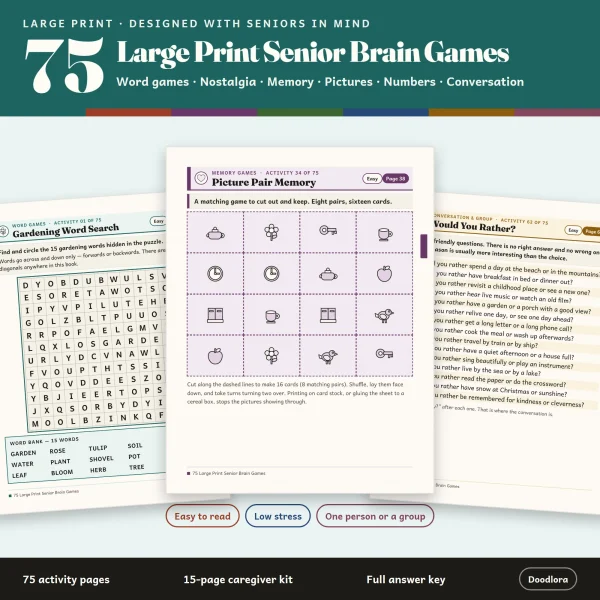
These suit an adult child, a grandchild or a caregiver sitting with one person. Sit beside them rather than across the table, so the page sits between you and it feels like a shared puzzle. The six printed games in this section come from the memory section of our large-print activity book, pages 35 to 44.
Look, cover and name
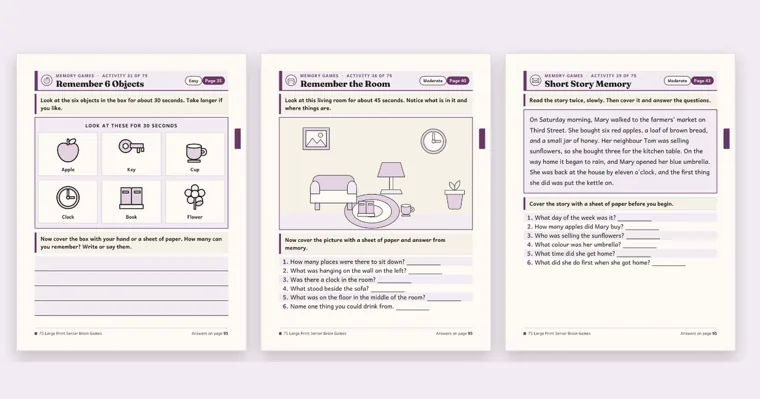
One or two people, about five minutes. Page 35 shows six everyday objects in a box: an apple, a key, a cup, a clock, a book and a flower. Look for about 30 seconds, cover the box with a hand or a sheet of paper, and say or write as many as come back.
Page 36 is the same game with eight objects: a bird, a shoe, a teapot, a candle, glasses, a basket, a leaf and a bell. The page suggests grouping them, two for the kitchen and two you wear, which makes eight feel like four. The game ends when the person has named all they can. Then lift the paper and look together.
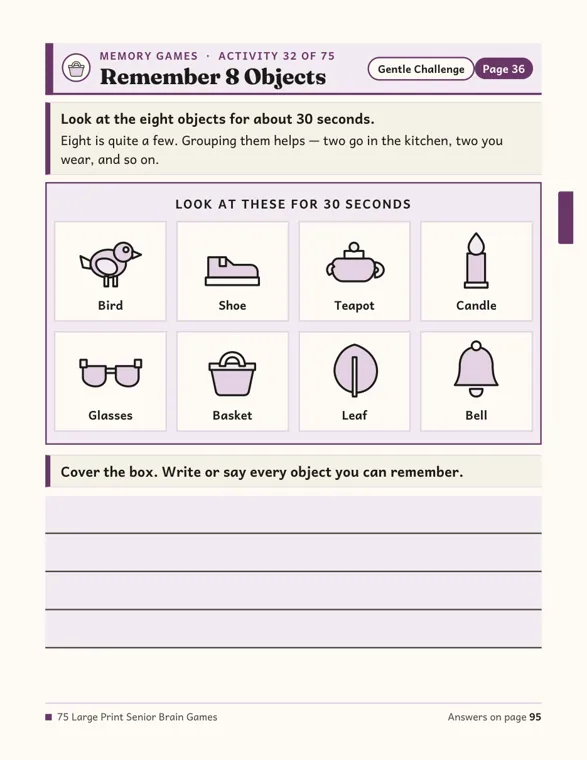
The book itself says the 30 seconds is a suggestion, not a test. Longer is fine and looking twice is fine. Drop the timer altogether if it makes anyone tense.
What’s Missing?
One or two people, about five minutes. Page 37 has four sets of pictures. Each set shows a first row of six objects, then a second row of five, and the player says which one has gone.
Cover the second row while the first is being studied, then swap. Without that, the eye just flicks between the rows and it becomes a spot-the-difference page.
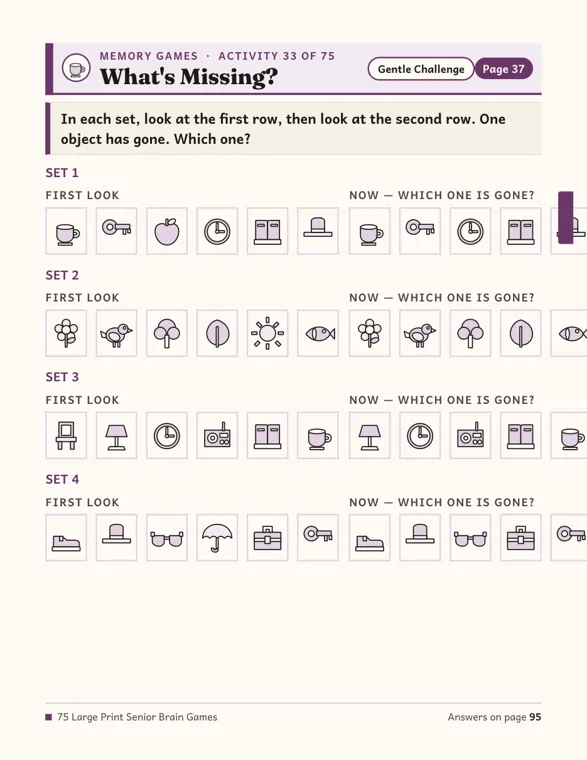
There is a printing catch on this page. The last picture of every second row runs past the right edge and gets cut off: a hat, a fish, a cup and a key. They are there, just clipped, and none of them is the answer. Say so before you start, or a sharp player will name the half-hidden picture and be marked wrong. The answers are the apple, the sun, the chair and the umbrella.
Remember the Grocery List
One or two people, about five minutes. Page 39 lists six groceries: milk, bread, eggs, an apple, cheese and coffee. Read it for about 30 seconds, cover it, then circle the six that were on the list from a longer list of ten.
The four extra items are sugar, an orange, butter and rice. Circling is easier than writing, so this page suits shaky hands. For someone who can’t see the page, read the six items aloud twice, then read the ten and let them say “yes” or “no” to each.
Remember the Room
One or two people, about ten minutes, and best kept for a good day. Page 40 is a simple drawing of a living room: a sofa, a picture on the left wall, a clock on the right, a lamp, a rug, a plant and a cup. Look for about 45 seconds, cover the picture, and answer six questions, such as “What stood beside the sofa?”
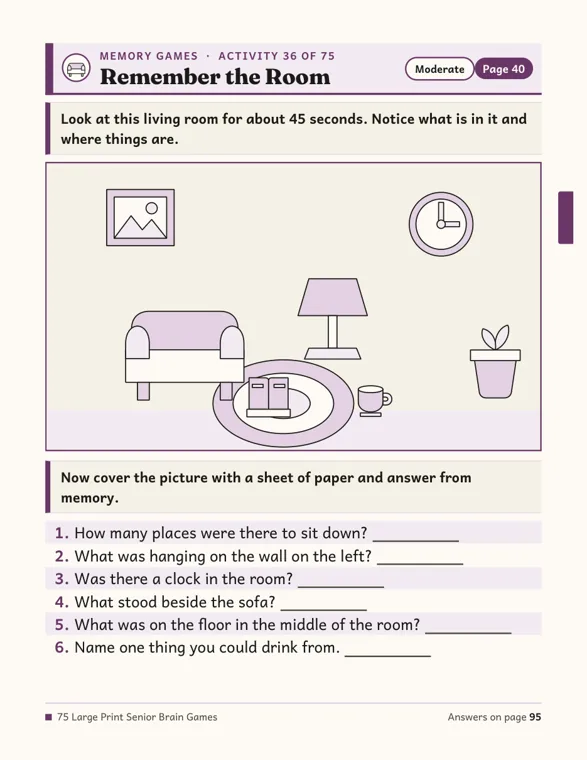
This is one of the book’s seven Moderate pages. The questions ask where things were as well as what was there, which is harder than naming a list. If it goes badly, leave the picture uncovered and answer the questions while looking. The book’s own caregiver pages suggest exactly that, because it turns the page into a naming activity that is still worth doing.
Short Story Memory
One to three people, about ten minutes. Page 43 is a five-sentence story about Mary’s Saturday trip to a farmers’ market. Read it twice, slowly, cover it, and answer six questions: what day it was, how many apples she bought, who sold the sunflowers, the color of her umbrella, when she got home and what she did first.
Read the story aloud rather than handing it over. The book’s caregiver kit lists this page under “avoid for now” for someone whom reading tires. Heard aloud, it becomes a pleasant listening game instead.
Number Memory
One or two people, about five minutes. Page 41 has six numbers of three to five digits, such as 482 and 51937. Look at each for about ten seconds, cover it with a thumb, and write it on the line below.
The page’s tip is a good one: say the digits out loud while reading them. For someone who dislikes writing, they can say the number back instead. This is a Moderate page, and five digits is a lot. Stop after the three- and four-digit numbers if the mood drops.
Memory games for a holiday visit with grandchildren
A visit with three generations at the table needs games where a six-year-old and an eighty-year-old can both win. Picture games do that best, because nobody needs to read and the youngest are often surprisingly good at them.
Picture pairs (Concentration)
Two to four players, about 10 to 15 minutes. This is the classic game, also called Concentration, Pairs or Pelmanism. Lay the cards face down, take turns turning over two, keep them if they match, and play passes on if they don’t. When the table is empty, whoever holds the most pairs wins.
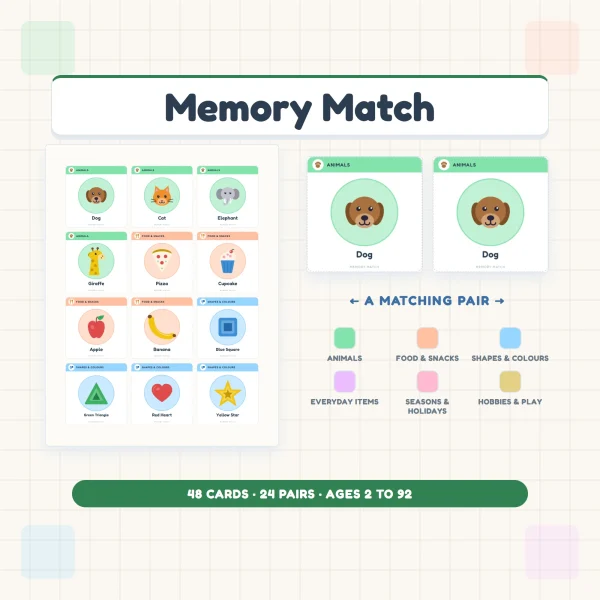
The number of pairs matters more than anything else. Our picture memory deck has 24 pairs across six themes, but its instructions suggest six to eight pairs for later years, from the most familiar themes. Everyday items such as a watch, a coffee cup, a book and a pencil work well, along with food and animals. For memory care the quick-reference card drops it to two to four pairs.
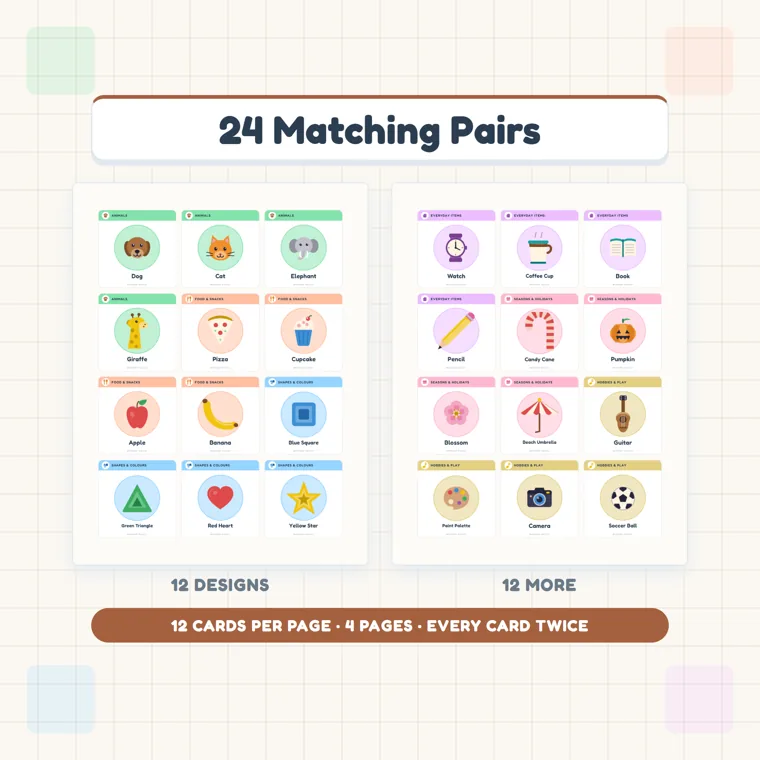
Watch the print size. The instructions say to print the cards at 120% for larger cards, but the card grid on the US Letter file measures about 7 by 9½ inches. At 120% it grows to about 8½ by 11⅜ inches, taller than a Letter sheet, so the bottom row gets cut off.
Print at 120% only on 11×17 paper. On Letter, stay at 100%, where each card is about 2¼ inches square, or try 110%. Use card stock so the pictures don’t show through. Scoring, the two-player version and what to do with the last two cards are covered in our memory game rules.
Memory Walk
Two to six players, five to ten minutes. Lay six to eight pairs face up and let everyone study them for 30 seconds. Turn them all face down. Then players take turns calling out a pair before turning it over, such as “the dog and the other dog.”
The deck’s instructions say this game and Half Match were written with memory care in mind. Both keep the turn-taking and the talk about the pictures, and take some pressure off the recall. Let the grandparent go first while the cards are freshest.
Half Match
One to four players, about ten minutes. Cut a few blank cards down the middle, draw one simple picture across each pair of halves, and mix the halves up. Players match the halves back together.
This is far gentler than recalling from memory, and the drawing is half the fun. A grandchild can draw the pictures while the grandparent matches them, then swap roles. The deck comes with 12 blank cards, and each one cut in half makes one drawing, so there are enough for 12.
Kim’s Game
Two to ten players, about ten minutes. Put eight to twelve ordinary objects on a tray: a spoon, a key, a button, a thimble, an orange. Everyone looks for a minute, then cover the tray with a cloth. Players say or write down as many objects as they can.
The game takes its name from Rudyard Kipling’s 1901 novel Kim, where the hero plays it with a tray of jewels. The version usually played with young children is easier: cover the tray, take one object away, uncover it and ask what has gone. That version suits mixed ages, and grandchildren love being the one who secretly removes something.
Pick objects from the grandparent’s own house and life. An old thimble or a darning egg starts a story that a plastic toy never would.
I Packed My Bag
Three to eight players, about ten minutes, and nothing to prepare. The first player says “I packed my bag and in it I put…” and names something. The next player repeats the whole list and adds one item, and so on around the table.
In the traditional rules, a player who forgets an item is out. Drop that rule for a mixed table. Let others give a hint instead, and keep going until the list gets silly. There are other forms too, such as “I packed my grandmother’s trunk,” “I went on a picnic,” or an alphabetical version where the items go A, B, C. The alphabet version helps, because each letter is a clue to the next item.
Memory games for a small group in an activity room
With six to twelve people and one leader, the games need to be visible from every seat and spoken rather than written. The caregiver kit in our large-print book suggests one warning for a group of mixed ability: avoid the timed memory pages. A 30-second clock shows everyone who is slowest.
Team picture pairs
Six to twelve players in two teams, about 20 minutes. Split into two teams and seat them alternately around the table. Teams take turns flipping two cards, a match lets that team go again, and the team with the most pairs wins.
Small cards are hard to see from the far side of a table. Use eight to twelve pairs at most, laid out in the middle, and let each player call “that one” while the leader does the turning. Calling out the card names as they are turned, “a pumpkin… and a guitar,” helps anyone whose eyesight is poor.
Read-aloud word list
Six to twenty players, about ten minutes. The leader reads eight words from page 42 twice, slowly: chair, river, button, garden, pencil, winter, basket and candle. Then the leader reads a list of 15 words, and the group calls “yes” for each one they heard.
Seven of the 15 are new, such as mirror, summer and kettle, so a “yes” to every word gives itself away. Nobody writes and nobody is singled out, so it suits a mixed group. For a second round, let a resident pick the eight words.
Memory games for a large group of 15 or more
A big room needs one thing everyone can see and answers called out by teams. For a word game, the read-aloud list above works at any size.
Memory Challenge poster
Ten to thirty players in teams of four to six, about 15 minutes. Page 44 shows ten objects, from an apple and a key to a car and an umbrella. Enlarge it to 11×17 inches on a copier, hold it up for about 45 seconds, then put it away.
Read the eight questions aloud, such as “Which object had wheels?” and “How many food items were shown?” Each team agrees on an answer before calling it out. The questions ask what things are for and what color they were, not just their names, which gives every team something to argue about. End by holding the poster up again and going through the answers together.
I Packed My Bag also works in a big room if you split into circles of six to eight. One long circle of 20 means a long wait between turns.
Making memory games easier or harder
The same page can be made gentle or tough in a few seconds. Our large-print book’s caregiver pages list several ways, and they work for any game here.
- Easier: cover the bottom half of the page so it doesn’t loom. Leave the picture uncovered and simply name what is there. Do it together, with you holding the pen.
- Harder: turn the page over and ask for the answers out loud. Add a second round, such as five more items after the first five.
- Fewer pieces: the card deck’s instructions start small children on a few pairs laid face up, so it is just a hunt. The same trick works with four or six pairs for anyone who finds face-down cards frustrating.
Keeping memory games fun, not a test
Treat these as games for company, not as a check on anyone’s memory. The book that most of the printed pages come from says plainly that it is not a medical product, not a test, and makes no health claims. Its advice for doing the memory pages in company is the friendliest one: read the list aloud together, then cover it.
Never keep a written score of who remembered what from week to week, and don’t comment on a slow day. A wrong answer usually leads somewhere. “A teapot? We had one shaped like a cottage” is a better result than a perfect list.
If the answers start turning into stories, follow them. Our trivia for seniors has questions from the 1950s to the 1970s for the next round, and our family conversation starters has questions grandchildren can ask.
Where to find the answers in the large-print book
Each memory page’s footer says “Answers on page 95,” but page 95 is only where the answer key starts. The memory answers are on pages 101 and 102. They are listed under activity numbers 31 to 40, four lower than the printed page numbers, so Remember the Room is listed as 36 although it is printed on page 40. If a caregiver page or the answer key mentions a number, add four to find the printed page.
Printables from this article
Related articles
Brain Games for Seniors
How to Play Sudoku: Sudoku Rules and Tips for Beginners
Sudoku rules in plain words, a small puzzle solved one move at a time, the scanning and pencil-mark habits that crack a 9×9, and what to do when you get stuck.
Brain Games for Seniors
Word Games for Seniors: 16 Printable and Group Word Games
Sixteen word games for seniors, from large-print scrambles to Ghost and a three-minute word search race, sorted for one person, a family visit or a group.
Brain Games for Seniors
Trivia for Seniors: 1950s, 1960s & 1970s Trivia Questions
Thirty-six trivia questions for seniors from the 1950s, 1960s and 1970s, each answer checked, with setup tips for holiday visits and activity rooms.