How to Play Sudoku: Sudoku Rules and Tips for Beginners
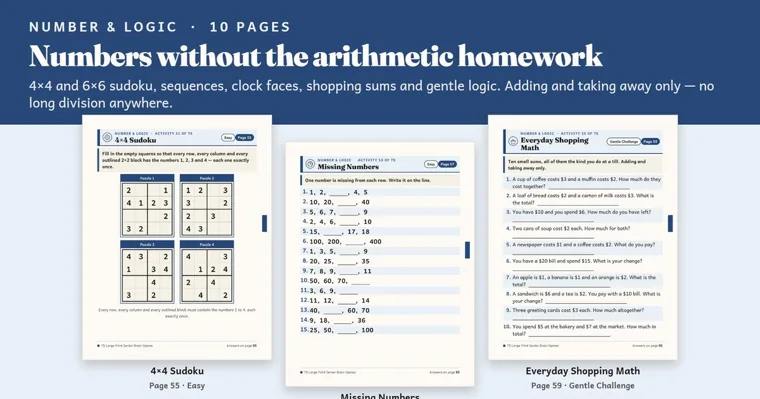
Sudoku is a logic puzzle on a grid of squares: you fill every empty square with a number so that each row, each column and each outlined box holds every number exactly once. On the standard 9×9 grid those numbers are 1 to 9. There’s no arithmetic in it. You find a row, column or box that is nearly full, write in the numbers you’re sure of, and pencil in possibilities when you run out of sure ones.
Below, we solve a real 4×4 puzzle from the first move to the last, start a 6×6, and then cover the moves that open up a 9×9. The later sections are for anyone teaching a parent or a grandchild: which size to start with, large print, and what to do when a puzzle stalls.
Sudoku rules and the names of the grid’s parts
Sudoku has one rule: no number may appear twice in any row, column or box. A row runs across, a column runs down, and a box is the group of squares outlined by thicker lines. The rule applies to all three at once, so a number that fits its row can still clash with its column.
Puzzle books and solving guides use a handful of words for the parts. These are the ones worth knowing:
| Word | What it means |
|---|---|
| Cell | One square of the grid. A 9×9 grid has 81. |
| Row, column | A line of cells running across, or running down. |
| Box (also block or region) | The outlined group of cells: 3×3 on a standard grid, 2×2 on a 4×4. |
| Given (or clue) | A number printed at the start. Givens never change. |
| Candidate | A number that could still go in an empty cell. |
| Proper puzzle | A puzzle with exactly one solution. |
A well-made puzzle has one solution, and you can reach it by reasoning, not luck. Wikipedia notes that the fewest givens a proper 9×9 sudoku can have is 17. The puzzle first ran in 1979 in Dell Magazines under the name Number Place. The name sudoku came later, from the Japanese puzzle publisher Nikoli: su means number, doku means single.
Before your first sudoku: size, pencil and a spare copy
Whether you’re learning alone at the kitchen table or sitting beside a parent who wants to try, the setup is the same. Start on a 4×4 grid even if your goal is the 9×9 in the newspaper. It uses only the numbers 1 to 4, so you see the whole rule at work in a few minutes instead of drowning in 81 cells.
Use a pencil with an eraser, and print two copies of each page. One wrong number can spread through a grid before anyone notices, and starting clean on the spare is quicker than erasing ten cells. A first 4×4 might take five to ten minutes and a first 6×6 longer; those are our estimates, and a 9×9 can easily run past one sitting. Leave it on the table and come back.
Print size matters more than people expect. In our large-print brain games book, the 4×4 grids are about 2.3 inches across with 24-point numbers, and the 6×6 grids are about 3 inches across with 21-point numbers. Print at 100% or “Actual size,” because “Fit to page” shrinks everything by about 6%. Normal print quality is enough, but Draft can make the grid lines too faint to follow.
Solving a 4×4 sudoku from start to finish
Page 55 of our large-print brain games book holds four 4×4 puzzles, all marked Easy, and each starts with nine numbers filled in. Every row, column and outlined 2×2 box must end up holding 1, 2, 3 and 4 once each.
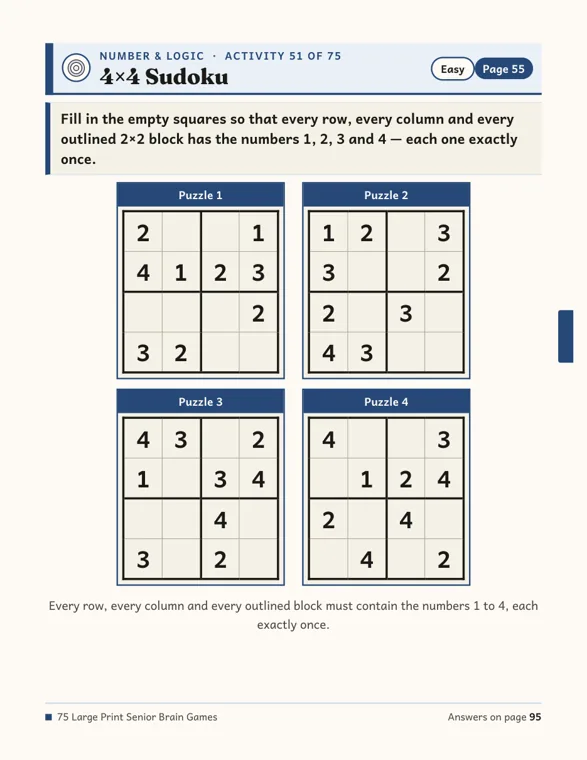
Here is Puzzle 1, with a dot for each empty cell. The four boxes are the top-left corner (rows 1–2, columns 1–2), the top-right corner, the bottom-left and the bottom-right.
| Col 1 | Col 2 | Col 3 | Col 4 | |
|---|---|---|---|---|
| Row 1 | 2 | · | · | 1 |
| Row 2 | 4 | 1 | 2 | 3 |
| Row 3 | · | · | · | 2 |
| Row 4 | 3 | 2 | · | · |
Start with the fullest group. The top-left box already holds 2, 4 and 1, so its one empty cell, row 1 column 2, must be 3.
Row 1 now reads 2, 3, ·, 1. The only number missing is 4, so row 1 column 3 is 4.
Column 1 reads 2, 4, ·, 3, which leaves 1 for row 3 column 1.
Row 4 reads 3, 2, ·, · and needs a 1 and a 4. Column 3 already has its 4 at the top, so the 4 can’t go in row 4 column 3. That cell is 1, and row 4 column 4 is 4.
Row 3 reads 1, ·, ·, 2 and needs a 3 and a 4. Column 2 already has a 3 in row 1, so row 3 column 2 is 4, and row 3 column 3 is 3.
| Col 1 | Col 2 | Col 3 | Col 4 | |
|---|---|---|---|---|
| Row 1 | 2 | 3 | 4 | 1 |
| Row 2 | 4 | 1 | 2 | 3 |
| Row 3 | 1 | 4 | 3 | 2 |
| Row 4 | 3 | 2 | 1 | 4 |
Before calling it finished, read each row, each column and each box once more. A repeated number means one move went wrong, and the cells after it need checking too. Every move above used one of two ideas, “only one number is missing here” or “this number can only go in one place,” and those two ideas carry you through most of a 9×9.
Moving up to a 6×6 sudoku
A 6×6 grid uses the numbers 1 to 6, and in our book its boxes are two rows tall and three columns wide. Follow the thick lines on whatever page you print, because 6×6 puzzles elsewhere sometimes turn the boxes the other way, three rows by two columns. Page 56 has two of these puzzles, marked Gentle Challenge, each with 18 givens.
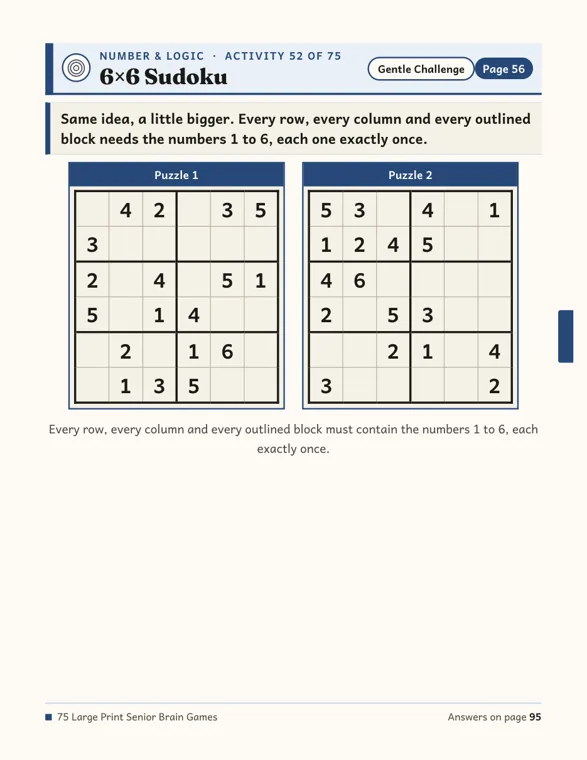
Puzzle 1 opens with this top row: ·, 4, 2, ·, 3, 5. Only 1 and 6 are missing, and they belong in column 1 and column 4. Column 4 already has a 1 further down, in row 5, so its top cell takes the 6, and the 1 goes in column 1.
That new 6 unlocks the next move, which happens often in sudoku. Row 3 reads 2, ·, 4, ·, 5, 1 and needs a 3 and a 6. Column 4 now holds a 6 at the top, so row 3 column 4 is 3, and row 3 column 2 is 6. From there, keep looking for the fullest row, column or box.
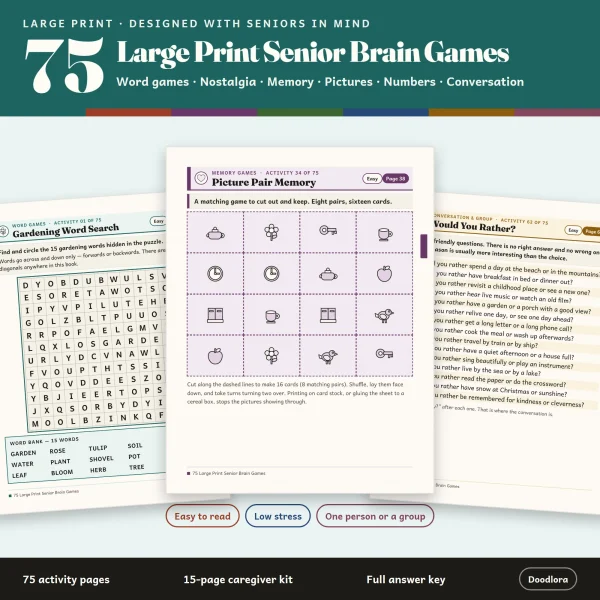
Those two pages come from our large-print brain games book, which has 75 activity pages. The 4×4 and 6×6 pages are its only sudoku, so it suits a beginner’s first week rather than a long run of 9×9s. For the other number pages in it, the shopping sums and clock faces, see our activities for seniors guide.
How to solve a 9×9 sudoku: the first moves
A 9×9 grid works on the same two ideas, with more places to look. The habit that helps most is to work through one number at a time, 1 to 9, and check every box for it, rather than staring at the grid as a whole.
Cross-hatching to find where a number goes
Pick a number, say 7, and a box that doesn’t have one yet. Run your eye along the three rows that pass through that box. Any row that already holds a 7 somewhere else is ruled out. Then run down the three columns the same way. If only one empty cell in the box survives, the 7 goes there.
The Glossary of Sudoku on Wikipedia calls this cross-hatching: checking the rows and columns that cross a box for one number. On an easy puzzle it often places the first several numbers, so make one full pass through 1 to 9 before trying anything else.
Singles: the cell with only one possible number
Now turn it around and start from a cell. List which numbers its row, column and box already use. If eight of the nine are taken, the ninth is the answer. The Glossary of Sudoku on Wikipedia calls this a single, also a singleton or lone number. The first move on the 4×4 puzzle above was a single: the box had room for one number only.
Hidden singles: the only place left for a number
A cell may have several candidates, but if one of those numbers fits nowhere else in its row, column or box, it has to go there. That’s a hidden single. The 1 in the top row of the 6×6 puzzle was one: column 4 couldn’t take it, so column 1 was its only home. Cross-hatching is really a quick way of finding hidden singles.
Pencil marks for candidates
When scanning stops turning up anything, write the candidates small in the corner of each empty cell: every number its row, column and box don’t rule out. Erase each candidate the moment a new number rules it out. With the marks on the page, singles and hidden singles become easier to spot.
Pencil marks are tiny, which is a problem for tired eyes. In large print, mark one box at a time, or copy the row you’re stuck on onto scrap paper and work the candidates there.
Naked pairs when singles run out
Sometimes two cells in the same row, column or box can each only be the same two numbers, for example 3 or 8. You don’t know which cell takes which, but the pair has claimed both numbers. Cross 3 and 8 off every other cell in that row, column or box. That’s a naked pair, and it often turns a cell nearby into a single.
What to do when a sudoku gets stuck
On an easy or medium puzzle, a stall usually means a missed number or a mistake rather than a puzzle that’s too hard. Work through these in order:
- Scan 1 to 9 again, in order. People tend to skip the same number on every pass. Saying each number out loud helps.
- Look for a repeat. Read every row, column and box for a number that appears twice. If you find one, erase back to the last move you were certain of.
- Fill in all the candidates. Most people only pencil in a few cells. A full set of marks shows singles and pairs that weren’t visible before.
- Take a break. Ten minutes away often shows you the move you couldn’t see.
- Check one cell, not the whole answer. Cover the answer grid with paper and slide it down to reveal one row. One correct number is usually enough to restart.
Guessing works, but if a guess is wrong, everything after it is wrong too. If you do guess, circle the guessed cell and use a different color for the moves after it, so you know exactly what to erase.
How to pick the right sudoku difficulty
Choose the grid size first, then the label. Move from 4×4 to 6×6 to 9×9, and stay on a size until you can finish one without help. Difficulty labels belong to each publisher: our book marks its 4×4 page Easy and its 6×6 page Gentle Challenge, while newspapers and apps use their own scales. An easy puzzle in one book can feel like a medium in another, so try two or three at a level before deciding.
Two signs say it’s time to move up: you finish without needing pencil marks, or you’re bored halfway through. If every puzzle needs the answer key, step down a level. Sudoku should be pleasant; a puzzle that ends in frustration doesn’t teach anything.
For older eyes, print size matters as much as difficulty. Newspaper grids are small, so if a parent squints at the daily puzzle, a large-print page at the same difficulty is the better change.
Teaching sudoku to a parent or a grandchild
Sit side by side with one copy, and let the learner hold the pencil. Point at a row and ask “what’s missing here?” instead of naming the answer. If a wrong number goes in, say “check that column” rather than “that’s wrong,” and let them find the clash. If their hands are unsteady, they say the number and you write it in. A sheet of paper laid under the row being read keeps the eye from slipping.
With a grandchild, take turns: one person places a number, and the other checks its row, column and box before the next turn. A child who knows the numbers 1 to 4 can usually manage the 4×4 grids with a little help. For younger children, the four-shape sudoku in our brain teasers for kids uses pictures instead of numbers.
In an activity room, give everyone their own copy at their own level instead of sharing one grid, since sudoku is quiet, solo work. If the group also wants something louder, follow it with a round from our trivia for seniors questions, or a game from memory games for seniors.
Where to find the sudoku answers in the large-print book
The answer key in our book is easy to misread. The footer of each sudoku page says “Answers on page 95,” which is where the answer key begins. The sudoku answers themselves are on page 104, under the headings “Page 51 · 4×4 Sudoku” and “Page 52 · 6×6 Sudoku.” Those headings use activity numbers, which run four lower than the printed page numbers. So “Page 51” means the 4×4 page printed on page 55.
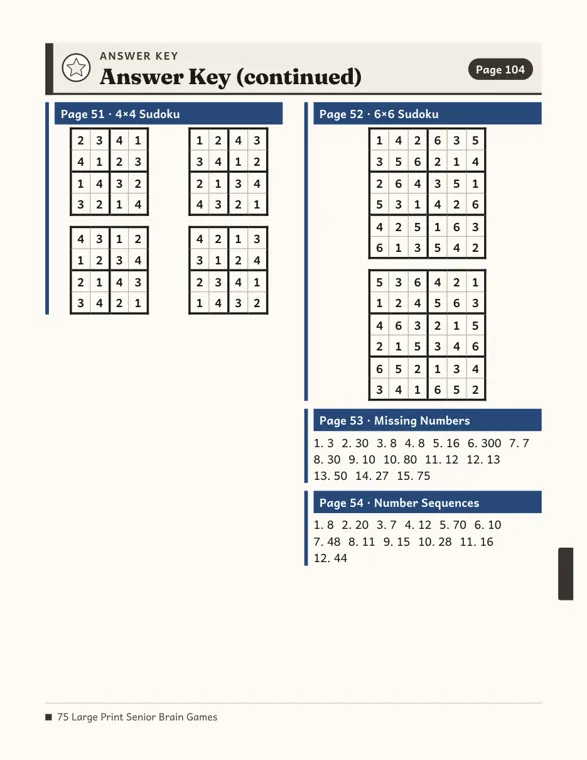
The answer grids use smaller numbers than the puzzles, so a magnifier helps. The download also includes each activity as its own PDF, named by activity number: a51 is the 4×4 page and a52 the 6×6. Print those alone when you want a fresh copy, rather than the whole 106-page book.
Printables from this article
Related articles
Brain Games for Seniors
Word Games for Seniors: 16 Printable and Group Word Games
Sixteen word games for seniors, from large-print scrambles to Ghost and a three-minute word search race, sorted for one person, a family visit or a group.
Brain Games for Seniors
Memory Games for Seniors: 14 Printable and Group Activities
Fourteen memory games for seniors, from look-and-cover pages to picture pairs and I Packed My Bag, sorted for a kitchen-table visit, grandchildren or a group.
Brain Games for Seniors
Trivia for Seniors: 1950s, 1960s & 1970s Trivia Questions
Thirty-six trivia questions for seniors from the 1950s, 1960s and 1970s, each answer checked, with setup tips for holiday visits and activity rooms.