Family Conversation Starters: 64 for Dinner, Kids and Teens
A good family conversation starter asks about one specific moment, is easy for the youngest person at the table to answer, and leaves room for a second question. “How was school?” gets “fine.” “Who made you laugh today?” gets a name, and a name usually comes with a story. Ask one question of the whole table, let the youngest answer first, then follow up on what you just heard with “Why?” or “What else?”
Below are 64 family conversation starters in seven groups, sorted by the kind of night you’re having and who’s at the table. After the lists come ways to keep one question going across ages, what to ask next, and when to let someone pass. The ages in the table are a rough guide, not a rule.
| Group | When it fits | Who answers best | Watch for |
|---|---|---|---|
| Easy questions about today | School-night dinners, one or two questions | Everyone from about 4 up | Questions about the whole day get “fine” |
| Funny questions | Tired kids, picky eaters, visiting cousins | Mixed ages | Laughing at someone instead of with them |
| Family history questions | Grandparents visiting, holidays | Kids ask, adults answer | Old stories that touch on a loss |
| What-if questions | Car rides, waiting rooms, bedtime | About 5 and up | Correcting a made-up answer |
| Questions for ages 4 to 7 | Preschool and early grades | Little kids, going first | Copying an older sibling |
| Questions for teens | Weeknights with older kids | 12 and up | Questions that are really grade check-ins |
| Deeper questions | A small group on a slow evening | Older kids and adults | Asking in front of guests |
Easy family dinner questions about today
Use these on a school night when people mostly want to eat: one question, one round, then let dinner be dinner. They work for everyone from about four up because each one points at something from the last few hours, which is far easier to answer than a summary of the whole day.
- Who made you laugh today?
- What was the best part of your day, and what was the second-best part?
- What did you have for lunch, and would you trade it for anything?
- What was the hardest thing you did today?
- Did anything surprise you today?
- What did you see on the way home that nobody else at this table saw?
- If today were a book, what would the title be?
- What is one thing you’re looking forward to this week?
- Who did you help today, or who helped you?
- If you could replay one part of today, which part would you pick?
The snag with “the hardest thing” is that some kids hear it as “what went wrong,” and the table goes quiet. Answer it yourself first with something small, like a jar lid that wouldn’t open, so everyone sees that a small answer counts.
Funny conversation starters for tired kids and visiting cousins
Silly questions are the easiest way in when the table is tired, a picky eater is digging in, or cousins who barely know each other sit down together. Nobody can get a funny question wrong, so shy kids often answer these first. Let people act out their answer if they want to, since a hummed theme song beats a described one.
- What animal would be the worst at your job or at your school, and why?
- If our family had a theme song, how would it go? Hum a bit.
- What food would you refuse to eat even for a hundred dollars?
- What is the strangest thing you believed when you were little?
- If you swapped lives with a pet for a day, what would you do first?
- Which household chore would be fun if it were an Olympic sport?
- What is your superhero name, and what is your very small superpower?
- If the furniture in this room could talk, which piece would complain the most?
- What noise would a dinosaur make if it stubbed its toe? Show us.
- What silly rule would you add to this house for one day?
The usual problem is a sibling laughing at an answer instead of with it. Set the line before the first question: everyone laughs at the joke, nobody laughs at the person. If it happens anyway, move straight on to the next answer rather than stopping dinner for a lecture. And if the cousins would rather play than talk, our family game night ideas are sorted by who’s playing, from preschoolers to teens.
Family history questions to ask grandparents and parents
These turn the usual direction around, because the kids ask and the adults answer. They fit holidays and visits, when a grandparent is at the table and the kids have never heard what school was like back then. Hand the question to a child to read out. A grandparent will often tell a grandchild more than an adult who asks the same thing.
- What is your earliest memory?
- What was your favorite toy or game when you were my age?
- What did your family usually eat for dinner when you were a kid?
- What was your first job, and what did you buy with your first paycheck?
- What is a family trip or day out that people still talk about?
- Where did you live when you were ten, and what was your street like?
- Where does one of our family recipes, jokes or sayings come from?
- What was school like when you were young, and what would surprise kids today?
- What music was playing in your house when you were growing up?
- What is the story behind your name?
Old stories sometimes lead to a person who has died, a move nobody wanted or a hard year. Let the storyteller decide how far to go, and don’t push for details. Two people may also remember the same trip differently. Ask each one for the detail they noticed and let both versions stand, so nobody gets corrected at dinner.
What-if questions for car rides and waiting rooms
Imagination questions need no shared history and no table, so they suit the car, a waiting room or the last few minutes before bed. Kids from about five can play, and adults usually find them easier than they expect. If your family likes choosing between two options more than open questions, our would you rather questions for kids are built on either-or choices.
- If you could keep any animal as a pet, with no limits on space or cost, what would it be?
- If you could live inside a book, show or game for a week, which would you pick?
- If you invented a new holiday, what would people do on it?
- If you could talk to one kind of animal, which would you choose, and what would you ask?
- If our house could sit anywhere in the world, where would you move it?
- If you could be any age for one week, what age would you pick?
- If you were in charge of school lunch for a month, what would be on the menu?
- If you shrank to the size of an ant for an hour, where would you explore?
- If you could add one room to our house, what would it be for?
- If you could time travel once, would you go forward or back, and to when?
The answers are made up, so keep the follow-up inside the made-up world. If a child moves the house next to a candy factory, don’t explain why that can’t happen. Ask who is allowed to visit, or what it costs to get in. For a long drive, our road trip games for kids and adults mix questions like these with games played out the window.
Conversation starters for kids ages 4 to 7
Little kids answer best when a question is concrete and can be answered with a few words, a color or a quick show-and-tell. Let them go first. Once a four-year-old has heard an older sibling’s answer, the easiest thing to do is repeat it.
- What color do you feel like today?
- What is your favorite thing to do outside?
- Which animal can you act out? Show us.
- What did you play with today?
- What is the yummiest thing on your plate right now?
- If you had a magic hat, what would come out of it?
- What game do you like to play with your friends?
- What makes you feel brave?
A one-word answer from a four-year-old is still an answer, so ask about the word. “Blue” can become “What else is blue?”, and “Pizza” can become “What goes on top?”
Conversation starters for teens that don’t feel like a quiz
Teenagers tend to go quiet when a family question is really a check-in on homework or grades. Questions that put them in the expert’s chair work better, and so do questions the adults have to answer as well. Keep it to one or two a night, because a whole list in a row starts to sound like an interview.
- What is something you know a lot about that we probably don’t?
- What song, show or video should the whole family try, and why?
- What skill would you learn if time and money didn’t matter?
- What is something adults get wrong about people your age?
- If you ran this house for a week, what would you change first?
- Which fictional character would make a great roommate, and which would be a nightmare?
- What is a food or movie opinion you’d defend against everyone at this table?
- What advice would you give yourself from three years ago?
Question 4 invites a complaint, and that’s the point of asking it. Hear the whole answer before defending anything, or the next answer you get will be “I don’t know.”
Deeper family conversation starters for quieter nights
Save these for evenings with fewer people around, like a slow Sunday dinner or a drive with one child. They need older kids and adults who are in the mood, and they go better when nobody outside the family is listening.
- What is something you’re proud of that nobody noticed?
- What is a mistake that taught you something useful?
- Who outside our family has been kind to you lately?
- What makes someone a good friend?
- What small thing makes you feel at home?
- What is something you’ve changed your mind about, like a food, a book or a habit?
- What do you hope people remember about you?
- What would you like our family to do more of together?
A deep question asked in front of guests can feel like a spotlight. When a family friend or a cousin’s new partner is at the table, pick from the funny or what-if lists instead, and keep this list for when it’s just you.
How to keep one question going when the ages are mixed
The hardest table to talk at has a preschooler and a grandparent at it. Keep everyone on one topic and change only how deep the question goes. A four-year-old answers “What was the best part of today?” while a parent takes “What moment from today would you want to remember a year from now?” Both answers are about today, so they land next to each other, and the youngest actually hears what the adults said.
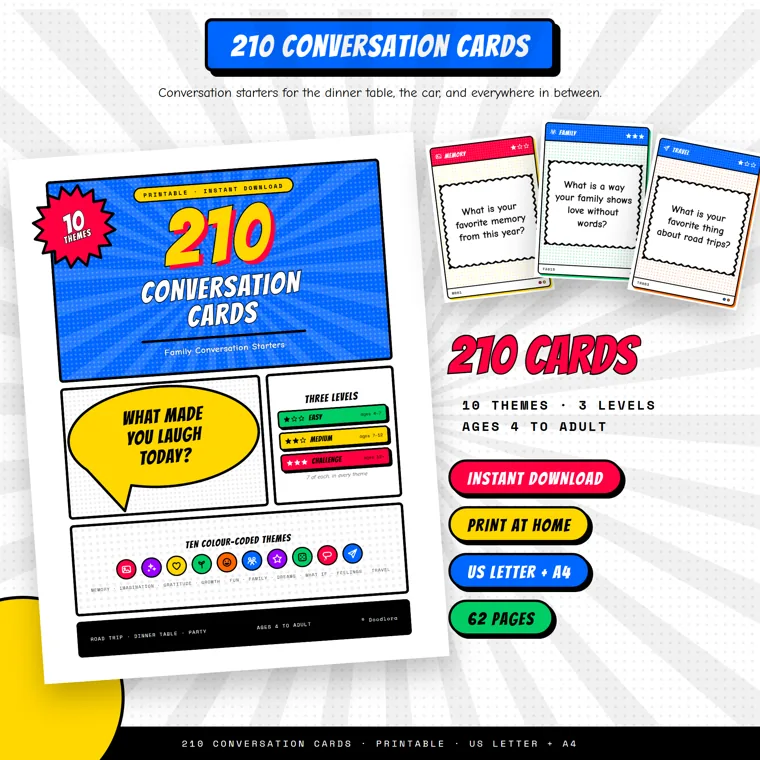
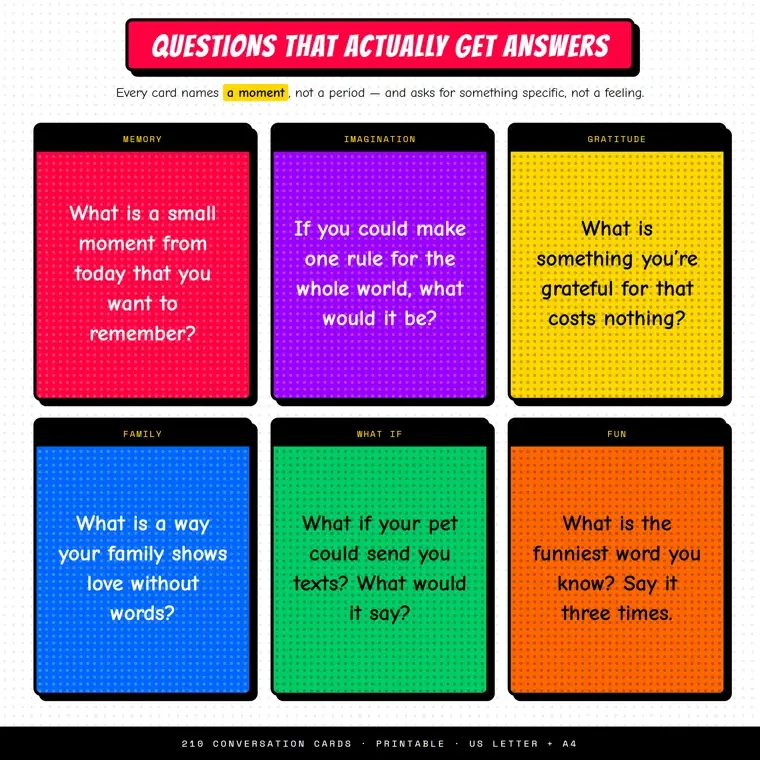
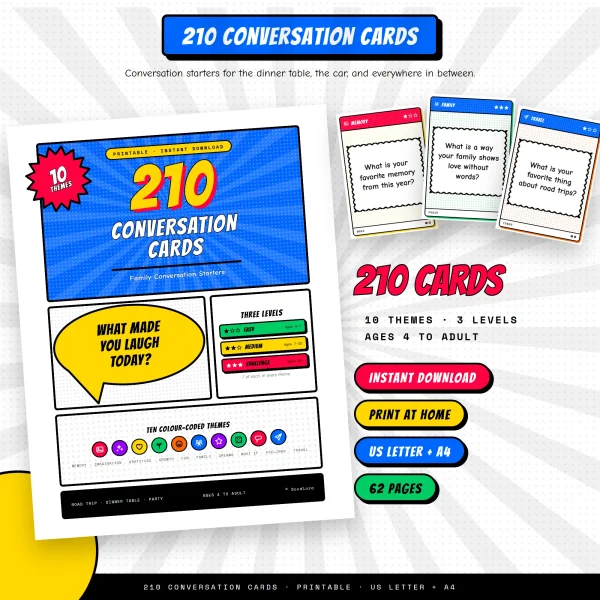
Separate lists for kids and adults split the table into two conversations, which is the opposite of the point. Our printed Family Conversation Cards are built around the same idea. Each of the ten themes has easy, medium and challenge cards, marked with one, two or three stars for ages 4 to 7, 7 to 12 and 12 and up, so a child and a grandparent can draw from the same theme.
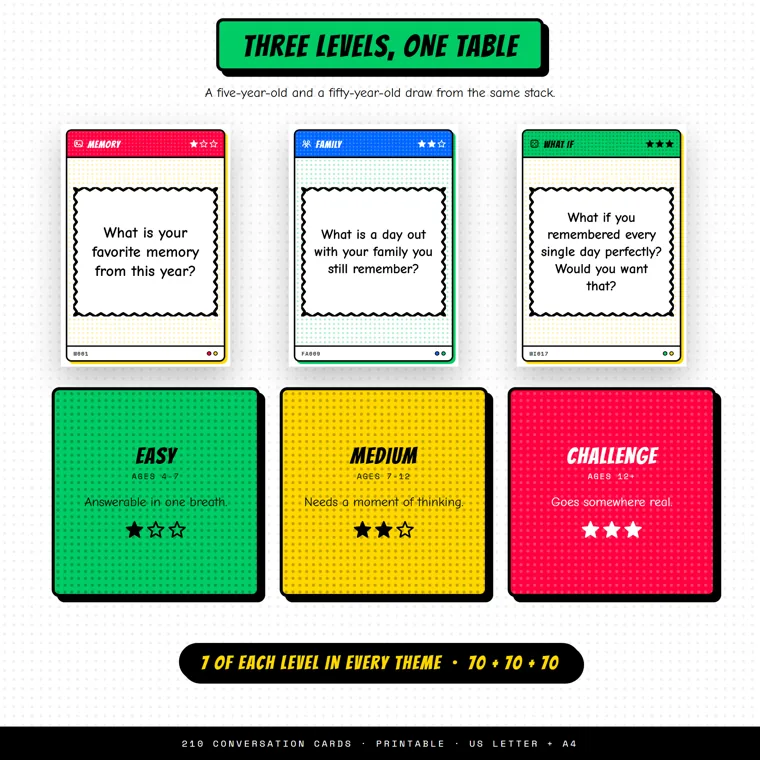
Grown-ups answer too. The deck’s how-to page prints that as a house rule, with the reason that it’s what makes kids answer honestly. Treat “easy” and “deep” as a way to pick a question, not a label for a person. A tired adult can take an easy one, and a seven-year-old who wants a deep question can answer it with one example or a drawing.
Follow-up questions that use the answer
The first answer only opens the conversation. “Why?” or “What else?” works anywhere, and the deck’s how-to page calls that second question the place where the real conversation starts. A stronger follow-up borrows a detail from the answer itself. If the best part of the day was “the aquarium,” ask what they thought it would be like before they went. If someone would pack the dog first for a one-bag move, ask what has to come out so he fits.
Ask one follow-up at a time. “Where was it, who was there, and why did you like it?” is three questions, and the person answering has to pick which one to drop.
When the answer is “I don’t know”
The deck’s house rules include a line that helps here: there are no wrong answers, only short ones. If someone says “I don’t know,” offer an easier question on the same topic instead of repeating the first one louder. Or move to the next person and come back at the end of the round. Hearing two or three other answers first gives a hesitant speaker something to agree or disagree with.
Letting family members pass, and when to hold back
A follow-up asks someone to say more, and a pass rule lets them say nothing at all. Our deck puts it plainly: “Anyone may pass — passing is always allowed and never explained.” The “never explained” part matters, because asking why someone passed is the same question again with more pressure. Offer the question to the next person, or give the person who passed a different one, and keep going.
Questions about feelings need the most care. The Feelings theme in our deck runs from what makes you feel happy or calm to what makes you feel sad, nervous or lonely. Questions like those suit a quiet car ride with one child and make a risky pick at a holiday table full of guests, so leave them out when you’re asking a crowd.
Don’t turn a private answer into entertainment for the table. If a question leads somewhere uncomfortable, thank the person, move on and offer to talk later, just the two of you. When an answer turns into a real conversation, stop asking questions.
Family questions stall at a table of adults who met an hour ago, because there are no shared stories to draw on yet. Start that crowd with icebreaker games for grown-up guests, which ask for something easy to say first.
Printing a family conversation card deck
Everything above works from a phone screen, but a printed deck lets kids draw the question themselves, which is half the fun for a five-year-old. The deck holds 210 questions, 21 in each of ten themes, from Memory and Family to What If and Travel.
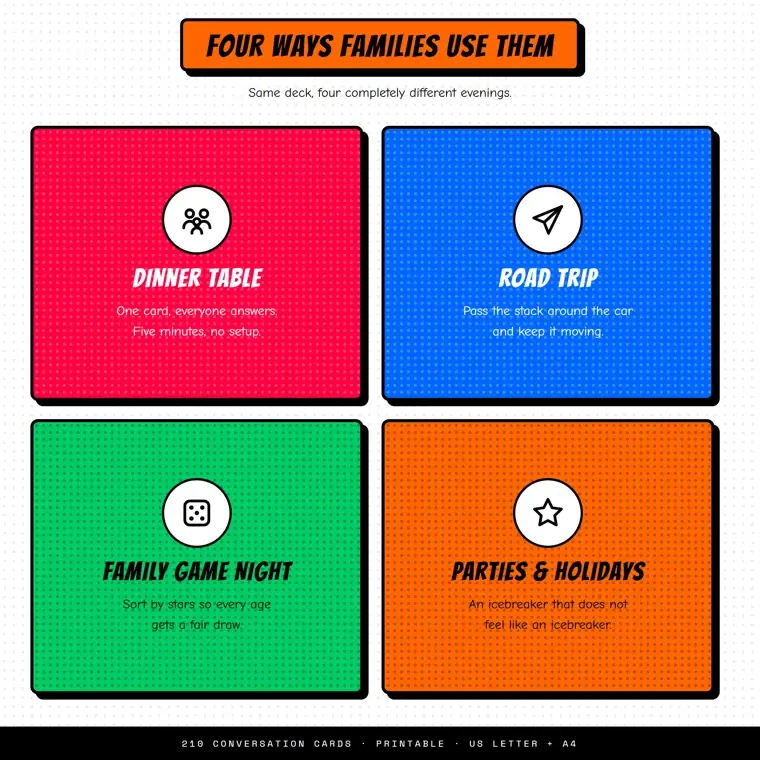
Its how-to pages suggest five ways to use it: one card for the whole table at dinner, a stack passed around the car, cards sorted by stars, everyone guessing an answer before it’s given, and a jar on the counter anyone can dip into.
The deck comes as US Letter and A4 PDFs, 62 pages each, and the cards print four to a sheet at 3.5 x 5 in (8.9 x 12.7 cm). The guide asks for white card stock between 65 and 110 lb (170 to 300 gsm). Store labels make that confusing, since a 110 lb index sheet is a little lighter than an 80 lb cover sheet, and comparing the gsm on the pack settles it.
Print at actual size, not Fit to page, or the cards come out smaller. With 53 sheets of question cards, a paper trimmer saves a lot of scissor work.
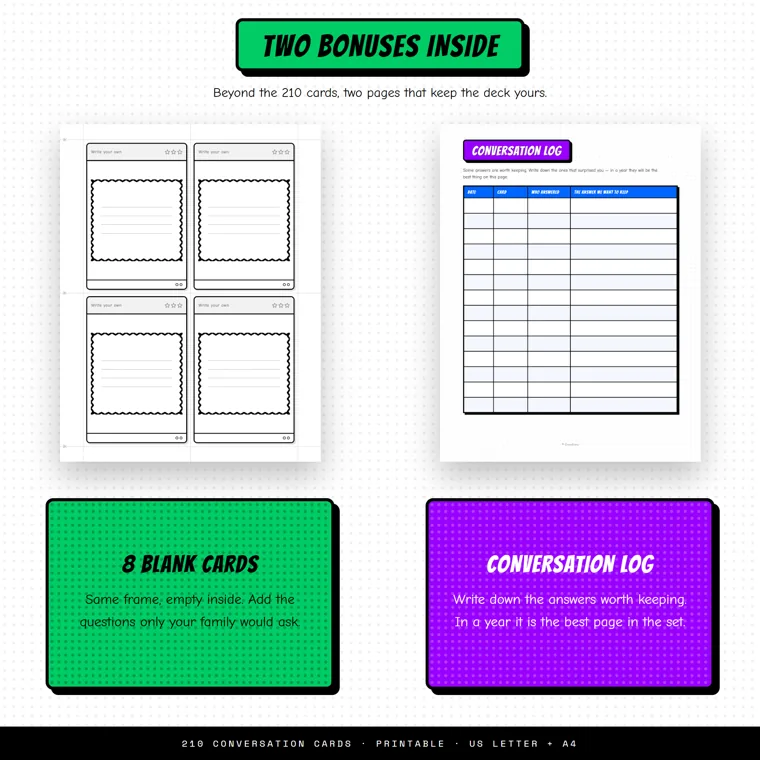
Two pages near the end hold eight blank “Write your own” cards, and the page after them is a conversation log with columns for the date, the card, who answered and the answer worth keeping. Use the blanks for questions only your family could ask, about a pet, a grandparent’s hometown or a running joke. Ask before you write anyone’s answer in the log, especially a child’s.
Printables from this article
Related articles
Printable Party Games
How to Plan a Baby Shower: Timeline, Food & 2-Hour Schedule
A baby shower plan from the first talk with the parents-to-be to the last gift: timing, guest list, budget, venue, a two-hour schedule, safe food and backup plans.
Printable Party Games
How to Plan a Bridal Shower: Timeline, Budget and Schedule
A host's plan for a bridal shower, from the first talk with the bride and co-hosts to the guest list, invitations, a timed party schedule, the gift opening and what to do when something slips.
Printable Party Games
35th Birthday Ideas: Party, Trip, Theme and Gift Ideas
Ways to celebrate turning 35, sorted by how many people the birthday star wants around, with group size, time, prep and the snag to plan for in each.