Word Games for Seniors: 16 Printable and Group Word Games
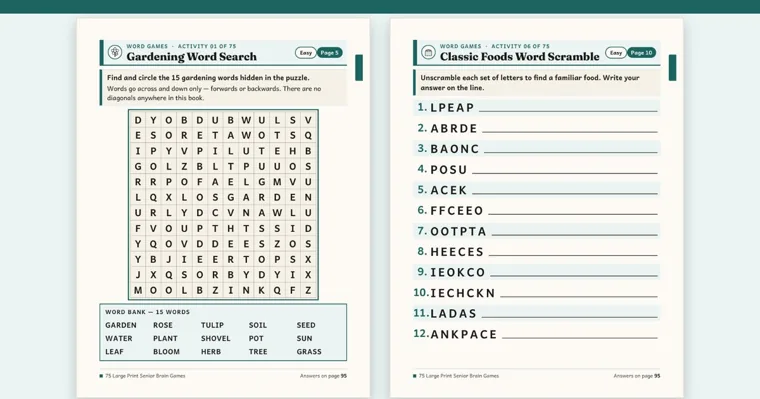
The best word games for seniors use everyday words, big letters and rules you can explain in one breath. Pick them by the situation: a quiet page for one person at the kitchen table, a spoken game when grandchildren visit over the holidays, or a race that a whole activity room can play at once.
The 16 games below are sorted that way. For every game you’ll get the number of players, a rough running time, the setup, the rules and the point where it stops. Those players-and-minutes figures are our own guesses, so expect a talkative group to take longer. Where a game has a catch, such as small print, letters that sound alike or an answer key that gives itself away, you’ll find it in that game’s entry.
Pick a word game by situation
| Game | People | Time | You need | Good for |
|---|---|---|---|---|
| Christmas or winter word search | 1 | 10–20 min | One printed page, a pencil | A quiet holiday afternoon |
| Word scramble | 1 | About 10 min | One printed page | Someone who likes to write |
| Missing vowels | 1, or a group at a whiteboard | About 10 min | One page or a whiteboard | Short sittings |
| Finish the word | 1–2 | About 10 min | One printed page | Reading clues aloud together |
| Line-matching pages | 1 | 5–10 min | One page, a felt-tip pen | Unsteady hands |
| Alphabet challenge | 1 | 10–15 min | One page | A slow, no-pressure page |
| Snowman hangman | 2–5 | 5 min a word | Paper, a thick marker | Grandchildren visiting |
| Ghost | 2–5 | A few minutes a round | Nothing | Sharp spellers |
| Word ladder | 1–4 | 10 min | Paper, a pencil | Puzzle lovers |
| Twenty Questions | 2–8 | 5–10 min a round | Nothing | Mixed ages, poor eyesight |
| Words within a word | 2–6 | 10 min | Paper for each player | Gentle competition |
| Word search race | 2–12 | 3–5 min | The same page for each player | An activity room |
| Finish the saying | 6–20 | 10 min | A list of sayings | Big groups, no paper |
| Word chain | 3–12 | 5–10 min | Nothing | A circle of chairs |
| Rhymes and pairs, read aloud | 4–20 | 10 min | One page for the leader | Mixed-ability groups |
| Fictionary | 4–8 | 10 min a round | A dictionary, slips, pens | Keen readers |
Pencil-and-paper word games for one person
These suit one person with a table, good light and half an hour. Print two or three pages, not a stack, and let them choose. For setup basics, such as which pen to use and where to put the lamp, see our activities for seniors, which also covers the large-print gardening and hobbies word searches.
Christmas or winter word search
One person, 10 to 20 minutes for an Easy page. Print one puzzle at actual size (100 percent) and set out a pencil or a highlighter, which is what the printing guide in both books suggests.
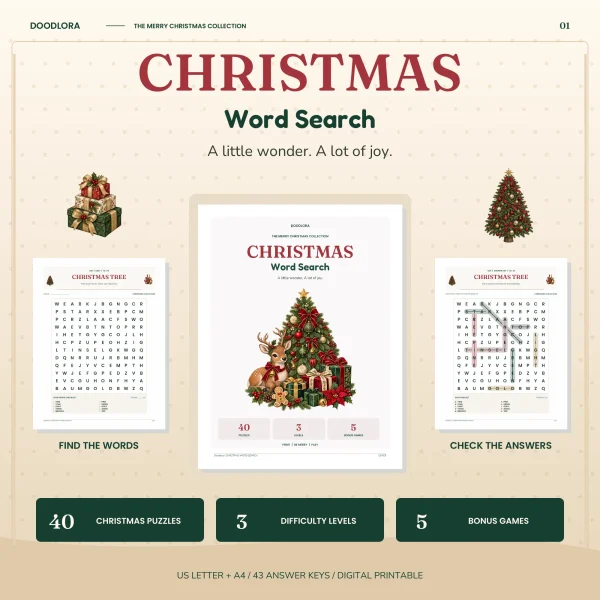
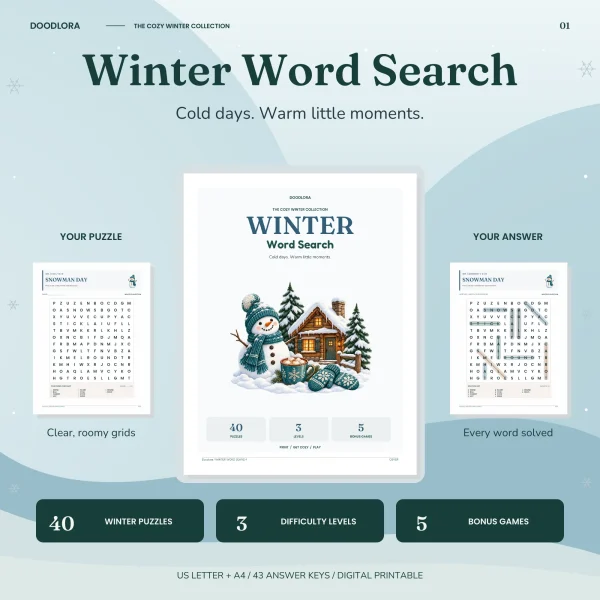
Our Christmas and winter word search books hold 40 puzzles apiece, split into 12 Easy, 16 Medium and 12 Hard. Each puzzle has a word checklist under the grid. An Easy grid is 12 by 12 and hides 10 words. They read left to right or top to bottom, and at most two slant down toward the bottom right corner. Medium (15 by 15, 12 words) and Hard (20 by 20, 16 words) hide words in every direction, including backward and up.
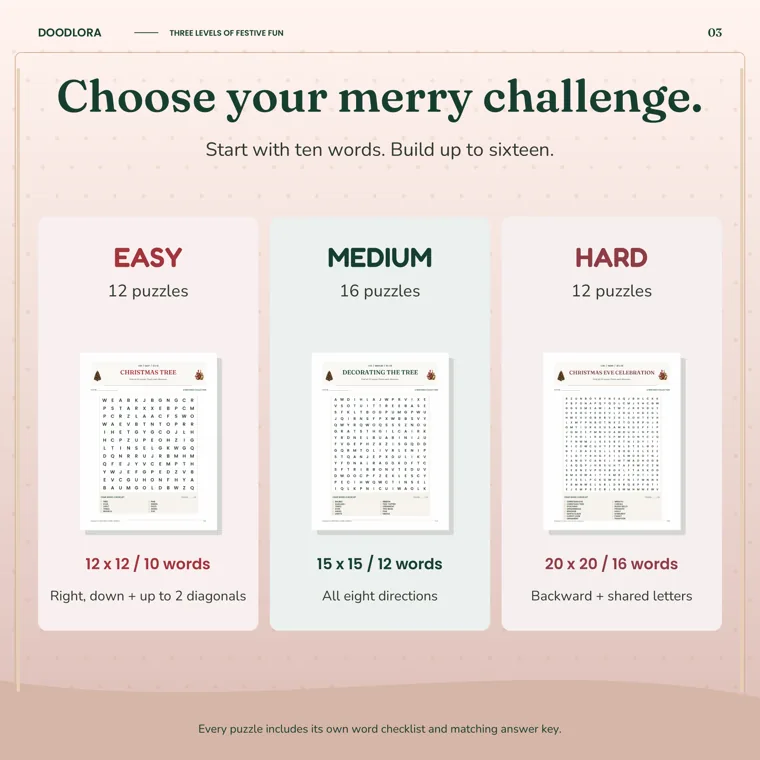
None of the 40 puzzles in the winter book mention Christmas. Their themes are snowmen, mittens, hot cocoa, red foxes and frozen ponds. That makes it the one to print for January, or for anyone who doesn’t celebrate Christmas.
The catch is the checklist. On an Easy page the letters in the grid measure about 20 point, while the checklist below is printed at roughly 9 point. Someone who can read the grid easily may still struggle with the list of words to find. Read the list aloud, or copy the 10 words onto an index card in thick marker. Hard pages bring the grid letters down to about 12 point, so keep those for people with good close-up eyesight.
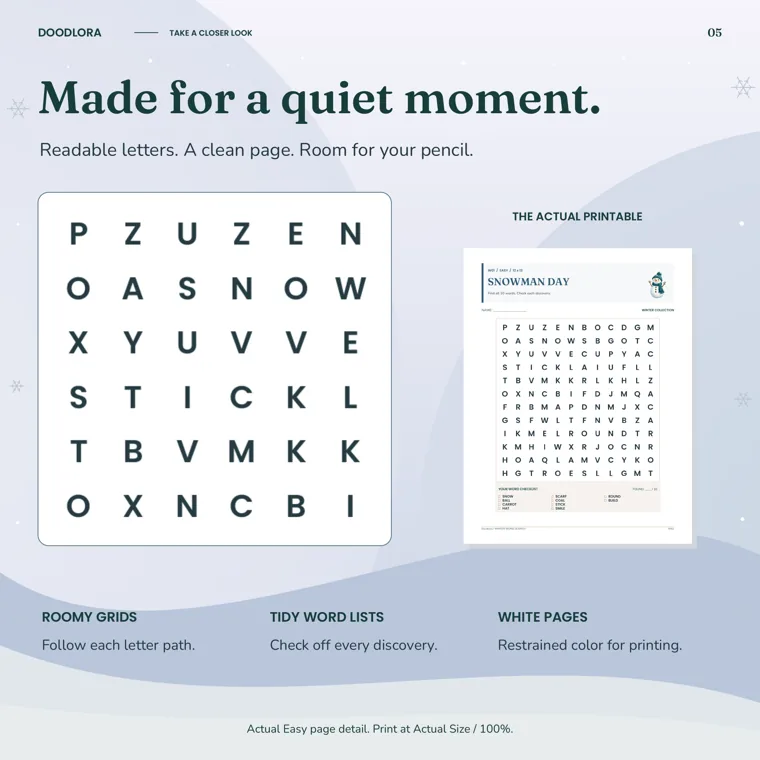
The game ends when all 10 words are circled or the person decides to stop. Every puzzle has its own answer key, 40 pages later in the file, so the key for the first puzzle on page 3 is on page 43.
Word scramble
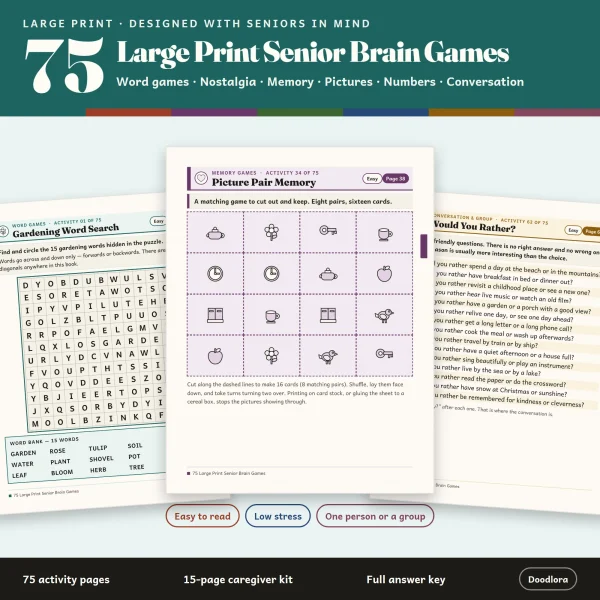
One person, about 10 minutes. Our large-print activity book has two scramble pages: familiar foods on page 10 and household items on page 11, 12 words each. The scrambled letters are printed big, about 24 point, with a line beside each for the answer.
The first food is LPEAP, which is APPLE. That one is a good test of the page, because doubled letters slow everyone down. If someone gets stuck, give the first letter rather than the answer. The page is finished when all 12 lines are filled, or when the person has had enough. Leave the rest for tomorrow.
Missing vowels
One person, about 10 minutes. Page 12 of the large-print book takes every vowel out of 15 everyday words, so G_RD_N is GARDEN. Each word has a box and a line to write in.
The page also works as a group game. Copy five of the words onto a whiteboard in big capitals, one at a time, and let the room call out the answer. The hard ones are words with two vowels side by side, such as BR__KF_ST for BREAKFAST and T__P_T for TEAPOT. Say “two letters missing there” when a word stalls.
Finish the word
One or two people, about 10 minutes. Page 15 gives 15 word beginnings with a short clue under each: GAR with “where flowers grow,” KIT with “where you cook,” TEA with “you pour from it.” It works well with two people, one reading the clue aloud and the other answering.
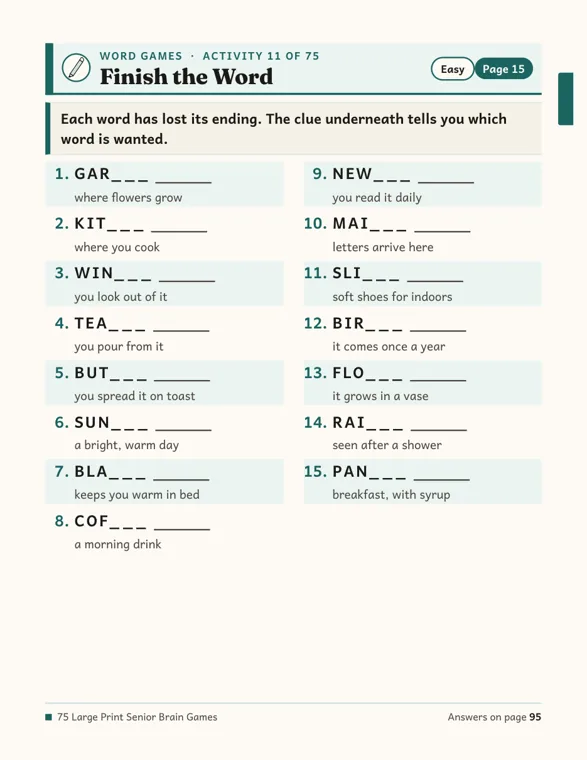
Warn the solver about the dashes before they start. Every word shows three of them, but most answers need more letters: SUN becomes SUNSHINE and NEW becomes NEWSPAPER. A careful person who counts the dashes will reject the right answer. Tell them the dashes are only decoration and the clue is what counts.
Line-matching pages
One person, five to ten minutes a page. Three pages in the large-print book ask you to draw a line between two columns instead of writing. Page 13 joins 12 compound words, such as SUN and FLOWER. Page 16 matches 12 opposites, and page 17 matches 12 words with a word that means nearly the same.
Choose these pages for shaky hands. A line from one word to another needs far less control than writing a word on a short line. Use a felt-tip pen, which needs less pressure than a pencil. Each word is used once, so the last pair always falls into place, and that makes a good place to stop.
Alphabet challenge
One person, 10 to 15 minutes. Page 19 asks for one word starting with each letter from A to M, and any word counts. The page itself says to skip a letter that won’t come and go back to it later, which makes it the most relaxed page in the section.
To give it a winter feel, pick a topic first: things you’d find in a kitchen in December, or names of places you’ve traveled to. The page is done at M. Nobody has to finish the alphabet.
Word games for a holiday visit with grandchildren
These need two to five people and almost nothing to prepare, so they fit a winter visit when everyone’s around the table after a meal. Let the older player hold the pen or set the word. Children enjoy being the guessers.
Snowman hangman
Two to five players, about five minutes a word. The setter picks a secret word and marks one blank per letter. Everyone else calls out letters one by one. Each correct letter is written into its blanks, and each miss earns one more piece of the picture.
Hangman’s usual drawing is a hanged stick figure, and many families swap it for something gentler. Wikipedia’s article on the game mentions crossing apples off a tree or taking slices out of a pie. In winter, build a snowman instead: three balls, a hat, two eyes, a nose and a scarf give eight wrong guesses. Guessers win when every blank is filled, and they may call out the full word whenever they think they know it. If the snowman gets its scarf first, the setter wins.
Two rules prevent arguments. Decide up front if names are allowed, and write every wrong letter in a row under the drawing in big capitals. Without that row, someone will guess the same letter twice.
Ghost
Two to five players, a few minutes a round, no equipment. Going round the table, each player says one letter and tacks it onto a growing string, which must always be able to grow into a real word. Whoever completes a word of three or four letters or more (agree which before you start) loses the round. A player can challenge instead of adding a letter, and the full challenge rules are in our party games for adults.
Lose a round and you collect the next letter of GHOST. Spell the whole word and you’re out. For a family table, play to three letters (G-H-O) so the game doesn’t run past dessert.
The trap is hearing. Spoken letters such as B, D, P and T sound alike, especially across a noisy table. Write the string on a sheet of paper as it grows, and keep it where the person with the weakest hearing can see it.
Word ladder
One to four players, about 10 minutes. You’re given a start word and an end word, and you change one letter at a time, making a real word at every step. COLD to WARM goes COLD, CORD, CARD, WARD, WARM.
Lewis Carroll is credited with inventing the game, and he said he came up with it at Christmas in 1877. That makes it a fitting puzzle for the holidays. Stick to three- or four-letter words for a first try, because five-letter ladders get hard quickly. Write the ladder as a column on the page, so everyone can see the rungs. A pair can work on one ladder together, with a grandchild suggesting letters and a grandparent checking spelling.
The ladder is done when it reaches the end word. If two people are racing, the shorter ladder wins.
Twenty Questions
Two to eight players, five to ten minutes a round, nothing to print. One player picks a secret thing, and the rest ask yes-or-no questions in turn. Whoever names it correctly picks next. After 20 questions with no right answer, the same player wins the round and picks again.
Twenty Questions suits poor eyesight best, because nothing has to be read. Before the first question, the thinker says which of three kinds it is: person, place or thing. That’s a common variant, and it stops the first five questions being wasted. Keep a tally of questions on paper, because everyone loses count around question 12.
Words within a word
Two to six players, about 10 minutes. Write one long word at the top of a sheet for each player, such as SNOWFLAKE. Everyone lists as many words as they can make from its letters in five minutes: SNOW, LAKE, FLOW, OWL, ANKLE and so on.
Settle two things before the timer starts: whether three-letter words count, and whether plurals count. At the end, read the lists aloud. A word nobody else found scores one point, which keeps strong spellers from running away with it. The highest score wins, and children can play on a team with a grandparent.
Group word games for an activity room
These work for six to twenty people with one leader. Everyone can join in from their chair, and the spoken games don’t need a pen at all. Plan about 30 minutes and use two or three games. For timed memory games and quiz rounds, see our memory games for seniors and trivia for seniors.
Word search race
Two to twelve players, three to five minutes. Five bonus games sit at the end of each word search book. The simplest is Jingle Bell Sprint, on page 83 of the Christmas book. Everyone gets a copy of the same puzzle, a timer runs for three minutes, and each player circles all the words they can. Each correct word is one point, and a tie counts as a shared win.
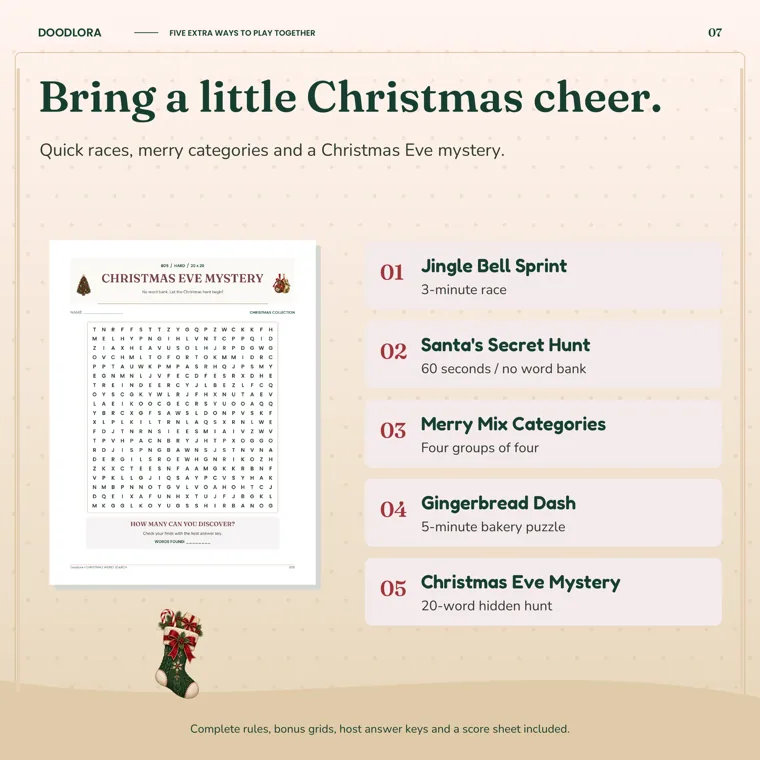
Merry Mix Categories, on page 86, suits a group better. Players get five minutes to hunt for 16 words, sorted under four headings of four words each, from decorations and treats to gifts and characters. Players score one point per word and a bonus point for each group they finish. The winter book has its own set, from Snowflake Sprint to Snowbound Mystery.
Two things to plan ahead. The Jingle Bell Sprint page has lines for only two players, so print the score sheet on page 91 for a bigger group. And skip the 60-second hunt with no word bank (Santa’s Secret Hunt) for a mixed room. One minute without a word list is over before slower readers have found their place. Pairing players, one reading and one circling, helps everyone keep up.
Finish the saying
Six to twenty players, about 10 minutes. The leader reads the first half of a familiar saying, and the room calls out the rest: “A penny saved…” (“is a penny earned”), “The early bird…” (“catches the worm”), “Too many cooks…” (“spoil the broth”). Prepare a list of 20 before the session.
Write each first half on a whiteboard as you read it, for anyone who can’t hear well. Accept any ending that people recognize, because families learned sayings in slightly different words. When people start adding their own versions, let them. That’s often the best part of the round.
Word chain
Three to twelve players, five to ten minutes. Pick a category, such as food. The first person names one, and each next word must start with the last letter of the word before: soup, peas, sugar, rice. No word can be used twice.
The usual rule gives each player a time limit of about five seconds. Drop it for a mixed group, because it only puts a slow speaker on the spot. Words ending in Y or X tend to stall the chain, so let the next person use any letter from the end of the word. The game ends when the chain has gone round the circle twice, or when the room runs out of ideas.
Rhymes and pairs, read aloud
Four to twenty players, about 10 minutes. Two pages in the large-print book become group games when the leader reads them aloud. Page 18 gives a word and three choices, one of which rhymes: CAT, with hat, dog or cup. Page 14 is the same idea with words that go together: BEE, with honey, chair or clock. Each page has 15.
Here’s the catch. Every correct answer on both pages sits in the A position, and the key confirms it. Read the three choices in a different order each time, or the room will spot the pattern by the third word. Nobody needs a pen. Take the first answer someone calls out and move on.
Fictionary
Four to eight players, about 10 minutes a round. This bluffing game suits a small group of keen readers. One person, the picker, chooses an obscure word from a big dictionary, announces it and spells it. The other players each invent a definition that sounds real. The picker mixes those with the true one and reads the lot aloud, then reads it a second time so each player can vote. Full scoring is in our party games guide linked above.
For an older group, hand out large index cards and thick pens, and ask everyone to print in capitals. The picker should read every card privately as it comes in. Stumbling over messy handwriting gives a fake away, and it can embarrass the person who wrote it.
Adjusting word games for eyesight, hands and hearing
Most problems come from the page or the room, not the player. A few small changes help:
- Eyesight: a copier can blow a Letter page up to 11 by 17 inches, or you can read the clues aloud. For word searches, copy the checklist onto a card in big letters.
- Hands: choose the line-matching pages, or let the person answer aloud while someone else writes.
- Hearing: for any spelling game, write the letters down as well as saying them. Face the group when you read, and keep the room quiet during a round.
- Energy: stop while people are still enjoying it. Two short games beat one long one.
Keep the tone light. These are games, not tests, so a wrong answer can be met with “Good try” or a clue instead of a correction.
Where the answers are in the large-print book
The word game pages in our large-print book all say “Answers on page 95” in the footer. That’s just the first page of the key. The answers for the scrambles and missing vowels are on page 97, compound words through synonyms on page 98, and rhyming words on page 99.
The key also lists each page by activity number, which is four lower than the printed page number. Finish the Word, printed on page 15, appears in the key as “Page 11.” For the Christmas and winter word searches it’s simpler: each answer key sits 40 pages after its puzzle, and the bonus game keys are on pages 93 to 95.
Printables from this article
Related articles
Brain Games for Seniors
How to Play Sudoku: Sudoku Rules and Tips for Beginners
Sudoku rules in plain words, a small puzzle solved one move at a time, the scanning and pencil-mark habits that crack a 9×9, and what to do when you get stuck.
Brain Games for Seniors
Memory Games for Seniors: 14 Printable and Group Activities
Fourteen memory games for seniors, from look-and-cover pages to picture pairs and I Packed My Bag, sorted for a kitchen-table visit, grandchildren or a group.
Brain Games for Seniors
Trivia for Seniors: 1950s, 1960s & 1970s Trivia Questions
Thirty-six trivia questions for seniors from the 1950s, 1960s and 1970s, each answer checked, with setup tips for holiday visits and activity rooms.