Winter Activities for Kids: Snow, Indoor & Quiet Ideas
Winter activities for kids work best when they match the weather outside the window. Fresh snow calls for sledding, a snow fort or a track hunt. A cold, dry day suits ice suncatchers and a window bird count. When the wind chill keeps everyone in, burn energy with a paper snowball fight, then settle into fuse beads or a reading challenge.
Check the forecast first and choose from the matching group below. Treat the ages and times as rough planning numbers, since your own kids will run shorter or longer. Winter break is long, and a day with one outdoor block and one quiet block holds up better than a list of twenty ideas.
Pick a winter activity for the day you have
| Activity | Best day for it | Ages | Time | You need |
|---|---|---|---|---|
| Snow sculpture family | Packing snow | 3+ | 30–60 min | Snow gear, sticks, a carrot or two |
| Sledding hill | Snow on a clear slope | 4+ with an adult | 1 hour | Steerable sled, helmet |
| Snow fort | Deep snow | 5+ with an adult | 45 min | Shovel, buckets |
| Animal track hunt | Fresh snow overnight | 4+ | 30 min | Ruler, pencil, notebook |
| Catching snowflakes | Light snowfall | 4+ | 20 min | Dark paper, magnifier |
| Ice suncatchers | A night below freezing | 3+ | 15 min, plus overnight | Pie tin, water, string |
| Window bird count | Cold and clear | 5+ | 30 min | Feeder, printed checklist |
| Morning weather log | Any day | 6+ | 5 min a day | Thermometer or forecast |
| Paper snowball fight | Stuck inside | 3+ | 15 min | Scrap paper, tape |
| Paper-plate skating | Stuck inside | 4+ | 15 min | Paper plates, carpet |
| Snow gear relay | Before going out | 3–7 | 10 min | Everyone’s winter gear |
| Penguin waddle race | Stuck inside | 3+ | 10 min | Rolled socks |
| Arctic or Antarctic sort | Quiet afternoon | 6–10 | 30 min | Printed animal page |
| Winter fuse bead animals | Several quiet sessions | 6+ | 1–3 hours | Beads, pegboards, adult with iron |
| Bookmark reading challenge | All of winter break | 6+ | Ongoing | Cardstock, scissors |
Freeze dance, an indoor obstacle course and a printable escape room already have their own write-ups in rainy day activities for kids, so they aren’t repeated here. December crafts like paper snowflakes and gingerbread houses are in the Christmas activities for kids list.
Snow day activities outside
Fresh snow gets kids out the door faster than anything else in winter. Plan these for the morning, while the snow is new and the kids are fresh, and keep a warm room with dry socks ready for breaks (see the safety section further down).
1. A snow sculpture family
Building a whole family of snow figures works better for a group than a single snowman, because each child gets a figure to own. Two to six kids from age 3 can join in, and it takes 30 to 60 minutes.
Collect sticks, pebbles and a carrot before anyone goes out. Each child builds one figure: a snowman, a snow cat, a snow turtle or anything else. Push the finished figures together into a “family photo” and take the picture to finish.
The catch is the snow itself. Light, powdery snow falls apart in the hand and won’t roll into a ball. Squeeze a handful first: if it holds a shape, start building, and if it crumbles, switch to the track hunt or sledding and save sculptures for a wetter snowfall.
2. A sledding hill with clear rules
Sledding is the main event of most snow days, and the American Academy of Pediatrics (AAP) has specific advice for it. Children under 12 should always be supervised. Keep preschoolers sledding apart from teenagers, and keep everyone away from trees, fences and motor vehicles.
Pick a slope that is covered in snow rather than ice, is not too steep (the AAP gives less than 30 degrees) and ends in a flat runout. Kids should sit up facing forward or go feet first, never head-first lying down, and a helmet is worth considering. Steerable sleds give more control than snow disks or inner tubes.
Set up a turn system at the top: one sled goes, and the next waits until the rider has walked off to the side. Most sledding arguments start at the bottom of the hill, when one child walks back up the middle of the run.
3. A snow fort with an open door
Plan a snow fort for deep snow, with at least two builders aged 5 and up and an adult nearby the whole time. It takes about 45 minutes, plus a small shovel and a sand bucket or two for packing blocks.
Build the walls from packed blocks or a heap of shoveled snow. The AAP warns that a fort or tunnel can collapse, so supervise while it goes up, make sure the fort keeps an opening to exit and keep sharp tools out of children’s hands. A low wall with no roof is the safer kind for younger kids.
To finish, hold a snowball “defense” from behind the walls, or let the fort stand as a base for tomorrow’s game.
4. An animal track hunt
The morning after a snowfall is the best time for tracks, before people and dogs walk over them. A single child or a few kids from age 4 need about 30 minutes in a yard or a park.
Bring a ruler, a pencil and a small notebook. When the kids find a line of prints, they measure one print, sketch it and count how many prints they can follow. Back inside, they guess what made the tracks: a bird, a squirrel, a dog or a cat.
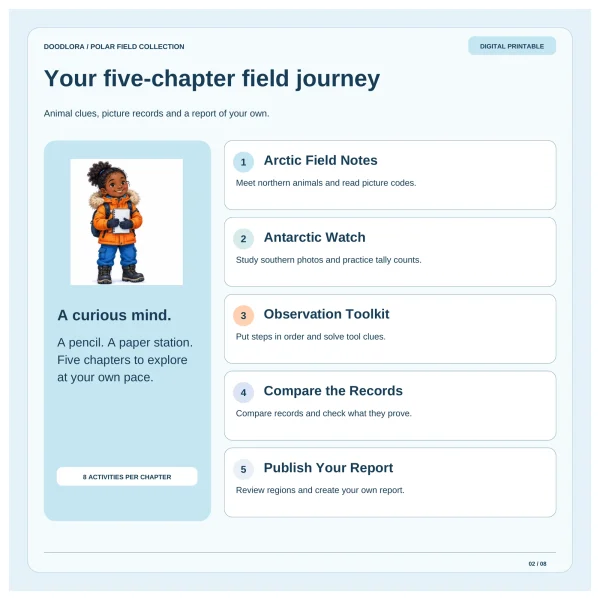
Our polar animal activity pack has a warm-up for this on page 25: note 21 shows three invented track cards with inch scales. The page says the cards are not real animal tracks, so use it to practice reading the ruler, not to identify a real print.
5. Catching snowflakes on dark paper
Light snowfall makes this possible. Leave a dark sheet of paper outdoors until it’s cold, then hold it under the falling snow and study the flakes with a magnifying glass before they melt.
Kids can compare flakes: how many arms each one has, and whether any two look alike. Twenty minutes is plenty, because cold hands end it quickly.
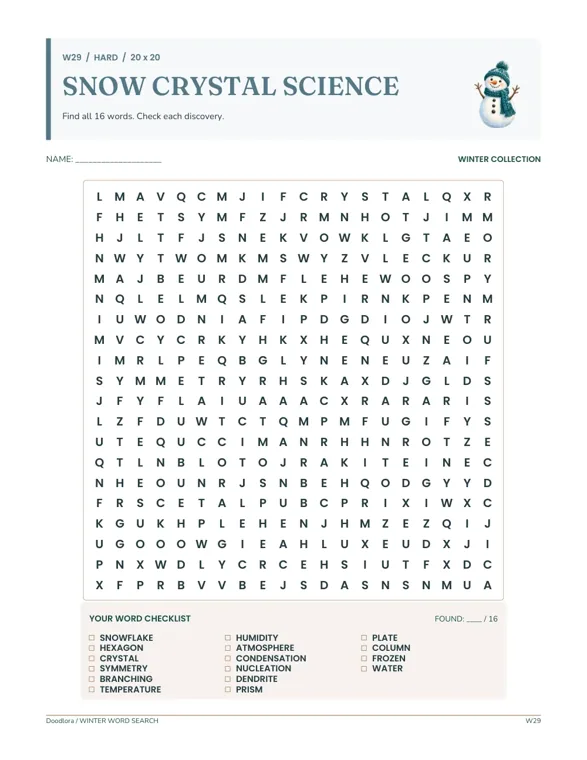
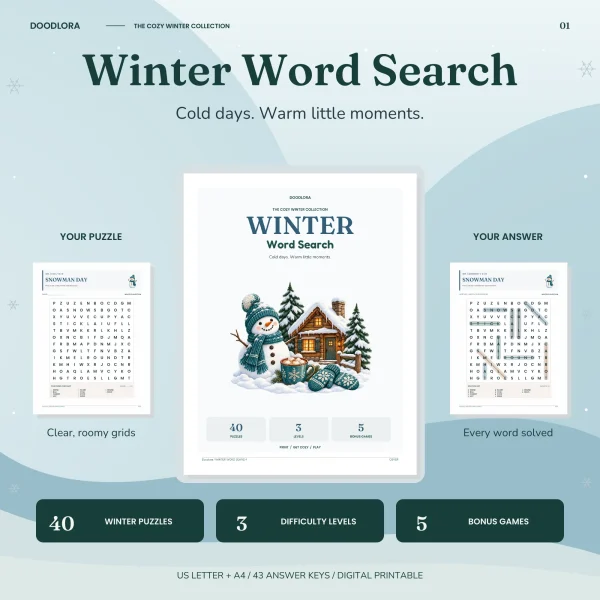
Back inside, older kids can try Snow Crystal Science, puzzle W29 in our winter word search book. Its 16 words include SNOWFLAKE, HEXAGON, SYMMETRY, BRANCHING, DENDRITE, PLATE, COLUMN and PRISM. It’s one of the 20 × 20 Hard grids, so for kids under about 9, the 12 × 12 Easy puzzle W09 Snowflakes (FLAKE, CRYSTAL, DRIFT, FROST) is the better match.
Outdoor winter activities when there’s no snow
Many winters bring weeks of cold without snow. These activities need only cold air, or nothing more than a window.
6. Ice suncatchers
Ice suncatchers need a night that dips below freezing and about 15 minutes of setup. Any child from age 3 can arrange the contents.
Fill a pie tin or shallow plastic container with a little water. Kids add pine needles, small pinecones, berries, orange slices or dried leaves. Lay a loop of string in the water with both ends hanging out, then set the tin outside overnight. In the morning, pop the ice out and hang it from a low branch.
The common mistake is forgetting the string until the ice is already solid. Another is a mild night: check the low temperature in the forecast, and use the freezer if it won’t freeze outside. Hang the suncatchers where nobody walks underneath, since they drop when the weather warms.
7. A window bird count
Birds that stay through winter visit feeders all season, and kids can watch them from a warm room. One or two children from age 5 can do a 30-minute count at a window.
Put up a feeder a few days ahead, since a brand-new feeder can sit unvisited for a while. Print Snowy Birdwatching, puzzle W22 in the winter word search book. Its word list includes seven birds: CARDINAL, CHICKADEE, NUTHATCH, WOODPECKER, JUNCO, OWL and FINCH. Kids solve the puzzle first, then make a tally mark next to each bird name every time that bird lands.
The other five words on the list (FEEDER, BIRDSEED, WING, SUET and BINOCULARS) aren’t birds, so tell kids to tally only the seven names. The count ends when the timer does. The bird with the most tallies is “bird of the day”.
8. A morning weather log
A weather log takes five minutes a day and helps decide whether today is an outdoor day. Kids from about age 6 can read a thermometer outside a window or the “feels like” number in a forecast.
Each morning, the child writes the temperature, the wind chill and one word for the sky. According to the AAP, kids generally shouldn’t play outside in temperatures or wind chills under −15°F, since exposed skin starts freezing within minutes at that point. Give the child the job of checking that line. Above it, the family heads out with breaks; below it, it’s an indoor day.
After a week, kids can circle the coldest morning and the warmest one. Older kids can make a bar chart.
Indoor winter activities that burn energy
Cold days pile up energy fast. These four need little more than paper and floor space, and none of them repeats the games in the rainy day list.
9. Paper snowball fight
A paper snowball fight works for 2 to 10 kids from age 3. You need scrap paper, masking tape and about 15 minutes.
Run tape across the middle of the room to make two sides, and give each side an equal pile of crumpled paper “snowballs”. On “go,” everyone throws snowballs over the line for 60 seconds. When time runs out, each side counts the snowballs on its floor, and the side with fewer wins. Play best of three.
Set one rule before the first round: throw at the floor on the other side, not at faces. Clear breakables off nearby shelves too.
10. Paper-plate skating
Paper-plate skating turns a carpeted room into a rink. Each child stands with one paper plate under each foot and slides around in skating strides. It suits kids from age 4, for about 15 minutes.
Play skating music and call out moves: glide forward, spin slowly, skate backward, freeze. End with a “show” where each skater does one move.
Do this on carpet only. On a wood or tile floor, plates slide too fast and kids fall. Plates also wear through after a few sessions, so keep spares.
11. Snow gear relay
The snow gear relay is a game and a dress rehearsal at once. Two teams of kids aged 3 to 7 race to put on boots, snow pants, coat, hat and mittens, run to a line, and take everything off again. It takes about 10 minutes.
Put each child’s own gear in a pile at the start line. The first team fully dressed and undressed wins. Small kids get practice with zippers and mittens, which makes the real trip outside faster.
This is also where you find out that last year’s boots don’t fit. Run the relay early in the season, while there’s still time to buy a bigger pair.
12. Penguin waddle race
The penguin waddle race works for three or more kids from age 3. Each child holds a rolled pair of socks between their knees and waddles to a finish line and back. If the socks drop, the child goes back to the start.
Run a single race or a relay with a hand-off. Ten minutes covers several rounds. Clear the route of table corners first, since waddling kids look at their knees rather than where they’re going.
Quiet winter activities for the afternoon
After a morning outside, most kids need a slower stretch. These three take a table, a printer and some patience.
13. Arctic or Antarctic sort
Pictures of winter often put polar bears and penguins side by side, but those two don’t share a home in the wild. This 30-minute sorting activity builds on that, for one or two kids aged about 6 to 10.
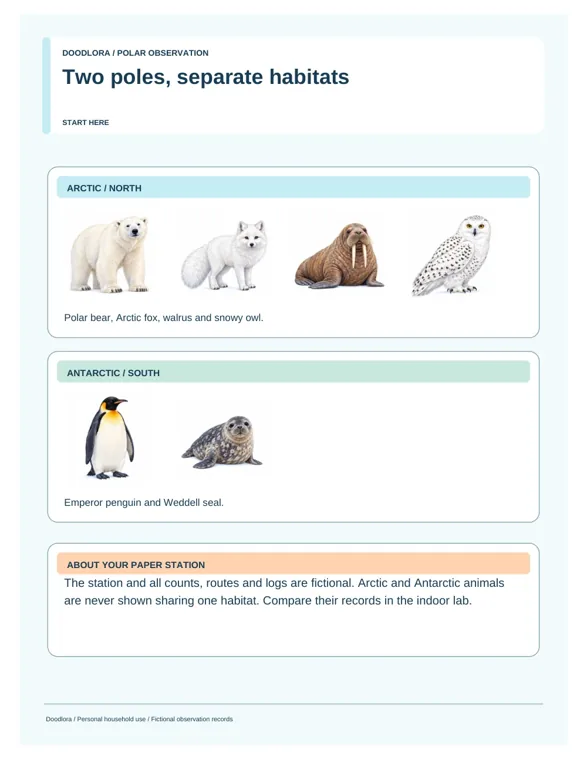
Page 2 of our polar animal pack puts the polar bear, Arctic fox, walrus and snowy owl under Arctic / North, and the emperor penguin and Weddell seal under Antarctic / South. Note 33, near the end of the pack, gives the same six animal names to label N or S, and note 29 sorts them into birds and mammals.
The pack’s guide pitches it at ages 7 to 10 and expects an adult to help with the reading. Younger kids can do the sort out loud while you write.
Once the page is done, hand kids a stack of winter picture books, cards or decorations from around the house. They label every animal N or S and look for any picture that puts a penguin next to a polar bear. Finding a “mistake” in a store-bought card is the part kids enjoy most.
14. Winter fuse bead animals
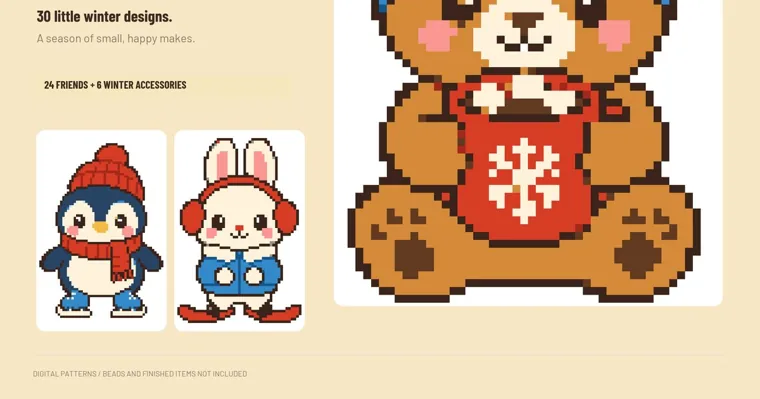
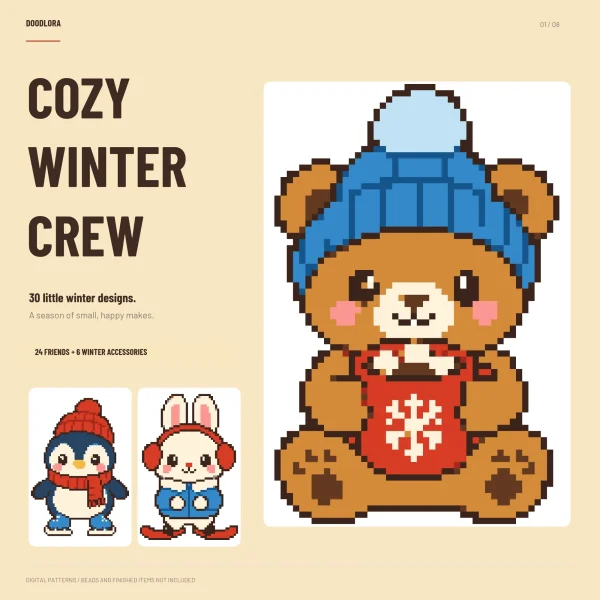
Fuse beads keep a 6- to 12-year-old busy for a long stretch, but they’re a project for several sessions, not a quick afternoon. Our winter fuse bead patterns hold 30 designs: 16 smaller animals, 8 detailed animals and 6 winter objects such as a snowman, a mitten and a snowy fir tree.
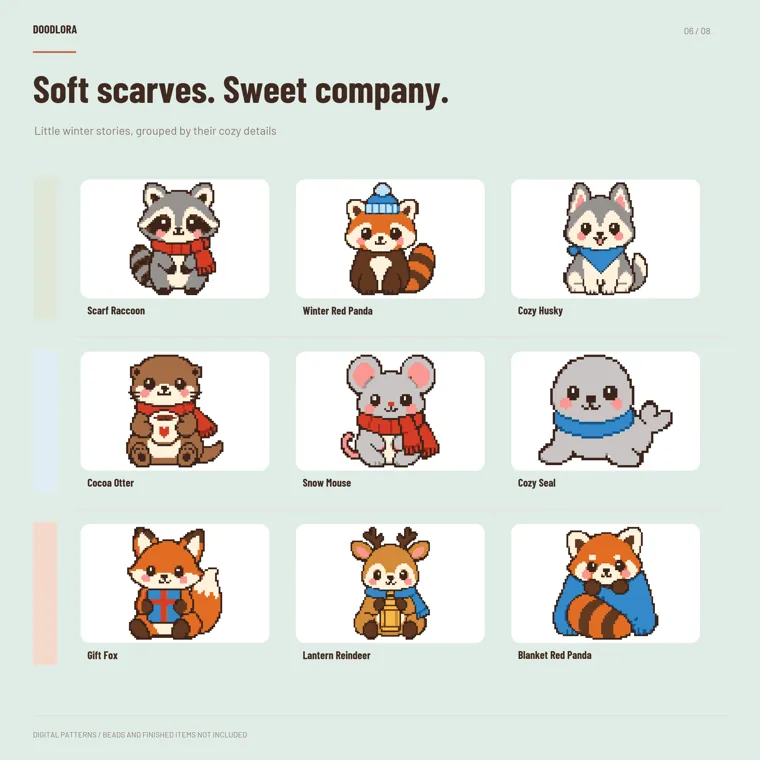
Start with the smallest design, not the cutest one. Even the snowy fir tree needs 1,123 beads in 7 colors, and with regular 5 mm beads it comes out about 7.1 inches wide. The blanket red panda needs 3,052 beads. The set also has actual-size sheets for 2.6 mm mini beads, which bring the fir tree down to about 3.7 inches wide.
Two things to know before printing. The reading charts are enlarged for easy reading, so a child shouldn’t lay beads on them as a template; for that, print the “Actual-Size” file for your bead size at 100%. The guide also says the beads are small parts not for children under 3, children should be supervised, and an adult should handle the hot iron.
15. A bookmark reading challenge for winter break
A reading challenge gives a long break some shape. Set a goal at the start, such as one finished book for each bookmark, and let the child pick a new bookmark after every book. It fits readers from about age 6 and runs the whole break.
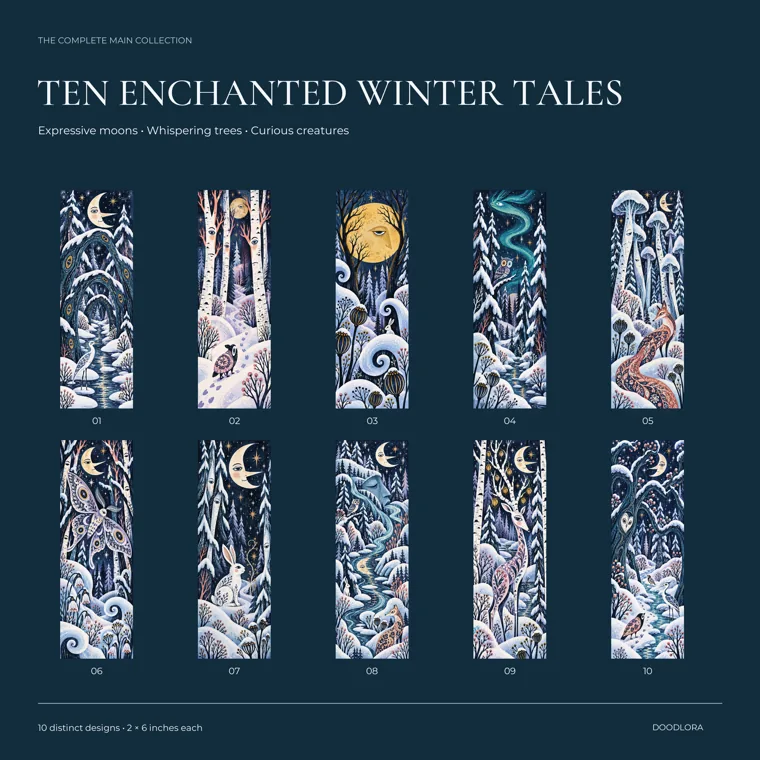
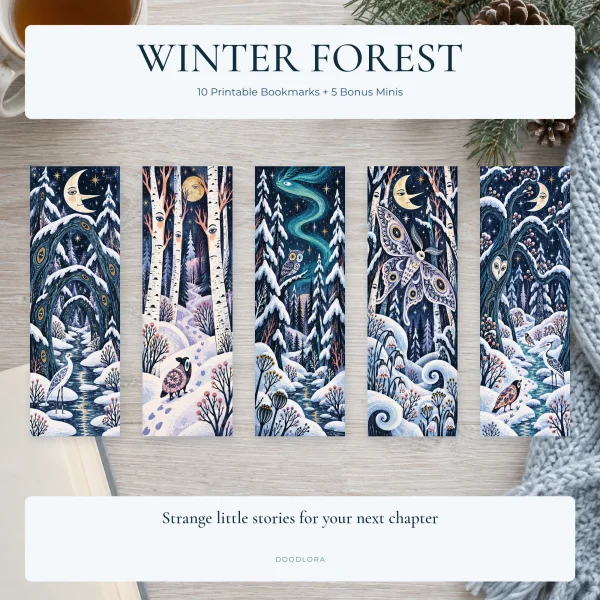
Our winter bookmarks come as three printable sheets: ten main bookmarks at 2 × 6 inches and five minis at 1.5 × 5 inches. That gives ten “prize” bookmarks for a big goal and five small ones for younger readers or short books.
Use cardstock and print at actual size, not “fit to page.” The art runs all the way to the trim line with no white border, so a wobbly cut shows. An adult or an older child should cut along the trim marks, ideally with a paper trimmer. The bookmarks are single-sided, so kids can write the book title and date on the back.
What kids should wear and when to call them in
Smaller bodies lose heat faster, so children get cold sooner than adults, the AAP explains, and a child who is having fun rarely asks to go in. Set the limits before anyone goes out.
Dress. Several thin layers keep kids warmer and drier than one thick one. Every child needs insulated boots, a hat, and mittens or gloves. Change wet clothes as soon as kids come inside.
Breaks. Set a reasonable time limit for outdoor play and plan regular warm-up breaks indoors. A timer on your phone helps.
Frostbite. Fingers, toes, ears and noses are most likely to be affected. Frostbitten skin may hurt or feel like burning, then go numb, and it may turn white or pale gray and blister.
If you suspect frostbite, the AAP’s advice is to bring the child in, not to rub the area or pop blisters, and to soak it in warm, not hot, water for 20 to 30 minutes. Call your pediatrician if the pain or numbness lasts more than a few minutes.
Hypothermia. A child may shiver at first, then become sluggish or clumsy or start to slur words. Hypothermia is a medical emergency: call 911, bring the child inside, take off wet clothes and wrap the child in blankets.
The full list, including ice skating and skiing advice, is on the AAP’s HealthyChildren.org page on playing outside in winter.
When the winter day doesn’t go to plan
The snow won’t pack. Powder is great for sledding and track hunts but useless for sculptures and forts. Swap the plan rather than fighting the snow.
One child is cold after ten minutes. Bring that child in for a warm drink and dry mittens while the others keep playing. Then try a short second trip. Insisting on “just ten more minutes” usually ends in tears.
There’s no snow at all where you live. Ice suncatchers can freeze in the freezer, the bird count works in any climate with a feeder, and the indoor games need only floor space. Our fall activities for kids list also has outdoor ideas that work in mild winters.
It’s 3 p.m. and everyone is fighting. Split the kids up. Give one a fuse bead project at the table and another a book and a bookmark in a different room. The screen-free activities for kids list has more solo ideas for this stretch of the day.
Printables from this article
Related articles
Kids Activity Books
Secret Agent Activities for Kids: Spy Codes, Clues & Party
Spy codes, invisible ink, Kim's Game, a string laser maze and a case to solve, with player counts, timings, supplies and the snags to plan around.
Kids Activity Books
Math Puzzles for Kids With Answers, Sorted by Grade
Ready-to-use math puzzles from kindergarten to middle school, each with its answer, plus how to run them as a home warm-up or a classroom center.
Kids Activity Books
Quiet Time Activities for Kids: Bin and Quiet Book Ideas
How to swap a dropped nap for an hour of quiet time, with a starting length, a timer, a rotating bin and solo activities sorted by age, from board books to build-and-play mats.