Quiet Time Activities for Kids: Bin and Quiet Book Ideas
Quiet time activities are things a child can do alone, in one spot, without calling you over: a basket of books, a puzzle on a tray, a drawing box, a few laminated activity pages. When a 3- or 4-year-old drops the afternoon nap, an hour of quiet time in the same slot keeps the rest break for both of you, and the activities are what make that hour work.
The setup matters as much as the activities. A child who knows how long quiet time lasts, where to stay and what’s in the bin will usually settle.
Below is how to start it, then solo ideas sorted by age, with how long each one tends to hold a child and where it goes wrong. Every age band and minute count on this page is a starting estimate from us, so adjust them to your own child.
Pick a quiet time activity by age
Use this table to fill a first bin. Pick four or five things your child can already do without help, and save new ones for when you’re in the room.
| Activity | Ages | Alone, or with you close by | How long it may hold | What to prepare |
|---|---|---|---|---|
| Book basket | 2 to 8 | Alone | 10 to 20 minutes | 8 to 10 books, swapped weekly |
| Putting the toys down for a nap | 2 to 4 | Alone | 10 to 15 minutes | Stuffed animals, a blanket |
| Big-block tray | 2 to 5 | Alone | 15 to 20 minutes | A tray and chunky blocks |
| Sticker scenes | 3 to 6 | Alone | 10 to 15 minutes | A reusable sticker pad |
| Quiet book or laminated matching pages | 3 to 5 | Alone once shown | 10 to 15 minutes for two or three pages | Print, laminate, hook-and-loop dots |
| Build-and-play mats | 3 to 5 | Alone once shown | 10 to 15 minutes per mat | Cut pieces into an envelope |
| Mazes and look-and-find pages | 4 to 6 | Alone | 5 to 10 minutes a page | Page protector, dry-erase crayon |
| Jigsaw puzzle on a board | 3 to 8 | Alone | 15 to 30 minutes | A puzzle at the right piece count |
| Drawing box | 3 to 8 | Alone | 15 to 30 minutes | Paper, crayons, a prompt card |
| Building from instructions | 5 to 8 | Alone | 30 to 60 minutes | A set and a tray |
| A letter to a relative | 5 to 8 | Mostly alone | 15 to 20 minutes | Paper, envelope, an address |
How to start quiet time
Quiet time is a rest hour, not a nap with a different name. The child stays in one room, plays quietly, and doesn’t have to sleep. If they do fall asleep some days, let them.
Where it happens and how long to start
Use the bedroom if the child sleeps alone, or a corner of the living room with a rug and a basket if they share. Keep it at the time the nap used to happen, usually right after lunch, so the day still has the same shape.
Start shorter than you want. Twenty minutes is a fair first target for a 3-year-old. Add five minutes every few days once the first stretch goes smoothly, and work up to 45 or 60 minutes if your afternoon needs that much. A first week that ends early but calm is worth more than one long hour of door-opening.
A timer your child can read
Preschoolers can’t tell how long an hour is, so give the end a signal they can see or hear. Three options work:
- A kitchen timer set outside the room, so the child hears it ring but can’t keep resetting it.
- A toddler clock that changes color when it’s time to come out.
- An audiobook or an album of known length. When the last track ends, quiet time is over. Our screen-free activities guide has notes on pairing an audiobook with something for the hands.
What goes in the quiet time bin
A quiet time bin is a box that only comes out for this hour. That’s what keeps its contents interesting. Fill it with four to six things from the table above and keep it out of reach the rest of the day.
Rotate about half the bin each week and keep the favorites. Every item should be something the child can start, do and put away without you. Anything a grown-up has to read aloud or set back up belongs in play time with you, not here.
Two bins are worth the effort if you have two children at home. Sharing one bin turns quiet time into an argument about who had the puzzle first.
When your child keeps coming out
Most children test the new rule in the first week. Walk them back with as few words as possible, something like “It’s still quiet time, the timer will ring.” A long conversation at the door makes coming out the most interesting thing on offer.
Two small tools help. Give one paper “pass” that is good for one trip out, for a hug or a question. Bathroom trips don’t use up the pass. And plan a check-in halfway through, where you bring one new thing from the bin. A child who knows you’ll come back at the halfway point is less likely to come looking for you.
Keep the bin safe for a child playing alone
A child playing behind a closed door needs a bin with nothing small enough to choke on. The choking-prevention page on HealthyChildren.org, run by the American Academy of Pediatrics, names balloons, coins, marbles, small balls, pen or marker caps, button batteries and toys with small parts as household items to keep away from young children.
That page also warns that many choking incidents start when an older brother or sister gives a younger child something small. Keep it in mind if two children share a room for quiet time.
Printable activities have loose pieces too. The printed guide that comes with our preschool activity book says loose pieces need a grown-up watching, and that its small cards and the sticky dots should stay away from a child who still mouths things. For that child, stick to books, chunky blocks and bound pages, and save the cut-out cards for when you’re in the room.
Quiet time activities for 2- and 3-year-olds
Children at this age need very simple activities with an obvious end. Check on them more often, and for a 2-year-old still in the nap transition, a short quiet time with you in the room is a fine place to begin. For activities that need you within sight while you cook, see our list of activities for 3-year-olds.
Book basket
A basket of 8 to 10 books is the backbone of most quiet time bins. Board books suit 2-year-olds, and picture books suit 3-year-olds, who will “read” a familiar story to themselves from the pictures.
Mix three favorites with a few they haven’t seen in a while. Swap the rest weekly. A book basket has no real end, so it works well as the last thing before the timer rings.
The catch: Library books and toddlers alone in a room don’t mix well. Put the ones you’d have to pay for on a high shelf and keep sturdy books in the basket.
Putting the toys down for a nap
Pretend play gives a child who has just given up napping a way to act the nap out. Give them three or four stuffed animals and a small blanket or dish towel. Their job is to get every toy to sleep: tuck them in, read them a book, sing to them.
The activity ends when every toy is “asleep.” Many children then start again with the toys waking up, which is fine.
The catch: Doll accessories like bottles, shoes and hair clips are often small. Leave them out of the bin for under-3s.
Big-block tray
A tray marks out the play space and keeps blocks from spreading across the room. Use chunky blocks, such as large interlocking bricks or wooden blocks, sized for the child’s age on the box.
Suggest one thing to build, like a tower as tall as the bed or a house for one animal. Done is when the blocks go back in the tray.
The catch: Towers fall, and falling blocks are loud. Put a towel or rug under the tray to soften the noise for anyone sleeping next door.
Sticker scenes
A reusable sticker pad, the kind with a background scene and vinyl stickers that peel off and re-stick, is calm, tidy work for a 3-year-old. The child decorates the scene, peels everything off and starts again.
The catch: Paper stickers that don’t come off end the activity after one use, and tiny ones frustrate small fingers. Pick larger, reusable stickers for this age.
Quiet time activities a 4- or 5-year-old can do alone
Four- and five-year-olds can manage activities with a few steps, a clear finish and, sometimes, a page with rules. Show each new activity once during play time before it goes into the bin.
A quiet book or laminated matching pages
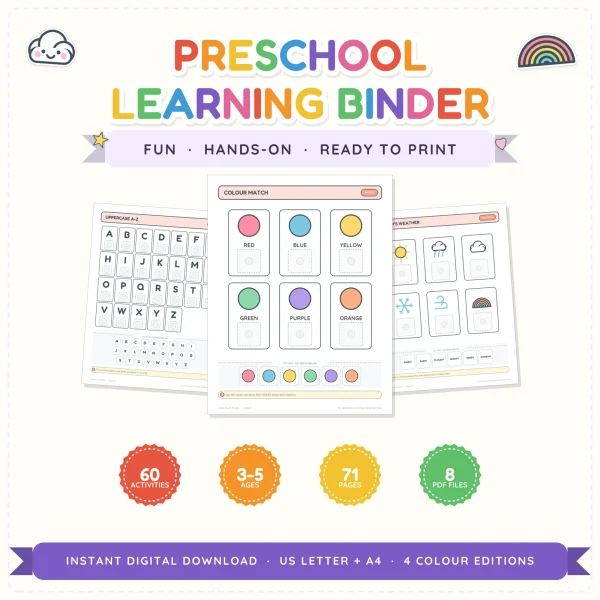
A quiet book is a set of pages with pieces that attach and come off again. The classic version is sewn from felt. A printable version is printed on card, laminated and fitted with hook-and-loop dots, so a child can match a color or count apples and then pull everything off.
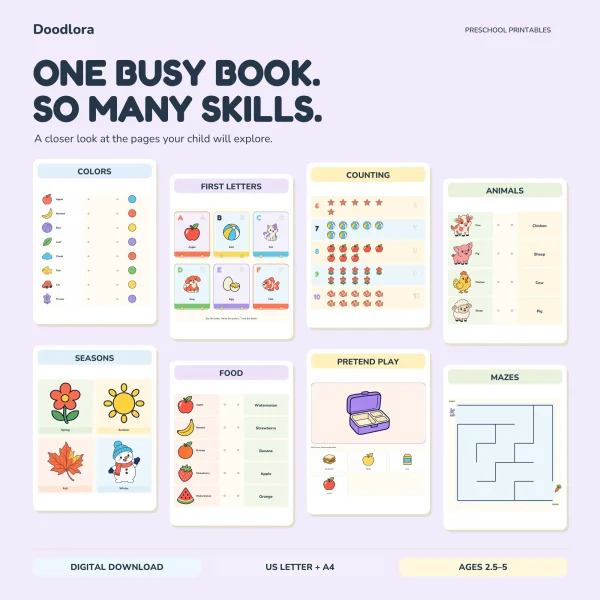
Our preschool binder holds 60 activities in four parts of 15. For most of them, the pieces to cut out are printed along the foot of the same page.
The grown-up guide near the back describes a hand-off that suits quiet time. Name the activity, do one piece yourself, hand it over, then stay quiet. The same page says to start small, with two or three activities at a time, so put only two or three pages in the bin, all ones your child has done with you before.
That page also says a piece in the wrong place isn’t an emergency. Nobody needs to fix the color match until the halfway visit.
The catch: Pieces walk off when nobody is watching. For storage, the guide suggests a zip bag per page or one pencil case per section. Two spare sheets at the back replace the letters, numbers and small shapes that vanish first.
Build-and-play mats
A build-and-play mat is a printed scene with pieces to place on it, like a pizza to top or a bedroom to furnish. Children who like arranging things will spend a long time on one.
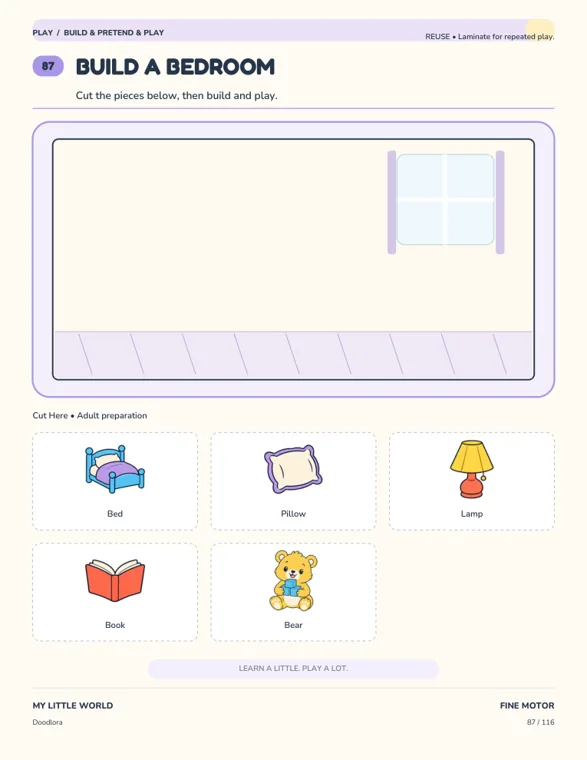
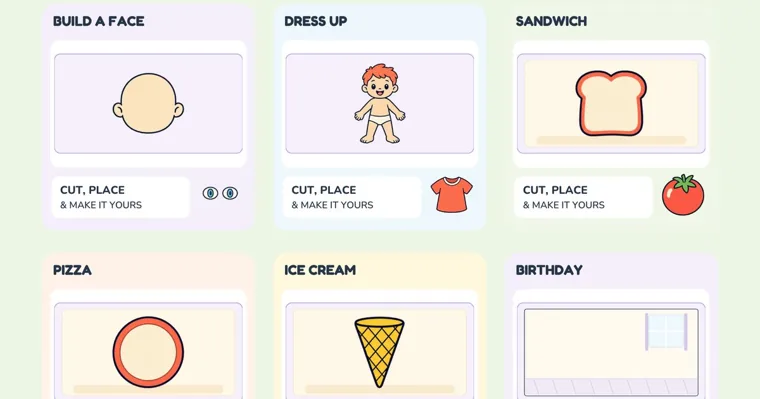
Pages 81 to 90 of our preschool activity book are ten of these mats. They let a child build a face, dress a child, make a sandwich, a pizza or an ice cream, pack a school bag, set up a bedroom, lay out a picnic, a birthday party or a garden. The bedroom, party and garden mats have no single right answer, which suits quiet time: there’s nothing to get wrong while you’re out of the room.
Laminate the mat, cut the pieces and store every set in a labeled envelope, as the book’s guide suggests. The activity ends when the scene is built and the pieces go back in the envelope.
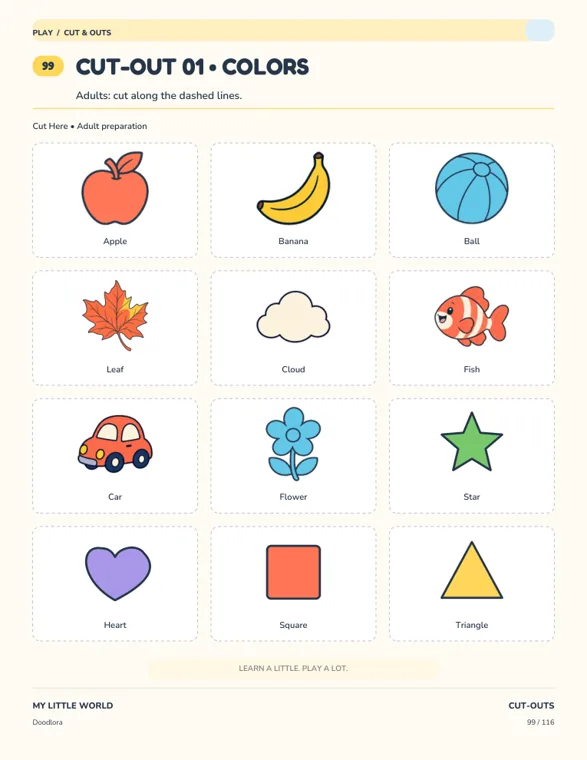
The catch: Each mat’s pieces sit below it on the same sheet, so cutting them off cuts up the book. Use the 15 separate cut-out sheets at the back instead (pages 99 to 113). The ice cream and bunny puzzle pieces appear only on their own pages, so print a second copy of those two.
Mazes and look-and-find pages
Mazes and search pages give a 4- or 5-year-old a clear finish: the path reaches the end, or everything on the list is found. Slip the page into a plastic sleeve and add a dry-erase crayon, and one printout lasts for weeks.
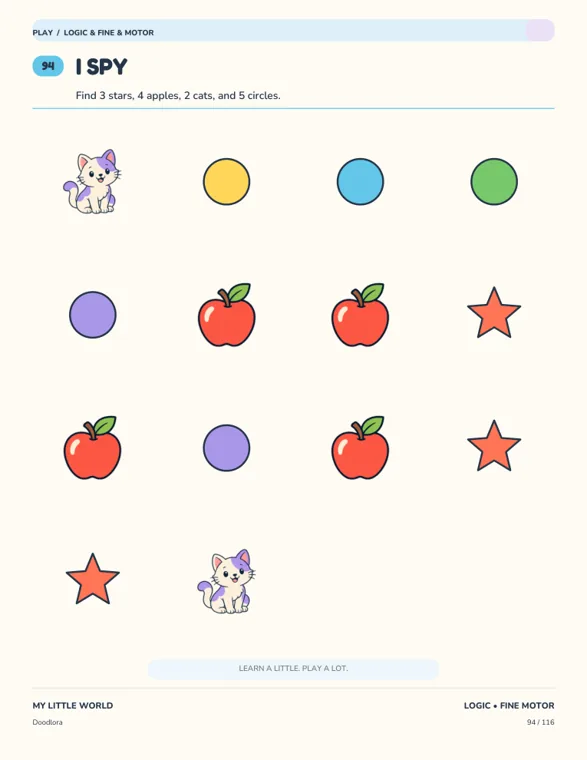
The logic section of our preschool activity book, pages 91 to 98, has two easy mazes, a spot-the-difference with five changes, an I Spy page, an odd-one-out page, pattern rows, a shadow match and a four-piece bunny puzzle. The answers to the spot-the-difference, the I Spy and the patterns are in the book’s text guide, so you can check them together at the halfway visit.
The catch: Some activity pages need a grown-up to read the instructions aloud, like the animal clue page in the same book. Before a page goes into the bin, make sure your child can do it from the pictures alone. Dry-erase markers have caps, which is why a crayon is the safer pick for younger siblings.
Jigsaw puzzle on a board
A jigsaw on a puzzle board or a baking sheet is portable and keeps pieces in one place. Most puzzle boxes give an age range, and a puzzle the child has done before is a better quiet time pick than a new, harder one.
The activity ends when the puzzle is finished, or when the timer rings and the board slides under the bed until tomorrow.
The catch: One missing piece can upset a child alone in a room. Count the pieces into a zip bag when it’s put away.
Drawing box
A shoebox with paper, crayons and a few stencils is the most flexible item in a quiet time bin. Add one prompt card a day, such as “draw where you’d go in a hot air balloon” or “draw your family as animals,” for children who freeze at a blank page.
Done is when the child decides the picture is finished. Hang one picture where the child can see it after quiet time, and it gives them something to show you.
The catch: Markers dry out when caps are left off, and washable paint is a lot to clean behind a closed door. Crayons and colored pencils are the low-stress choice.
Quiet time for school-age kids on weekends and winter break
Children aged 6 to 8 rarely need a rest hour on school days, but a daily quiet hour over winter break or on long weekends gives everyone a reset. They can manage longer projects, so one bigger activity often beats a full bin.
Building from instructions
A building set with a printed instruction booklet suits a quiet hour, since the booklet does the job a grown-up would otherwise do. Set it up on a tray or a large baking sheet so the small bricks stay together.
Big sets can be built in stages across several days. Mark the stopping point with a sticky note in the booklet.
The catch: Building sets with small parts belong in a room where younger siblings can’t reach them. Keep this activity for when the younger child is having quiet time elsewhere.
A letter or card to a relative
Winter break comes with thank-you notes and holiday cards to send, which makes a ready-made quiet time job. Give the child paper or a blank card, an envelope with the address already written, and a list of what they might mention: a gift, a visit, something they did over break.
The activity ends when the envelope is sealed. If your child is still learning to write, a drawing with one dictated line counts.
The catch: Children often stall on what to say. A short list of three questions (“What did you like? What did you do? What will you do next?”) gets them past the first line.
Puzzle books and reading
For school-age children, a chapter book or a puzzle book can easily take up the whole hour. Our rainy day activities cover word searches and secret codes, and the screen-free guide linked above has logic puzzles. Both work alone at a desk.
When quiet time stops working
Most quiet time problems have one of three causes. Look at these before you give up on it.
- The bin is stale. If the child comes out saying there’s nothing to do, rotate more of it, or bring back something that has been away for a few weeks.
- It’s too long. Drop back to the last length that worked and build up more slowly.
- The child is overtired. A child who melts down at quiet time every day may still need sleep in the afternoon. The AAP’s HealthyChildren sleep page counts naps in a child’s total sleep for the day, so once the nap goes, an earlier bedtime can make up the difference.
Running around before quiet time helps too. Fifteen minutes of active play from our rainy day list, such as freeze dance or an indoor obstacle course, can make a quiet hour easier to settle into.
Printables from this article
Related articles
Kids Activity Books
Secret Agent Activities for Kids: Spy Codes, Clues & Party
Spy codes, invisible ink, Kim's Game, a string laser maze and a case to solve, with player counts, timings, supplies and the snags to plan around.
Kids Activity Books
Math Puzzles for Kids With Answers, Sorted by Grade
Ready-to-use math puzzles from kindergarten to middle school, each with its answer, plus how to run them as a home warm-up or a classroom center.
Kids Activity Books
Winter Activities for Kids: Snow, Indoor & Quiet Ideas
Fifteen winter activities sorted by the day you actually have: fresh snow, cold without snow, energy stuck indoors or a quiet table, plus when to call everyone in.