Math Puzzles for Kids With Answers, Sorted by Grade
Pick the grade band your child is working in, read one puzzle aloud or copy it onto a whiteboard, and keep the answer covered until someone has made a real guess. Every puzzle below comes with its answer and a short explanation, and the math stays inside what kids at that level already know, from adding within 20 in kindergarten to times tables in the middle grades and squares, primes and simple equations in middle school. When a band feels too easy, the next one up uses the same puzzle styles with bigger numbers, so moving up never means learning a whole new kind of puzzle.
| Grade | Ages | What they need to know | Puzzle styles | Rough time per puzzle |
|---|---|---|---|---|
| Kindergarten–1st | 5–7 | Counting and adding within 20 | Missing number, what comes next, make ten, shape codes, which is more | Under 1 minute |
| 2nd–3rd | 7–9 | Adding within 100, early times tables | Missing number, patterns, “what number am I”, number pyramids, number paths | 1–2 minutes |
| 4th–5th | 9–11 | All times tables, division facts, primes | Multi-step missing numbers, patterns, compare and order, magic square, target numbers | 2–3 minutes |
| Middle school | 11–14 | Order of operations, squares and powers, simple equations | Equations with a blank, harder patterns, two-clue shape codes, target numbers | 2–5 minutes |
The times in the table are only our planning guess for one child working alone. A pair talking a puzzle through will usually take longer. That’s fine.
Math puzzles for kindergarten and first grade
These puzzles use numbers up to 20, so kids can count on their fingers, line up small toys as counters, or point along a number line while they think. Three to five puzzles is plenty for one sitting at this age, and stopping while your child still wants one more keeps the next session easy to start. Short beats long here. For picture riddles and word puzzles at the same level, our brain teasers for kids start at age 4.
Missing number
In each one, the empty box stands for the number that makes the sum true. Point to the box as you read.
- 3 + □ = 7: the box is 4, which comes from counting on from 3 until you reach 7.
- □ + 5 = 11: the box is 6, and starting at 5 and counting up six more steps checks it.
- 10 − □ = 3: the box is 7, and a quick check is to put the 7 back in, because 10 take away 7 really does leave 3.
What comes next?
- 2, 4, 6, 8, □: the next number is 10, because each number is 2 more than the one before it.
- 10, 20, 30, □: the next number is 40, since this pattern is counting by tens.
- 9, 8, 7, 6, □: the next number is 5, and this countdown surprises kids who expect every pattern to grow bigger.
Make ten
- Which two of these numbers add up to 10: 2, 4, 6, 9? The answer is 4 and 6, while 2 and 9 overshoot by exactly one.
- Which two of these numbers add up to 10: 1, 3, 5, 7, 8? The answer is 3 and 7, and if someone says 5 and 5, point out that the list has only one 5, so it can’t be used twice.
Shape codes
Each shape stands for a number, and the same shape always means the same number, so drawing the shapes on paper turns the puzzle into a picture instead of a word problem.
- If circle + circle = 6, what is one circle? The circle is 3, because the two equal numbers that make 6 are 3 and 3.
- If square + square = 10 and square + star = 8, what is the star? The star is 3, since the first line makes each square 5 and 5 + 3 = 8.
Which is more
- Compare 4 + 3 with 2 + 6: the second one is more, because 2 + 6 makes 8 and 4 + 3 makes only 7.
- Compare 5 + 5 with 3 + 7: neither one is more, since both make 10, and this puzzle is worth doing on purpose because young kids often think one side always has to win.
Math puzzles for second and third grade
Numbers go up to 100 here, and the last puzzles in each set lean on early times tables, which most kids meet during third grade. Keep scrap paper nearby for the pyramids and the number path, since writing the numbers down is much easier than holding them all in your head. Use pencils, not pens. If your child already likes grid puzzles, a 4×4 sudoku fits this level too, and our sudoku guide solves one from start to finish.
Missing number
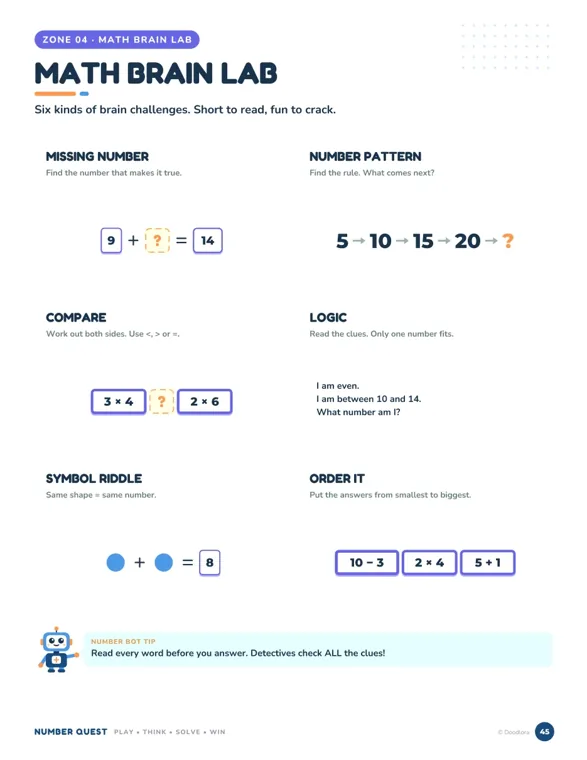
- 25 + □ = 40: the box is 15, which is the gap between 25 and 40 when you count up by fives.
- □ − 18 = 12: the box is 30, and the common trap is subtracting 12 from 18 to get 6, which falls apart as soon as you put it back in, because 6 − 18 doesn’t make 12.
- 6 × □ = 30: the box is 5, since six fives make thirty.
- □ ÷ 4 = 7: the box is 28, because splitting 28 into four equal groups puts 7 in each group.
Find the pattern
- 3, 7, 11, 15, □: the next number is 19, since the pattern adds 4 every time.
- 50, 45, 40, 35, □: the next number is 30, because each step takes away 5.
- 1, 3, 6, 10, □: the next number is 15, and the trick is that the jumps keep growing, from adding 2 to adding 3, then 4, then 5.
What number am I
Read every clue before guessing, because the answer has to fit all of the clues and not just the first one that sounds right. Cross out numbers as you go.
- I’m between 20 and 30, I’m in the 4 times table, and my digits add up to 10. The answer is 28, because the 4 times table gives only 24 and 28 in that range, and just 2 + 8 makes 10.
- I’m a two-digit number less than 20, I’m odd, and I’m in the 3 times table. The answer is 15, the only odd multiple of 3 between 10 and 19.
- I’m an even number between 30 and 40, and my ones digit is double my tens digit. The answer is 36, since the tens digit has to be 3 and double 3 is 6.
Shape codes
- If triangle + triangle = 12 and triangle + circle = 10, what is the circle? The circle is 4, because the first line makes each triangle 6.
- If star + star + star = 15 and star − heart = 2, what is the heart? The heart is 3, since three equal stars making 15 means each star is 5.
Number pyramids
In a number pyramid, each block is the sum of the two blocks right under it, so draw three blocks on the bottom row, two in the middle and one on top before you start.
- The bottom row is 4, □, 6 and the middle row is 9, 11, so what goes in the gap and what sits on top? The gap is 5 and the top is 20, because 4 + 5 = 9, 5 + 6 = 11 and 9 + 11 = 20.
- The top block is 30, the middle row is □ and 14, and the bottom row is □, 7, □. Working down from the top gives a middle block of 16 and a bottom row of 9, 7, 7, since 30 − 14 = 16, 16 − 7 = 9 and 14 − 7 = 7.
Number path
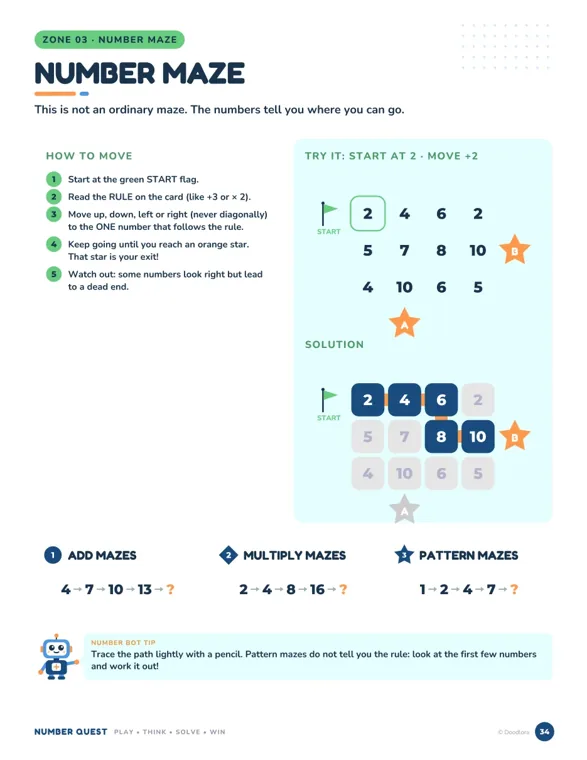
Start at 3 in the top-left corner and add 4 each time, moving up, down, left or right to the one square that follows the rule, never diagonally, and see which corner you’ll finish in.
| 3 | 7 | 10 | 14 |
| 6 | 11 | 15 | 19 |
| 9 | 12 | 16 | 23 |
| 13 | 17 | 21 | 27 |
- The path ends in the bottom-right corner, running 3, 7, 11, 15, 19, 23, 27, and the 10 beside the 7 is a decoy for anyone who adds 3 instead of 4. Trace it with a finger first.
Math puzzles for fourth and fifth grade
These puzzles need quick times tables and two steps of thinking, and kids who get stuck usually know every fact but lose track halfway through. That’s why scrap paper matters more here than at any other level, along with the habit of writing every step down. Don’t skip that habit.
Missing number
- 4 × □ + 6 = 34: the box is 7, which comes from taking the 6 off first to get 28 and then dividing 28 by 4.
- 72 ÷ □ = 9: the box is 8, because nine groups of eight make seventy-two.
- (□ − 3) × 5 = 35: the box is 10, since the brackets have to make 7 and the box is 3 more than that.
Find the pattern
- 1, 4, 9, 16, 25, □: the next number is 36, because they’re the square numbers 1 × 1, 2 × 2, 3 × 3 and so on up to 6 × 6.
- 100, 91, 82, 73, □: the next number is 64, since every step takes away 9.
- 2, 3, 5, 8, 12, □: the next number is 17, because the pattern adds 1, then 2, then 3, then 4, then 5.
Compare and order
- Compare 7 × 8 with 60 − 3: the subtraction wins by one, because 60 − 3 is 57 and 7 × 8 is 56.
- Compare 81 ÷ 9 with 3 × 3: neither one is bigger, since both sides work out to exactly 9.
- Put 6 × 7, 50 − 9 and 4 × 11 in order from smallest to biggest. The order is 50 − 9 (41), then 6 × 7 (42), then 4 × 11 (44), so all three land within a few numbers of each other and careful multiplication decides it.
What number am I
- I’m in the 3 times table and the 4 times table, and I’m greater than 25 but less than 40. The answer is 36, because numbers in both tables are multiples of 12, and 36 is the only multiple of 12 in that range.
- I’m a prime number between 40 and 50, and my digits add up to 11. The answer is 47, since the primes in that range are 41, 43 and 47 and only 4 + 7 makes 11.
Shape code
- If star + star + heart = 17 and star + heart = 11, what is the star? The star is 6, because the first line is the second line plus one extra star, so that star must be 17 − 11, which leaves 5 for the heart.
Magic square
- Fill in the four blanks with 1, 3, 7 and 9 so that every row, every column and both diagonals add up to 15.
| 8 | □ | 6 |
| □ | 5 | □ |
| 4 | □ | 2 |
The top middle is 1, the middle row reads 3, 5, 7, and the bottom middle is 9, because each of those lines already holds two numbers and only one of the four choices brings it to 15. The complete 1–9 square has eight versions that are all correct, since turning or flipping the grid keeps every line at 15, so a child who builds a different one from scratch may still be right. Check the diagonals last.
Target numbers
Use all four numbers once each, with addition, subtraction, multiplication, division and brackets, to reach the target, and accept any answer that follows those rules, because most of these puzzles have more than one.
- Make 20 with 3, 4, 6 and 8: one answer is (6 − 3) × 8 − 4 = 20, which turns the 6 and the 3 into a 3 before multiplying by 8.
- Make 12 with 1, 2, 4 and 6: one answer is 6 + 4 + 2 × 1 = 12, and another is 4 × 6 ÷ 2 × 1, so the 1 can tag along almost anywhere.
Number path
Start at 2 in the top-left corner and multiply by 3 at every step, moving up, down, left or right, and see where you’ll end up.
| 2 | 6 | 12 |
| 4 | 18 | 54 |
| 8 | 36 | 162 |
- The path finishes at 162 in the bottom-right corner by way of 2, 6, 18 and 54, while kids who double by mistake head down the left side to 4 and 8 and hit a dead end, which is exactly what that column is for.
Math puzzles for middle school
Middle school puzzles bring in brackets, powers and an unknown on both sides of an equation, and that’s where the order of operations starts to matter. A calculator takes the fun out of most of them, and scrap paper does the job better. Keep it in the drawer.
Equations with a blank
- 5 × □ − 8 = 42: the box is 10, because adding the 8 back gives 50 and 50 ÷ 5 = 10.
- (□ + 4) ÷ 3 = 9: the box is 23, and you’ll get there by working backward, since 9 × 3 = 27 and 27 − 4 = 23.
- 2 × □ + 5 = 3 × □ − 4, with the same number in both boxes: the box is 9, and both sides come to 23 when you check it.
Harder patterns
- 2, 5, 10, 17, 26, □: the next number is 37, because each number is a square plus 1, and 36 + 1 = 37.
- 1, 1, 2, 3, 5, 8, □: the next number is 13, since each number is the two before it added together.
- 3, 5, 9, 17, 33, □: the next number is 65, because the rule is to double the number and then take away 1.
What number am I, the harder set
- I’m a two-digit square number, I’m even, and my digits add up to 10. The answer is 64, since the even two-digit squares are 16, 36 and 64 and only 6 + 4 makes 10.
- I’m a three-digit multiple of 25 that is less than 200, and my digits add up to 8. The answer is 125, picked from the four candidates 100, 125, 150 and 175.
- I’m a prime number between 70 and 80, and my digits add up to 10. The answer is 73, because the primes in that range are 71, 73 and 79.
Two-clue shape codes
- If circle + square = 11 and circle − square = 3, what is each shape? The circle is 7 and the square is 4, and you’ll find them by adding the two lines together to get two circles worth 14.
- If triangle × triangle = 49 and triangle + star = 12, what is the star? The star is 5, because the only positive whole number that times itself makes 49 is 7.
Target numbers, the harder set
- Make 30 with 2, 3, 5 and 7: one answer is (2 + 3) × 7 − 5 = 30, and another is 7 × 5 − 3 − 2.
- Make 50 with 2, 4, 6 and 8: one answer is 6 × 8 + 4 − 2 = 50, which gets most of the way there with the biggest product first.
Compare powers
- Compare 2⁵ with 5²: the first one is bigger, because 2⁵ is 32 and 5² is only 25, and it’s easy to guess the other way because 5 is the bigger base. Write both out to see it.
- Put 3³, 5² and 2⁵ in order from smallest to biggest. The order is 5² (25), then 3³ (27), then 2⁵ (32), which only works out if you multiply each one fully.
How to use these puzzles at home
Ten minutes before school or dinner works better than one long session, because short, regular practice keeps puzzles feeling like a game rather than homework. Pick three to five puzzles from your child’s band, start with one that’s a little too easy so the first answer comes fast, and stop on a puzzle your child solved rather than one that beat them. All you need is paper, a pencil and something to cover the answers, such as a sticky note or a folded sheet. Keep it light.
With two kids of different ages, give each one a puzzle from their own band and let them race to answers at the same time, so the older child doesn’t simply solve the younger one’s puzzle. A single puzzle written on the fridge whiteboard in the morning, with the answer revealed at dinner, builds confidence without any setup. It’s an easy habit to keep.
To make a puzzle easier, take away any time limit and let your child use counters, fingers or a number line. To make it harder, ask for a second answer to a target-number puzzle, or ask your child to write a new puzzle in the same style for you to solve, which takes more understanding than answering one.
How to use them in the classroom
For a whole-class warm-up, project one puzzle and give pairs a minute or two to agree on an answer before anyone calls out. The first pair to answer explains how they got there, which matters more than speed. Five minutes covers two or three puzzles.
For math centers, put one puzzle style on each table, such as missing numbers, patterns, shape codes or number paths, and rotate groups every 10 minutes. Copy the number path grids onto paper, because kids want to trace the route with a pencil, and keep a box of laminated puzzle cards with a dry-erase marker for early finishers, since the same card can be wiped and used again.
Where kids get stuck
- Guessing from the first clue: in what-number-am-I puzzles, kids often stop at the first number that fits one clue, so ask them to test the answer against every clue out loud.
- Doing the subtraction backward: for □ − 18 = 12, the quick wrong answer is 6, and putting that answer back into the puzzle catches the mistake every time. It’s the most common slip.
- Working left to right: 2 + 3 × 4 is 14 rather than 20, because multiplication comes before addition, and in target-number puzzles writing brackets around each step avoids the argument.
- More than one rule fits: the pattern 1, 2, 4, □ could be doubling, which gives 8, or adding 1, then 2, then 3, which gives 7, and the number maze page in our Number Quest file uses 1, 2, 4, 7 as its pattern example for that reason. Give one more number, or accept any answer the child can explain with a rule.
- Moving diagonally on a number path: the paths only allow up, down, left and right, and tracing lightly in pencil makes it easy to back out of a dead end.
- A puzzle with no answer, or with two: when kids write their own puzzles, have them solve each one first, because a good puzzle has exactly one answer and some sets of four numbers can’t reach the target at all.
Printable math puzzle cards
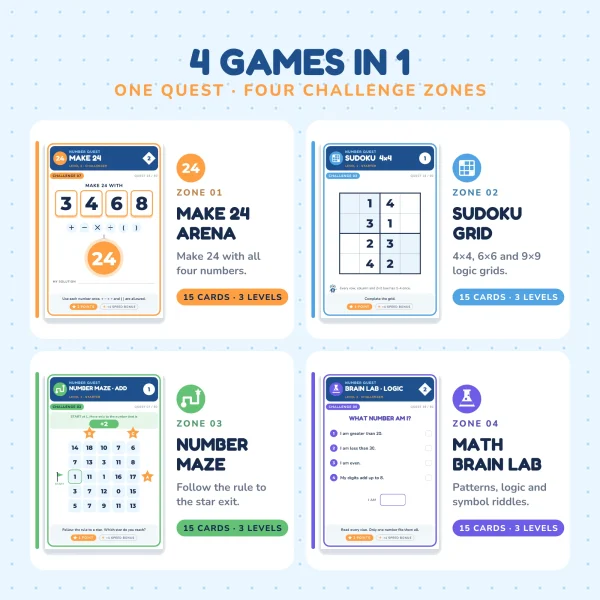
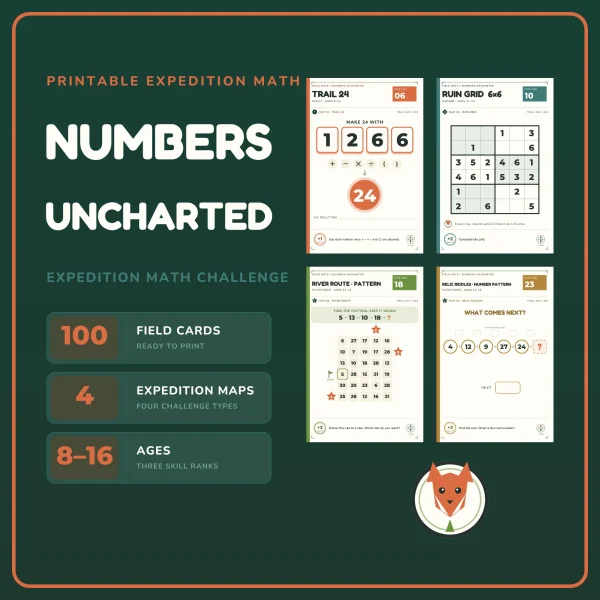
If you’d rather print than copy puzzles by hand, we make two card sets that use the same puzzle styles as this page, along with sudoku grids and number mazes. Each card prints at 4 by 6 inches, two cards to a letter page, and every puzzle type has its own answer pages right after its cards.
Number Quest is the younger of the two, with 60 cards split across four games and three levels aimed at ages 7–8, 8–10 and 10–12. One of its Level 2 logic cards asks for an even number greater than 20 and less than 30 whose digits add up to 8, and the answer guide gives 26 as the only number that fits every clue. Its parent and teacher guide suggests one game a day as a 10-minute warm-up at home and one game per table with a 10-minute rotation in class.
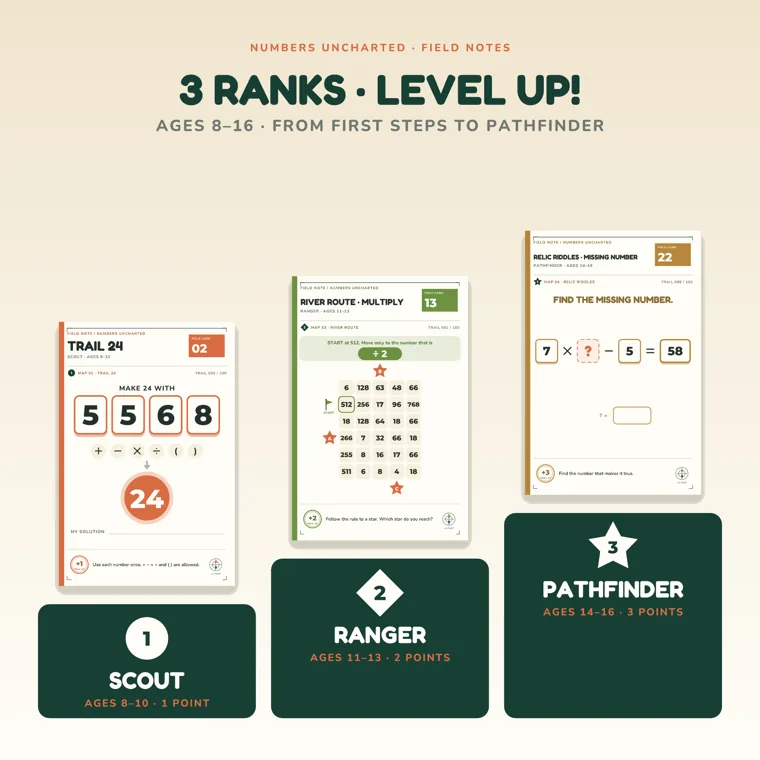
Numbers Uncharted is the bigger set. It has 100 cards for ages 8–16, split into three ranks. The Pathfinder rank, meant for ages 14–16, includes three-digit square numbers and two-step equations such as 7 × □ − 5 = 58, where the missing number is 9.
Once your child has worked through a band, the brain teasers and sudoku pages linked above make a good next step. They’ll stretch the same skills in a different format.
Printables from this article
Related articles
Kids Activity Books
Secret Agent Activities for Kids: Spy Codes, Clues & Party
Spy codes, invisible ink, Kim's Game, a string laser maze and a case to solve, with player counts, timings, supplies and the snags to plan around.
Kids Activity Books
Quiet Time Activities for Kids: Bin and Quiet Book Ideas
How to swap a dropped nap for an hour of quiet time, with a starting length, a timer, a rotating bin and solo activities sorted by age, from board books to build-and-play mats.
Kids Activity Books
Winter Activities for Kids: Snow, Indoor & Quiet Ideas
Fifteen winter activities sorted by the day you actually have: fresh snow, cold without snow, energy stuck indoors or a quiet table, plus when to call everyone in.