Screen-Free Activities for Kids: 15 Ideas for Winter Break
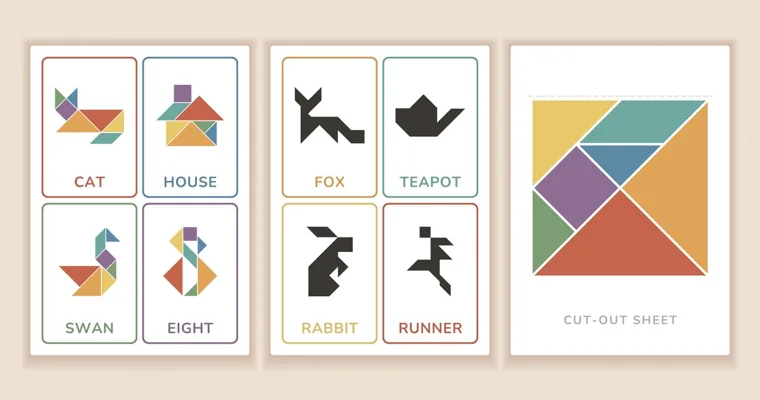
Screen-free activities for kids work best when they fit the hour you’re actually in: a puzzle one child can do alone while you’re on a call, a game cousins can share at Grandma’s, something for the back seat, and a no-prep option for the dark stretch before dinner. Winter break puts all four in the same week.
It pays to have one or two ready for each situation before anyone asks for the tablet. Below are 15 activities sorted that way, and each lists the head count, rough ages, timing, supplies and the finish line, plus the spot where it usually goes wrong. The ages and times are our planning estimates, so adjust them for the kids you’ve actually got.
Pick a screen-free activity by situation
| Situation | Try this | Players | Ages | Rough time | What you need |
|---|---|---|---|---|---|
| You need quiet for a work call | Detective logic puzzles | 1 | 6–10 | 15–30 min a puzzle | Printed pages, pencil, eraser |
| One child, no printer | A folded comic strip | 1 | 5 and up | 20–40 min | One sheet of paper, pencils |
| Cousins visiting for the holidays | Tangram silhouette swap | 2 | 6 and up | About 30 min | Two cut-out tangram sets |
| Mixed ages who need to move | Paper airplane contest | 2–6 | 5 and up | About 30 min | Paper, masking tape |
| A long drive with preschoolers | ABC road trip book | 1 per book | 3–6 | A page per stretch of road | Printed pages, clipboard |
| A plane or a waiting room | Cat’s cradle | 2 | 7 and up | 5–15 min a game | A loop of string |
| Dark outside, dinner not ready | Hand shadows | 1–4 | 3 and up | About 15 min | Flashlight, blank wall |
| Fresh snow in the yard | Snow painting | Any | 3 and up | 20–30 min | Squeeze bottles, food coloring |
For a wet weekend when everyone’s stuck in one house, our rainy day activities for kids cover energy-burning games, word searches and long-afternoon projects. None of them are repeated below, so the two lists work together over a two-week break.
Screen-free activities a child can do alone
These four keep one child busy at a table or on the floor while a parent works, cooks or rests. Set the activity up before you need the quiet, since explaining a new puzzle while the phone rings rarely goes well.
Detective logic puzzles
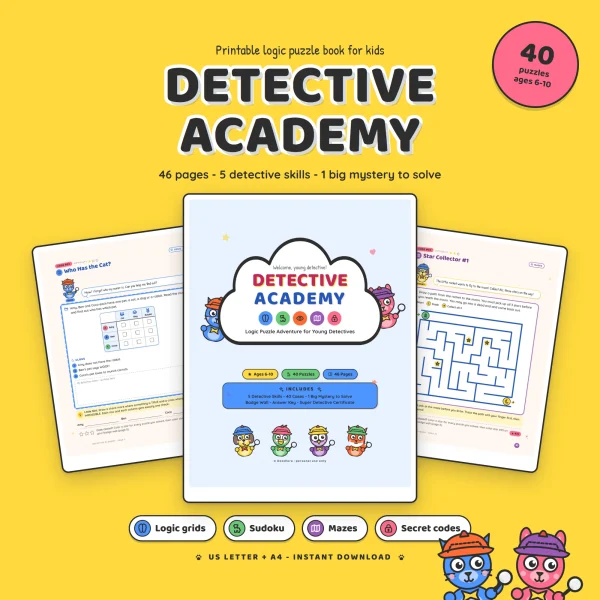
A logic grid puzzle hands over a short list of clues and a small table, then asks who owns which pet or who ate which lunch. One child works alone with a pencil, and a single puzzle takes roughly 15 to 30 minutes for a 6- to 10-year-old. Put an eraser on the table, because the whole method is marking, checking and rubbing out.
The rule that makes it work is printed on the first logic page of our Detective Academy book. Draw a check where something is true and a cross where it’s impossible, and each row and each column gets exactly one check.
Read one clue, mark everything it rules out, then move to the next. The grid’s solved when every row has its single check and no clue is broken.
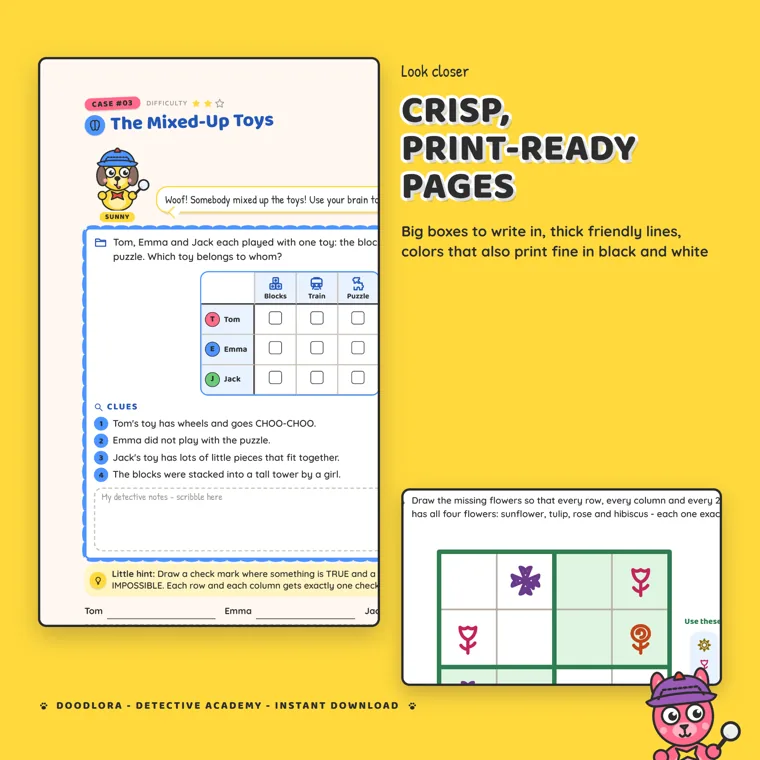
The book has 40 puzzles in five sections of eight: logic grids, sudoku, patterns, mazes and codes. Finishing a section knocks one of four museum suspects off a list, and that running mystery is what brings a child back on day three of the break. The first three grids use three children, and the rest step up to four.
The catch is that the answer key sits on pages 43 and 44 of the same file. Leave those two pages out when you print, or keep them in a folder with you, because a stuck 7-year-old will find them. A child who reads slowly may also need each clue read aloud once.
A comic strip on one folded sheet
For a child who’d rather draw than solve, a comic is a story they invent and draw in boxes. Fold one sheet of printer paper in half three times and it opens into eight panels, which is enough for a beginning, a problem and an ending. Kids from about 5 can do it in 20 to 40 minutes with a pencil and something to color with.
Ask for the last panel first: what happens at the end? A child who knows the ending can work toward it, while one staring at an empty first box often stalls right there. Pre-writers draw the speech bubbles empty and dictate the words for you to add.
The comic’s done when all eight boxes have something in them, and a title across the back turns it into a book to show at dinner.
A jigsaw puzzle that stays out all week
A jigsaw left on a side table becomes an activity for whoever walks past: one child alone in the morning, a cousin or two after lunch, a grandparent after dinner. Choose a piece count that the box marks for your youngest regular puzzler’s age. Then set it up somewhere it can sit for days, such as a card table or a large tray.
Start everyone the same way. Find the edge pieces and build the frame, then sort the rest by color into bowls or box lids.
The trap is the dining table. A half-finished puzzle that gets packed away every evening loses pieces and loses momentum. It ends when the last piece goes in, and it’s worth leaving it up a day so the whole family sees it finished.
An audiobook with something for the hands
Listening counts as screen-free as long as the screen stays out of sight. An audiobook or a recorded story fills 20 minutes to an hour for one child or several, and it pairs well with building blocks, a coloring page or the jigsaw above. Picture-book recordings suit preschoolers, while chapter books suit older kids who can follow a plot across several sittings.
The weak spot is the device. Audio playing from a tablet or phone in a child’s hands turns back into screen time within minutes. Play it through a speaker, or set the phone on a high shelf with the display face down. Stop at the end of a chapter rather than mid-scene, so there’s a clean place to pick up tomorrow.
Screen-free games for siblings, cousins and friends
When two or more kids share a room over the holidays, a game with a shared goal or a big reveal keeps them from fighting over one toy. Card games such as Go Fish and Crazy Eights are in our family game night ideas. The four below need paper, socks or a printed sheet instead of a deck.
Tangram silhouette swap
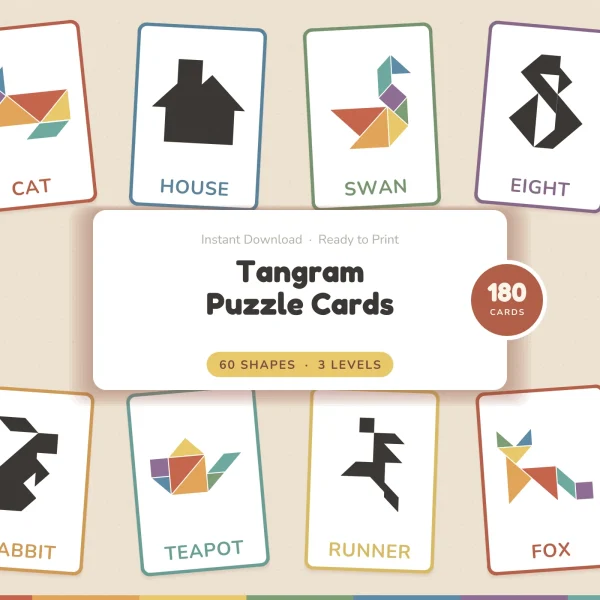
A tangram is a square cut into seven pieces that can be rearranged into animals, numbers and objects. In this version two kids each invent a shape, trace its outline and hand the outline to the other to solve. It suits two players from about 6 and takes around 30 minutes, including the cutting.
Each player needs a full set. The cut-out sheet in our tangram cards prints all seven pieces as one square: two big triangles, one medium triangle, two small triangles, a square and a parallelogram. Print that page twice at actual size, on thin card if you have it, so both sets come out the same size.
The rules come from the cards’ how-to-play page. Use all seven pieces, let them touch but never overlap, and make sure every piece touches at least one other, along an edge or just at a corner.
Each player builds a shape behind a propped-up book, traces around the outside with a pencil, lifts the pieces away and shades the outline in dark. Then they swap papers and try to fill each other’s silhouette.
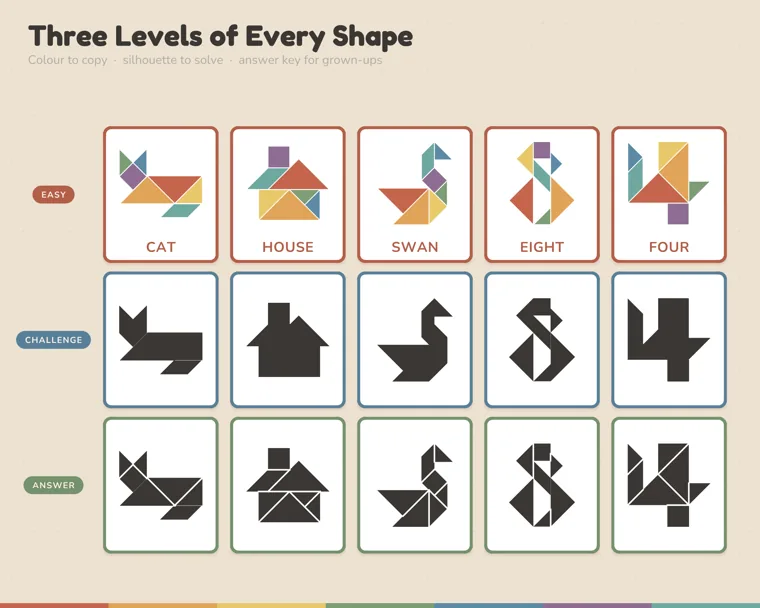
Pieces sliding while a child traces is the usual problem. Have the builder hold the two big triangles down with a flat hand and trace one side at a time. If the solver’s stuck, the builder rebuilds their shape one piece at a time as a hint, and the round ends when both outlines are filled.
For first-time hints that leave the solving to the child, see tangram puzzles for beginners.
Fold-over monster drawings
In this drawing game each player adds one part of a creature without seeing what came before, and the folded paper hides it all until the end. Surrealist artists played a version in the 1920s and called it exquisite corpse, and it resembles an older parlor game played with words. Three players is ideal, two can alternate, and a round takes about 10 minutes for kids from about 5.
Fold a sheet of paper into three bands. The first player draws a head in the top band, lets the two neck lines run a little past the fold, then folds the head back out of sight.
The second player starts from those lines and draws a body, and the third adds legs and feet. Unfold the paper together, give the monster a name, and start the next round.
Forgetting to carry the lines over the fold is the usual slip, and it leaves the next player nothing to join. Say “lines over the fold” before every pass. Rotate who draws the head, so the youngest doesn’t always end up with the feet.
Paper airplane distance contest
A paper airplane contest needs a hallway and printer paper, and it handles mixed ages well because a 5-year-old’s plane can win on a lucky throw. Two to six players can join, and folding plus three throws each takes about 30 minutes. Mark a throwing line on the floor with masking tape and keep a tape measure nearby.
Everyone folds one plane, and younger kids can copy an older sibling fold by fold or have an adult make theirs. Each player gets three throws from behind the line, and the spot where the nose stops is what counts. The best single throw wins. A second prize for the longest time in the air gives the slow, floaty designs a chance too.
Throw in one direction only, with everyone who isn’t throwing standing behind the line. A pointed nose aimed at someone’s face is the one real hazard, so blunt the tip of each plane by folding the point back a little.
A sock puppet show
Odd socks from the laundry turn into puppets in about 15 minutes, and the show is the payoff. Two to four performers from about age 4 work well, with parents or grandparents as the audience. Turn a couch so its back faces the room, or tip a sturdy table on its side, and the performers crouch behind it.
Draw faces with markers, or glue on felt scraps if you have them. Give the show a simple shape: who the puppets are, what goes wrong and how it gets fixed. Every performer gets at least one line, and the audience claps at the end.
Skip buttons and googly eyes on puppets for toddlers, who still put things in their mouths, and draw the eyes on instead. Shows tend to run long once kids get going, so cap each one at a few minutes and promise an encore after dinner.
Screen-free activities for car rides, flights and waiting rooms
Holiday travel puts kids in a seat for hours with no room to spread out. Pack a small bag the night before with a clipboard, crayons, a loop of string and a few printed pages, and hand out one thing at a time instead of everything at the first rest stop.
For games the whole car plays out loud, such as I Spy and the license plate game, see our road trip games.
ABC road trip activity book
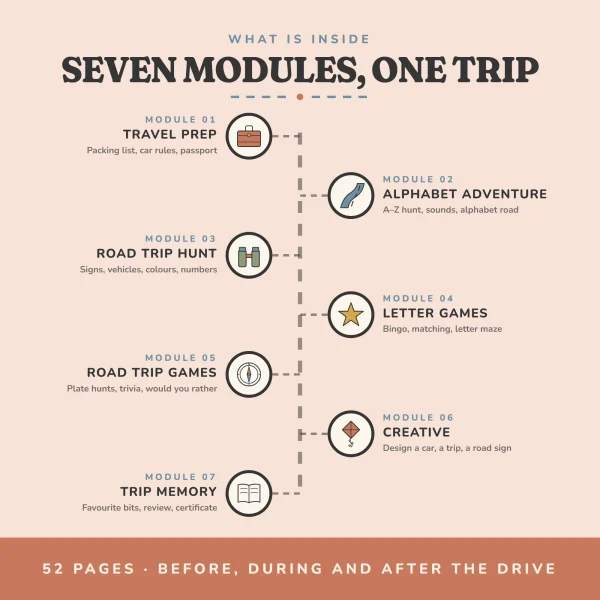
Our ABC Road Trip book turns the view out the window into alphabet practice for ages 3 to 6. One child works per book on a clipboard, and a single hunt page can last from one town to the next. No page needs a child to read a sentence alone. An adult reads the instruction once, and the child does the spotting and ticking.
The printing guide splits the pages by age. Three- and four-year-olds can do the hunts, I Spy, bingo and drawing pages, while 5- and 6-year-olds add beginning sounds, missing letters and writing lines. Pages 18 to 27 are ten hunts for road signs, vehicles, colors, numbers and more, and they print fine on their own if you don’t want all 52 pages.
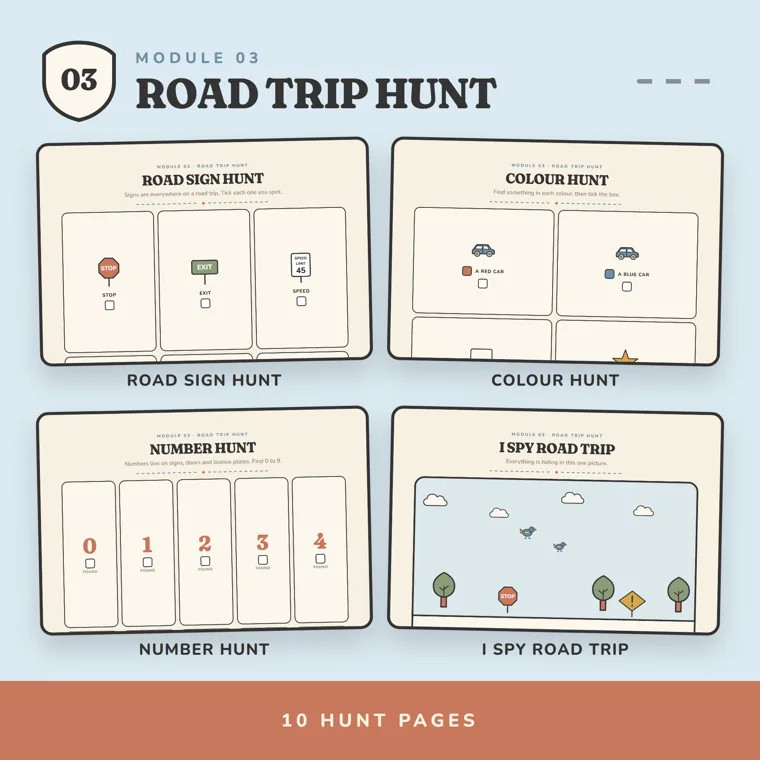
The hunts don’t work on a plane or after dark, since there’s nothing to spot. Keep the drawing pages, 44 to 48, for those stretches. Print at 100% or actual size, because the guide warns that “fit to page” shrinks the writing boxes. For the two bingo cards on pages 28 and 29, the guide suggests one clipboard per child.
Cat’s cradle
Cat’s cradle is a string game played with one loop passed back and forth between two players’ hands, so it fits an airplane seat or a bench at the gate. It suits two players from about 7, who’ve got the finger control for the pickups, and a game usually lasts 5 to 15 minutes.
Tie a piece of soft string or yarn into a loop that stretches comfortably between two hands.
One player makes the first figure, the cradle itself, across both hands. The partner takes the loop off with one of a few simple moves and ends up holding a new figure, often the one called diamonds. Players keep trading through figures with names like candles and manger. The game ends when someone makes a mistake or reaches a dead-end figure that can’t be turned into anything else.
The first moves are hard to learn from words alone. Learn the opening figure and the first pickup from a diagram, or from a grown-up who already knows them, before the trip rather than in the seat. When the game is over, put the loop away where babies and toddlers can’t reach it.
A paper fortune teller
A paper fortune teller, also called a cootie catcher, is a folded square with eight hidden messages under its flaps. It takes one sheet of paper and about 10 minutes to fold, so it suits a restaurant table or a long wait at the airport. Kids from about 6 can fold it with a little help, and the game needs two: one holds it, one picks.
Fold one corner of a sheet down to the opposite side and cut off the extra strip, which leaves a square with a diagonal crease. Crease the other diagonal too. Fold all four corners into the center, turn the square over, and fold the four corners into the center again. Write colors or numbers on the flaps and a message under each of the eight inner flaps. Then fold the corners up so the points meet in the middle, and push your fingers into the four pockets.
To play, the other person picks a color or number, and the holder opens and closes the fortune teller in turn while spelling or counting it out. The player then picks one of the flaps showing, and the holder lifts it and reads what’s underneath.
Between siblings, “fortunes” can turn into insults fast. Make it a rule that every hidden message is a task that works from a seat, like “name three animals that live in snow” or “do your best robot voice.” Swap holders once everyone has had three turns.
Screen-free activities with almost no preparation
Some afternoons there’s no time to print or cut anything. These four use what’s already in most homes and can start within five minutes, which helps in December, when it’s dark by late afternoon in much of the country. For a bigger game that still uses only household objects, an indoor scavenger hunt has ready-made lists and clue chains.
The floor is lava, played on cushions
In the floor is lava, someone shouts the name of the game and everyone has to get off the floor within a few seconds. Two or more kids from about 4 can play, and it burns off energy in 10 to 15 minutes. Before you start, scatter couch cushions, pillows and folded towels across the floor as islands.
Count down from five after the shout, and anyone still touching bare floor at zero sits out a round. Between shouts, players keep moving from island to island, and the caller can pull one cushion away each round so the safe spots shrink. The last player still on an island wins and becomes the next caller.
The classic version has players standing on furniture, and that’s the part to change. Keep every island on the floor, and rule out bookcases, dressers and chair arms, which can tip or slide. Socks slip easily on hard floors, so play barefoot or move the game onto a rug.
Hand shadows with a flashlight
Hand shadows need a dark room, one bright light and a blank wall, which makes them a good match for a winter evening. One to four kids from about 3 can take part, and 15 minutes is usually plenty. Turn off the overhead lights and set a flashlight on a stack of books, pointing at the wall.
Start with shapes a small child can copy, such as a bird made by hooking two thumbs together and flapping the fingers. Show how moving a hand toward the light makes the shadow bigger and blurrier, while moving it toward the wall makes it smaller and sharper. Finish with a guessing show, where each child makes an animal and the others name it.
A lamp with a shade spreads its light too widely for crisp edges. One small, bright flashlight gives the sharpest shadows, and it keeps candles out of the game entirely.
Snow painting with colored water
If there’s snow on the ground, a few bottles of colored water turn the yard into a canvas. Any number of kids from about 3 can join, and painting lasts 20 to 30 minutes before hands get cold. Fill clean squeeze bottles or spray bottles with water, add a few drops of food coloring to each, and head outside in old clothes, since the dye can stain.
Kids can paint a picture on a flat patch, color a snowman they’ve built, or mark a target for snowball throwing. The activity ends when the bottles run dry or the painters get cold, whichever comes first.
Dress them in several thin layers, insulated boots, mittens or gloves and a hat, which the American Academy of Pediatrics calls essential for winter play. Wet mittens usually end snow play early, so bring a spare pair. The AAP also advises changing out of wet clothes right away and taking regular indoor breaks to warm up.
Sock matching race
A sock matching race turns a basket of clean laundry into a game for kids from about 3. Dump a load of socks on the floor, set a timer for two minutes, and count how many pairs each child matches. One child can race the timer alone, and two can race each other.
It ends when the pile is gone and the pairs are folded and put away, so the game doubles as a chore. Older siblings win every time on plain socks, so give them the patterned ones and leave the solid colors for the youngest.
When screen-free time falls apart
Most screen-free days wobble at least once, and three problems come up again and again. The first is “I’m bored” five minutes in. Offer two choices from this list rather than fifteen, because a long menu leads straight back to the tablet.
The second is siblings fighting over one activity. Split them, with one at a solo puzzle or comic and the other at the sock race or the jigsaw, and bring them back together for a shared game after a break. The third is needing quiet for a call when the activity still needs you. Start the solo activity ten minutes before the call and watch the first step, so the child isn’t stuck on page one when you’re unavailable.
When the tablet keeps coming up, decide when screen time happens that day and say it once, so “not now” has a clear answer. For more printable puzzle books and activity sheets to keep in the drawer for days like these, start from our home page.
Printables from this article
Related articles
Kids Activity Books
Secret Agent Activities for Kids: Spy Codes, Clues & Party
Spy codes, invisible ink, Kim's Game, a string laser maze and a case to solve, with player counts, timings, supplies and the snags to plan around.
Kids Activity Books
Math Puzzles for Kids With Answers, Sorted by Grade
Ready-to-use math puzzles from kindergarten to middle school, each with its answer, plus how to run them as a home warm-up or a classroom center.
Kids Activity Books
Quiet Time Activities for Kids: Bin and Quiet Book Ideas
How to swap a dropped nap for an hour of quiet time, with a starting length, a timer, a rotating bin and solo activities sorted by age, from board books to build-and-play mats.