Tortoise vs Turtle: Shell, Feet and Habitat Differences
What’s the difference between a turtle and a tortoise? Boston’s Museum of Science puts it in one line: all tortoises are turtles, but not all turtles are tortoises. “Turtle” is the name for the whole order of shelled reptiles, around 360 species, and tortoises are one family inside it that lives on land. To spot one, look for a tall domed shell and thick, stumpy legs. Most other turtles have flatter shells and webbed feet or flippers, and they spend much of their lives in water.
The chart below lines up shell, feet, habitat, food and swimming. After it come terrapins and sea turtles, the box turtle that breaks the rule, and a feet-first game for kids.
Turtle vs tortoise side by side
The chart compares tortoises with the two groups people usually mean by “turtle”: freshwater turtles in ponds and rivers, and sea turtles. The details come from Wikipedia’s articles on turtles, tortoises and sea turtles, which agree with the Museum of Science’s description. Treat each row as the usual pattern, not a law, because a few species cross over.
| Tortoise | Freshwater turtle | Sea turtle | |
|---|---|---|---|
| Shell | High and domed | Flatter and smoother | Flat and streamlined, tapered at both ends |
| Feet | Column-like legs with elephant-like feet and short toes | Longer toes with webbing | Front legs are flippers; back legs work like rudders |
| Where it lives | On land, from deserts and grassland to forests | In and around ponds, rivers and marshes | In the ocean; females come ashore to lay eggs |
| What it eats | Mostly plants: grasses, weeds, leafy greens, flowers, some fruit | Most are omnivores, often more meat than land turtles eat | Varies by species |
| Can it swim? | No; tortoises are described as unable to swim | Yes, paddling with all four legs or walking along the bottom | Yes, and fast: up to about 19 mph |
| Head pulled into the shell? | Yes, straight back | Many can; side-necked turtles fold the neck sideways | No, sea turtles can’t pull in the head or limbs |
Shell shape: a tall dome or a flatter lid
Shell height is the first clue most people notice. Wikipedia’s turtle article says land-dwelling turtles have more dome-shaped shells, which may make them harder for large animals to crush. Water turtles have flatter, smoother shells that slip through the water. Sea turtles take that furthest, with streamlined shells that cut drag in the open ocean. So a shell that rises like an upside-down bowl points to land, and a low, smooth shell points to water.
Feet and swimming: stumps, webbed toes or flippers
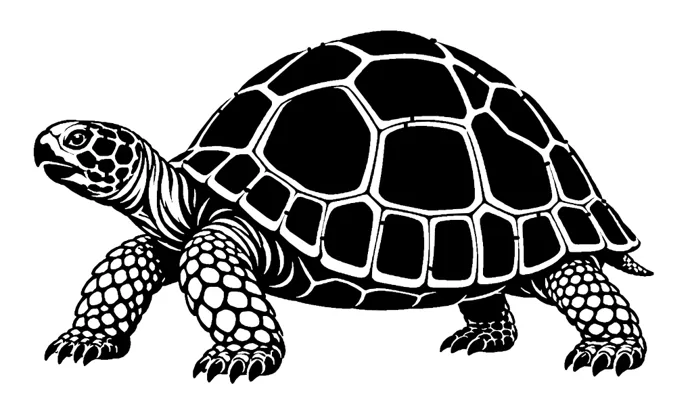
Feet are the most reliable clue, and they also tell you whether the animal swims. Tortoises walk on column-like legs with elephant-like feet and short toes. The Museum of Science describes them as squared off and clunky, with flat claws suited to digging. Freshwater turtles have more flexible legs and longer, webbed toes for pushing through water. Sea turtles have turned their front legs into flippers, and the shorter back legs steer like rudders.
Those feet explain the swimming row of the chart. Wikipedia’s tortoise article says tortoises can’t swim, yet some have survived long drifts at sea and reached islands that way. Speed shows the same split. A desert tortoise walks at only about 0.14 to 0.30 mph, while a sea turtle can swim at about 19 mph.
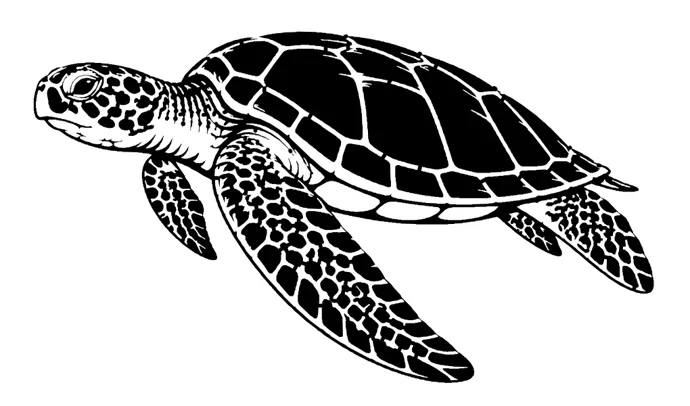
Shell height and legs are also what make a drawing read as one animal or the other. A child sketching both can switch from a dome to a low arc and from posts to paddles with the tortoise and side-view sea turtle steps in how to draw a turtle.
Food: mostly plants or a mixed diet
Diet follows habitat. Wikipedia describes tortoises as generally strict herbivores that eat grasses, weeds, leafy greens, flowers and some fruit, though a few species also take worms, insects or carrion. The Museum of Science notes that its desert tortoise eats only plants, while its red-footed tortoises are opportunistic omnivores that may eat a worm they stumble across. Most other turtles are opportunistic omnivores. Land species lean toward plants, and water species eat more animals.
Terrapins, sea turtles and the box turtle exception
Three names cause most of the remaining confusion, and each fits somewhere in the turtle group. If you’re unsure what a shelled reptile is, calling it a turtle is never wrong.
Terrapin. In American English, a terrapin usually means a small turtle that lives in fresh or brackish water, especially the diamondback terrapin. The word comes from an Algonquian name for that species.
Sea turtle. There are seven living species of sea turtle: flatback, green, hawksbill, leatherback, loggerhead, Kemp’s ridley and olive ridley. They are turtles but never tortoises. Their bodies taper at both ends, so they can’t tuck in their head or flippers.
Box turtle. The box turtle is the classic exception. North American box turtles live on land and have a high domed shell and clunky feet, yet they are called turtles and sit in the family Emydidae, not with the tortoises. A hinge on the bottom shell lets a box turtle close up tightly. The Museum of Science keeps box turtles from the U.S. East Coast and uses them to show that the simple rules have exceptions.
Wikipedia’s box turtle article warns that taking them from the wild can seriously harm wild populations, so a box turtle found on a walk stays where it is.
Why “tortoise” changes meaning between countries
The words also shift with the variety of English. Wikipedia’s tortoise article explains that American scientists and most American speakers use “turtle” for every species and “tortoise” only for land turtles. British English uses “tortoise” for any land-dwelling species and “terrapin” for a bigger group of semiaquatic turtles. In Australia, which has no native land tortoises, freshwater turtles were traditionally called tortoises. So British, Australian and American books can name one animal three ways without any of them being wrong.
How to teach kids to tell a turtle from a tortoise
Give younger children one clue they can check every time, the feet. Add the shell and the habitat as they get older, and save the family names for kids who like sorting things into groups. The table works for a parent reading a picture book or a teacher planning a 15-minute science starter.
| Age | What to say | The clue to check |
|---|---|---|
| 3 to 5 | “Every tortoise is a turtle. A tortoise walks on land and has round, stumpy feet.” | Feet only: flippers mean the sea, stumpy feet mean land |
| 6 to 9 | “Tortoises live on land. They have tall shells and elephant feet, and they can’t swim.” | Feet, then shell height, then where it was found; add the box turtle as the trick question |
| 10 and up | “Turtle is the whole order, Testudines. Tortoises are one family in it, Testudinidae, the way every poodle is a dog but not every dog is a poodle.” | Feet, shell and habitat, plus the British and Australian meanings |
A rhyme helps the youngest group remember the feet clue: “Flippers in the sea, webbed toes in the pond, stumpy feet on dry land.” Say it while pointing at a picture. When a child gets an answer wrong, ask them to look at the feet again instead of telling them, because the clue sticks better when they find it.
The cover-the-shell game with printed turtle outlines
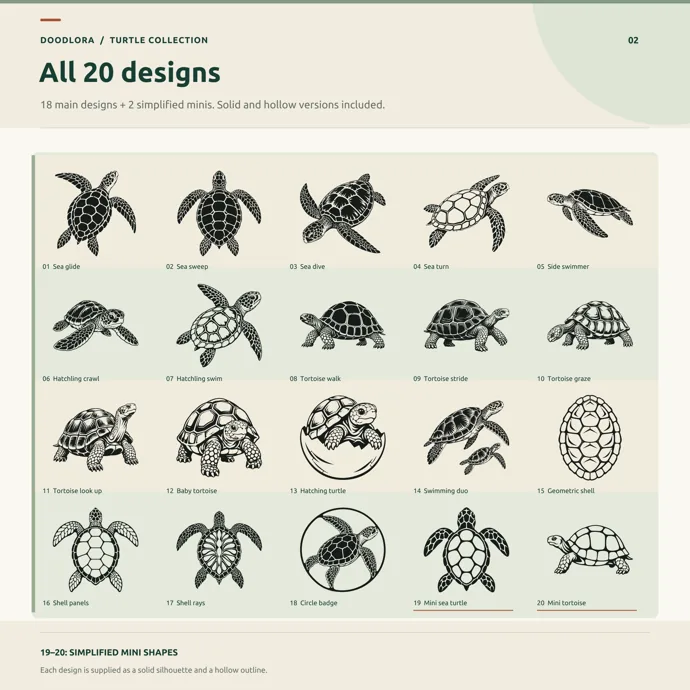
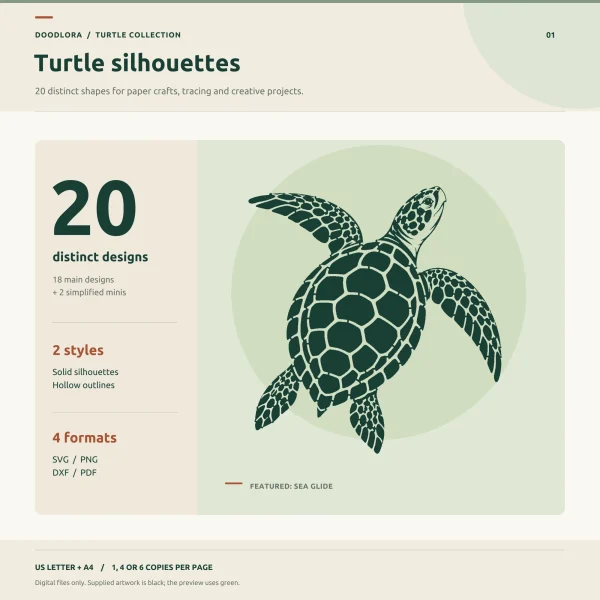
This game trains the feet clue and takes about 10 to 15 minutes for a small group or a class working in pairs. Use our turtle outline set. Its START-HERE file suggests starting with the US Letter solid PDF printed at Actual Size. Each of its 20 pages shows one design with its name at the top.
- Print pages 1 to 14 plus 19 and 20. Skip 15 to 18, which are shell patterns and a badge, not whole animals.
- Fold a strip of paper over each design’s name and shell, so only the head, legs and tail show.
- Hold up one page at a time. Kids call out “land” or “sea” and point to the feet that told them.
- Lift the strip to check. Designs 1 to 7, 14 and 19 are sea turtles. Designs 8 to 13 and 20 live on land.
- End by swapping roles: kids cover a page, and the adult guesses.
Watch for the hatchlings. Designs 6 and 7 are baby sea turtles with flippers, and design 13 is a land hatchling climbing out of its egg on clawed feet. Their round heads look alike, so these three pages test whether a child is really checking the feet. Classroom copies are fine on the personal license, which covers a teacher’s own students and printing within a single school.
For a hands-on version, the sea turtle and tortoise sort in our turtle crafts for kids has children cut, color and glue each animal onto a land sheet or a sea sheet.
Cartoon turtles: why the faces don’t help
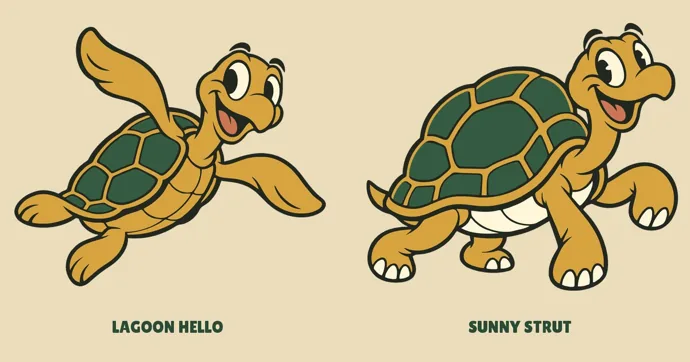
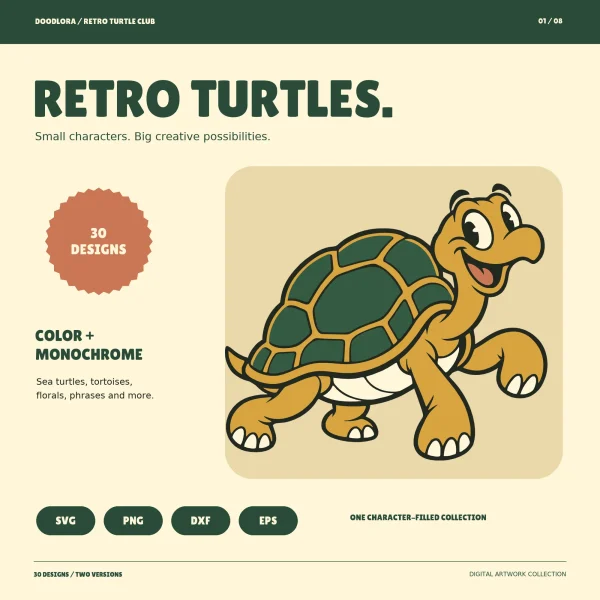
Cartoon turtles make good coloring and labeling pictures, but they are not field guide drawings. In our Retro Turtle SVG set, the sea turtles and tortoises share one face: the same big eyes, arched eyebrows and open grin. The shells use the same green plates too. Only the legs separate them, so cartoon art suits the feet clue and not the shell or face clues.
The outline set is more lifelike, but its START-HERE file still calls its designs stylized craft graphics, not scientific diagrams.
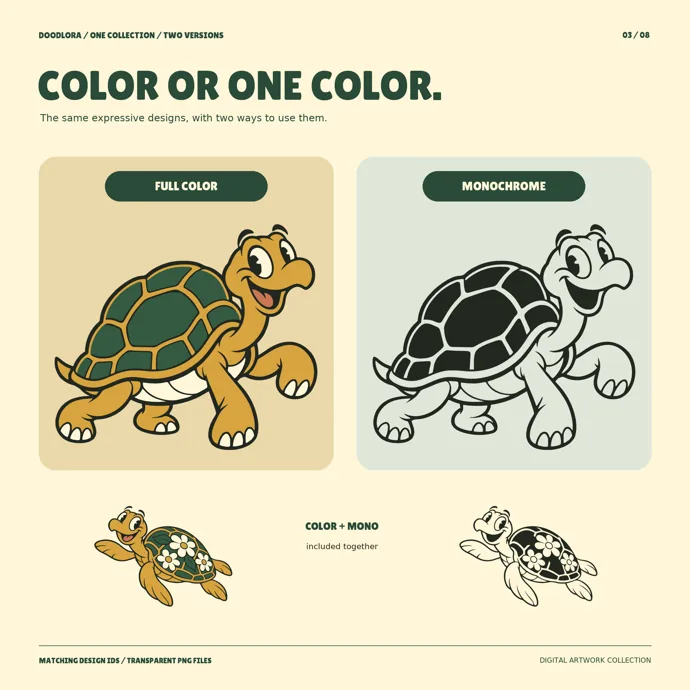
The retro set’s 30 designs sort cleanly by feet. Designs 1 to 6 are sea turtles, 7 to 9 are tortoises, and design 12 is a paddling baby sea turtle. Designs 13 to 21 all have flippers too: flowers on the shell in 13 to 15, symmetrical shell patterns in 16 to 18, and waves, sand or a half sun around the turtle in 19 to 21. Designs 10 and 11 are babies with toed feet. The file index files all three babies under one “baby” label, so check the legs before you put them in a land or sea pile.
For labeled picture cards on a slideshow or worksheet, the retro PNGs give a friendly color version and the outline silhouettes a realistic one. Not sure whether to grab the PNG, SVG or DXF? The file format section of what is clipart compares them. Both sets are also sold with a commercial option for people who make finished items to sell. Read the terms that come in the download before you start. For the outline set, the commercial option covers only the SVG files, and the PNG, PDF and DXF files stay for personal use. Our license page has the full commercial license text.
If you find a turtle on a road or a beach
Turtles move around more as the weather warms, and the U.S. Fish and Wildlife Service notes that many females cross roads looking for places to lay eggs. Only an adult should step in, and only where it is safe to stop. Children can watch from the car or the roadside.
- Put your own safety first: check for traffic and pull over properly.
- Often the best help is to stand guard while the turtle crosses on its own.
- If it has to be moved, take it to the side it was heading toward. A Vermont Fish and Wildlife Department notice puts it simply: “They know where they’re going.”
- Never pick a turtle up by its tail, which can seriously injure it. Some turtles bite, and a car mat slid underneath lets you move one without lifting it.
- Do not take it with you. Once it is across, leave it there.
Sea turtles need more room. NOAA Fisheries asks people not to approach or touch marine animals and recommends staying at least 50 yards from sea turtles, on land or in the water. Federal law prohibits harassing or harming protected marine species, sea turtles included. For kids out on a walk, the look-only finds in our nature scavenger hunt ideas set the same rule: wild animals stay where you found them.
Turtle and tortoise questions kids ask
Is a tortoise a turtle?
Yes. A tortoise is a turtle that belongs to the land-living family Testudinidae. Turtle is the name for the whole order, Testudines, so every tortoise is a turtle. Most turtles, including pond turtles, terrapins and sea turtles, are not tortoises.
Can tortoises swim?
No. Wikipedia’s tortoise article describes tortoises as unable to swim, and their heavy domed shells and stumpy legs are built for walking. The surprising part is that some tortoises have drifted across the sea and survived, and this is part of the reason giant tortoises turn up on so many islands.
Is a box turtle a tortoise?
No. A box turtle lives on land and has a domed shell and sturdy feet, but it belongs to a different family and is called a turtle. It’s the best example of why the shell and habitat clues are rules of thumb rather than definitions.
How long do tortoises live?
Wikipedia gives a typical range of 80 to 150 years for most tortoise species. Galápagos tortoises are noted to live over 150 years, and the same article calls tortoises the longest-living land animals in the world.
Which tortoises live in the United States?
The desert tortoises of the Mojave and Sonoran deserts, the Texas tortoise and the gopher tortoise are all tortoises in the genus Gopherus. The Museum of Science notes that the desert tortoise spends most of its life in an underground burrow, away from both heat and cold. The turtles most Americans see in ponds or crossing roads are freshwater turtles and box turtles, not tortoises.
Printables from this article
Related articles
Clipart & SVG Cut Files
How to Draw a Truck: Easy Pickup, Big Rig and Cartoon
Split a pickup into three parts before you draw a single wheel: a bed, a cab and a hood. Keep the roof about 2.2 wheels tall and the bed rail level with the hood, and the truck looks right even before the details go on.
Clipart & SVG Cut Files
How to Draw a Train: Steam Engine, Cars and Tracks
Split the page into a 10-square grid, lay a long boiler tube across the middle, set a box cab at the back and a tall stack at the front, hang two big driving wheels under the cab end, then couple cars behind and run the rails to a vanishing point.
Clipart & SVG Cut Files
Hawk vs Falcon: Wings, Size, Hunting Style and Eagles
A falcon has long, narrow wings that taper to sharp points and flies on steady, quick wingbeats; a hawk has broader wings with rounded tips and either soars in slow circles or flaps hard and glides. Falcons kill with a notched beak and hawks with their talons, and eagles are the largest, heaviest-billed members of the hawk family.