Thanksgiving Activities for Kids: 20 Crafts, Coloring & More
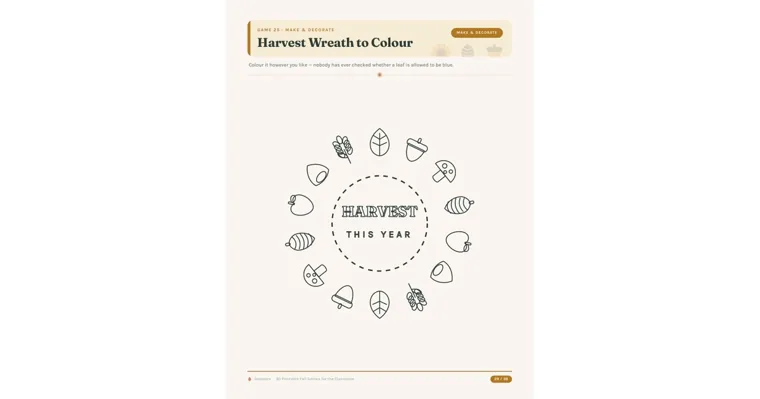
The right Thanksgiving activities for kids depend on what the grown-ups are doing at that hour. A coloring page holds a child at the table while the turkey roasts, a jar of cream gives restless hands something to shake, and place cards give a finished drawing a job at dinner. After the meal, a leaf pile or a game of touch football burns off the pie.
The 20 activities below are grouped by that kind of moment, so you can pick two or three instead of planning a whole day.
Start by counting your free adults. One adult minding the oven can still supervise a table of coloring or thank-you drawings. A second adult can run the butter jars or a craft, and anyone heading outside can take the cousins with a rake or a ball. Treat the times in the table as rough guides for planning, since nobody has timed these with a stopwatch.
| Your situation | Try these | What to have ready |
|---|---|---|
| 15–30 minutes before dinner, kids at the table | Coloring pages, a thank-you drawing, a placemat to color | Printed pages, crayons or colored pencils |
| Preschoolers who need an adult’s help | Handprint turkey, shaking butter in a jar, one gratitude leaf an adult writes on | Washable paint, heavy cream, paper leaves |
| Kids who want to help cook | Butter in a jar, pie-crust leaves, one kitchen job matched to age | Plastic cups or jars, small cookie cutters, aprons |
| Crafty school-age kids with an hour | Paper plate turkey, pinecone turkey, leaf wreath | Paper plates, glue, pinecones, fallen leaves |
| A table that still needs setting | Place cards, colored placemats, a centerpiece from the yard | Card stock, scissors, a basket or tray |
| A yard full of cousins after the meal | Leaf pile, touch or flag football, a family turkey trot | A rake, a ball, warm layers |
| A classroom the week before | Thankful tree, picture counting, learning about the Wampanoag | One printed page per child, a paper tree or branches |
Thanksgiving coloring and thank-you drawings while dinner cooks
Quiet table activities keep children out of the kitchen during the busiest hours. The National Fire Protection Association, the U.S. fire-safety nonprofit, calls Thanksgiving the leading day of the year for home fires involving cooking equipment. Its holiday tip sheet suggests games, puzzles or books to keep kids busy away from the stove. Set up a separate table with paper and crayons before the cooking starts.
1. Thanksgiving coloring pages
Coloring works for any number of children, each with their own sheet, for about 15 to 30 minutes. Choose the drawing before you print, because a few big shapes and a crowded feast ask for very different amounts of patience. Preschoolers do better with one large subject they can finish. Children who like small details can take a full table scene and sharpened colored pencils.
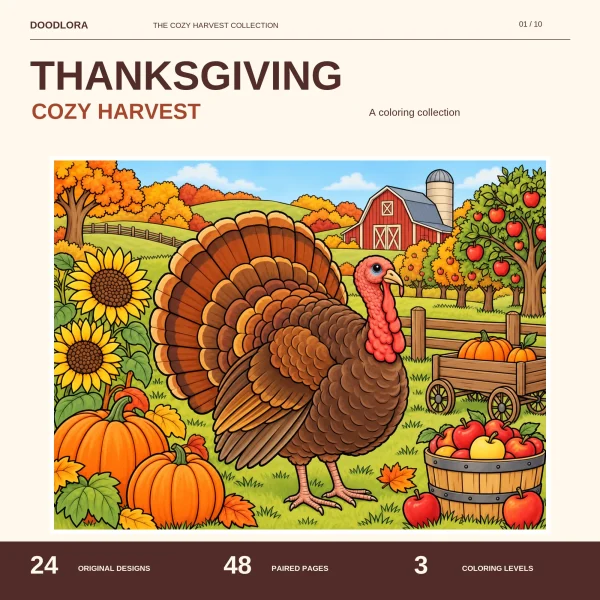
The 24 scenes in the Cozy Harvest Thanksgiving coloring pages come in Easy, Normal and Hard levels, so siblings of different ages can work from the same set. The detailed dinner table below comes from the Cozy November coloring pages, where fine lines run through the food, the chairs and the banner.
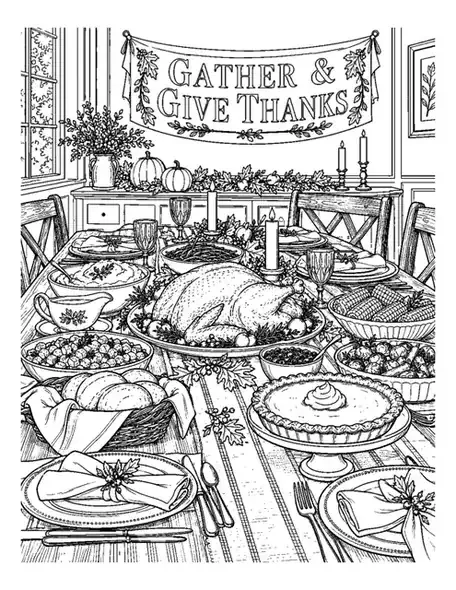
End the session by asking each child to finish one part, such as the pie, before the food comes out. The rest of the page can wait until after dessert. One printing trap catches people with the Cozy Harvest book: it alternates a line drawing with a colored reference page. Print only the odd pages, set to landscape and Actual Size, or you’ll spend ink on 24 pages that are already colored.
2. A thank-you drawing or card
A thank-you drawing suits one child or a whole table, and it takes about 15 minutes. Set out blank paper and crayons, then ask each child whom they want to thank. Pathways.org, the nonprofit child development organization, suggests drawings and letters for family near or far, with a specific prompt such as “draw why you’re thankful for Grandma.” Nebraska Extension also suggests a thank-you note or a homemade card.
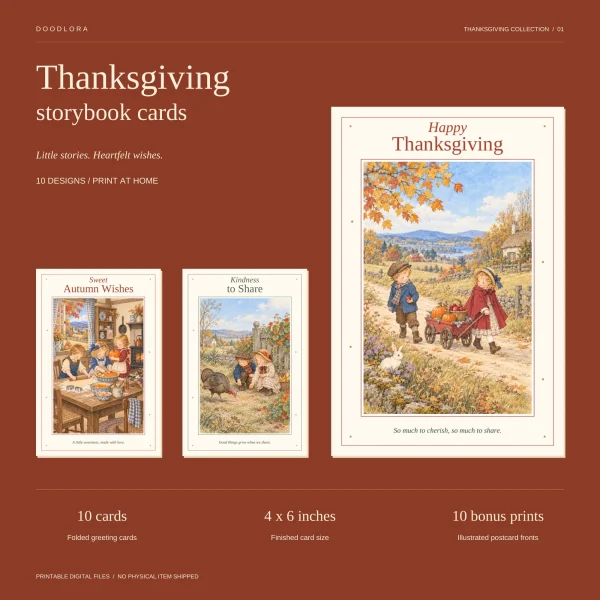
Let the child draw first, then ask what the picture shows. Write down the words they dictate, or let a beginning writer add their own name. Older children can write a full note inside a folded card instead. Each of our printable Thanksgiving cards puts its picture cover and back panel on one landscape sheet. After printing, an adult trims the sheet at its corner marks and folds it into a 4 x 6 inch card. The inside stays blank for the child’s message.
Choose who gets the drawing before anyone starts, so the page has somewhere to go. Finish by handing it over at dinner, sealing it in an envelope, or sending a photo to someone far away. For the cards, the print guide says to print at Actual Size with Fit to Page turned off and to test on plain paper before you use card stock.
Thanksgiving crafts for kids: turkeys and a leaf wreath
Turkey crafts are the classic Thanksgiving project, and these four start simple and get more involved. The handprint turkey suits preschoolers with an adult close by. The paper plate turkey, the pinecone turkey and the leaf wreath need more cutting and gluing, so they fit school-age kids with an hour to spare. Cover the table with newspaper before any paint comes out.
3. Handprint turkey
A handprint turkey needs only paper, a pencil and crayons, and it takes 10 to 15 minutes per child. Have the child spread their fingers flat on the paper while an adult traces around the hand. The four fingers become tail feathers and the thumb becomes the head and neck. The child then colors each feather, adds an eye, a beak and a red wattle, and draws legs under the palm.
Washable paint makes a printed version instead of a traced one. Paint the palm brown and each finger a different color, then press the hand down once and lift it straight up. Wiggly hands smudge the print, so trace instead of painting for a child who can’t keep still. Write the child’s name and the year on the back to finish, since these get kept for years.
4. Paper plate turkey
A paper plate turkey takes about 20 to 30 minutes and works well for a small group at one table. Each child needs a paper plate for the body, construction paper in fall colors, scissors and glue. Kids cut long feather shapes and glue them around the back edge of the plate so they fan out behind it. A brown paper circle becomes the head, with a small orange triangle for the beak and a red wattle.
Glue sticks don’t always hold on coated plates, so test one feather first. White school glue or tape on the back usually holds better. For children still learning to use scissors, cut the feathers in advance and let them choose colors and arrange them. The turkey is done when it has a face, and it can stand on the windowsill until dinner.
5. Pinecone turkey
A pinecone turkey suits school-age children and takes around 30 minutes, plus time for paint to dry. Libraries run it as a November craft: the Scott County Library System in Iowa listed it as best for ages 6 to 11. Columbus Public Library in Wisconsin paints the pinecones like a turkey’s tail and adds pompoms, felt and googly eyes for the face.
Collect dry, open pinecones on a walk the day before. Paint the scales in bands of red, orange and yellow, or tuck paper feathers between them at the wide end. Glue a pompom head with googly eyes and a felt beak at the narrow end. Keep the pompoms and googly eyes away from younger siblings who still put things in their mouths. The turkey is finished once it stands on its own, ready for the table.
6. Fall leaf wreath
A fall leaf wreath starts outdoors, so plan about 45 minutes including the walk. The Brandywine River Museum of Art’s version begins with collecting leaves, choosing flat, colorful ones because they glue more easily. Children can draw designs on the leaves with paint or markers, pressing lightly so the leaves don’t crack. Leaf walks and pressing leaves are covered in more detail in our fall activities for kids.
To build the wreath, cut the center out of a paper plate and punch a hole at the top for a loop of ribbon or twine. Then glue the leaves around the ring until most of the plate is covered. The museum recommends a stronger glue, glue dots or a glue gun. If you use a glue gun, an adult holds it and the child places each leaf. Hang the finished wreath on the front door before guests arrive.
Kitchen jobs for kids on Thanksgiving Day
Children can help with the meal if the job keeps them away from the stove. The NFPA’s tip sheet recommends a kid-free zone of at least 3 feet around the stove and anywhere hot food or drinks are prepared or carried. It also suggests recipes kids can make outside the kitchen. The butter jars and pie-crust leaves below both happen at the dining table.
7. Shake cream into butter
Shaking cream into butter turns a dairy product into a small science lesson, and it takes about 25 minutes from handwashing to tasting. Wisconsin Agriculture in the Classroom’s lesson gives each child a 2-ounce plastic cup, filled halfway with heavy whipping cream. Children snap the lid on, check that it’s tight, and hold the cup with two fingers on the lid and a thumb underneath.
Shaking takes 3 to 5 minutes, and the lesson says to stop once there is a large clump of butter in the cup. The leftover liquid is buttermilk. Add a pinch of salt if you like, then spread the butter on crackers. Utah Agriculture in the Classroom runs the same activity with small jars filled halfway and shared by a group, with children taking turns shaking until one mound of butter forms.
Ask about allergies before you hand out cups. The FDA lists milk among the nine major food allergens, so a child with a milk allergy needs a different job. Plastic cups or jars are safer than glass if one slips out of small hands. Clear up with wipes before anyone moves on to the next activity.
8. Cut pie-crust leaves
Pie-crust leaves give a child a real part in dessert, and the job takes about 15 minutes. An adult rolls out the spare dough, then the child presses small leaf or turkey cookie cutters into it. The adult lays the shapes around the edge of the pie before it goes into the oven. The Minnesota Department of Health’s WIC guide also lists cookie cutters as a way for kids to shape food.
Raw dough is the catch here. The FDA’s flour-safety advice says not to let children eat, taste or play with raw dough or batter, and not to use it for crafts or play clay. Raw flour and raw eggs can carry harmful bacteria. Bake the leftover scraps or throw them away instead of handing them over to play with. Everyone washes their hands with soap and running water when the cutting is done.
9. Kitchen helper jobs by age
Kitchen jobs work best when each child gets one task that matches their skills. The University of Illinois Extension lists washing produce, using measuring spoons and mixing for ages 2 to 4. Children aged 5 to 7 can crack eggs, cut with a small plastic knife and peel oranges or hard-boiled eggs. Ages 8 to 11 can use a peeler, open cans and follow a recipe. The Extension adds that every child is different, so adjust the job to the child.
For Thanksgiving, that might mean a preschooler washing green beans or stirring the cornbread batter. A 6-year-old can crack the eggs, and a 9-year-old can peel the sweet potatoes. The Minnesota Department of Health adds carrying unbreakable items to the table for toddlers, and mashing for preschoolers. Wash hands before any job starts.
Two warnings apply here. Let cooked potatoes cool before a child mashes them, because the NFPA warns that steam or splashes from vegetables, gravy or coffee can cause serious burns. And stirring the cornbread batter doesn’t include tasting it: the FDA says children should not eat raw batter.
Setting the Thanksgiving table with kids
Table jobs give finished crafts and drawings a place at the meal. Do this part before the food arrives, while there’s still room to move cards and decorations around. The three activities below suit children from preschool up, with an adult handling the scissors for the youngest.
10. Thanksgiving place cards
Place cards take about 20 minutes and work for one or several children. Gather the guest list, card stock, crayons and scissors first. Give each child a few names to decorate. Preschoolers can decorate a card while an adult writes the name and does the cutting.
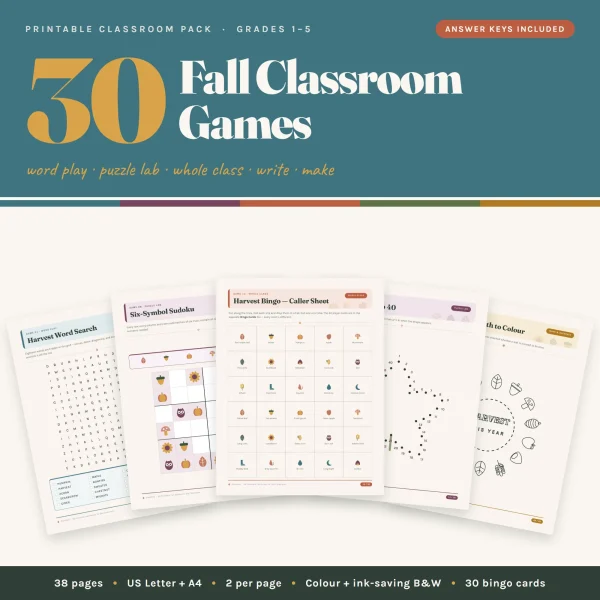
Each Desk Name Tents sheet from Fall Classroom Games prints three cards. For eight guests, print three sheets and keep the spare card for the cook. Print the US Letter file on Letter paper at actual size so the template keeps its shape. Card stock helps the folded tents stand up.
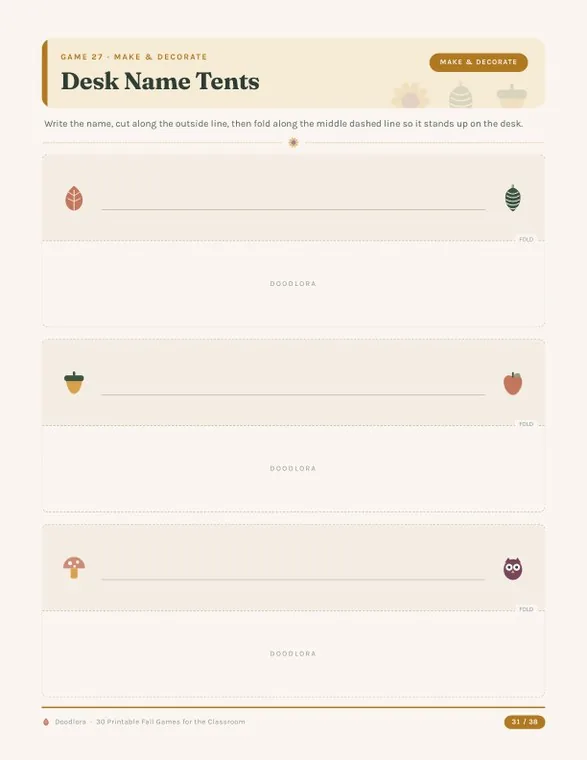
Write each name on the line, cut around the outside of the card, then fold along the middle dashed line so it stands. Check the first folded card before cutting the rest. A child who cuts along the middle line separates the two halves the tent needs. Finish by letting the children carry the cards to the seats while an adult checks the names.
11. Color-your-own placemats
A coloring page can double as a placemat, and children can color one for every seat in about 20 to 30 minutes. Landscape pages work best, since they lie across the table like a real placemat. All 24 scenes in our Cozy Harvest set print in landscape on Letter or A4 paper.
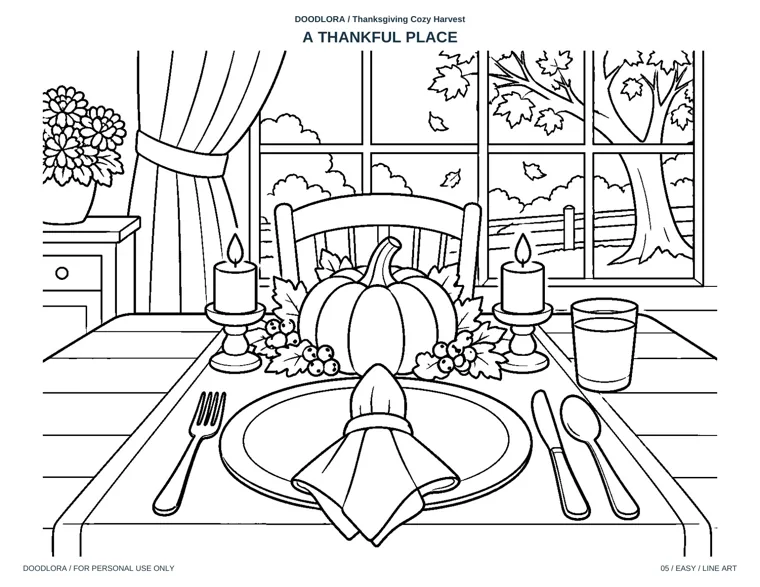
Give each child two or three seats to color for, and ask them to write a guest’s name in the margin. Put the finished mats down only when the table is otherwise set. Gravy and cranberry sauce will stain plain paper, so treat these as one-dinner mats. Clear contact paper on both sides protects one a child wants to keep.
12. A centerpiece from the yard
A homemade centerpiece takes about 15 minutes once the materials are gathered. Send children out with a bag to collect pinecones, colorful leaves and acorns. Add a few small pumpkins or apples from the kitchen. Let them arrange everything in a low basket or tray down the middle of the table, keeping it short enough that guests can see each other across it.
Leave real candles out of the children’s version. The NFPA’s Thanksgiving advice is never to leave children alone in a room with a lit candle, and leaves and pinecones burn easily. The centerpiece is done when the children are happy with it, and the pinecones can come back for a pinecone turkey next year.
Gratitude activities for kids
Gratitude activities turn “what are you thankful for?” into something children can make, keep or give. The thankful tree suits a classroom or a large family, the jar works across the whole week, and the food-drive bag gives the idea a practical end. All three work for children who can’t write yet, if an adult takes dictation.
13. A thankful tree with gratitude leaves
A thankful tree works for a family or a class, with each child adding one or two leaves in about 10 minutes. Dayton Children’s Hospital’s classroom version uses a large paper tree, one or two paper leaves per child, scissors for children ready to cut, and glue sticks or tape. An adult writes for the youngest. WQED, the Pittsburgh public broadcaster, suggests real branches in a vase, steadied with marbles, small rocks or crumpled newspaper.
Talk about what each child is thankful for, then write or draw the answer on a leaf and attach it to the tree. Keep a few blank leaves next to it so children can add more through the week. WQED’s plan ends by reading all the leaves together, and Thanksgiving dinner is a natural time for it. A child who gets stuck can start with a person who helped them or a food they enjoy.
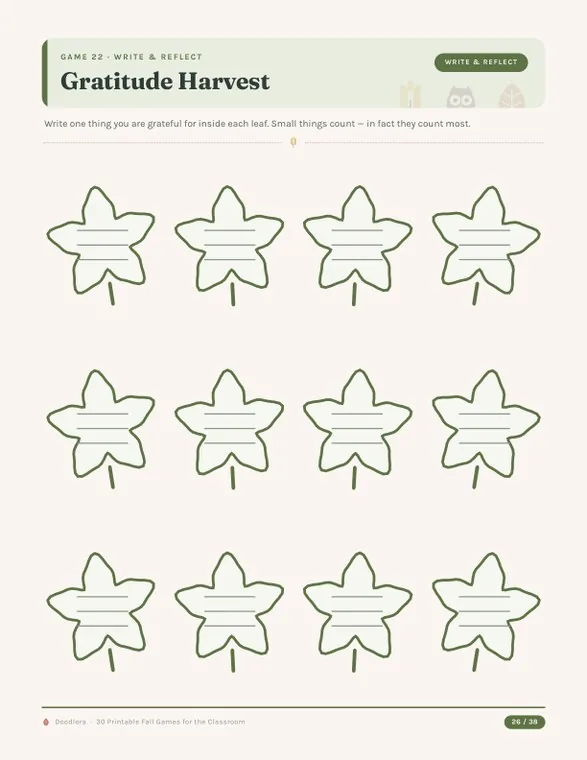
For a quicker setup, use the Gratitude Harvest page in the Doodlora Studio fall classroom pack, which has twelve leaves with writing lines on one sheet. Asking one child to fill all twelve turns a nice moment into homework. Cut the leaves apart instead and give each child one, and the pack’s printing notes suggest card stock for this page.
14. A gratitude jar
A gratitude jar runs through the week before Thanksgiving, and each slip takes a minute. Nebraska Extension describes it simply: put a slip of paper in the jar every time you think of something you’re grateful for, then set aside time to read them together. Any clean jar works, and children can decorate a paper label for it.
Keep slips and a pencil next to the jar, or it stays empty. Younger children can draw on their slips or tell an adult what to write. Read the slips aloud at Thanksgiving dinner or over dessert, and let each person guess who wrote which one. Keep the jar going for next year if the family enjoys it.
15. A food-drive bag
Packing a bag for a food drive takes about 20 minutes and gives older children a way to act on what they’re thankful for. Pathways.org lists giving-back activities such as donation drives among its Thanksgiving ideas. Most communities run food drives at Thanksgiving that collect non-perishable packaged and canned food.
Look up a local drive first, because drives often ask for particular items and set drop-off times. Let children check the pantry or shop from the list, read labels, and pack the bag themselves. A drawn card or a short note can go in on top. The activity ends at the drop-off, so bring the children along if you can.
Outdoor Thanksgiving activities before or after the meal
Outdoor activities give a crowded house some breathing room, either while the turkey roasts or after the plates are cleared. These three work for a mixed group of cousins and grown-ups. Dress in layers, keep a coat pile by the door, and pick a play area away from the street.
16. Jumping in a leaf pile
A leaf pile needs one rake and any number of children, and it can fill half an hour. Rake the leaves into a big pile in the middle of the yard, check it for sticks and stones, and let the children take turns running and jumping. Older kids can rake it back up between turns.
Keep the pile away from the curb. The City of Sherwood, Oregon, warns that piles of leaves in the street tempt young kids to play in them and drivers to drive through them. Back in 1958, Ann Arbor city officials warned that children hiding in piles raked to the street edge were playing an extremely dangerous game. The game ends with one last jump before the leaves go into bags.
17. Touch or flag football
Football on Thanksgiving goes back to the late 19th century, and a family game needs only a ball, two teams and about 30 minutes. In touch football, the person carrying the ball only has to be touched instead of tackled to end a play. Flag football ends the play when a defender pulls a flag from the ball carrier’s belt, and strips of cloth tucked into waistbands work at home.
Mix ages on both teams and mark the end zones with jackets or cones. Decide before kickoff whether a touch means one hand or two, since that’s where most arguments start. One-hand touch is often used with younger players because two-hand touch is harder to pull off. Play to a set number of touchdowns, or until someone calls everyone in to eat.
18. A family turkey trot
A turkey trot is a footrace held on or around Thanksgiving, and some are informal fun runs that suit families. The 5K, 3.1 miles (5 kilometers), is by far the most common distance, and the fun runs range from 1 mile to 3.1 miles (1.6 to 5 kilometers). Fun runs often raise money for charity, and runners dress up, particularly as turkeys. The oldest, in Buffalo, New York, has run since 1896.
Check the local race’s distances, start time and registration rules a few weeks ahead, since some events fill up. If there’s no race nearby, run a lap of the block before dinner, with a paper turkey medal for everyone who finishes. Bring hats and gloves either way, since a late-November morning can be cold.
Thanksgiving activities for the classroom
Classroom activities in the week before Thanksgiving can add some history and some math to the holiday art. The two below suit a full class with one sheet or one lesson each, and both work alongside the thankful tree. Groups who want a quiz afterward can pick from our Thanksgiving trivia questions.
19. Learning about the Wampanoag
The Wampanoag were the Native people at the 1621 harvest feast, and a short lesson on them takes 30 to 40 minutes. The National Museum of the American Indian’s inquiry, The “First Thanksgiving”, gives teachers a full lesson with sources. Its rationale points to the Wampanoag voice, which the museum says has been largely absent from the usual story.
For a shorter version, start with the name. The Wampanoag translate it as “People of the First Light,” and their homeland includes what is now Cape Cod, Martha’s Vineyard and Nantucket. Find those places on a map together. Wampanoag women grew the “three sisters,” corn, climbing beans and squash, so children can look for those three foods on a Thanksgiving menu.
End by pointing out that the Wampanoag are not only history. Two Wampanoag tribes are federally recognized today, the Mashpee Wampanoag Tribe and the Wampanoag Tribe of Gay Head (Aquinnah). Watch the pictures you use, too. A famous 1899 painting of the “first Thanksgiving” shows the Wampanoag dressed like Native Americans of the Great Plains, a misconception that still turns up today.
20. Picture counting with I Spy & Count
Picture counting suits a class of early readers, each with their own sheet, for about 15 minutes. The I Spy & Count page in the fall classroom pack asks children to find and count leaves, acorns, pumpkins, mushrooms, apples and owls in one woodland scene. Then they add up a total. The pack lists it among its pages for grades 1–2, and the answer key stays with the teacher.
Name the six kinds of pictures first, then count one kind at a time and write each number in its box. Pairs can take turns, with one child pointing and the other recording. For preschoolers, pick one kind to count together while an adult writes the number down.
The answer key gives 7 leaves, 6 acorns, 5 pumpkins, 4 mushrooms, 4 apples and 2 owls, for a total of 28. When a child’s total doesn’t match, go back through the six kinds to find the missed apple instead of starting over. For a more competitive round afterward, our Thanksgiving games collect table and party games for the same week.
Printables from this article

Related articles
Printable Coloring Pages
Turkey Disguise Ideas: 18 School Project Ideas & Template
Eighteen ways to disguise a paper turkey for the school project, from a ten-minute snowman to a recycled robot, with materials, ages, time and the usual snags.
Printable Coloring Pages
Coloring Tips: Supplies by Age, Shading and Fixing Mistakes
Which coloring tools and pages suit each age, the order to color a page in, simple shading, fixing mistakes and splitting a busy page across a few sittings.
Printable Coloring Pages
Fall Activities for Kids: Toddlers, Preschoolers & Outdoors
Leaf walks, apple and pumpkin play, counting games and rainy-day pages, sorted by age and by where you'll be, with timing and setup for each.