T-Shirt Design Ideas by Style, Color and Placement
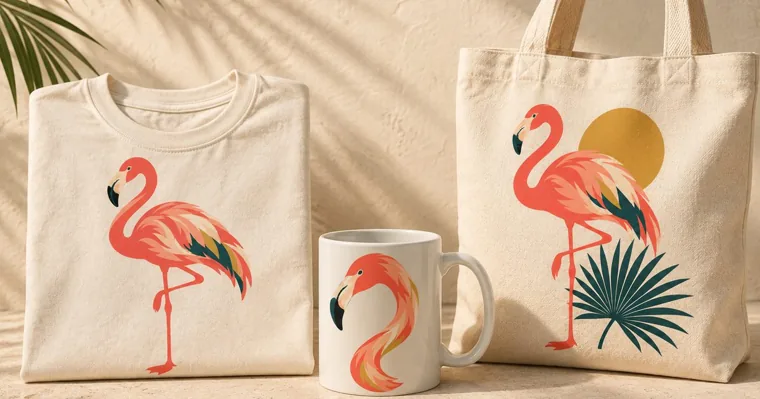
The best T-shirt design ideas start from how you’ll print the shirt. A solid one-color silhouette suits heat transfer vinyl and a first project. A fine line drawing needs a light shirt and a printed transfer. A full-color cartoon belongs on transfer paper or with a print shop, not cut from vinyl.
The table below sorts thirteen ideas by the job in front of you. Each idea further down says who it suits, which shirt color, where it sits, how to print it and the snag to check before you press.
| If you’re making… | Start with | Easiest way to print it | Shirt color |
|---|---|---|---|
| Your first vinyl shirt | A solid animal silhouette | Heat transfer vinyl, one color | Any color that contrasts |
| A shirt for a dog lover | A breed line portrait | Printed transfer or a print shop | White, cream, light gray |
| A kid’s birthday or holiday shirt | A cartoon duck dressed for the day | Printed transfer, or layered vinyl | White or a pale color |
| A cute everyday kids’ shirt | A chubby panda with a heart | Printed transfer | White or cream |
| A beach trip or summer party | A retro flamingo | Printed transfer, or the black version in vinyl | Cream, white, pale coral |
| Shirts for a family or a class | One design in two sizes, plus a name | Same method for every shirt | Same color for the whole group |
First decide how you’ll print it
The print method narrows the ideas more than anything else. Each method below accepts a different kind of art, so check it before you fall for a design.
| Method | What art it handles | Fabric | Good to know |
|---|---|---|---|
| Heat transfer vinyl (HTV) | Flat shapes in one color, or a few colors layered | Cotton, cotton/polyester blends, polyester, canvas | Cut in reverse, then weeded by hand. No gradients or full-color pictures |
| Printable iron-on transfer paper | Full-color art from a home printer | Works on 100% cotton | Image is printed in reverse and pressed with an iron or heat press |
| Sublimation | Full-color art | Polyester or polymer-coated; needs at least a 50/50 poly-cotton shirt | Dye goes into the fibers, so it won’t peel |
| Direct-to-garment (DTG), at a print shop | Full-color, high-detail art | Works best on natural fibers like cotton | Low cost for a single shirt; pretreatment matters most for white ink on dark shirts |
| Screen printing, at a print shop | One color per screen | T-shirts and other garments | Long setup, so it pays off on bigger orders |
Those facts come from Wikipedia’s articles on heat transfer vinyl, iron-on transfers, sublimation, DTG and screen printing. HTV is the one most home crafters picture, and it has the strictest rule: each color is cut, weeded and pressed as its own layer. A design with three flat colors means three layers to line up. A design with soft shading can’t be cut at all.
For temperature, time and pressure, follow the instructions that came with your vinyl or transfer paper. Wikipedia gives a typical HTV range of 250 to 300°F, but each maker lists its own settings, and the guides in our downloads say the same.
One-color designs for heat transfer vinyl
These three ideas cut cleanly from a single sheet of vinyl. They’re the right place to start if you’ve never weeded a design.
A solid animal silhouette
Who it suits: a first vinyl project, a teen who wants a plain graphic tee, or anyone pressing several shirts in one evening.
Colors and placement: one vinyl color that contrasts with the shirt, such as black on white, white on navy or gold on black. Center it on the front of the shirt.
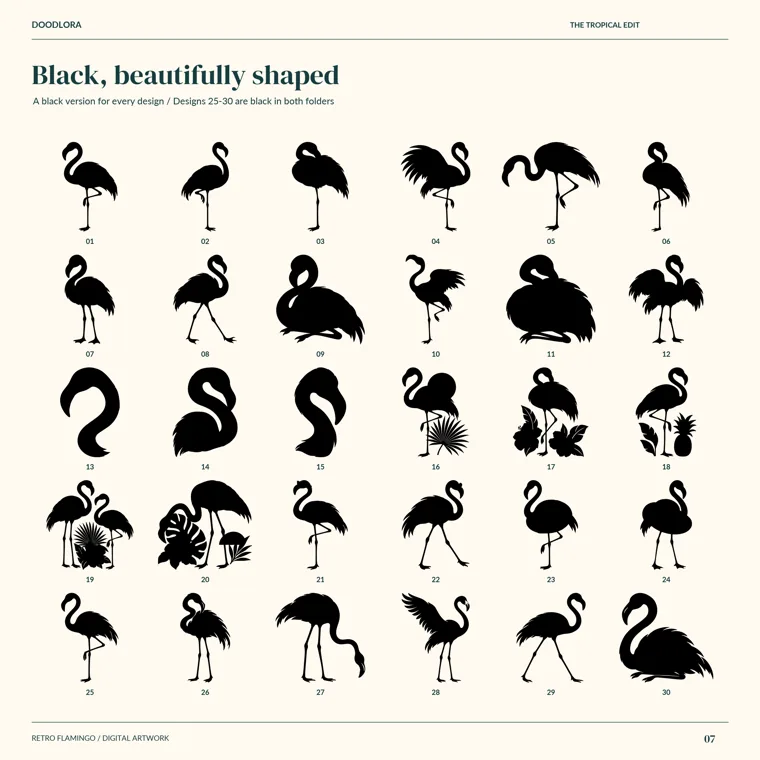
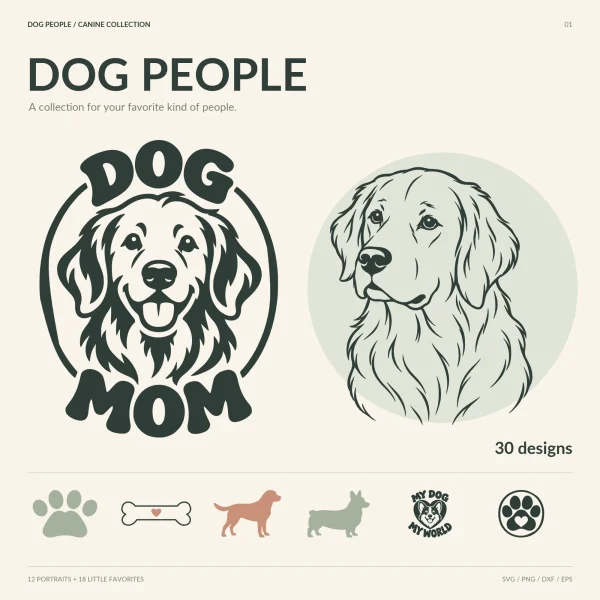
How to print it: cut it from HTV. A silhouette has no inner lines, so weeding means peeling away the background and little else. The flamingo set has a black version of all 30 designs, and the dog bundle has five solid breed silhouettes: a retriever, a dachshund, a corgi, a poodle and a sitting German shepherd. The dog guide suggests starting the simple silhouettes at about 4 inches wide, and calls that a starting point, not a tested minimum.
The snag: a solid shape hides every detail inside its outline. On the flamingo set, the two birds in sunglasses lose their sunglasses in black and look almost like plain flamingos. Pick a pose whose outline tells the story on its own.
A line drawing in one dark ink
Who it suits: someone who likes a lighter, sketchy look instead of a solid block of vinyl.
Colors and placement: a near-black line on a white, cream or pale shirt. Center front.
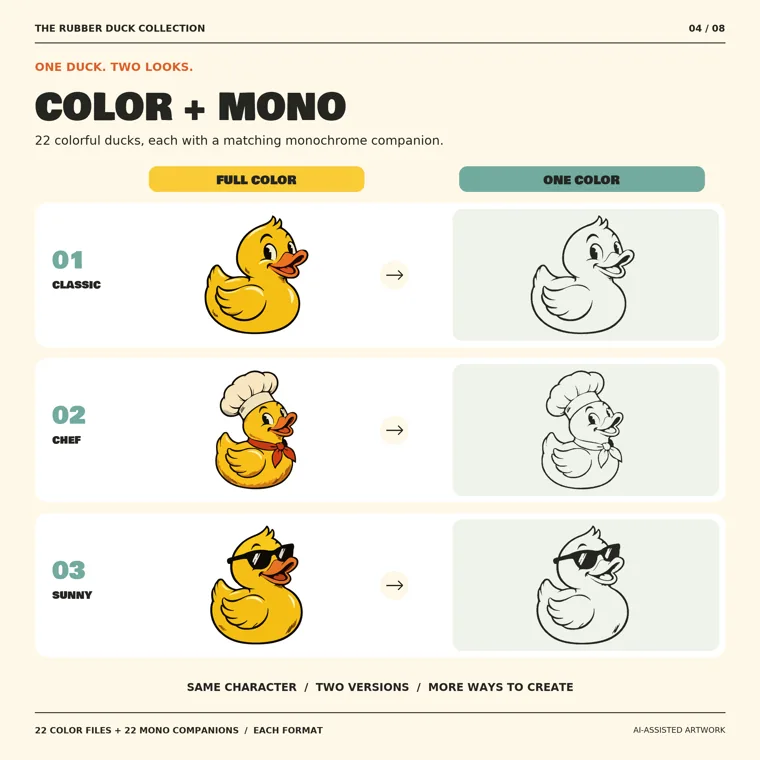
How to print it: each of the 22 color ducks in the rubber duck set has a one-color twin that keeps the ink outline and leaves the body open. The panda set has an ink style that keeps the black parts black and leaves the white parts open. Both print well on transfer paper. For a vinyl cut, the duck guide says to use a mono file rather than the color DXF.
The snag: thin lines are hard to weed. The duck guide warns that the vintage ink accents may be too fine for small vinyl cuts, and the panda guide says fine details and lettering may need a larger size. If the drawing looks spidery at your planned width, print it on transfer paper instead of cutting it.
A small accent: paw print or bone
Who it suits: dog owners who want something quiet, or a second design for the sleeve of a shirt that already has a big front print.
Colors and placement: one color on the left chest, on a sleeve or just below the back collar.
How to print it: the dog bundle has four paw prints and two bones. In the Color folder the solid paws, the paw steps and the solid bone come in sage green, clay or tan, which give you a softer vinyl color than black.
The snag: several paws are built from separate toe shapes. At a small size each toe is a tiny piece of vinyl that can lift off the carrier while you weed or shift while you press. Cut one test paw at your real size before you cut a whole set.
Line-art portraits for dog people
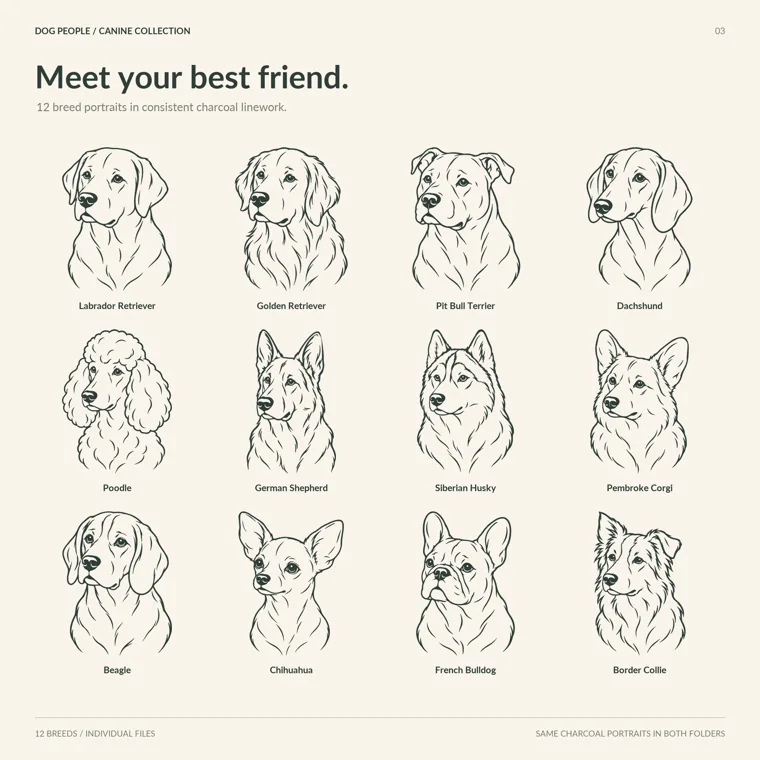
The dog SVG bundle leads with twelve breed portraits in one charcoal line style, which makes it suited to these two ideas.
One breed portrait on the chest
Who it suits: a dog owner, as a gift or for yourself. The breeds are the Labrador retriever, golden retriever, pit bull terrier, dachshund, poodle, German shepherd, Siberian husky, Pembroke corgi, beagle, chihuahua, French bulldog and border collie.
Colors and placement: keep the charcoal line on a white, cream or light gray shirt. Center front works for a large portrait.
How to print it: use the transparent PNG on transfer paper, or take it to a DTG print shop. Cutting is possible but hard. The guide says the portraits include fine facial lines and separate pieces, suggests trying one at about 8 inches wide, and asks you to keep the detached eyes and inner lines exactly where they sit in the file.
The snag: the spaces inside each portrait are transparent, not white. On a dark shirt the fur area shows the shirt color and the charcoal lines nearly disappear. That’s why this one belongs on a light shirt.
A different breed for each person
Who it suits: a family or a group of friends with different dogs who want shirts that match without being identical.
Colors and placement: the same shirt color and the same print width for everyone, each with a different breed, centered on the front.
How to print it: pick each person’s breed from the twelve and print them all the same way. The portraits share one line weight and one color, so a Labrador and a chihuahua printed at the same width still look like one set.
The snag: these are breed drawings, not portraits of a particular pet. If someone’s dog is a mix or a breed outside the twelve, a paw print or a dog silhouette is the fairer choice than the closest-looking breed.
Retro and cartoon designs in full color
Full-color cartoons have the most personality, and they’re also the hardest to cut. Print these ideas unless you’re ready to layer vinyl color by color.
A comic rubber duck dressed for the day
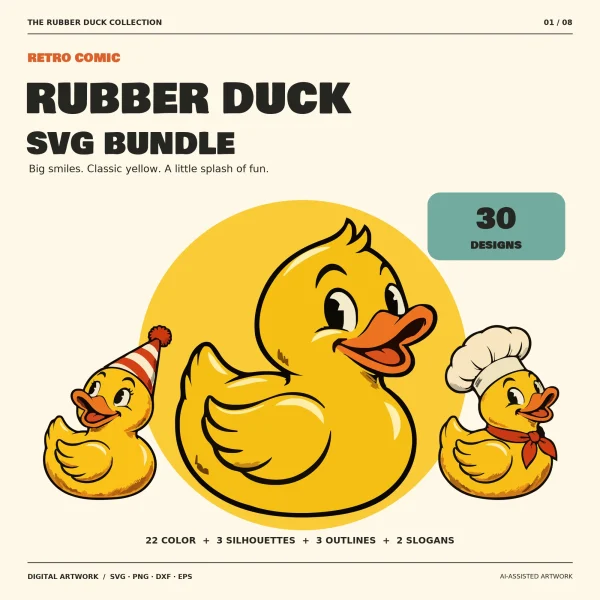
Who it suits: a kid’s birthday shirt, a family Christmas morning, a Halloween party or a graduation. The duck set includes ducks in a striped party hat, a Santa hat, a purple witch hat, bunny ears and a graduation cap.
Colors and placement: the ducks are bright yellow with orange beaks and thick black outlines, so they pop on white or a pale color. Center front.
How to print it: the easiest route is the color PNG on transfer paper. For layered vinyl, the guide points to the SVG, where each color duck is built from roughly one shape per color, ready to ungroup.
The snag: the four file formats open at different sizes, so a duck imported from the DXF won’t match one from the PNG. Set the final width yourself after you import. The guide suggests 9 to 11 inches wide for shirts.
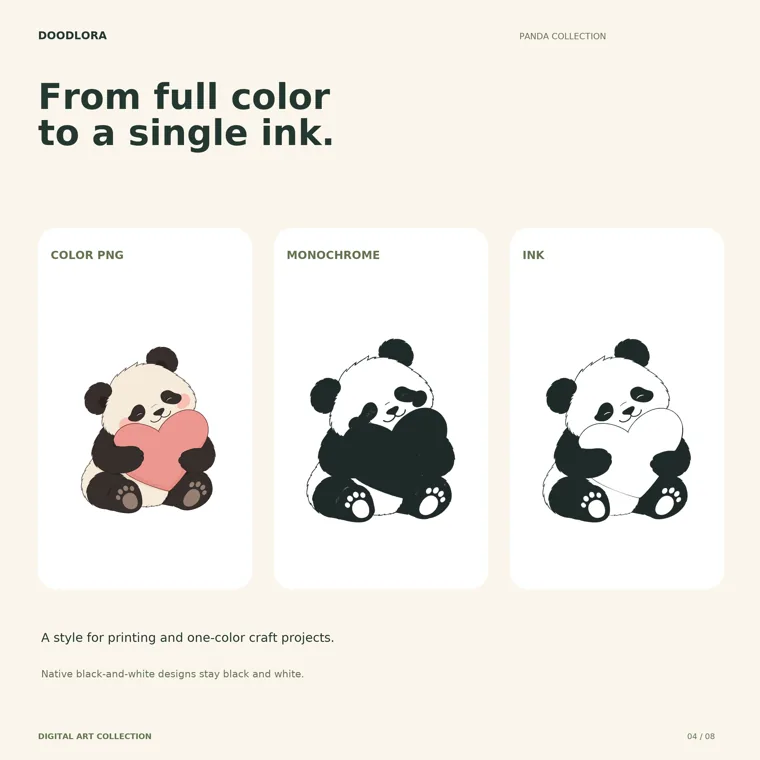
A chubby panda holding a heart
Who it suits: an everyday kids’ shirt, a Valentine’s Day shirt or a gift for a panda fan.
Colors and placement: cream fur, pink cheeks and black patches suit a white or cream shirt. The panda guide gives 7 to 8 inches wide for a youth shirt and 10 to 11 inches for an adult shirt.
How to print it: the color PNG keeps the soft fur shading, so print it on transfer paper or have a shop print it. Vinyl can’t reproduce shading. For a one-color cut, the panda guide points to the mono style.
The snag: the mono style turns the whole design into one dark color, and on the heart-hugging panda the heart merges with the arms into one solid mass. The ink style keeps the heart as a clean open shape, so compare the two files before you cut this design in one color.
A panda in a bamboo ring on the back
Who it suits: a teen or adult who prefers a big back print and a plain front.
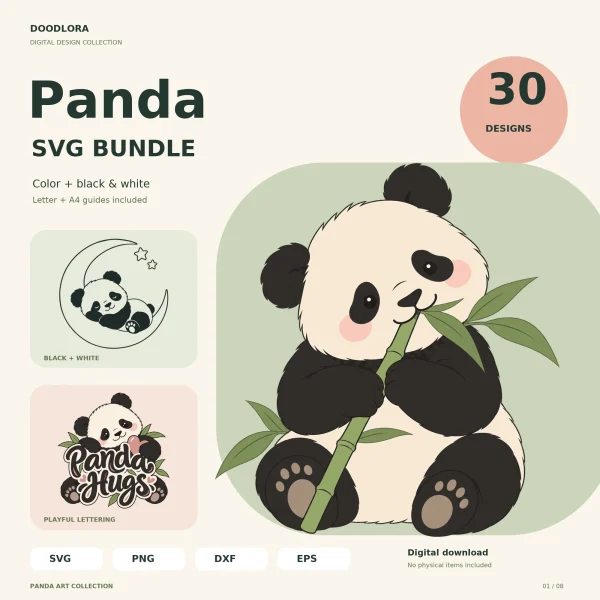
Colors and placement: two of the bamboo scenes put the panda inside a ring, a cub in a bamboo wreath and a sleeping cub circled by leaves, which gives you a round badge. A round design suits the upper back, where it frames well between the shoulder blades.
How to print it: print the color PNG on transfer paper or at a shop. It keeps the soft fur shading that a vinyl cut can’t reproduce.
The snag: the PNGs are 3600 pixels square, and the panda guide says not to enlarge a PNG beyond 12 inches square. For a wider back print, use the SVG or EPS, which scale without losing sharpness.
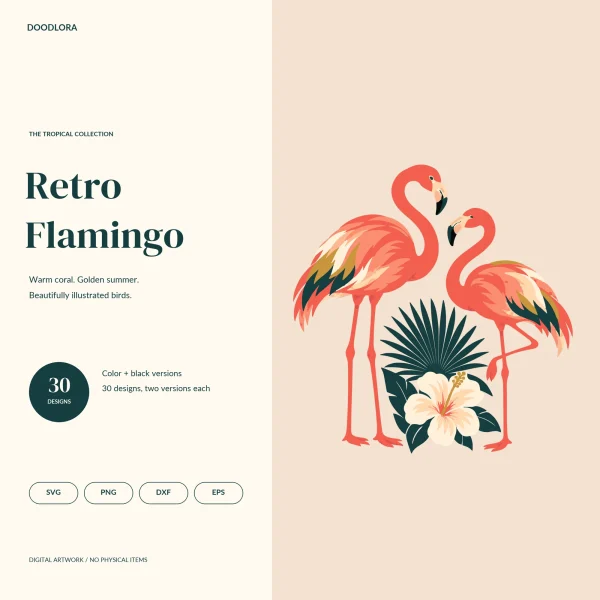
A retro tropical flamingo
Who it suits: a beach vacation, a summer birthday, a pool party or a bachelorette weekend in a warm place.
Colors and placement: coral birds with apricot feathers and deep teal wingtips look best on cream or white. The flamingo guide suggests 10 to 11 inches wide for an adult shirt and 7 to 8 inches for a kid’s shirt.
How to print it: print the color version on transfer paper or at a shop. For vinyl, use the black version, which the guide calls the simpler starting point for a one-color cut.
The snag: the guide warns that the multicolor feather areas are made of many small pieces and should be enlarged or simplified before cutting. A coral-and-teal flamingo cut from vinyl means dozens of feathers to weed and line up.
Two flamingos for a couple’s trip
Who it suits: a honeymoon, an anniversary trip or two best friends on vacation.
Colors and placement: one design in the set shows two flamingos facing each other over a palm and a hibiscus. Use it centered on both shirts, or print one standing bird on each shirt, facing opposite ways, so the pair faces each other when you stand side by side.
How to print it: same as the single flamingo: print the color version, or cut the black version.
The snag: to make two single birds face each other, one of them has to be flipped in your design software. Do that before you set up any mirroring that the transfer method needs, and check each shirt’s design separately before pressing.
Shirts for a family, a class or a team
Group shirts are less about the picture and more about keeping every shirt the same. Settle the shirt color, the print method and the print widths before anyone picks a design.
One design in adult and kid sizes
Who it suits: a family photo day, a reunion, a family trip.
Colors and placement: the same shirt color and the same design for everyone, centered on the front.
How to print it: the panda and flamingo guides both give two widths, 10 to 11 inches for an adult shirt and 7 to 8 inches for a child’s shirt. Export the design at those two widths and print every shirt from those two files.
The snag: a design scaled down for a small child may lose its finest lines. Check the smallest version at actual size before you print the whole batch.
A picture plus your own words
Who it suits: a reunion, a class field trip or a team, where the shirt needs a name or a year.
Colors and placement: keep the lettering the same color as the darkest part of the picture. Set the text under the design, or put the picture on the front and the words on the back.
How to print it: add the text in your design software with a font you’re allowed to use. If you’re cutting vinyl, convert the text to shapes first so it cuts the same as the picture.
The snag: write your own wording. A team or school name you don’t own, a brand slogan or a catchphrase from a show can belong to someone else, even on a shirt made at home.
A small front, a big back
Who it suits: an event shirt where people should be recognizable from behind, such as a run, a class trip or a volunteer day.
Colors and placement: a small accent on the left chest, such as a paw print or a silhouette, and the main design large across the upper back.
How to print it: you can mix methods on one shirt. A one-color accent cut from vinyl and a full-color back printed on transfer paper both work, as long as each is pressed by its own instructions.
The snag: two methods means two sets of press settings. Read both sets of instructions before you start. If either one warns against pressing a finished design again, plan the order of the two sides around that warning.
Where the design goes and how big
Three spots cover most shirts: center front, left chest and the upper back. The table gathers the widths given in our downloads’ guides. None of them gives a width for the left chest or a sleeve.
| Spot | Width given in the guides | Where the number comes from |
|---|---|---|
| Center front, adult shirt | 10–11 in | Panda and flamingo guides; the duck guide says 9–11 in for shirts |
| Center front, youth or kid’s shirt | 7–8 in | Panda and flamingo guides |
| Heat transfers | Start at 8–10 in | Panda guide |
| Vinyl cuts | Start at 6 in (panda), 5 in or larger (duck) | Panda and duck guides |
For a spot the guides don’t cover, print the design on plain paper at two or three widths, cut each one out and hold it against the shirt while someone wears it. The paper copy shows you the size and height before you spend any vinyl.
Keep the proportions locked when you resize. The dog, duck and panda guides all say so, and a stretched duck or a squashed panda is easy to miss on screen and obvious on a shirt.
What the license lets you do with these shirts
All four sets in this article come with our Personal License only. That PDF sits in every one of the four downloads, and the current version is on our license page.
| You can | You can’t |
|---|---|
| Make shirts for yourself and your household | Sell the shirts, or any finished copies made from the files |
| Use the designs with your own students as a teacher | Put the designs into anything someone pays for, such as a fundraiser shirt |
| Use them inside one organization, such as one school, library or office, for its own activities | Use any part of a design in a logo, trademark or brand |
| Print as many copies as those uses need | Share or send the files outside those uses |
If you want to sell shirts, the license says to buy the Commercial License where a product offers it. These four products don’t, so pick a set whose product page offers the Commercial License instead. Not sure where your plan falls? Email [email protected] before you print. For more on picking between PNG and SVG and how the two licenses differ, read how to use clipart, and for line art versus silhouettes, what clipart is.
Ideas to skip
Some of the most searched shirt ideas belong to someone else. Cartoon and movie characters, sports team logos, band logos and brand names aren’t free art to copy onto a shirt, so they’re left out of this list. Short slogans can be registered as trademarks too. Search a catchy phrase in the USPTO’s trademark database before you build a shirt around it.
The safer route is art you have a license for, plus wording you wrote yourself.
Printables from this article
Related articles
Clipart & SVG Cut Files
How to Draw a Truck: Easy Pickup, Big Rig and Cartoon
Split a pickup into three parts before you draw a single wheel: a bed, a cab and a hood. Keep the roof about 2.2 wheels tall and the bed rail level with the hood, and the truck looks right even before the details go on.
Clipart & SVG Cut Files
How to Draw a Train: Steam Engine, Cars and Tracks
Split the page into a 10-square grid, lay a long boiler tube across the middle, set a box cab at the back and a tall stack at the front, hang two big driving wheels under the cab end, then couple cars behind and run the rails to a vanishing point.
Clipart & SVG Cut Files
Hawk vs Falcon: Wings, Size, Hunting Style and Eagles
A falcon has long, narrow wings that taper to sharp points and flies on steady, quick wingbeats; a hawk has broader wings with rounded tips and either soars in slow circles or flaps hard and glides. Falcons kill with a notched beak and hawks with their talons, and eagles are the largest, heaviest-billed members of the hawk family.