Sea Turtle Facts for Kids: Fun Facts, Species and Nests
Sea turtles are reptiles that live in the ocean, breathe air with lungs and come onto land only when a female lays her eggs. There are seven species: the green, hawksbill, Kemp’s ridley, leatherback, loggerhead, olive ridley and flatback turtles. Six of them swim in U.S. waters, and NOAA Fisheries notes that all of those six are protected under the Endangered Species Act. The seventh, the flatback, lives only in the waters of Australia, Papua New Guinea and Indonesia.
This page collects facts about sea turtles for parents and teachers who want to explain them to children from preschool to about fifth grade. It covers the species, what each one eats, how long they stay underwater, how they nest, how the hatchlings reach the sea and why they need protecting. The beach rules near the end come straight from NOAA Fisheries and the National Park Service, because a child who meets a real turtle or nest needs to know them before anything else.
Sea turtle fun facts to start a conversation
Short facts work best as a hook for young children, then the sections below fill in the why. Each of these sea turtle fun facts comes from NOAA Fisheries, the National Park Service or Wikipedia’s sea turtle articles.
- They can’t hide in their shells. A sea turtle’s body tapers at both ends for swimming, so it can’t pull its head and legs inside the way many other turtles and tortoises can.
- The biggest one has no hard shell. The leatherback is the largest turtle in the world, and it is the only sea turtle without scales and a hard shell. Its back has seven ridges and feels rubbery.
- The smallest is Kemp’s ridley. NOAA calls it the smallest sea turtle in the world.
- Leatherbacks dive very deep. They can reach about 4,000 feet (about 1,220 meters) and stay down for up to 85 minutes.
- The green turtle isn’t named for its shell. The name comes from the green color of its fat.
- Warm sand makes more girls. Warmer sand around the eggs produces more female hatchlings and cooler sand more males.
- They cry salty tears. A gland near each eye gets rid of extra salt from seawater, which looks like crying.
- Mothers don’t come back. After covering the nest, the female returns to the sea and never checks on the eggs.
- They live a long time. NOAA says green turtles could live at least 70 years.
The seven species of sea turtles
Use the NOAA Fisheries names when you teach the species: green turtle, hawksbill turtle, Kemp’s ridley turtle, leatherback turtle, loggerhead turtle and olive ridley turtle, plus the flatback turtle, which NOAA doesn’t cover because it doesn’t live in U.S. waters. The table gives one feature a child can remember for each, plus its main food.
| Species | What makes it stand out | Main food | Where it nests or lives |
|---|---|---|---|
| Green turtle | Largest hard-shelled sea turtle; adults are about 3 to 4 feet (0.9 to 1.2 m) long | Mostly seagrasses and algae | Nests in Florida, Georgia, South Carolina, North Carolina, Puerto Rico, the U.S. Virgin Islands, Hawaii and U.S. Pacific territories |
| Hawksbill turtle | A pointed, hawk-like beak; shell 2 to 3 feet (0.6 to 0.9 m) long | Mainly sponges on coral reefs | Largest groups in the Caribbean, Indian and Indo-Pacific Oceans |
| Kemp’s ridley turtle | Smallest sea turtle in the world; often nests in daylight | Crabs, once it moves to shallow coastal water | Nests in northeastern Mexico and in Texas |
| Leatherback turtle | Largest turtle in the world; rubbery skin instead of a hard shell | Jellyfish and salps | Nests in the U.S. and Caribbean from March to July |
| Loggerhead turtle | Very large head and strong jaws | Hard-shelled animals such as whelks, conch and horseshoe crabs | The most common sea turtle nesting in the United States |
| Olive ridley turtle | One of the smallest, but the most widespread and abundant | Algae, crustaceans, tunicates and mollusks | Mass nesting in huge groups happens on only a few beaches worldwide |
| Flatback turtle | A flatter, lower shell than the others | Soft corals, sea cucumbers, shrimp, jellyfish and mollusks | Only Australia, Papua New Guinea and Indonesia |
Two names trip children up. “Ridley” is part of two species names, so ask which ridley, Kemp’s or olive. “Loggerhead” refers to the turtle’s huge head, which makes a good memory hook: a big head for cracking shells.
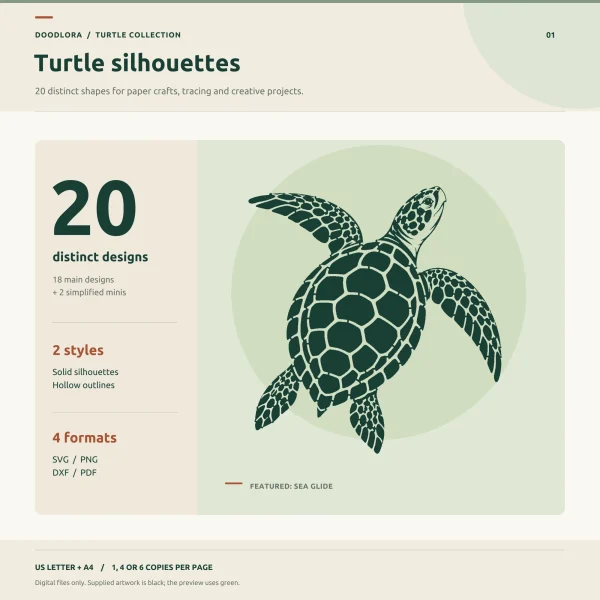
To give each species a picture, print sea turtle silhouettes from our turtle outlines set and write a species name under each one. The set doesn’t label species, so the names and features come from the table, not from the drawings.
What do sea turtles eat? It depends on the species
There’s no single answer to what sea turtles eat, because each species has a mouth shaped for different food. The green turtle is the only sea turtle that mostly eats plants. Its beak has serrated edges, and adults graze on seagrasses and algae, though they may also eat small animals when they find them.
The others mostly eat animals. A loggerhead’s big jaws crush whelks and conch, and Kemp’s ridleys prefer crabs. The hawksbill’s narrow beak reaches into cracks in coral reefs, where it finds sponges, its preferred food in many areas. Leatherbacks don’t have a crushing beak at all. Their jaws have pointed, tooth-like edges for holding soft prey, mainly jellyfish and salps.
Babies eat differently from adults. Young green turtles and Kemp’s ridleys spend their early years in the open ocean around floating mats of Sargassum seaweed, eating the small plants and animals that live there. Green turtles move to seagrass and algae only after they settle in shallow coastal water.
The jellyfish fact matters for children beyond trivia. Sea turtles can mistake floating balloons and plastic bags for jellyfish and swallow them, which is why NOAA asks people not to release balloons. That makes a concrete reason for picking up beach trash.
A “who eats what” matching game
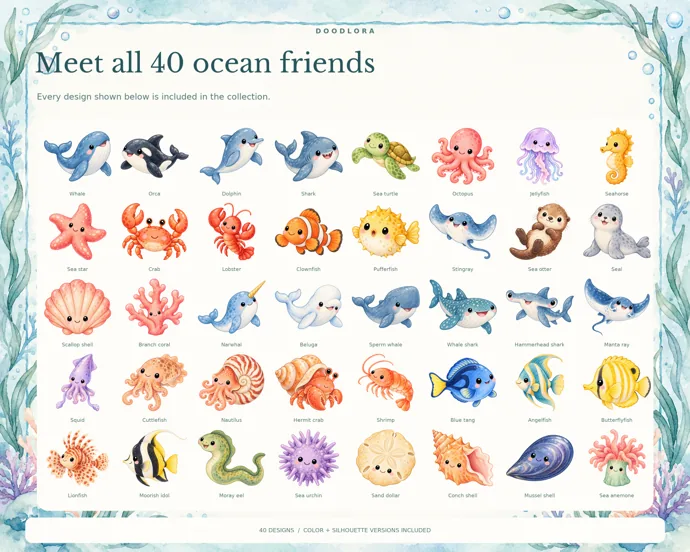
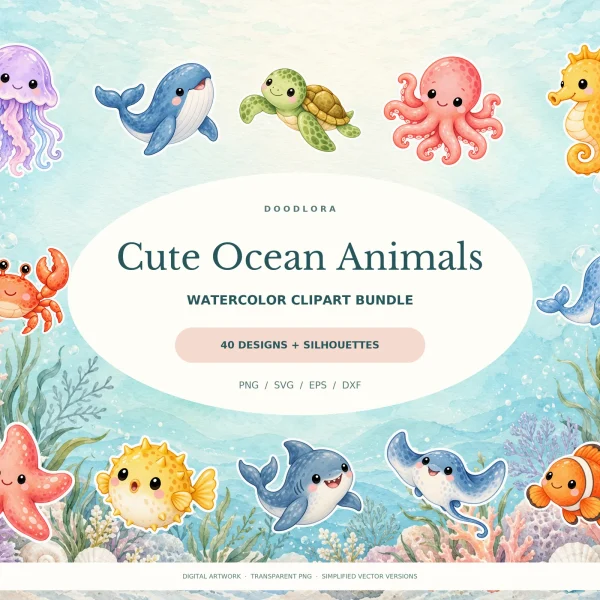
This works for 2 to 6 children aged about 5 to 9 and takes 15 to 20 minutes. Print the seven species names on cards, then print food pictures from the watercolor sea animals clipart a few inches wide: jellyfish, crab, shrimp, sea urchin, branch coral, conch shell and mussel shell. Children take turns placing each food card under the turtle that eats it, and an adult checks with this answer key from the NOAA species pages and Wikipedia’s flatback article.
| Food card | Sea turtles that eat it |
|---|---|
| Jellyfish | Leatherback (its main food), flatback, hawksbill |
| Crab | Kemp’s ridley (its preferred food), loggerhead; hawksbill and olive ridley also eat crustaceans |
| Shrimp | Flatback; shrimp are crustaceans, so hawksbill and olive ridley count too |
| Sea urchin | Hawksbill |
| Branch coral | Hawksbill; the flatback eats soft corals |
| Conch shell | Loggerhead |
| Mussel shell | Mollusk eaters: loggerhead, olive ridley, hawksbill, flatback |
Some foods belong to more than one turtle, and that’s the point to talk about. Crabs go with the Kemp’s ridley and the loggerhead, and jellyfish with the leatherback and the flatback. The set has no seagrass or sponge, so write “seagrass” and “sponge” on blank cards for the green turtle and the hawksbill. End when every turtle has at least one food, then ask which turtle would be hungry in a place with no jellyfish.
How sea turtles breathe and how long they stay underwater
Sea turtles breathe air with lungs, so every one of them has to come to the surface to breathe. They can hold their breath for a long time, and how long depends on what they’re doing. A turtle looking for food usually stays underwater for about 5 to 40 minutes. A sleeping turtle can stay down for 4 to 7 hours.
When it surfaces, a sea turtle empties and refills its large lungs with one quick, explosive breath out and a fast breath in. Leatherbacks are the record divers, reaching about 4,000 feet (about 1,220 meters) and staying down for up to 85 minutes. Olive ridleys dive to about 500 feet (about 150 meters) to feed on animals that live on the bottom.
Breath-holding explains one of the biggest dangers. A turtle caught in a fishing net can’t reach the surface, and NOAA notes that sea turtles caught accidentally in shrimp nets can drown. For younger children, a kitchen timer makes the numbers real: set it for 40 minutes and see how much of the afternoon passes before it rings. Skip breath-holding contests; the timer makes the point safely.
A sea turtle’s body: shell, flippers and beak
A sea turtle is built for swimming. It has flippers instead of feet, and its body narrows at both ends, which cuts drag in the water. That shape is also why it can’t tuck its head inside its shell.
The top shell is called the carapace and the bottom shell the plastron. On hard-shelled species the carapace is covered with large plates called scutes. NOAA describes the green turtle’s shell as having five scutes down the middle and four on each side. The leatherback is the exception: its “shell” is a layer of small bones under rubbery skin, with seven ridges running along its back.
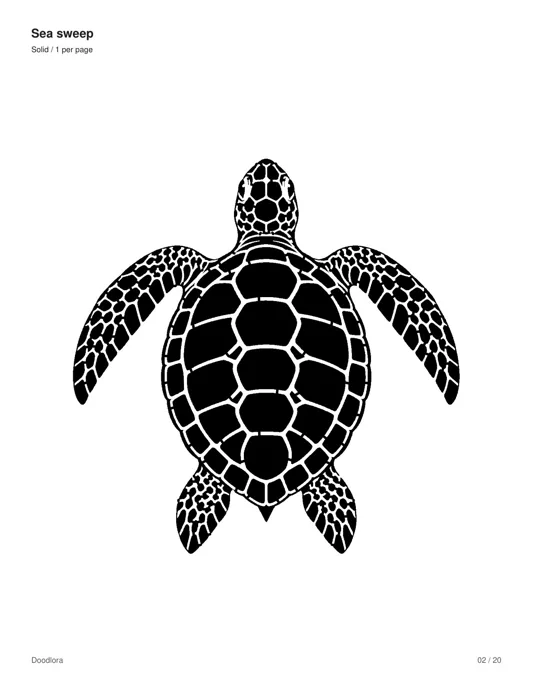
Page 2 of the turtle outlines PDF works as a counting sheet. Print it and have a child put a dot on each plate down the middle, then each plate along one side. It shows five down the middle and four along each side, the same count NOAA gives for a green turtle. The file’s own guide calls its designs stylized craft graphics, not scientific diagrams, and doesn’t name a species. So present the page as “a turtle shaped like a green turtle,” not as a labeled diagram.
One page in the same set needs a warning. Design 13, “Hatching turtle,” shows a baby with clawed feet climbing out of an egg. That’s a tortoise, and the set’s index files it with the land turtles. For a sea turtle hatchling lesson, use designs 6 and 7, which have flippers.
Where sea turtles lay their eggs
Female sea turtles come back to land only to nest, usually on a beach in the same general area where they hatched decades earlier. Most species nest at night and alone. Kemp’s ridleys are different: they nest mostly in daylight, often in big groups called arribadas, a Spanish word for “arrivals.” Olive ridleys also nest in arribadas, sometimes thousands of turtles at once.
The nesting itself takes about 30 minutes to an hour. The female crawls up the beach, digs a hole with her back flippers about 16 to 20 inches (40 to 50 cm) deep, lays her eggs in it and covers them with sand. Then she goes back to the sea and doesn’t return to care for the eggs. A loggerhead nest holds about 100 eggs and a green turtle nest about 110. A loggerhead usually lays three to five nests in one season, about two weeks apart.
In the United States, NOAA lists green turtle nesting in Florida, Georgia, South Carolina, North Carolina, Puerto Rico, the U.S. Virgin Islands, Hawaii and U.S. Pacific territories. The National Park Service notes that the Outer Banks of North Carolina sit near the northern edge of where loggerheads, greens and leatherbacks nest. Kemp’s ridleys nest on Padre Island, Texas, from April through mid-July.
Sand temperature decides more than hatching time. The eggs’ surroundings set whether each hatchling becomes male or female, with warmer sand producing more females. The Park Service lists this among the reasons visitors should never move or rearrange eggs in a nest.
How baby sea turtles find the ocean
The eggs incubate in the warm sand for about two months. The eggs in a nest hatch around the same time, and the babies dig up through the sand together, usually at night. Once hatchlings start coming out, the whole nest can take anywhere from 15 minutes to 2 days to empty.
Hatchlings find the sea by the light. They crawl away from the dark shapes of dunes and plants and toward the brightest horizon, which on a natural beach is the sky over the ocean. Bright lights from houses, streets or flashlights can pull them the wrong way. The National Park Service explains that lost hatchlings may head inland, where they can die from exhaustion or dehydration, get eaten or crawl onto roads.
The trip is dangerous even on a dark beach. Gulls, ghost crabs and coyotes catch hatchlings on the sand. Once in the water, the babies swim hard for open ocean, and young loggerheads spend their first 7 to 15 years out there before moving closer to shore.
A hatchling race-to-the-sea game
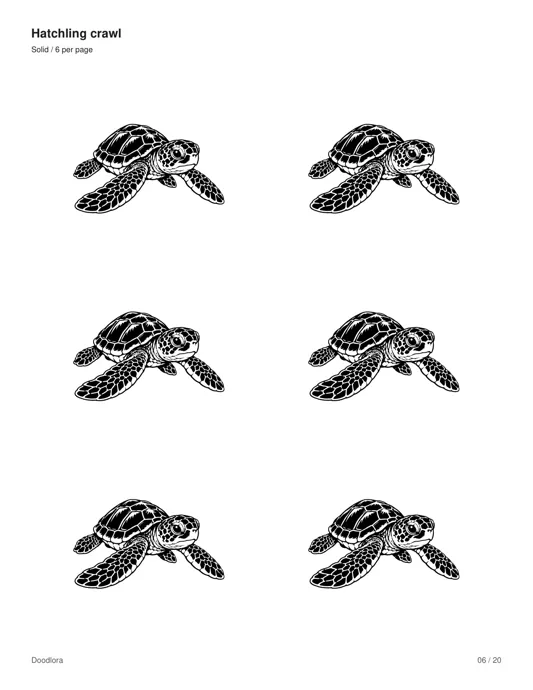
This game fits 4 to 20 children aged about 4 to 8 and takes about 10 minutes. Print page 6 of the six-per-page solid PDF from the turtle outlines set, one page for every six players, and let an adult cut out the hatchlings. At one end of the room, tape a big blue paper “ocean” under a sheet labeled “moon.” Along one side, tape a yellow sheet labeled “porch light.”
Each child holds a hatchling and starts at the far wall, the “nest.” In round one, call “lights out!” and everyone crawls their turtle toward the moon and the ocean. In round two, call “porch light on!” and the hatchlings head for the porch light instead. Stop there and ask what happens to a turtle that crawls toward the houses. End with round three: someone “turns off” the porch light by taking the sign down, and every hatchling reaches the sea. The game teaches the most useful beach rule without any lecture.
Why sea turtles are in danger
All six sea turtle species found in U.S. waters are protected under the Endangered Species Act. NOAA Fisheries names these as the main threats:
- Fishing gear. Turtles get caught by accident in nets and on hooks, which is called bycatch. Trapped underwater, they can drown.
- Lost beaches. Seawalls, buildings and beach driving destroy or block nesting sand.
- Lights. Beachfront lights keep females from coming ashore and confuse hatchlings.
- Boats. Turtles near the surface can be hit by boats and ships.
- Trash. Turtles swallow balloons, plastic bags and fishing line, or get tangled in lost fishing gear.
- Hunting and egg collecting. It’s illegal in the United States but still happens in some countries.
- Hotter sand and rising seas. Very hot sand can kill eggs or produce too many females, and storms and rising water can wash nests away.
For young children, keep the list short and pair each threat with something a family can do: turn off lights, pick up trash, skip the balloons. Older children can handle the full list and the idea of bycatch.
What to do if you see a sea turtle or a nest
NOAA Fisheries and the National Park Service give the same core advice: look, but don’t touch or disturb. Go over these rules with children before a beach trip, especially in the southeastern states, Texas or Hawaii.
- Keep your distance. NOAA recommends staying at least 50 yards (about 46 meters), half a football field, from a sea turtle in the water or on the beach, including pets. In Hawaii the recommended distance is at least 10 feet (3 meters).
- Never touch, feed or ride a sea turtle. NOAA says not to swim with, ride, pet or touch sea turtles, and not to take selfies with them.
- Leave nesting turtles alone. The National Park Service asks people not to rush up to a turtle crawling ashore, because it may go back into the water without nesting. Move away or sit quietly at a distance.
- No lights or flash. Don’t shine flashlights or use flash photography on a nesting turtle or hatchlings. Turn off or shield lights that can be seen from the beach.
- Don’t touch nests or hatchlings. Don’t move or rearrange eggs, and don’t pick up, crowd or carry hatchlings to the water. Only trained, permitted biologists and volunteers may handle them.
- Respect marked nests. Parks post signs and fences around known nests; stay outside them.
- Clean up before you leave. Fill in holes, knock down sandcastles and take home chairs, umbrellas and trash, so turtles and hatchlings don’t get trapped.
- Keep dogs on a leash. A dog can smell eggs buried in the sand and dig up a whole nest.
- Report what you see. Tell a ranger or call the number posted at the beach if you find turtle tracks, a nesting turtle, hatchlings heading away from the water or an injured turtle. On Padre Island in Texas, for example, the park asks visitors to call 1-866-TURTLE5.
Sea turtles, their eggs and hatchlings are protected by law, and harassing or harming them is illegal. A child who knows the rules can be the one who reminds the adults.
How to explain sea turtles at different ages
The same facts land differently at 4 and at 10. This table gives a starting point for each age group, with an activity from this page that fits.
| Age | What to explain | Good activity |
|---|---|---|
| 3 to 5 | Sea turtles live in the sea, breathe air, have flippers and hatch from eggs on the beach | Hatchling race-to-the-sea game |
| 6 to 8 | The seven species, what each eats, and why lights confuse hatchlings | “Who eats what” matching game, counting shell plates |
| 9 to 11 | Breath-holding and diving, temperature and male or female hatchlings, threats like bycatch, beach rules | Make a fact card for each species and a beach rules poster |
For the youngest group, pick three facts and repeat them: flippers, eggs on the beach, babies go to the sea. Save numbers like dive depth for children who can picture a football field or a tall building.
Sea turtle picture cards and other printables
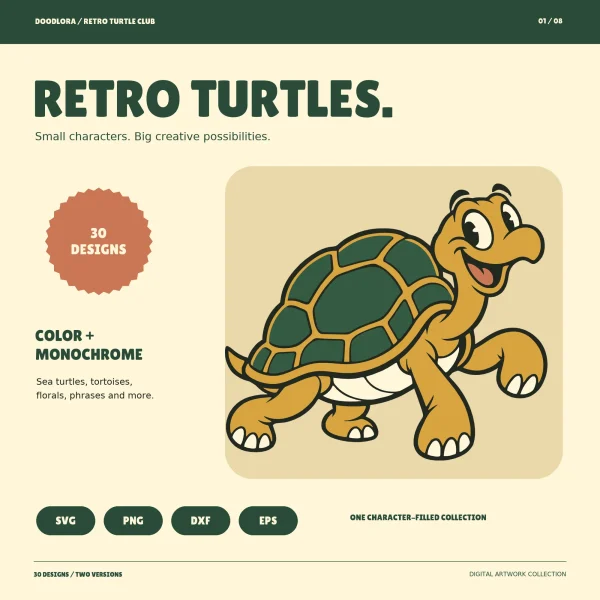
Cartoon sea turtles make friendly picture cards for fact cards, name tags or a classroom display. The retro turtle SVG set has 30 designs in color and one-color versions, including six sea turtles (designs 1 to 6) and a paddling baby sea turtle (design 12). Print one turtle per card and write a fact from this page on the back.
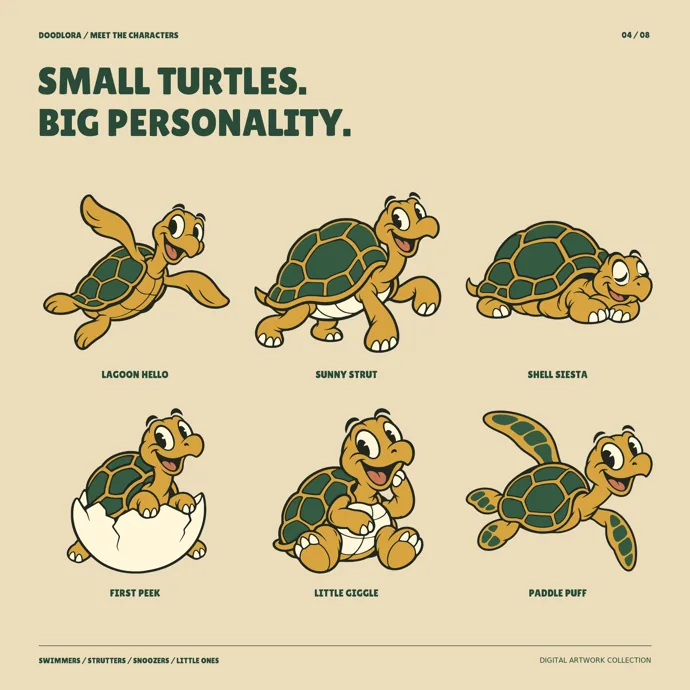
The retro turtles are cartoons, so don’t use them to teach what a real sea turtle looks like. Only the swimmers have flippers. The baby climbing out of the eggshell (design 10) and the sitting baby (design 11) have clawed feet like a tortoise. A sea turtle hatchling already has flippers when it breaks out of the egg. Use the turtle outlines set when the drawing needs to look like the real animal. A personal license covers printing these files for your own family, your own students or activities inside one school.
For more hands-on projects, the turtle crafts page has paper plate, tissue paper and shell mosaic turtles, and how to draw a turtle walks through a sea turtle seen from above. The ocean crafts page fits a wider sea animal unit.
Sea turtle questions kids ask
Can a sea turtle live on land?
No. Sea turtles spend almost their whole lives in the ocean. Females come ashore only to lay eggs, and the babies head for the water right after hatching. Some green turtles in Hawaii and a few other places crawl onto beaches to rest in the sun, but they still live in the sea.
Do sea turtle mothers take care of their babies?
No. The mother covers the nest and swims away. The hatchlings dig out, find the ocean and start feeding on their own.
Can I keep a sea turtle as a pet?
No. Sea turtles in the United States are protected by the Endangered Species Act, which makes it illegal to harass, harm, possess or kill them, their eggs or hatchlings. Even picking up a hatchling on the beach isn’t allowed.
Is a sea turtle the same as a tortoise?
No. Tortoises are turtles that live on land and walk on feet. A sea turtle lives in the ocean and has flippers instead of feet, so children can spot the difference on a picture by looking for flippers.
Why do sea turtles look like they’re crying?
They’re getting rid of salt. A gland near each eye pushes out extra salt from the seawater they take in, and the leatherback, which eats salty jellyfish, has a bigger gland than the others.
How many sea turtles are left?
There’s no single number for all seven species. The leatherback is the clearest example of decline: NOAA reports that all its major populations are falling quickly. That makes the beach rules above the most useful thing a family can learn.
Printables from this article
Related articles
Clipart & SVG Cut Files
How to Draw a Truck: Easy Pickup, Big Rig and Cartoon
Split a pickup into three parts before you draw a single wheel: a bed, a cab and a hood. Keep the roof about 2.2 wheels tall and the bed rail level with the hood, and the truck looks right even before the details go on.
Clipart & SVG Cut Files
How to Draw a Train: Steam Engine, Cars and Tracks
Split the page into a 10-square grid, lay a long boiler tube across the middle, set a box cab at the back and a tall stack at the front, hang two big driving wheels under the cab end, then couple cars behind and run the rails to a vanishing point.
Clipart & SVG Cut Files
Hawk vs Falcon: Wings, Size, Hunting Style and Eagles
A falcon has long, narrow wings that taper to sharp points and flies on steady, quick wingbeats; a hawk has broader wings with rounded tips and either soars in slow circles or flaps hard and glides. Falcons kill with a notched beak and hawks with their talons, and eagles are the largest, heaviest-billed members of the hawk family.