Tangram Puzzles for Beginners: Pieces, Rules and Hints
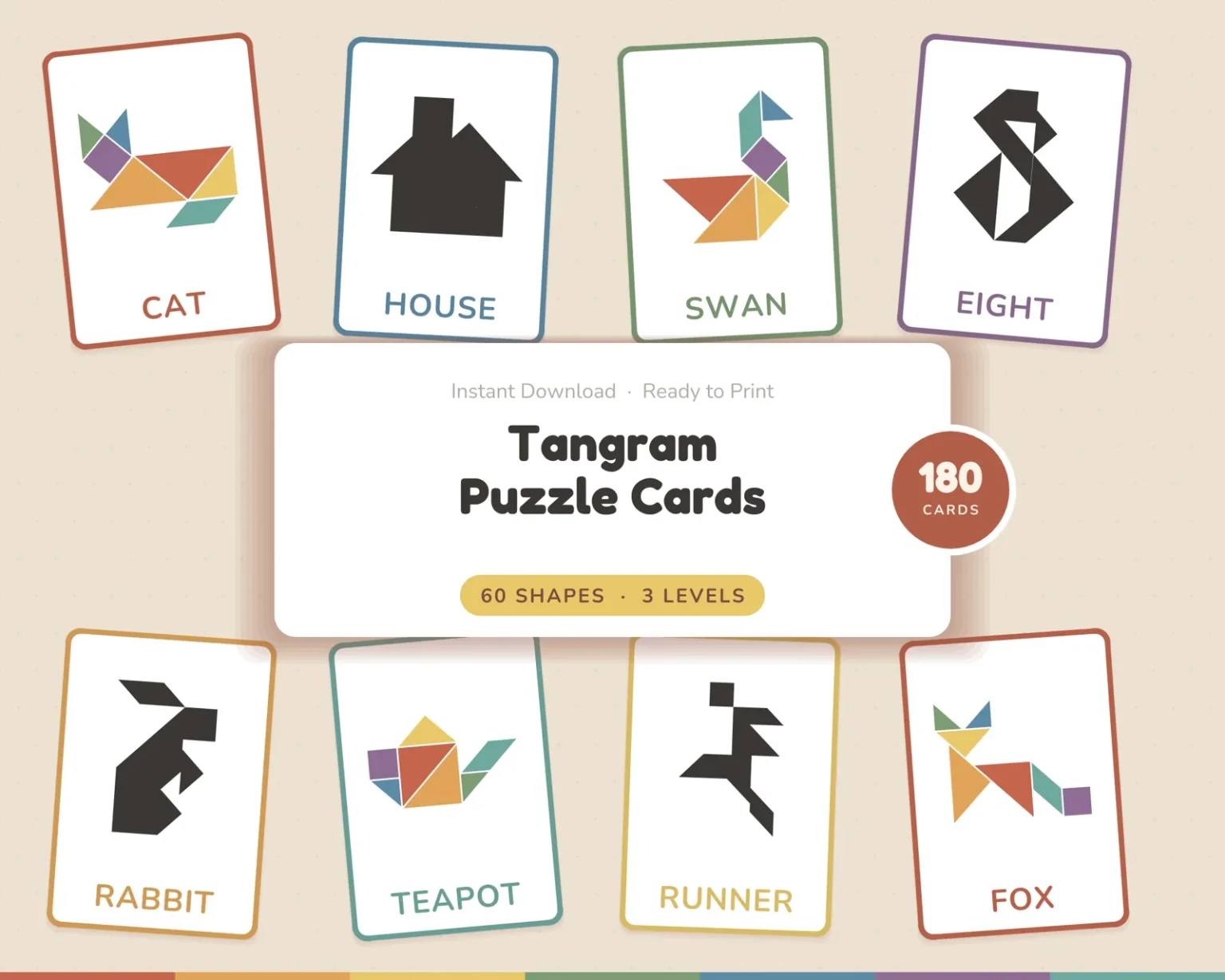
Tangram puzzles for beginners start with one habit: put the two large triangles down first, because together they cover half of any finished shape.
The rest is a short routine. Cut out the seven pieces, learn three rules, and copy a card that shows every piece in its own color.
Then build the same picture again from a solid black silhouette.
Keep the answer card face down, and use it for hints rather than for checking every move.
The seven tangram pieces and how their sizes compare
A tangram is one square cut into seven pieces: two large triangles, one medium triangle, two small triangles, one square and one parallelogram.
The sizes aren’t random. Count the small triangle as 1, and every other piece is a whole number of small triangles.
| Piece | How many | Size, counting a small triangle as 1 |
|---|---|---|
| Large triangle | 2 | 4 each |
| Medium triangle | 1 | 2 |
| Square | 1 | 2 |
| Parallelogram | 1 | 2 |
| Small triangle | 2 | 1 each |
That adds up to 16, and the two large triangles hold 8 of them.
On the cut-out sheet in our Doodlora Studio Tangram Shape Puzzle Cards, the colored areas of the seven pieces measure out at 4, 4, 2, 2, 2, 1 and 1.
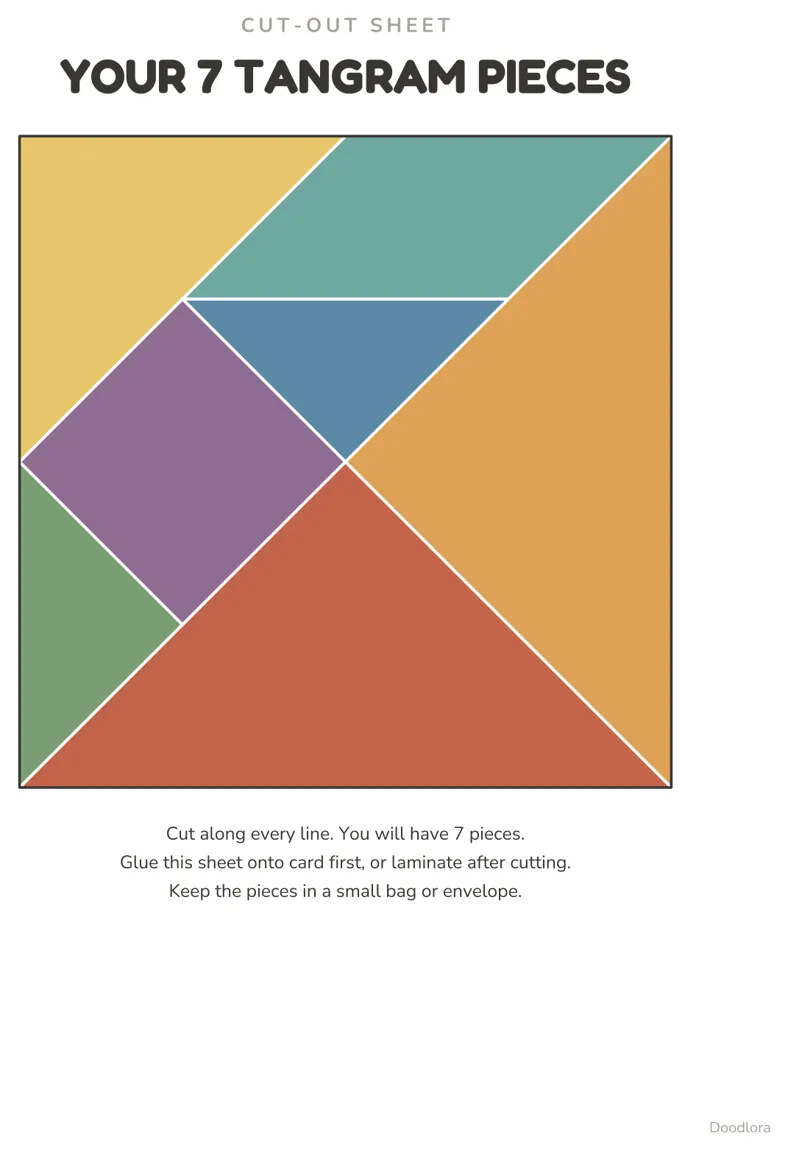
Every triangle in the set has the same shape, just scaled: one square corner and two 45-degree corners.
A square piece has four square corners.
Only the parallelogram mixes them: two sharp 45-degree corners and two wide 135-degree ones.
Edges line up as neatly as the areas do.
A small triangle’s long side is as long as the medium triangle’s short side and the parallelogram’s long side.
In the same way, the medium triangle’s long side matches a large triangle’s short side, and the square’s side matches the small triangle’s short side.
Flipping changes just one piece, the parallelogram. Face down, its slant leans the other way, while every triangle and the square look the same either side up.
Tangram rules: what counts as a finished puzzle
The rules on our how-to-play page fit in three lines. Use all seven pieces every time. Let pieces touch, but never overlap or stack them. Make sure every piece touches at least one other piece.
That last rule has a detail beginners miss.
A touch can be along an edge or just at a corner. A triangle that meets the rest of the figure at a single point still counts, so don’t pull a figure apart because two pieces only meet at a tip.
Pieces lie flat. A corner slid under its neighbor breaks the no-overlap rule even when the outline looks right.
When a figure seems to come together too easily, count the pieces, then lift the edges and look underneath.
Turning and flipping are both allowed.
The rules box in our City Adventure cards says so in plain words, and adds that there can be more than one way to solve a picture.
So if your arrangement fills the outline but doesn’t match the answer card line for line, it still counts. Swapping the two large triangles, for instance, changes nothing you can see.
Building your own pictures with fewer pieces is a fine game too. It just isn’t a tangram puzzle, so say which one you’re playing before a child compares answers.
Flat pieces need flat paper, and that’s where most homemade sets go wrong.
Making a tangram set that matches your puzzle cards
A paper tangram works as well as a wooden one, as long as it comes out the right size and stays flat.
Print the cut-out page at 100%, not “fit to page.” Our guide to printing at actual size shows where that setting hides in each print dialog.
Then take a measurement before you cut.
The square on our cut-out sheets is 5.9 inches (150 mm) across, and the people set prints a 2-inch (5 cm) line under its square so you can check the scale with a ruler.
Print on cardstock, or glue the printed sheet onto card before you cut. Laminating after cutting works as well.
Printed pieces are colored on one side only, so a flipped parallelogram shows its white back. That’s fine on a silhouette card, which only asks about shape.
Cut along every line, and you’ll have seven pieces.
Recut any piece with a bent corner, since a lifted corner can hide a gap.
Don’t expect the pieces to cover the pictures on the cards. In our shape cards, the figures are drawn at a little over half the size of the cut-out set, so you build next to the card, not on top of it.
If you’d rather lay pieces straight onto the picture, our animal tangram cards come with a second, card-size set. It’s a 3-inch (75 mm) square, and its pieces fit right on top of each printed animal.
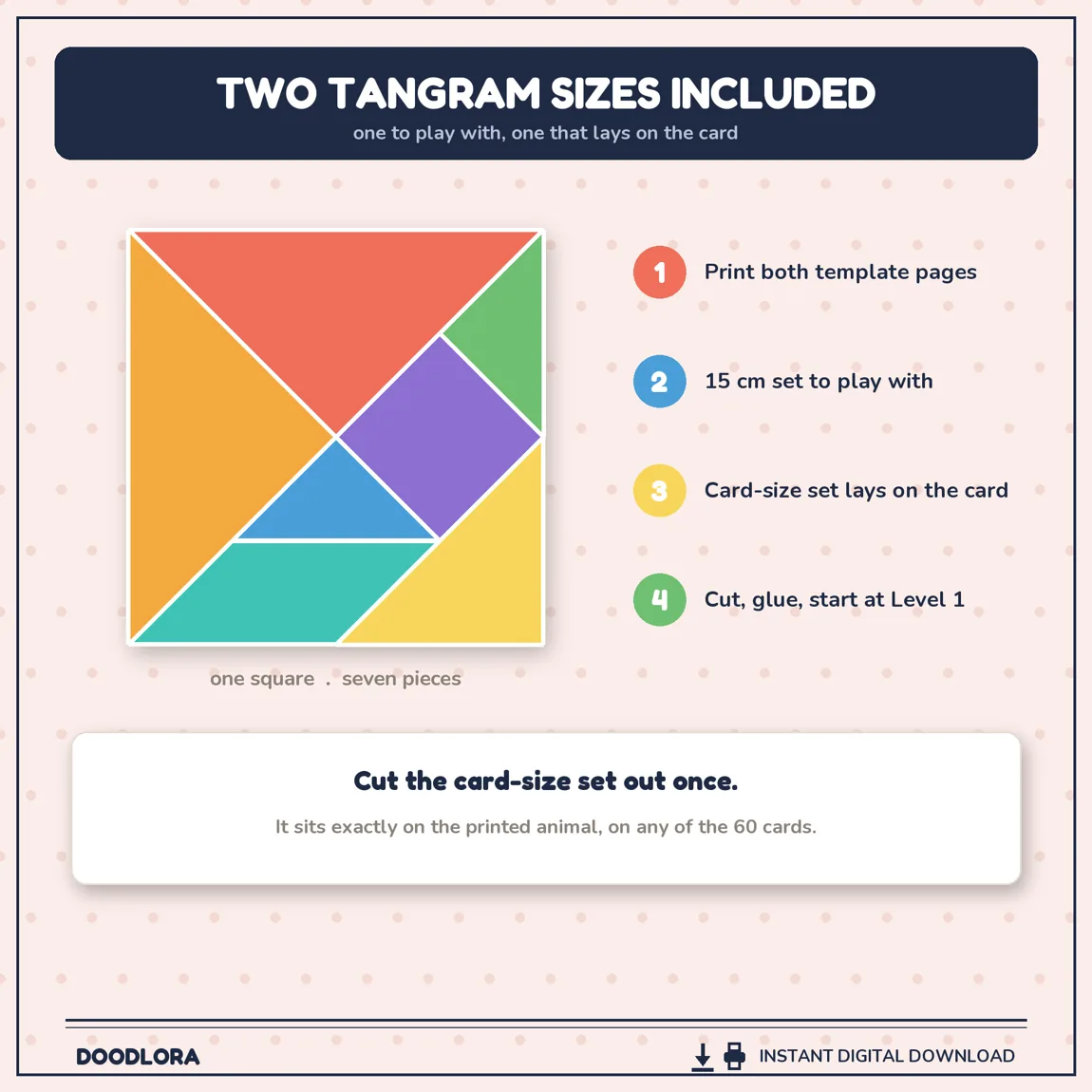
Keep each set in its own envelope.
A 3-inch set and a 5.9-inch set mixed in one bag can’t make any figure at all, and that mistake looks exactly like a very hard puzzle.
Easy tangram puzzles to start with: color card, silhouette, answer key
With a set cut and checked, pick a card that shows every piece in its own color.
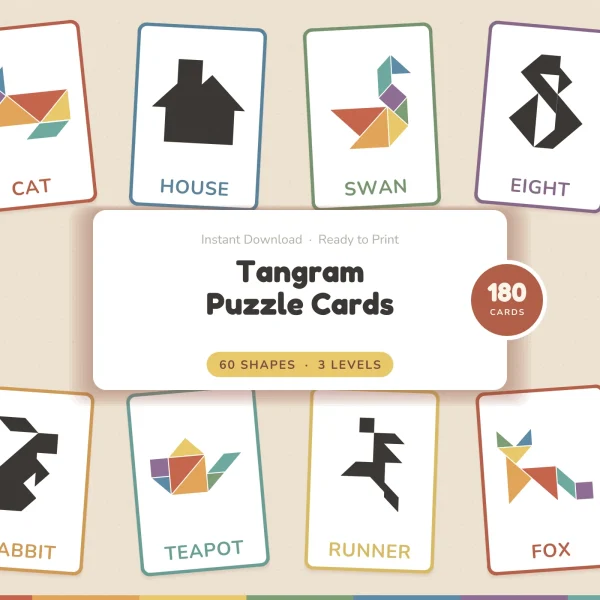
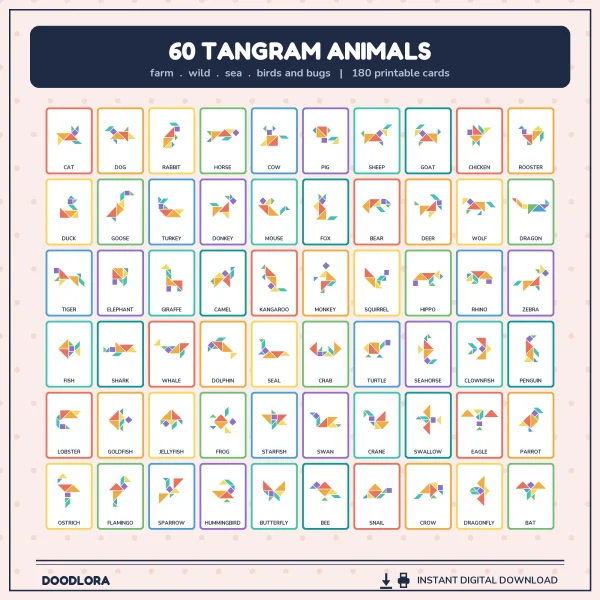
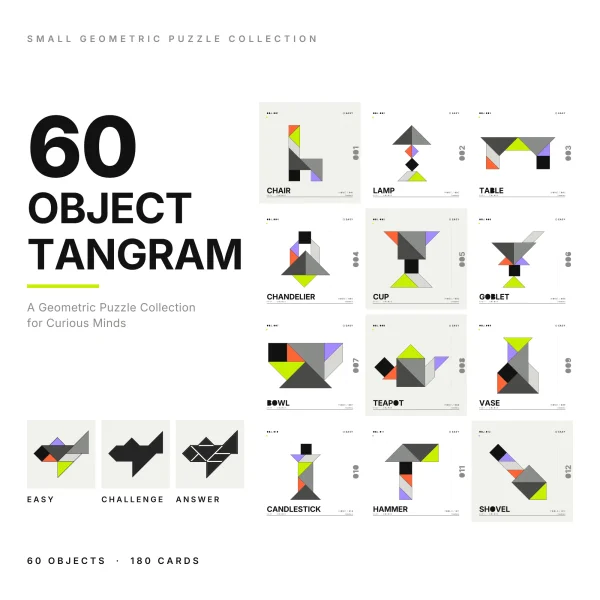
Each of the 60 shapes in our Tangram Shape Puzzle Cards comes on three cards. The colors on the easy card match the colors on the cut-out sheet, so a beginner matches orange to orange instead of reading angles.
The easy card also leaves a thin white gap between pieces, so you can see where one ends and the next begins.
On the challenge card, the same figure is one solid dark shape. The lines are gone, and finding them is the puzzle.
The third card is the answer key, labeled for grown-ups: the silhouette again, with white lines drawn over it.
Our product image calls these three levels, and the challenge card really is the harder step. The answer key isn’t a puzzle at all, though. It’s the check, or a source of hints.
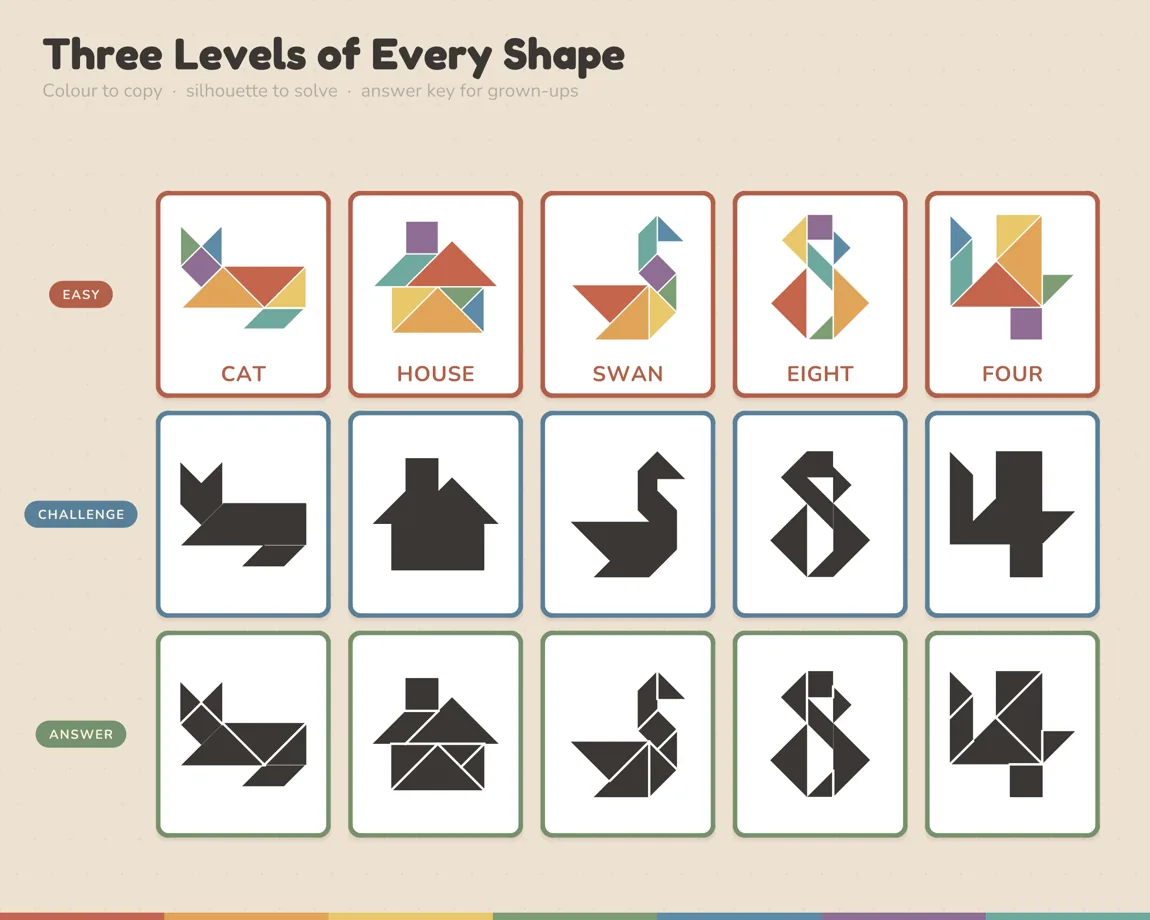
Work in pairs of cards. Build the easy card, take the pieces apart, then rebuild the same figure from its challenge card.
The second build shows which lines you were copying.
For a first pair, choose a figure that gives a few pieces away in its outline. In the house, the chimney is the square and the main roof is a single large triangle.
Nothing in the rules asks for speed, so leave the timer out until challenge cards start to feel easy.
We haven’t timed anyone on these cards, so we can’t tell you how long a first pair takes.
How to solve a tangram silhouette
A silhouette hides the joins, so solving it means reading the outline for clues. Three habits do most of that work.
Place the two large triangles first
Our how-to-play page gives the reason in one line: the two big triangles take up half the shape.
Find the biggest open area in the silhouette and try them there. Two large triangles can make a square, a bigger triangle or a parallelogram, so look for those outlines before anything else.
In the rocket from our Object Tangram Puzzle Cards, they make the square body, and the five smaller pieces build the nose and the fins around it.
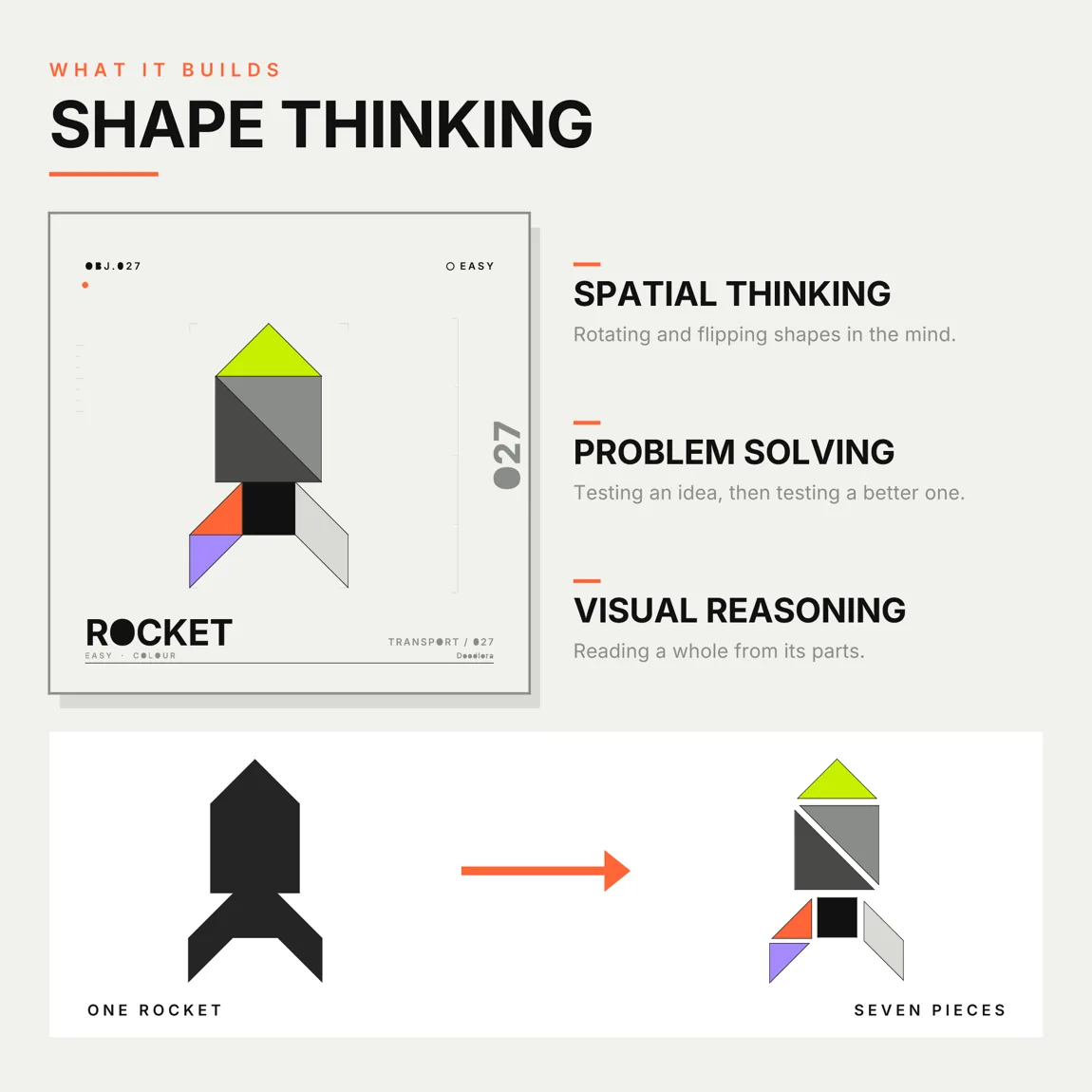
That’s a habit, not a required order.
If the silhouette has an obvious ear or tail the size of a small triangle, put it down early. It takes one piece out of the guessing.
Read the corners and the long edges
Every corner in an outline is one piece corner, or a few corners pushed together.
A sharp 45-degree point is the tip of a triangle or the narrow end of the parallelogram. A square corner can be the square, the square corner of any triangle, or two 45-degree tips side by side.
A wide 135-degree corner is the parallelogram’s wide end, or a square corner with a 45-degree tip next to it.
Long edges help too.
The longest edge in the whole set is a large triangle’s long side, so a straight stretch of outline that long often has a large triangle lying along it.
When a slanted strip is the right size but leans the wrong way, flip the parallelogram. Turning it won’t fix the lean, and flipping will.
Count the leftover space by area
When most of the figure is down and a gap is left, count the gap in small triangles.
A gap worth 2 can take the square, the medium triangle, the parallelogram, or both small triangles together. A gap worth 1 is a small triangle and nothing else.
The shopping cart in our City Adventure set shows why that helps. One wheel is the square, and the other is two small triangles pushed together into the same square shape.
If one piece is left over and won’t fit anywhere, the mistake happened earlier. A gap somewhere got filled with the wrong combination of pieces, so lift the pieces nearest the leftover space first.
| What you see | What it usually means | Try this |
|---|---|---|
| A thin gap between two pieces | A piece slid off its spot | Push the neighbors together and recheck the corners |
| A slanted strip leans the wrong way | The parallelogram is face down | Flip it, then turn it |
| One piece left over, figure looks done | Two pieces overlap somewhere | Lift each piece and check underneath |
| Your figure is bigger than the card’s | Nothing; the shape cards are drawn smaller than the 5.9-inch set | Compare the shape, not the size |
Tangram hints that leave the solving to the player
When those habits still leave a player stuck, the answer card is the quick fix, and it ends the puzzle on the spot. Give hints in steps instead, smallest first.
- Ask about one spot. “Which piece could make this point?” or “Is this edge as long as a big triangle’s?”
- Name a piece without placing it, such as “The parallelogram is in the neck.”
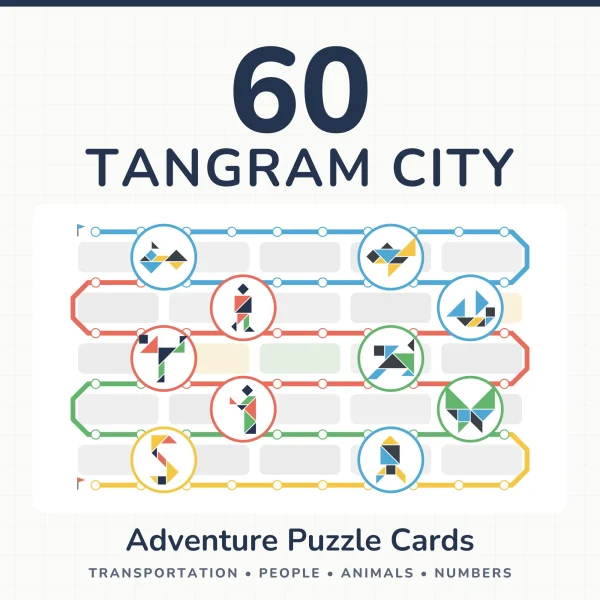
- Show where the two large triangles go. That’s half the shape, and it’s the middle level in our Tangram City Adventure cards, where the Explorer missions mark the two big triangles on the silhouette.
- Lay the answer card next to the puzzle and cover most of it, so only one corner shows. Our how-to-play page suggests exactly this for a card that’s too hard.
- Hand over the whole answer card.

Before step 5, go over the outline edge by edge with the player. A child who sees which corner doesn’t match can often fix that one spot without seeing the rest.
If a player needs step 4 on most cards, step back a level. More color cards and fewer silhouettes will do more than another hint.
Which tangram puzzles to try after the first set
Once the hints stop being needed, the next set should change one thing at a time.
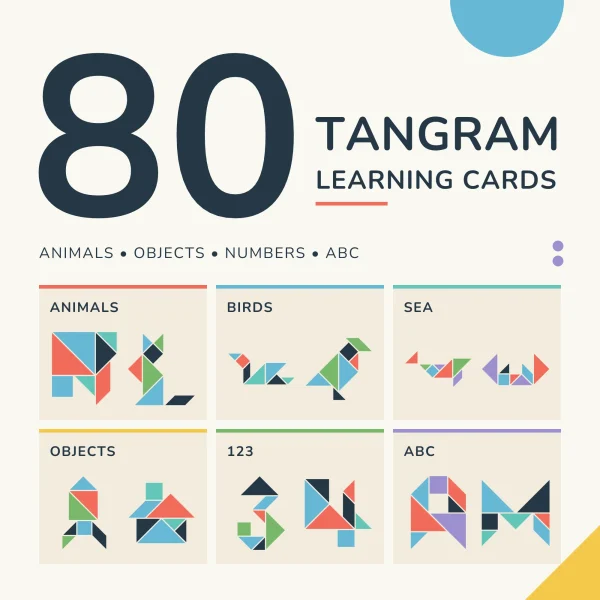
Letters and numbers are a different kind of puzzle. Our alphabet and number tangram cards explain it on their how-to-play page.
On their easy cards, some pieces sit a little apart so the letter stays readable, and O, B and P keep an open hole in the middle. The instruction there is to follow the picture on the card, not a rule.
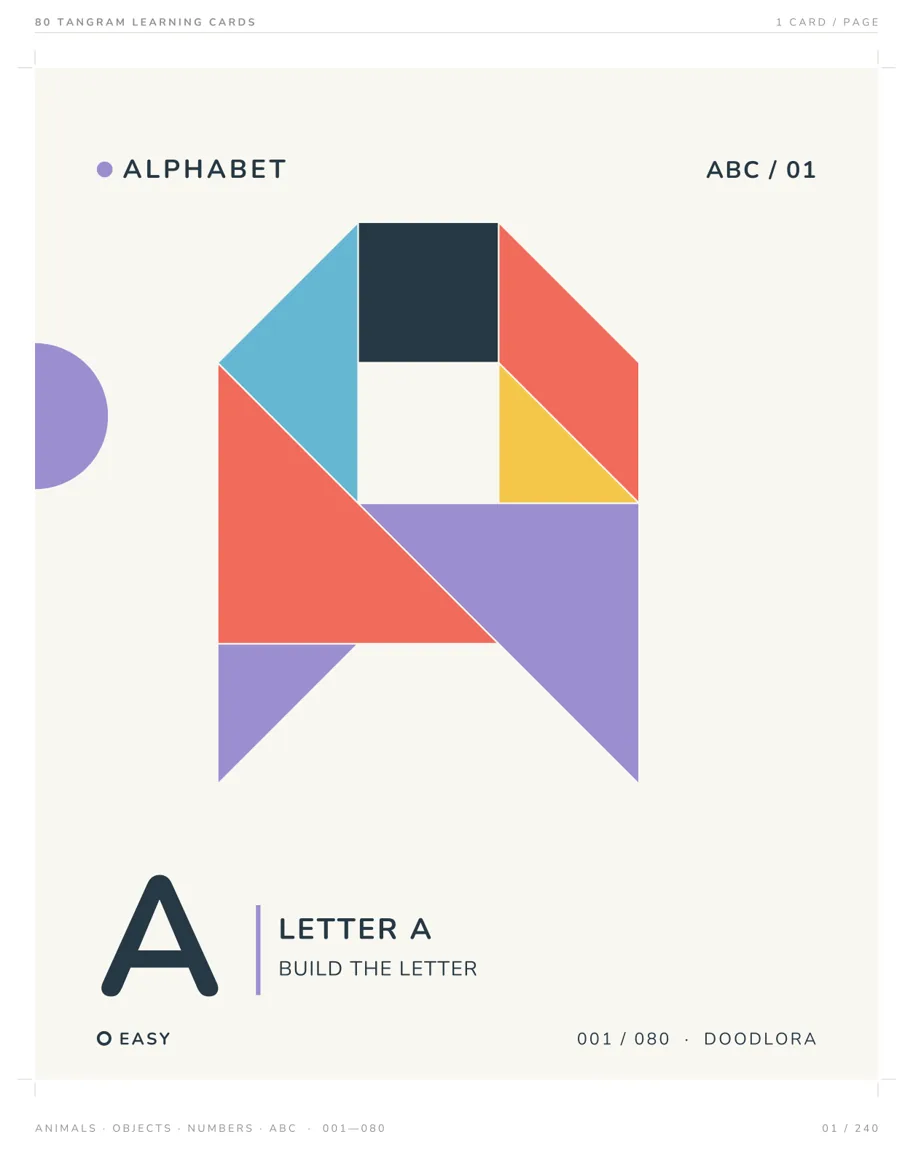
The zero in our shape cards has a hole through its middle too, so the space inside is part of the puzzle.
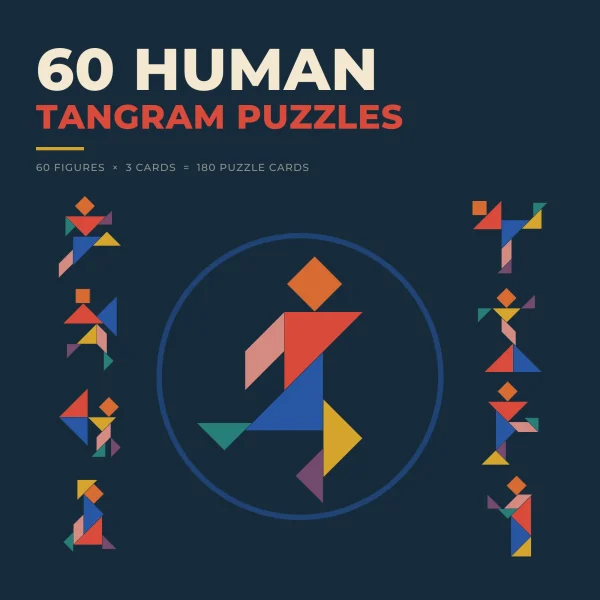
People figures spread the pieces out into arms and legs, so their outlines have more thin strips and loose corners than an animal’s. Our people tangram cards mark each card starter, tricky or expert in its bottom corner, which makes the next step easy to pick.
The ink-saver pages of the shape cards draw each challenge as an outline instead of a solid shape. They hold the same information as the silhouette and use far less ink.
If a player wants a break from pieces, our brain teasers for kids are word and logic puzzles with the answer printed under each one.
All six Doodlora Studio tangram sets are on one page in our tangram shop.
Choose the next set by where the player got stuck.
A player who still needs hint 3 or 4 on most cards wants more color cards, not a new theme. A player who solves silhouettes without help is ready for letters, with their gaps and holes, or for the expert people cards.
Printables from this article
Related articles
Printable Party Games
How to Plan a Baby Shower: Timeline, Food & 2-Hour Schedule
A baby shower plan from the first talk with the parents-to-be to the last gift: timing, guest list, budget, venue, a two-hour schedule, safe food and backup plans.
Printable Party Games
How to Plan a Bridal Shower: Timeline, Budget and Schedule
A host's plan for a bridal shower, from the first talk with the bride and co-hosts to the guest list, invitations, a timed party schedule, the gift opening and what to do when something slips.
Printable Flashcards
Pattern Activities for Preschool: AB to Growing Patterns
Fourteen pattern activities for preschoolers, ordered from first AB rhythms to growing number patterns, with what to prepare, how long each takes and where kids get stuck.