Office Christmas Party Games: Work Party Games by Group Size
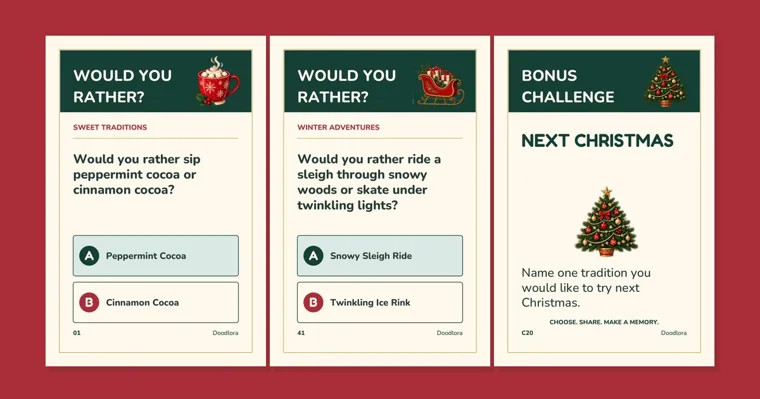
Office Christmas party games work best when the whole room plays at the same time, each round fits into 5 to 15 minutes, and anyone can pass without giving a reason. For a one-hour party, that usually means a mingling game while people arrive, two or three seated rounds, and the gift exchange last. Leave out drinking games, anything that needs touching, and any round that pushes one person to the front of the room.
Coworkers aren’t the crowd you’d invite to a house party. The new hire and the manager who approves their time off sit at the same table, a few people join from home on a video call, and some of them don’t celebrate Christmas at all. The plans here start from the minutes and the headcount you actually have, then move through the house rules, the seated games, the team games, the gift exchange and the remote version.
Office Christmas party games for 30, 60 or 90 minutes
Start with the clock, because a party held during work hours ends when the next meeting starts. A lunch-hour party in the break room has about 30 minutes of play once the food is out. An after-work party can run an hour or more, and it’s easier on the people who’d rather go home, since leaving early is normal there.
| Time you have | Running order |
|---|---|
| 30 minutes | Christmas Would You Rather, 5 to 8 cards (5 min) → a word search race (5 min, plus 5 to check) → one five-question trivia round in teams (10 min) → a winner certificate (5 min) |
| 60 minutes | Coworker bingo while people arrive (15 min) → Would You Rather (5 min) → a word search race (10 min) → the gift exchange (20 min) → certificates and a group photo (10 min) |
| 90 minutes | Coworker bingo (15 min) → Would You Rather (5 min) → Tower Building in teams (15 min) → a three-round trivia quiz (15 min) → a word search race (10 min) → the gift exchange (20 min) → certificates (10 min) |
Bingo goes first in the longer plans because it works with a half-full room. Late arrivals pick up a card and start asking around. If the guests barely know each other, swap it for one of our icebreaker games for adults, which come sorted by group size and include a few you can run in a work meeting.
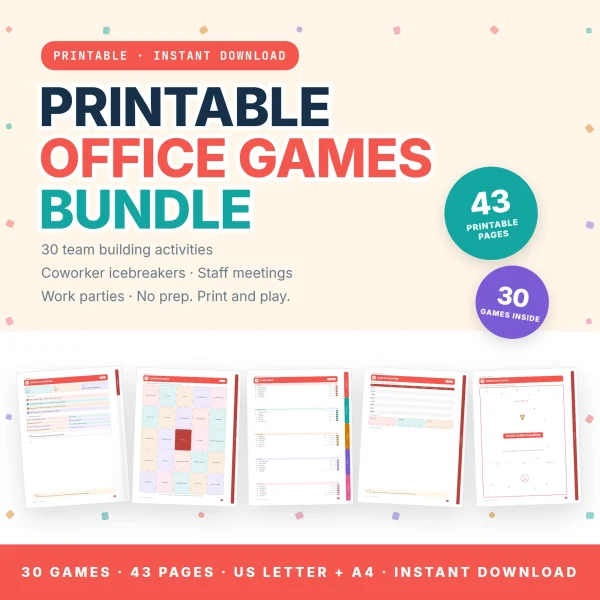
The game times above come from the pages they’re printed on. In our Office Party Games set, each of the 30 games gets its own page with the minutes and the group size at the top. The Game Selector at the back sorts them into 5, 15 and 30 minute columns.
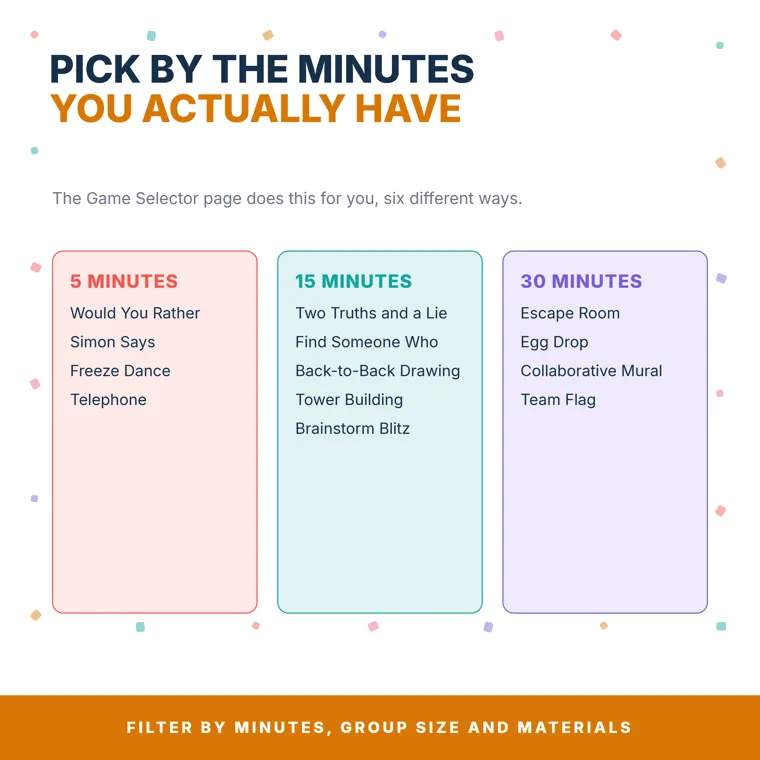
Plan with the time on the game page, and leave five spare minutes in any plan. Explaining a rule to 30 people, finding pens and handing out sheets often takes longer than the round itself. A party that ends when the invitation said it would is one people agree to next year.
Work party games by group size: 10, 25 or 50 coworkers
Headcount decides whether you play as one group or as teams. A game that’s lively with 12 people turns into a long wait with 40, because most of the room is watching one turn.
10 to 20 coworkers: one circle
Up to about 20, keep everyone in a single circle so each answer is heard by the whole team. That size suits games where people already know a little about each other. The Christmas Would You Rather cards include a Guess My Answer mode, in which someone predicts a coworker’s choice before the reveal, and a small team that’s worked together all year is good at it.
A team this size can also run the whole gift exchange in one ring. The left right story kit is written for 6 to 20 players, plus one host who reads.
20 to 50 coworkers: teams and a scoreboard
Past 20 people, pick games where everybody plays at the same moment and score by team. Human Bingo, Would You Rather with the room split into two sides, and a team trivia quiz all keep 40 people busy at once. Four Corners works too, though its page says to call two corners at a time once you pass 25 players, or the game outlasts the room booking.
The office set adds three sheets that make a bigger party easier to run: a 5 x 5 coworker bingo card, a team scoreboard and an Office Games Champion certificate.
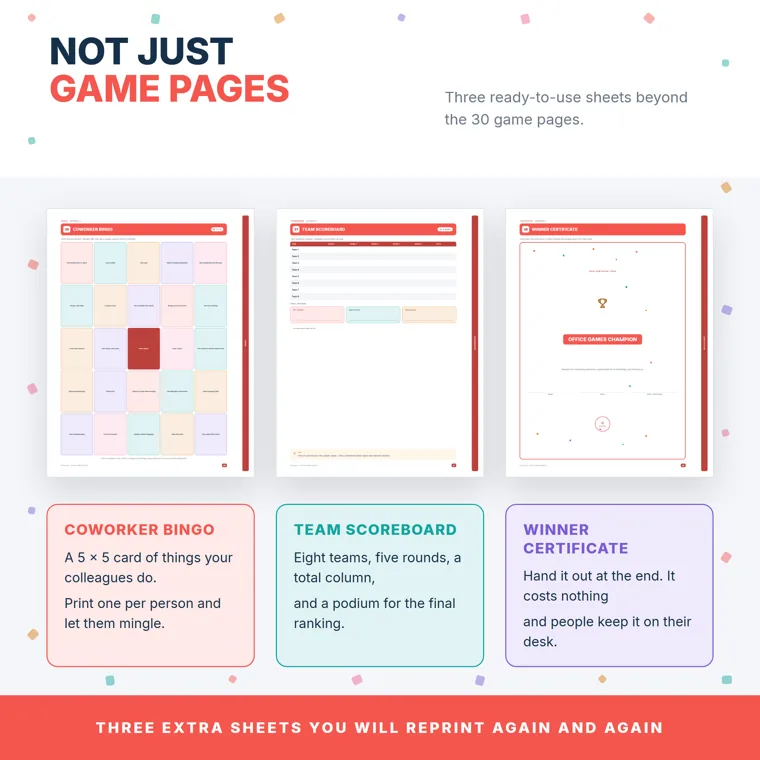
The scoreboard has rows for eight teams, so 40 coworkers in teams of five fill it exactly. At 50, either make teams of six or seven or print a second sheet. On the bingo card, the Human Bingo page allows each colleague to sign no more than two squares on any one card, which stops people from collecting a whole row from their deskmate. It also suggests playing on for five minutes after the first win, because that’s when the conversations get going.
Office party house rules: passing, no drinking games, no touching
A work party has a mix of reporting lines, ages and comfort levels that a family party doesn’t, so set a few rules before the first game and say them out loud.
Anyone can pass. Say it in the welcome, then build it into the games you choose. The Would You Rather how-to page already says passing is welcome. The Roll & Swap dice rules let a player hand an unwanted card to the person on the left and still keep the points.
Keep drinks out of the rules. Drinks can be on the table, but no game should score by drinking, finishing a glass or doing a dare after a drink. Coworkers who don’t drink shouldn’t have to explain why they’re sitting a round out.
No games that need touching. Human Knot has people take two different coworkers’ hands, and its own host tip says to check comfort with contact first and offers a version where each pair holds the ends of a pen. At a party, in party clothes, we’d leave it out along with anything built around mistletoe. Trust Walk uses blindfolds and spoken directions only, but it belongs to a team-building day, not a celebration.
Volunteers only for solo performance. Karaoke, lip sync and acting rounds put one person alone in front of their manager. Ask for volunteers. If your office does want a louder stretch, our one-minute party games include team challenges where the whole line plays, which spreads the attention around.
Watch the elimination games. Simon Says, Musical Chairs and Four Corners send people out to stand around while the game finishes. The Musical Chairs page warns that office chairs roll and tip, and suggests stackable chairs or tape marks on the floor instead. The Santa Says cards in the left right story kit are a gentler version: 20 action cards, such as ringing an imaginary bell, played with seated gestures and no one knocked out.
Not everyone celebrates Christmas. Keep questions about winter, food and the year at work rather than family traditions. In the Christmas Would You Rather deck, 17 of the 20 Winter Adventures cards never mention Christmas at all. They ask about sledding, light displays, ice skating and snowy cabins.
Christmas games for work party tables and conference rooms
Seated games carry most office parties, because the conference room is full of chairs and half the guests came straight from their desks. These three need paper, pens and a timer, and nobody has to stand up alone.
Christmas Would You Rather with sides of the room
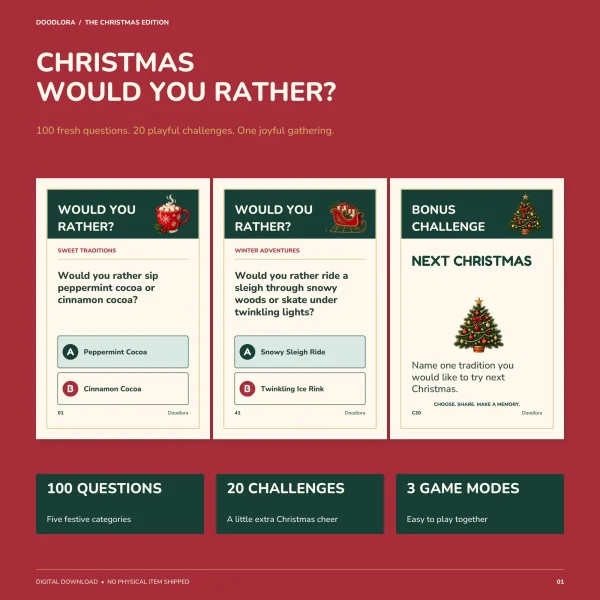
Our Christmas Would You Rather deck has 100 question cards in five categories of 20, plus 20 bonus challenge cards, each 4 x 6 inches and printed two to a US Letter page. The basic game is short: draw a card, read both options aloud, everyone picks A or B, and a few people say why.
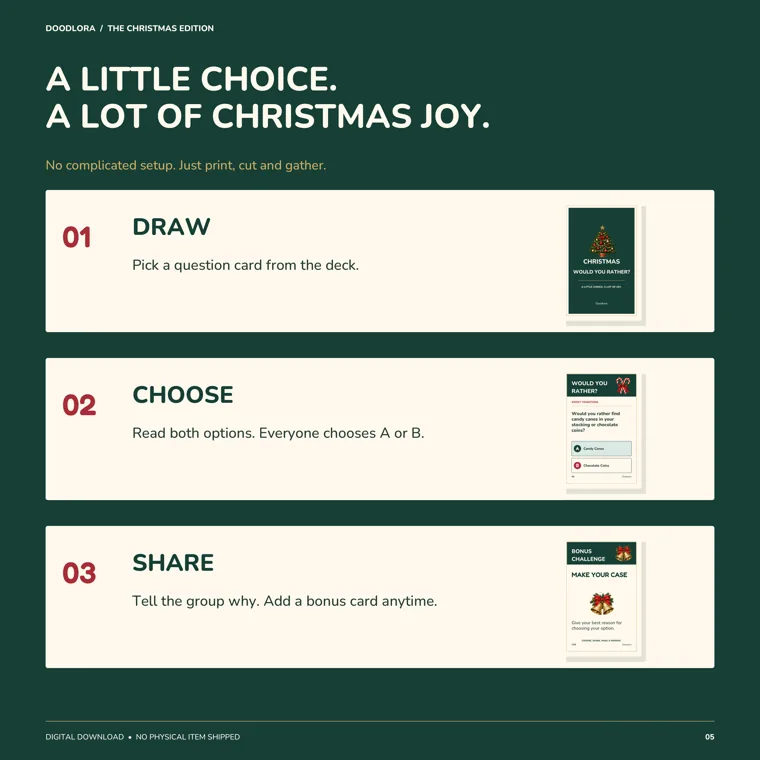
For a room of 30, borrow the movement from the office set’s Would You Rather page: option A walks to the left wall, option B to the right, and one person from each side explains the choice in a single sentence. Run five to eight cards and stop while people still want another.
Read through the deck before the party and pull the questions that fit coworkers. Would you rather be in charge of the holiday music or the table decorations? Would you rather join a gift-wrapping team or a cookie-decorating team? Would you rather choose the next Christmas movie or the next party game? Questions like these work for a new hire and a manager alike, because nobody has to share anything about home.
Set aside the family questions before you print, such as wearing a matching family outfit or opening one present on Christmas Eve instead of saving them all for the morning. They leave out anyone who spends the holidays alone or doesn’t celebrate. Keep the bonus challenge that sends people to find someone who picked the same option as them, because it gets the whole room moving between cards.
Word search races for the quieter half of the room
A word search race gives the people who’d never volunteer for charades a fair shot at winning. Everyone gets the same page, starts on the same signal and works alone, and nobody has to say anything until the scores come in.
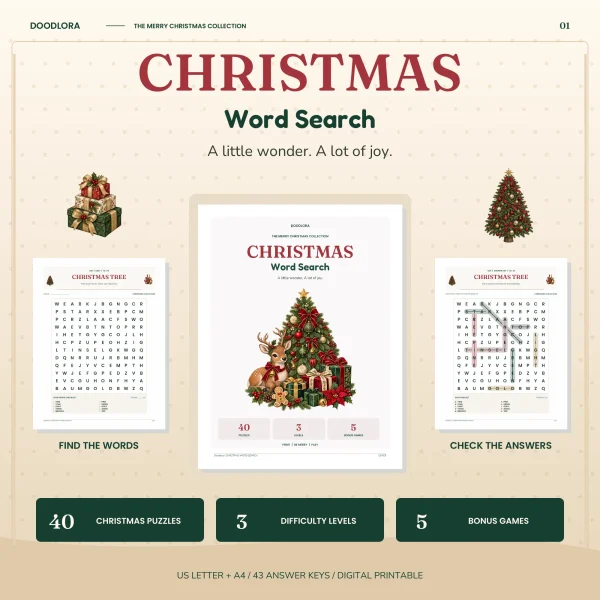
Our Christmas Word Search book has 40 puzzles in three levels: 12 Easy grids of 12 x 12 with 10 words, 16 Medium grids of 15 x 15 with 12 words, and 12 Hard grids of 20 x 20 with 16 words. Five bonus games at the back turn them into races.
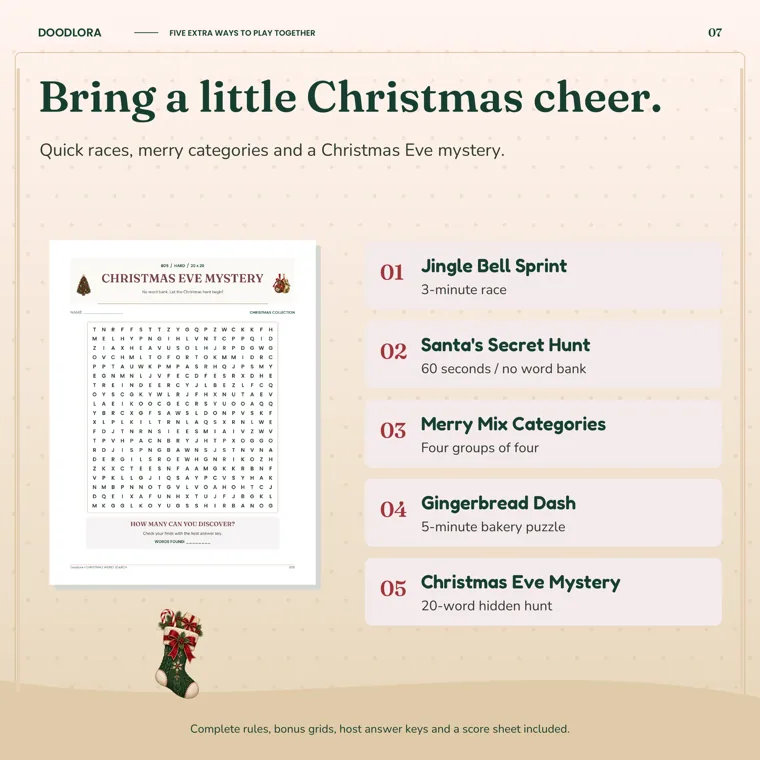
Gingerbread Dash is the easiest one to run at work. Print the C15 Gingerbread Bakery puzzle for every player, set a five-minute timer and score one point per word. Anyone who finds all 12 writes down their time, and among full grids the fastest wins. Santa’s Secret Hunt is a 60-second sprint on a grid with no word list, scored against 12 target words, and it makes a good tiebreaker.
One catch: the Jingle Bell Sprint rules page only has lines for two players. For a whole room, print the Christmas Score Sheet page instead, which has columns for player, puzzle, time, words found, bonus and total.
A trivia quiz about your own company
The Trivia Quiz page in the office set runs 15 questions in three rounds of five: general knowledge, your industry and the company itself. Teams of three to five write their answers, swap sheets to mark each other’s, and one small prize goes to the winner. The page gives you the format and a few sample company questions, such as how many floors the building has and what’s written on the mug in reception, but you write the 15 questions yourself.
For a Christmas party, turn the general round into five Christmas questions. Keep the company round about the building and the year’s events, not anyone’s salary, love life or performance review. Mix new hires and long-timers on each team, or the newest people will spend that whole round watching.
Team games for a longer office party
A 90-minute party has room for one game where teams build or make something together. These come from the Teamwork and Creative pages of the office set, and they each need a little shopping first.
- Tower Building, 15 minutes. Each team of three to five gets 20 paper cups and ten minutes to build the tallest freestanding tower, with no tape and no leaning on walls, chairs or people. The tallest one still standing when time’s up wins.
- Collaborative Mural, 20 minutes. Roll a long sheet of paper down the table, hand out markers and give one theme, such as what the team did this year. Each section has to connect to a neighbor’s. Its page suggests banning words for the first five minutes.
- Comic Strip, 20 minutes. Everyone folds a sheet into four panels and draws one moment from the team’s year in stick figures, then the comics go on a wall for a two-minute gallery walk.
- Egg Drop, 30 minutes. Teams get one egg, straws, tape and paper and 20 minutes to build a carrier. Cover the floor first, or use hard-boiled eggs, as the page suggests.
Escape Room looks like the obvious party pick, but read its page before promising it. Each team of four to six gets a sealed envelope with four linked puzzles, and each solved puzzle gives one number of the final code. The page describes that structure. It doesn’t include the puzzles, so someone has to write four of them, check that they lead to the code, and seal a set for every team. That’s an evening of work before the party.
Quick Christmas party games to fill a gap
Every office party has a stretch where the food is late, the gift table isn’t ready or half the room is still on a call. These six public party games fill 10 to 30 minutes with little or no printing, and each one follows the same house rules as the rest of the plan.
| Game | Players | Time | What you need | Works remote? |
|---|---|---|---|---|
| Ugly sweater contest | Any number | 10 min | Ballot slips, a small prize | Yes, on camera |
| Christmas charades | 8 to 40, in teams | 15 to 20 min | Title slips, a timer | Yes, with cameras on |
| Christmas categories | 2 to 50 | 10 to 15 min | Paper, pens, a timer | Yes |
| Guess the candy jar | Any number | Runs all party | A jar, candy, slips | Yes, jar shown on camera |
| Picture telephone | 6 to 12 per circle | 15 to 20 min | Paper strips, pens | In the room only |
| Cookie decorating contest | Teams of 3 to 5 | 30 min | Plain cookies, frosting, candy | In the room only |
Ugly sweater contest
Players: anyone who opts in. Time: about 10 minutes. Prep: ballot slips, a box and one small prize per category. Ugly Christmas sweater parties and contests spread across North America in the late 2000s, and the idea is simple: whoever turns up in the most over-the-top sweater wins. Line up the entrants, give everyone a ballot, and count the votes while the next game starts. Run two or three categories, such as most homemade and most lights, so the same popular person doesn’t take everything.
The catch is cost. Say in the invitation that a thrifted, borrowed or homemade sweater counts, or a paper ornament pinned to a regular sweater, because nobody should spend money to join a work game. Remote coworkers can enter on camera and get their own category.
Christmas charades in teams
Players: 8 to 40, split into two or more teams. Time: 15 to 20 minutes. Prep: slips of paper, a bowl per team and a one-minute timer. Each team writes Christmas song and movie titles on slips for the other team. One player draws a slip and acts it out without speaking, mouthing or spelling, and their own team guesses before the timer runs out. Teams score one point per title guessed, then take turns until the round ends.
Teach the common signals before the first turn. Holding up fingers shows the number of words, miming singing means a song, and cranking an old movie camera means a movie. At work, let each team act at its own table rather than at the front of the room. Players who’d rather not act can guess or keep time all round. On a video call, the actor turns their camera on and everyone else guesses in the chat.
Christmas categories
Players: 2 to 50, alone or in pairs. Time: 10 to 15 minutes for three rounds. Prep: paper, pens and a two-minute timer. Pick five Christmas categories, such as cookies, songs, things on a tree, gifts under $10 and winter clothes. Everyone writes the list down, the host calls a random letter, and players have two minutes to fill one answer per category starting with that letter.
Score the classic way: a unique answer is worth 2 points, and an answer someone else also wrote is worth 1. Swap sheets to mark, then pick a new letter for the next round. Skip hard letters like Q, X and Z, or the round stalls. It runs on a call as easily as in a room, since people only need to read their answers out.
Guess the candy jar
Players: any number. Time: runs quietly all party, with a two-minute reveal. Prep: a clear jar, wrapped candy you counted as you filled it, slips and a pen. Put the jar by the door with a stack of slips, and have each person write a name and one guess. At the end, the closest guess without going over wins the jar, or simply the closest if you’d rather keep it easy.
Read out the middle guess before the winner, because it’s usually closer than most people’s own. When the statistician Francis Galton looked at 800 guesses of an ox’s weight at a 1906 country fair, the median guess was within 1% of the true weight. For remote coworkers, show the jar on camera at the start and collect their guesses in the chat. Use individually wrapped candy and put the label out where people can read it, so anyone with a food allergy can check.
Picture telephone
Players: 6 to 12 per circle; run more circles for a bigger room. Time: 15 to 20 minutes. Prep: a long strip of paper and a pen for each player. Everyone writes a Christmas phrase at the top of their strip, such as “reindeer stuck in traffic,” and passes it on. The next person draws the phrase, folds the writing out of sight and passes it again. The next person sees only the drawing and writes what they think it shows. Keep alternating writing and drawing until the strips come back to their owners.
There’s no winner. The fun is reading each strip aloud, from the first phrase to the last. It suits a quiet team, because stick figures are fine and nobody performs. Ask people to keep phrases to things anyone could draw, and leave out coworkers’ names so no drawing turns into a joke about someone in the room.
Cookie decorating contest
Players: teams of 3 to 5. Time: about 30 minutes, plus judging. Prep: plain baked cookies or graham crackers, tubs of frosting, small candies, paper plates and napkins. Give each team the same supplies and one theme, such as the office in winter. Teams decorate for 20 minutes, then everyone walks the table and votes by placing a wrapped candy next to their favorite. The plate with the most candies wins.
Gingerbread houses look like the obvious version, but walls held together with royal icing need time to set. Flat cookies finish inside one lunch hour. Put ingredient labels on the table before anyone starts, keep a few cookies in their sealed packet for anyone avoiding a shared tray, and let people who’d rather not eat sugar at 2 p.m. be the judges.
Running the gift exchange at work
The gift exchange goes last because it decides what everyone carries home, and at work it needs three decisions made in the invitation, not on the day. Set one price limit. Make it opt-in, so coworkers who’d rather not buy a gift can watch, keep score or read the story. Ask for gifts anyone could use, wrapped, with no names on the tags.
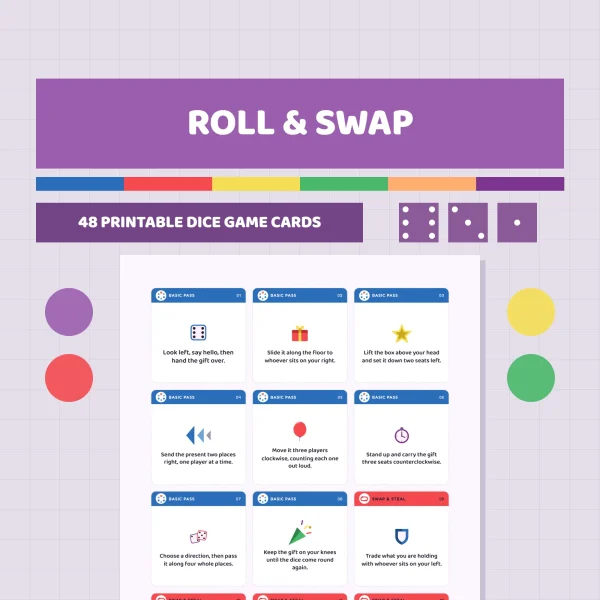
The price limit, the wrapping and the blank tags come straight from the office party notes on the setup page of Roll & Swap, our dice gift exchange for 4 to 20 players. It also suggests party favors in place of one big gift, and says twenty minutes of play is plenty. With 12 or more players, its rules split the group into two circles with two sets of dice and one scorekeeper.
Read the Fun Actions cards, numbers 25 to 32, before the party. They include singing, wiggling and balancing the gift on your head, so take out any card you wouldn’t want to do in front of your boss.
The Christmas left right gift pass suits a team that wants no competition at all. One host reads a story, everyone passes a gift one seat on each LEFT or RIGHT, and the gift in your hands at the end is yours. The kit is written for 6 to 20 players and recommends small, light gifts and one practice pass in each direction before the story starts.
If your office prefers stealing, settle the steal limit and the final turn with our white elephant rules before anyone opens a package. To compare a dice swap, a story, Secret Santa and a numbered draw side by side, see our gift exchange games. The same formats work for a family gathering, where our Christmas party games add floor games and a kids’ table.
Office Christmas party games for remote and hybrid teams
Remote coworkers drop out of a party fast when the games depend on being in the room. The Game Selector page in the office set lists eight games that run on a video call with no changes: Would You Rather, Telephone, Story Chain, Two-Minute Pitch, Brainstorm Blitz, Team Playlist, Time Capsule and the Trivia Quiz. It names three more that need one small adjustment each, Two Truths and a Lie, Comic Strip and Scavenger Hunt, without spelling the adjustments out.
Here’s how we’d adapt those three:
- Two Truths and a Lie. Players send their three statements to the host in a private chat, and the host reads them out so nobody’s typing shows.
- Comic Strip. Everyone draws on paper and holds the four panels up to the camera for the gallery walk.
- Scavenger Hunt. Make the list things people have at home and show on camera, and drop the items that need another department.
On a call, Would You Rather swaps the two sides of the room for thumbs up and thumbs down, as the host tip on its page says. Team Playlist is the one game in the set its page says works better remotely than in person. Each person names a song and a sentence about why, and the playlist stays open after the party. A word search race works if remote players have the page before the call, and they can report their counts when the timer ends.
For a hybrid party, set a laptop at the front of the room on the host’s microphone and call on the remote players first in every round. Side conversations in the room are the first thing a person on a call stops hearing. The gift exchange is the hard part, because the dice and the story need every present in one circle. Ship a remote coworker’s gift ahead and let someone in the room hold it in the circle, or run the remote group’s exchange as a mailed Secret Santa.
Printables from this article

Related articles
Printable Party Games
How to Plan a Baby Shower: Timeline, Food & 2-Hour Schedule
A baby shower plan from the first talk with the parents-to-be to the last gift: timing, guest list, budget, venue, a two-hour schedule, safe food and backup plans.
Printable Party Games
How to Plan a Bridal Shower: Timeline, Budget and Schedule
A host's plan for a bridal shower, from the first talk with the bride and co-hosts to the guest list, invitations, a timed party schedule, the gift opening and what to do when something slips.
Printable Party Games
35th Birthday Ideas: Party, Trip, Theme and Gift Ideas
Ways to celebrate turning 35, sorted by how many people the birthday star wants around, with group size, time, prep and the snag to plan for in each.