New Year Traditions: Eve, Day and Around the World

Most New Year traditions gather around two moments: the stroke of midnight on December 31, and the first meal or the first visitor on January 1. At midnight, people count down, make noise, eat something that stands for the twelve months ahead, or literally jump into the new year. On New Year’s Day the focus moves to lucky food and to who walks through the door first.
Each tradition below says where it comes from, what people traditionally do, and how to try a small version at home. None of them is something every family in that country does. They are customs that many people keep, and some are fading. Where a tradition has a catch for young children, the catch sits right next to it.
| Tradition | Where it comes from | When | What you need | With young kids |
|---|---|---|---|---|
| The ball drop countdown | New York City | The last minute of December 31 | A TV or a big clock | Yes |
| Twelve grapes | Spain, Latin America, the Philippines | Midnight | 12 grapes per person | Chop them for under-4s |
| “Auld Lang Syne” | Scotland | Midnight | The first verse and chorus | Yes |
| Jumping off a chair | Denmark | Midnight | A low, sturdy chair | Yes, with a hand to hold |
| Polka dots and round fruit | The Philippines | Evening and midnight | Dotted clothes, 12 round fruits | Yes |
| The temple bell, 108 strikes | Japan | Around midnight | A bell and a tally sheet | Yes |
| A midnight kiss and toast | Belgium and many other places | Midnight | Something sparkling to drink | Juice for kids |
| Hoppin’ John and greens | The American South | January 1 | Black-eyed peas, rice, greens, cornbread | Yes |
| Toshikoshi soba | Japan | Dinner on December 31 | Buckwheat noodles | Yes |
| Lentils | Italy | Dinner on December 31 | Lentils | Yes |
| A cake with a hidden coin | Greece, Mexico | Midnight or January 1 | A cake and a coin | Coin under the plate instead |
| Wearing white | Brazil | December 31 | White clothes | Yes |
| The suitcase walk | Chile | Midnight | An empty suitcase | Yes |
| First-footing | Scotland, Northern England | Just after midnight | A few small gifts | Yes |
| The Rose Parade | Pasadena, California | Morning of January 1 | A TV | Yes |
| New Year’s resolutions | Ancient Babylon and Rome | January 1 | Paper and a pen | Yes |
Midnight countdown traditions
The last minute of December 31 is where most of the famous customs live. They all mark the same instant in different ways: counting, eating, singing, jumping or ringing.
Watching the ball drop in Times Square
The ball drop is the New York City countdown that much of the US watches on TV. An illuminated ball on the roof of One Times Square starts down a flagpole at 11:59:00 p.m. Eastern Time and comes to rest at 12:00:00 a.m. At midnight, a team of 100 volunteers on the surrounding rooftops throws at least 3,000 pounds of confetti over the crowd. Other US cities stage their own “drops” with an object that stands for the town, such as Atlanta’s Peach Drop.
The catch for families is the clock. Midnight in New York is 11 p.m. Central, 10 p.m. Mountain and 9 p.m. Pacific, so a family on the West Coast can watch the real drop live and still get young kids to bed. In the Eastern time zone, an early countdown at home works better than keeping a five-year-old up.
To run your own countdown, put a big clock where everyone can see it. Our New Year’s backgrounds include two “Nearly Midnight” designs with a clock face sitting just before twelve. Printed at Actual Size on US Letter paper, the square artwork comes out 7.5 inches wide, which is big enough to tape to a wall. Hand out the hole-punched scraps from a test print as confetti, and have everyone shout the last ten seconds together.

Eating twelve grapes at midnight
Las doce uvas, the twelve grapes, is a Spanish tradition: you eat one grape with each of the twelve bell strikes at midnight on December 31. Each grape stands for one of the coming months, and finishing all twelve is said to bring a lucky year. The best-known place to do it is the Puerta del Sol in Madrid, where the clock’s strikes are broadcast on national TV. Many people eat them at home with family after dinner instead. The custom has spread to the Philippines, Latin America, the Caribbean and Hispanic communities in the US. In Mexico, many people make a wish with each grape.
At home, count twelve small seedless grapes into a cup for each person before 11:55, so nobody is counting while the bells start. Then play a clip of the twelve strikes, or just have one person ring a glass with a spoon twelve times at a steady pace.
The catch is choking. The American Academy of Pediatrics advises keeping high-risk foods away from children until about age 4, and says round, firm foods such as grapes can be served if they are completely chopped into tiny pieces. For little ones, give a cup of chopped grapes and drop the race. For older kids, make the rule “one grape per strike, no stuffing,” because racing to keep up is exactly how grapes go down the wrong way.
Singing “Auld Lang Syne”
“Auld Lang Syne” is the Scottish song that English speakers traditionally sing at the stroke of midnight to say goodbye to the old year. The words are a poem by Robert Burns based on an older folk song. The title translates roughly as “old long since,” and the line “for auld lang syne” means something like “for the sake of old times.”
Most people only sing the first verse and the chorus, and that is all you need. Print those lines on a card for each guest, because almost nobody knows the words past “Should auld acquaintance be forgot.” Start singing right after the countdown, while everyone is still on their feet.
Jumping off a chair in Denmark
In Denmark, a well-known New Year’s Eve custom is to stand on a chair and jump off it at midnight, a leap into the new year. Kids love this one because it turns the countdown into something to do with their whole body.
Use a low, sturdy kitchen chair, never one with wheels or a folding seat. Have small children hold an adult’s hand on the way down. If you have a crowd, line the chairs up and have everyone jump together on “one.”
Polka dots, round fruit and jumping in the Philippines
In the Philippines, many people wear new or bright clothes with circles on them, such as polka dots, and set out twelve round fruits. Circles are believed to attract money, and candies on the table stand for a sweeter year. Several customs happen exactly at midnight: scattering coins for wealth, and jumping up so children grow taller. The night is loud, too. People blow horns called torotot and bang on pots and pans.
This is the easiest tradition to do with small kids. Ask everyone to wear something dotted, put a bowl of twelve round fruits in the middle of the table (oranges, clementines, apples, a melon), and hand each child a pot and a wooden spoon for the midnight noise. Warn the neighbors in an apartment building, or keep the banging to ten seconds.
The temple bell rung 108 times in Japan
On New Year’s Eve in Japan, Buddhist temples ring their great bell at midnight in a ceremony called Joya no Kane, and most temples strike it 108 times. Some temples have moved the ringing earlier in the day, partly because of complaints about noise and partly because there are fewer monks and visitors to do it.
At home, a small bell and a tally sheet turn this into a counting game. Let children take turns ringing, one strike each, while someone keeps tally marks on paper in groups of five. It takes a few minutes to reach 108, so start before the countdown rather than at it.
A midnight kiss and toast
In many places, the first thing people do after the countdown is kiss, hug and raise a glass. In Belgium, for example, people kiss, exchange good-luck wishes and toast the new year and absent friends and relatives the moment midnight is called.
Pour sparkling apple juice or cider in real glasses for the kids so they get to clink too. For an adult party, keep a non-alcoholic choice next to anything stronger, and have rides home sorted before midnight.
Lucky foods for New Year’s Eve and New Year’s Day
Food traditions tend to be about money or a long life. Round foods stand for coins, green foods for bills, and long noodles for a long life. Most are ordinary home cooking, which makes them the easiest traditions to adopt.
Hoppin’ John, collard greens and cornbread
In the southern United States, eating Hoppin’ John with collard greens on New Year’s Day is thought to bring a lucky, prosperous year. Hoppin’ John is rice cooked with black-eyed peas (field peas or Sea Island red peas in some coastal areas) and usually some pork. The peas stand for pennies or coins. The greens stand for paper money, because they are the color of American bills, and cornbread stands for gold.
Two small customs go with it. Some families put a coin in the pot or under a dinner bowl. Others have each person leave three peas on the plate, for luck, fortune and romance in the year ahead. Leftovers eaten on January 2 even get their own name, “Skippin’ Jenny.”
If you have small children at the table, use the under-the-bowl version of the coin. A coin cooked into a pot of rice is easy to miss.
Toshikoshi soba on New Year’s Eve
Toshikoshi soba is a bowl of buckwheat noodles eaten in Japan on December 31. Because soba noodles break easily, eating them is meant to help you let go of the year’s hardships. Long noodles are also said to stand for a long life.
A simple bowl of soba in hot broth makes an easy New Year’s Eve dinner before a late night. The Philippines has a similar idea: pancit noodles at the midnight feast stand for a long life.
Lentils in Italy
Italian New Year’s Eve dinner often includes lentils, served with zampone or cotechino (pork sausages), and polenta in the north. The round lentils stand for coins. An older custom, rarely kept now, was to eat one spoonful of lentil stew with each strike of the midnight bell.
A pot of lentil soup is a good pick for a family that wants one lucky dish without a big project.
A cake with a hidden coin
In Greece, many Greek Orthodox families cut a vasilopita at midnight or on New Year’s Day, the feast of Saint Basil. A coin is slipped into the dough before baking. A slice is cut for each person, from the oldest to the youngest, and whoever finds the coin is said to be lucky for the year. Families often set aside a first slice for Saint Basil. In Mexico, a sweet bread with a coin or charm baked inside carries the same promise.
The catch here is the coin itself. Wrap it in foil, tell everyone before they bite, and serve the slices to small children in pieces you have checked. Even simpler, borrow the Southern habit and tape the coin under one plate instead of baking it in.
Oliebollen in the Netherlands
Dutch families traditionally snack on oliebollen (Dutch doughnuts) and apple fritters on New Year’s Eve. The evening is usually a cozy one at home with family or friends. A bakery batch or a box of doughnut holes makes a fair stand-in if you don’t want to deep-fry at night.
Clothes, colors and good-luck rituals
Some traditions are about what you wear or carry when the clock strikes. These need no cooking and suit a party where everyone arrives already dressed for it.
Wearing white in Brazil
In Brazil, many people wear colors with a meaning on New Year’s Eve: white for good luck, yellow for happiness and money, and red for love. The biggest public celebration is the fireworks show on Copacabana Beach in Rio de Janeiro, where it is summer at New Year.
For a party, put the color meanings on the invitation and let guests pick. It gives everyone an easy question to ask each other when they arrive.
Colors and a “bad things” list in Mexico
Mexican families often decorate in colors that stand for wishes for the coming year: red for love and a better life, yellow for work, green for money and white for health. Another custom is to write down the bad or unhappy things from the past twelve months and throw the list into a fire before midnight.
At home, skip the fire. Have each person write their list, then tear it into small pieces and drop it in the recycling bin together. Kids get the same “gone for good” moment without anyone handling a flame.
Red underwear in Italy
In Italy, a well-known New Year’s Eve ritual is wearing red underwear for luck. It is the quietest tradition on this list and the easiest to keep to yourself.
Walking with a suitcase in Chile
In Chile, people who hope to travel in the coming year walk the street with a suitcase in hand at midnight. Others hold money in their hand or put coins at the door.
For a family version, give kids an empty backpack or small suitcase and send them for one lap of the yard or the hallway right after the countdown. Ask each one where they would go if the suitcase worked.
New Year’s Day traditions
January 1 has its own customs, and they are kinder to families who went to bed early.
First-footing in Scotland and Northern England
In Scottish, Northern English and Manx folklore, the first-foot is the first person to enter a home on New Year’s Day, and that person brings luck for the year. In many places the first-foot is traditionally a tall, dark-haired man. A first-foot should never arrive empty-handed. Traditional gifts include a silver coin, shortbread or black bun, salt and coal, standing for wealth, food, flavor and warmth.
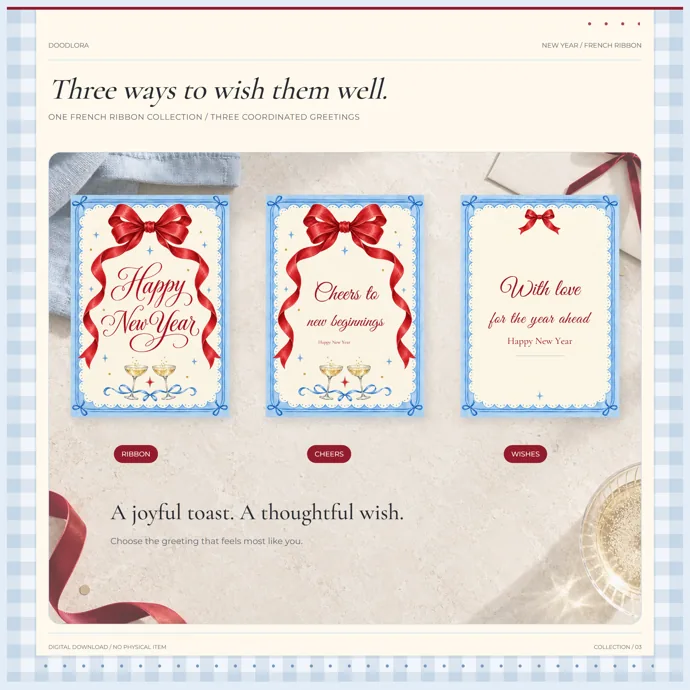
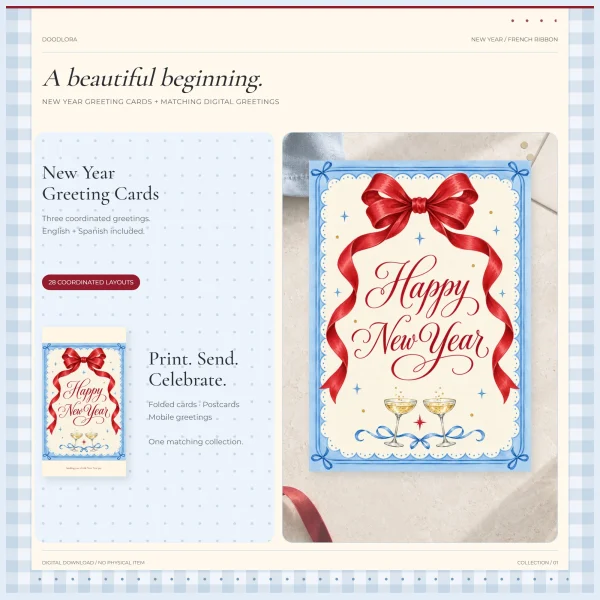
At home, pick a first-footer before midnight and send them out the door just before the countdown. Hand them a small basket with a coin, a few cookies, a twist of salt and a card, and let them knock to be let back in. A greeting card works well as the “message” gift. Our Happy New Year cards come in three designs, Ribbon, Cheers and Wishes, in English and Spanish, and fold to 5 x 7 inches for an A7 envelope. The Ribbon front’s lettering is fixed, while the Cheers and Wishes greetings and the inside text can be edited.
Watching the Rose Parade
The Rose Parade runs along Colorado Boulevard in Pasadena, California, on New Year’s Day, or on Monday, January 2, when January 1 falls on a Sunday. It usually starts at 8:00 a.m. Pacific Time, which is 11:00 a.m. Eastern, and features flower-covered floats, marching bands and riders on horseback. The Rose Bowl college football game follows in the afternoon.
The parade is a good late-morning tradition after a late night. Put it on during a slow breakfast, and let kids vote on their favorite float.
Making New Year’s resolutions
A New Year’s resolution is a promise to yourself to keep a good habit, change something, or reach a goal as the year begins. The idea is old. The Babylonians made promises at their new-year festival to pay their debts and return borrowed farm tools. The Romans later made promises to Janus, the god the month of January is named for.
Keep children’s resolutions small and concrete: “read one chapter before bed” works, while “be better” does not. Have everyone write theirs on a card, seal it in an envelope, and open the envelopes together next December 31.
Polar bear plunges
In Canada, many communities hold “polar bear swims” on New Year’s Day, when people run into icy lakes or the sea. In the Netherlands, around 60,000 people dive into the cold sea at Scheveningen every New Year’s Day. In the United States, polar bear plunges are usually charity fundraisers.
This one is for adults, and only at an organized event. Don’t attempt a cold-water plunge alone or with young children.
Fireworks traditions, watched rather than lit
Fireworks at midnight are part of New Year’s Eve in much of the world. Rio de Janeiro’s display over Copacabana Beach draws millions of people. In Copenhagen, fireworks go up as the Town Hall bells chime midnight. In Athens, a fireworks display lights the sky over the Parthenon. Many US towns also hold a public show.
The way to share this tradition with a family is to watch: a public display, a live broadcast, or a city countdown streamed from somewhere it is already midnight. If you want the look of fireworks without the bangs, put a fireworks image on the TV. Our fireworks backgrounds include 16 designs, six of them as widescreen images at 1920 x 1080 and 3840 x 2160 pixels. That is the right shape for a TV, a projector or a video-call background for relatives who can’t come. The artwork carries no words, so it works for a Fourth of July party as well.

Planning a traditions night at home
You don’t need all twenty. Three or four traditions, chosen for who is in the room, make a full evening.
With young kids
Pick traditions that are short, loud or physical, and run the countdown at whatever hour your kids can last. A good set is polka dots, the 108-strike bell tally, jumping off a chair, and pots and pans at the “midnight” you chose. Add round fruit on the table and chopped grapes for anyone under 4. For more ways to fill the hours before the countdown, our New Year’s Eve games and New Year’s trivia questions are written for mixed ages.
With older kids and teens
Older kids can handle the real midnight and the grape race. Try toshikoshi soba or lentils for dinner, the twelve grapes at midnight, “Auld Lang Syne” straight after, and a first-footer knocking at the door. Save the vasilopita for New Year’s Day lunch so the coin hunt doesn’t compete with the countdown.
Hosting a party
For a party, the traditions give the evening a shape. This run of the night works for most groups:
| Time | What happens | Tradition |
|---|---|---|
| 9:00 p.m. | Guests arrive | Wearing white or a lucky color |
| 10:00 p.m. | Food | Soba, lentils or Hoppin’ John in a slow cooker |
| 11:30 p.m. | Hand out grape cups and song cards | Twelve grapes, “Auld Lang Syne” |
| 11:55 p.m. | Everyone gathers for the countdown | The ball drop on TV |
| 12:00 a.m. | Countdown, then noise, a toast and a song | Pots and pans, a midnight toast |
| Just after midnight | The first-footer knocks | First-footing |
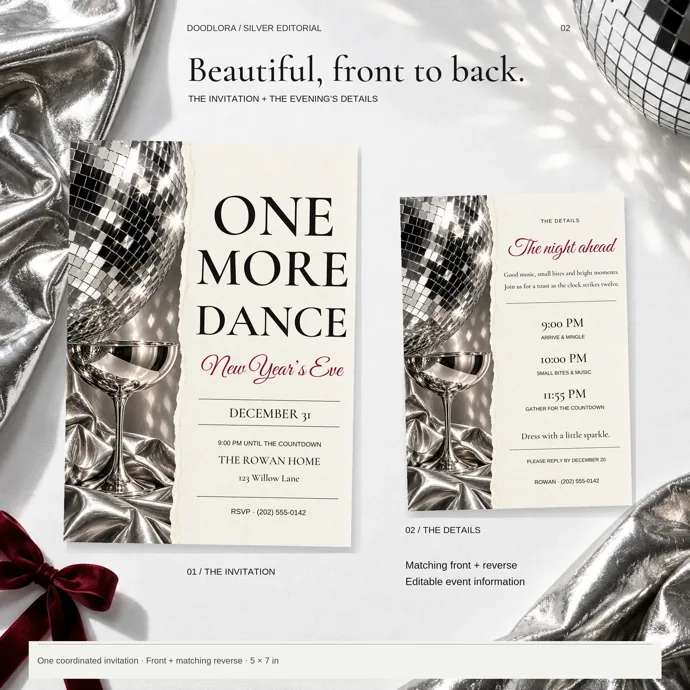
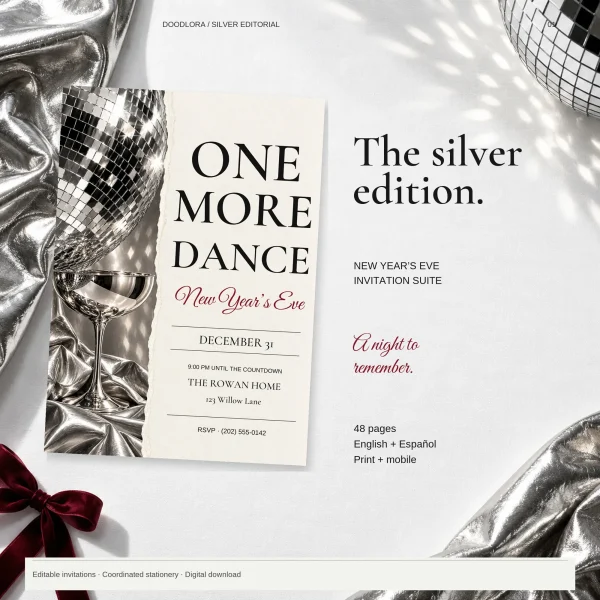
Put the traditions on the invitation so guests come dressed for them. Our New Year party invitation has two sets of wording, one for a party and one for a night in. The back of the invitation has room for a short schedule, and the sample reads 9:00 PM arrive and mingle, 10:00 PM small bites and music, and 11:55 PM gather for the countdown. The date carries no year, so the same file works again next December. You can change the host’s name, address, start time and reply-by date in a Canva copy, or in an editor file that opens in a desktop browser without an account.
In a classroom in January
The first week back in January is a natural time to teach these customs. Give each small group one tradition from the table above, and ask them to find the country on a map and work out what the tradition is wishing for. Most turn out to be money, health, travel or a long life. Grapes and coins are the two to leave as pictures rather than real props.
Other holiday traditions
Lunar New Year falls on a different date each year and has customs of its own, from red envelopes to the reunion dinner. Those are in our guide to Chinese New Year traditions. For the week before, our Christmas traditions guide explains where customs like the tree, stockings and Advent calendars come from, and how to start a new one at home.
Printables from this article


Related articles
Backgrounds & Digital Paper
Christmas Scrapbook Ideas: 16 Layouts with Printable Paper
Pick a Christmas scrapbook page by how many photos you have and what you want to keep, print one background paper at Actual Size, then cut it into mats, pockets and tags so the photos and keepsakes stay the main thing.
Backgrounds & Digital Paper
How to Draw a Snowman: Easy, Cute Steps for Kids
Stack three snowballs that shrink from bottom to top, sink each one a little into the ball below, and stand the whole snowman on a ground line. Then add the hat, face, scarf and twig arms, and shade the white with pale blue instead of coloring it.
Backgrounds & Digital Paper
How to Draw a Snowflake Step by Step: Easy Snowflake Drawing
Cross three lines through one center point, spaced like 12, 2 and 4 on a clock, and you have six even arms. Give every arm the same branches in the same order, and the snowflake looks right.