New Year’s Trivia: 49 New Year’s Eve Questions and Answers
Here are 49 New Year’s trivia questions with answers, sorted into six rounds so you can match them to the people at your table. There’s an easy round for kids, a round on traditions around the world for the whole family, one on the Times Square ball drop, one on what happened on December 31 and January 1, a hard round for adults and five number tie-breakers for the last minutes before midnight.
Every answer was checked against the matching Wikipedia article. Where a question has more than one fair answer, or a common wrong answer that sounds right, the note under it says what to accept.
Pick a round for your crowd
Most groups only need three or four of these rounds. Choose by who’s playing and how late they’ll stay up.
| Round | Questions | Best for | Rough time |
|---|---|---|---|
| Easy questions for kids | 10 | Younger kids, early in the evening | About 10 minutes |
| Traditions around the world | 10 | Mixed ages, the whole family | 10 to 15 minutes |
| Times Square and the countdown | 8 | Teens and adults, around 11 p.m. | About 10 minutes |
| On this day: December 31 and January 1 | 8 | Teens and adults who like history | About 10 minutes |
| Harder questions for adults | 8 | A grown-ups’ table or a trivia crowd | About 10 minutes |
| Tie-breakers | 5 | The last round before midnight | About 5 minutes |
The times are our planning estimates for reading a question, giving teams half a minute to answer and marking the sheet. A noisy party runs longer.
How to run New Year’s trivia on December 31
New Year’s trivia works for one family at the kitchen table or a party of twenty split into teams. With more than about eight people, play in teams so nobody waits long for a turn. Our guide on how to host a trivia night covers splitting teams, scoring sheets and house rules, so this page sticks to the questions and the timing.
What to prepare. Print this page or copy the rounds you want onto index cards for the host. Each team needs paper, a pen and something to write its team name on. A phone timer keeps answer time fair, and one person should hold the answers and not play.
When to play each round. Run the kids’ round early, around 7 or 8 p.m., because many children won’t make it to midnight. Our list of New Year’s Eve games has an early countdown for them. Start the last round by about 11:30 p.m. The Times Square ball starts moving at 11:59, and you’ll want the final answer read out before then.
How it ends. The team with the most points after the last round wins. If two teams are tied, read the tie-breakers one at a time, and the closer number takes the game.
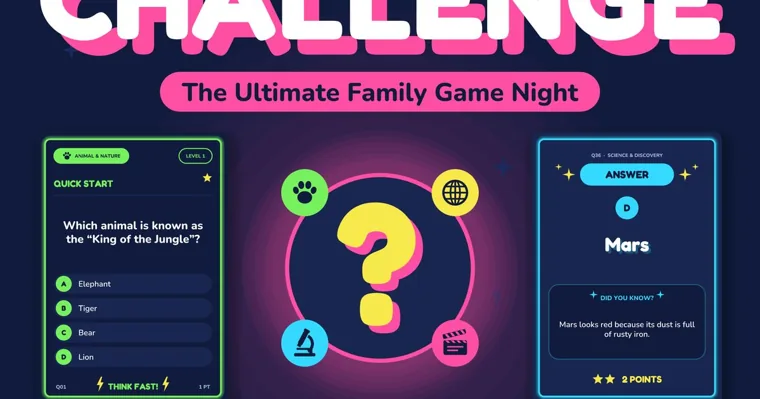
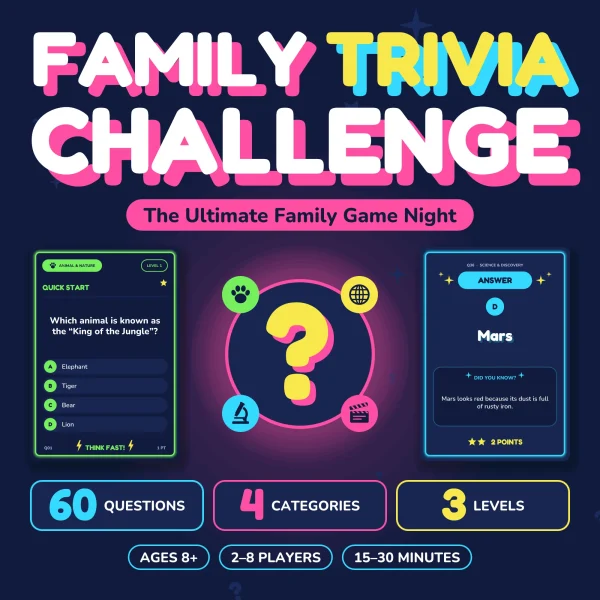
The usual problem with mixed ages. Adults shout out the answers to the kids’ questions before a child has had a chance to think. Give each kids’ question to the youngest players first, and let adults answer only if the kids pass. Another fix is to score by level, the way our Family Trivia Challenge deck does: easy questions are worth 1 point, medium 2 and hard 3, so a child answering easy questions can still keep up.

Easy New Year’s trivia questions for kids
These ten questions suit younger children, read aloud by an adult. The answers are short, and most kids will know two or three already.
- What is the first month of the year?
Answer: January. - What do people in New York City watch drop in Times Square on New Year’s Eve?
Answer: A giant ball covered in crystal panels. “A ball” is enough. - How many seconds does the Times Square ball take to drop?
Answer: 60 seconds. It starts moving at 11:59 p.m. and stops at exactly midnight. - In Spain, how many grapes do people eat at midnight?
Answer: 12, one for each strike of the clock bell. Each grape stands for one month of the new year. - Which song do people often sing right after midnight?
Answer: “Auld Lang Syne.” - In cartoons, a baby stands for the new year. What is he called?
Answer: Baby New Year. In the story, he grows into an old man like Father Time by the end of his year. - How many days will the year 2027 have?
Answer: 365. 2027 isn’t a leap year. The next one is 2028. - What do people in Scotland call New Year’s Eve?
Answer: Hogmanay. - What falls on the crowd in Times Square at midnight?
Answer: Confetti, at least 3,000 pounds of it. - January is named after a Roman god of beginnings. What is his name?
Answer: Janus.
Question 7 trips up kids who know the leap year rule but not which years it lands on. Writing “2024, 2028, 2032” on a scrap of paper turns it into a quick lesson after the answer.
New Year’s traditions around the world
This round works for the whole family because the answers are stories, not dates. Read the bonus lines aloud even when a team gets the answer wrong, since they’re the part people repeat later.
- Which country is one of the first in the world to reach the new year?
Answer: Kiribati. Its Line Islands, including Kiritimati, sit in UTC+14, the earliest time zone on Earth. Accept Samoa or Tonga too, since both are among the first places listed. Don’t accept American Samoa, which is one of the last. - In Japan, how many times do most temples ring their bells on New Year’s Eve?
Answer: 108. The custom is called Joya no Kane. - What noodles do many people in Japan eat on New Year’s Eve?
Answer: Toshikoshi soba, made from buckwheat. - In Scotland, who is the “first-foot”?
Answer: The first guest to step into a home after midnight. Bonus point for naming a gift the first-foot brings: coal, shortbread, salt, whisky or black bun, a rich fruit cake. - What is hidden inside a Greek Vasilopita?
Answer: A coin or small trinket. Whoever finds it in their slice is said to have good luck for the year. - In the Philippines, why do many people wear polka dots on New Year’s Eve?
Answer: Circles are believed to attract money. Some families also set out twelve round fruits. - What color underwear is a New Year’s Eve tradition in Italy?
Answer: Red. - Who brings children presents on New Year’s Eve in Russia?
Answer: Ded Moroz, usually translated as Father Frost or Grandfather Frost. His granddaughter Snegurochka, the Snow Maiden, helps him. - Which Southern dish of black-eyed peas and rice is eaten on New Year’s Day for luck?
Answer: Hoppin’ John, usually served with collard greens. The peas stand for coins. - In Costa Rica, why might someone run down the street with a suitcase on New Year’s Eve?
Answer: To bring travel and adventure in the new year.
Question 1 is the one that starts arguments. Samoa and American Samoa sit close together on a map but are on opposite sides of the International Date Line, so one is among the first to celebrate and the other among the last. Decide before the game whether you’ll give half a point for “the Pacific islands.”
Times Square ball drop and countdown trivia
Save this round for around 11 p.m., when most guests are watching the countdown on TV anyway. Teens and adults will get more of these than kids.
- In what year was the first Times Square ball drop?
Answer: 1907. It was held on December 31, 1907, to welcome 1908. Accept “1907 into 1908,” but not 1908 alone. - Which two New Year’s Eves went without a ball drop, and why?
Answer: 1942 into 1943 and 1943 into 1944, because of wartime lighting restrictions during World War II. - The first ball was built from iron and wood. About how much did it weigh?
Answer: 700 pounds. It was 5 feet across and lit by 100 light bulbs. - Which crystal company has made the ball’s panels since the 1999 to 2000 celebration?
Answer: Waterford Crystal. - The drop is set off from a control room inside which building?
Answer: One Times Square. - About how many volunteers throw the confetti from Times Square rooftops?
Answer: About 100, spread across the roofs of eight buildings. - Whose 1947 recording of “Auld Lang Syne” plays in Times Square right after the ball drops?
Answer: Guy Lombardo and His Royal Canadians. - How wide is the ball used for the 2025 to 2026 celebration?
Answer: 12.5 feet.
Ask question 8 with the year in it, as written. The ball has been rebuilt several times, and an older article or a guest’s memory will give a smaller size that was right for an earlier ball.
History trivia: what happened on December 31 and January 1
Every question in this round is about something that happened on one of these two dates. That makes it a good round for teens and adults who like history, and it gives the host an easy thing to say between questions.
- Which order signed by Abraham Lincoln took effect on January 1, 1863?
Answer: The Emancipation Proclamation. - Which immigration station in New York Harbor began processing immigrants on January 1, 1892?
Answer: Ellis Island. - Which country was formed on January 1, 1901, when six British colonies joined together?
Answer: Australia, as the Commonwealth of Australia. - What did Thomas Edison show the public for the first time on December 31, 1879?
Answer: Incandescent electric lighting, at Menlo Park, New Jersey. - On December 31, 1999, the United States handed which waterway over to another country?
Answer: The Panama Canal, to Panama. - Which currency was introduced on January 1, 1999?
Answer: The euro. If a team writes 2002, explain the difference before marking. The euro started as an accounting currency in 1999, and coins and notes arrived on January 1, 2002. - In which California city is the Rose Parade held on New Year’s Day?
Answer: Pasadena. The first parade was held on January 1, 1890. - When New Year’s Day falls on a Sunday, the Rose Parade moves to Monday. Why?
Answer: Since 1893, organizers have avoided disturbing horses hitched outside Sunday church services.
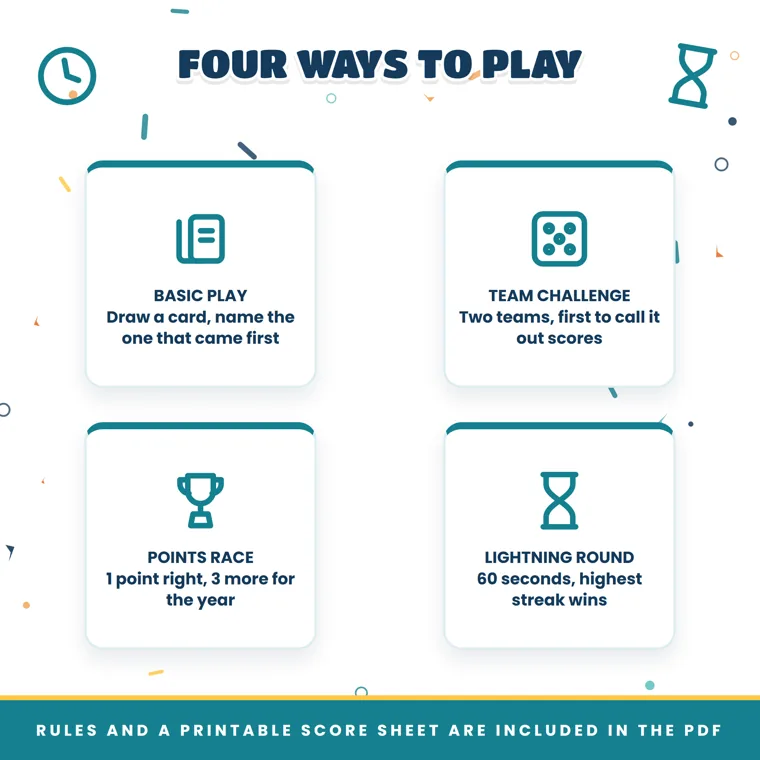
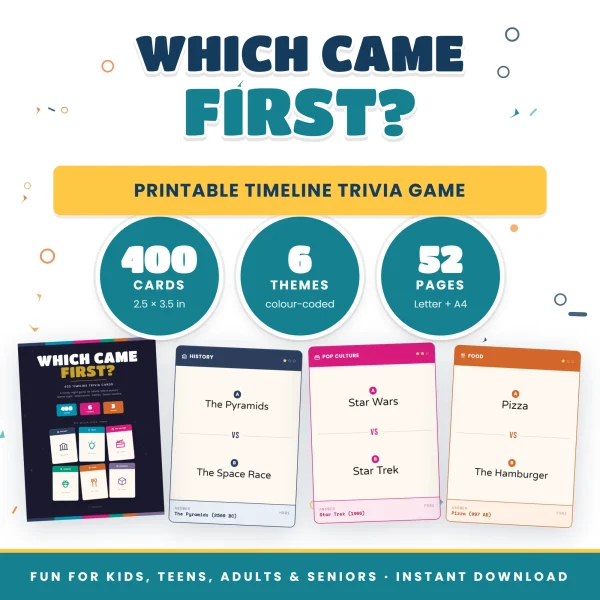
If this round goes over well, add a which-came-first round with our Which Came First? timeline cards. The deck has 80 history cards among its 400, and each card names two events with the answer and date printed at the bottom. Its Lightning Round rule gives one player 60 seconds to answer as many cards as possible, with a pass to skip, and the longest streak wins. A round like that fits the ten minutes before the ball drop.
Harder New Year’s trivia for the adults’ table
These eight questions are for adults who play pub trivia or like calendars and history. They also work as a bonus round where a right answer is worth double.
- Whose calendar took effect on January 1, 45 BC?
Answer: Julius Caesar’s. He proposed the Julian calendar in 46 BC. - Before January, which month began the year in the old Roman calendar?
Answer: March. That’s why September, from the Latin word for seven, is now the ninth month. - Which Scottish poet wrote down “Auld Lang Syne” in 1788?
Answer: Robert Burns. He based it on an older Scottish folk song. - What does “auld lang syne” mean?
Answer: “Old long since.” Accept “long, long ago,” “days gone by” or “old times.” - In which season did ancient Babylon hold its New Year’s festival, Akitu?
Answer: Spring. The festival celebrated the sowing of barley. - The last time zone to reach the new year is UTC−12. Who lives there?
Answer: Nobody. It covers only Baker Island and Howland Island, uninhabited U.S. nature reserves. The last inhabited places, in UTC−11, include American Samoa and Niue. - In what year did Japan move its New Year to January 1?
Answer: 1873, when it adopted the Gregorian calendar. - Were 1800 and 1900 leap years in the Gregorian calendar?
Answer: No. A century year has to divide evenly by 400 to be a leap year, so 2000 was one, but 1800 and 1900 were not.
Question 6 is a trick question, and some teams will feel cheated. Warn the room that one question in this round has an unexpected answer, and it plays as a puzzle instead of a gotcha.
Tie-breakers for the last round before midnight
Use these when two teams finish level. Read one, have each team write a number, and the closer guess wins. Go to the next one only if the guesses are equally close.
- How many triangle-shaped Waterford Crystal panels covered the Times Square ball that welcomed 2000?
Answer: 504. - In what year was the Rose Bowl college football game added to the Pasadena celebrations?
Answer: 1902. - In what year was the Coney Island Polar Bear Club founded? Its members swim in the Atlantic every New Year’s Day.
Answer: 1903. - Kiritimati, one of the first places to see the new year, is how many miles from Honolulu?
Answer: 1,340 miles. - Spain’s twelve grapes became popular when grape growers in Alicante promoted them to sell a large harvest. In what year?
Answer: 1909.
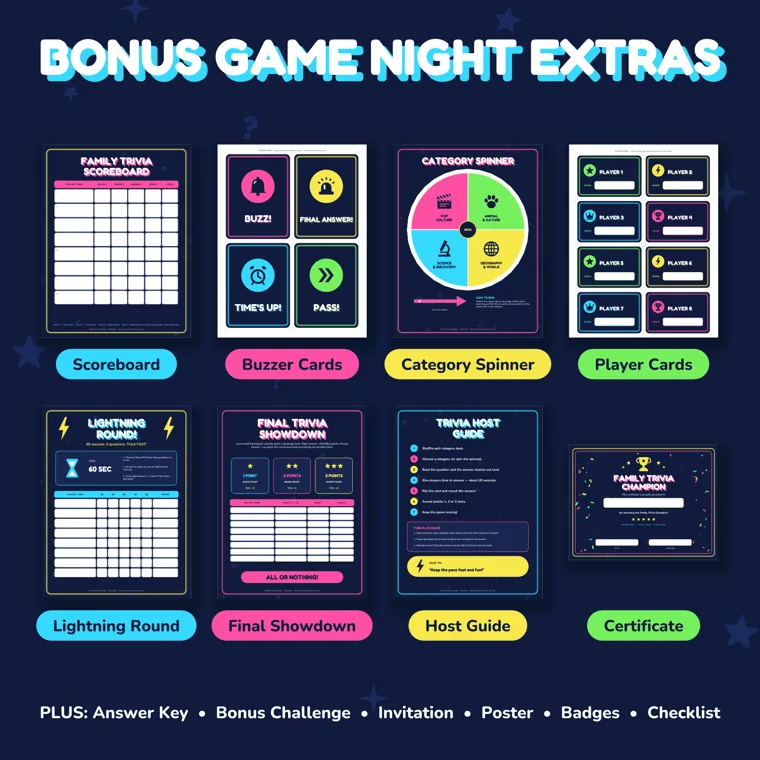
If you’d rather end on a game than a single question, our Family Trivia Challenge has two printable finales. Its Lightning Round is 60 seconds and 5 easy questions, with 1 point per right answer and a pass if you’re stuck. In the Final Showdown, each player secretly picks a level, a right answer earns double points and a wrong one earns nothing for that round. Its 60 question cards cover animals, geography, science and pop culture rather than New Year’s, so they work best as an extra round once the 49 questions above run out.
Whichever round you finish with, read the last answer and add up the scores before 11:59 p.m. That leaves the final minute free for the countdown.
Printables from this article
Related articles
Printable Party Games
How to Plan a Baby Shower: Timeline, Food & 2-Hour Schedule
A baby shower plan from the first talk with the parents-to-be to the last gift: timing, guest list, budget, venue, a two-hour schedule, safe food and backup plans.
Printable Party Games
How to Plan a Bridal Shower: Timeline, Budget and Schedule
A host's plan for a bridal shower, from the first talk with the bride and co-hosts to the guest list, invitations, a timed party schedule, the gift opening and what to do when something slips.
Printable Party Games
35th Birthday Ideas: Party, Trip, Theme and Gift Ideas
Ways to celebrate turning 35, sorted by how many people the birthday star wants around, with group size, time, prep and the snag to plan for in each.