Games to Play at School: Classroom, Recess and Rainy Days
The best games to play at school are the ones that fit the slot you actually have. For ten minutes of review at desks, play Four Corners with answer choices or a round of Twenty Questions. When the room stops listening mid-lesson, two minutes of walk-to-a-side Would You Rather resets it. Outside at recess, four square and freeze tag need almost nothing. On a rainy day, a pile of question cards on each table keeps 25 kids busy without anyone running.
Below are 20 games grouped by where you are, with how many kids each one handles, how long it runs, what to get ready, how it ends, and the catch to know before you start. Pick by the column that matters most to you, usually time.
| Game | Where | Players | Time | Prep |
|---|---|---|---|---|
| Four Corners review | Classroom | 5–30 | About 10 min | Four corner labels, review questions |
| Hangman | Board | Whole class | 5–10 min | A word list |
| Twenty Questions | Desks | Whole class | 5–15 min | None |
| Word scramble race | Board or desks | Teams of 4–6 | 10 min | Printed puzzle pages |
| Harvest bingo | Desks | Up to 30 | 15–20 min | Cards and caller slips |
| Egg drop | Tables | Teams | 30 min | Eggs, straws, tape, paper |
| Would You Rather, walk to a side | Classroom aisle | 2–30 | 5 min | A list of questions |
| Telephone | Line or circle | 8+ | 5–10 min | None |
| Simon Says and Freeze Dance | Standing at desks | 3–30 | 5–10 min | Music for Freeze Dance |
| Four square | Playground | 4 at a time plus a line | Any length | Ball, chalk court |
| Freeze tag | Field | 6+ | 10–15 min | Boundaries |
| Red Light, Green Light | Field or gym | 5+ | 10 min | A long open space |
| Duck, Duck, Goose | Grass or rug | 8+ | 10 min | None |
| Hopscotch | Blacktop | 1–5 per court | Any length | Chalk, a marker |
| Kickball | Field | Two teams | Set innings | Rubber ball, bases |
| Autumn scavenger hunt | Schoolyard or window | Pairs or teams | 15–20 min | One list per team |
| Would You Rather card piles | Tables | 4–6 per table | 20–30 min | Cut card decks |
| Hot potato | Circle | 8+ | 10 min | Soft object, music |
| Classroom scavenger hunt | Classroom | Teams of 3–4 | 20 min | A list of 10–15 things |
| Word scramble pages | Desks | Solo | 5–10 min each | Printed pages |
Classroom games that review what you’re teaching
These run at desks or in the aisles, so you can play them between lessons without moving furniture. Most of them double as a check on what the class remembers.
Four Corners with review questions
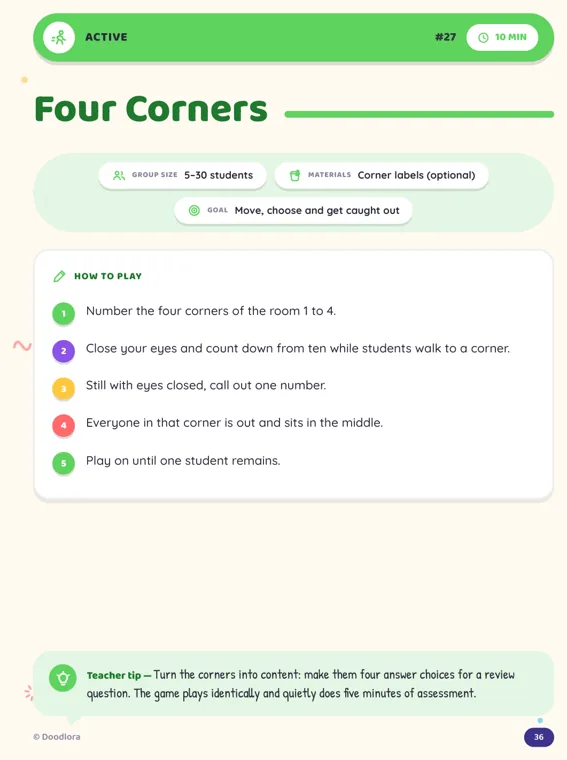
Four Corners works for 5 to 30 students and takes about 10 minutes. Number the corners of the room 1 to 4, close your eyes, and count down from ten while students walk to a corner. With your eyes still closed, call one number. Everyone in that corner is out and sits in the middle, and play continues until one student is left.
The review version is the reason to play it in class. Put a multiple-choice question on the board, label the corners A to D, and have students walk to the answer they think is right. The game plays the same way, and you can see at a glance who chose what.
The catch: in the review version, don’t eliminate the corner with the wrong answer. A student who is out stops thinking about the questions, which defeats the point. Keep everyone in and tally correct corners on the board instead.
Hangman on the board
Hangman takes 5 to 10 minutes and needs only a board and a word list. One player picks a word and draws a row of dashes, one for each letter. The class guesses letters. A correct letter goes into every place it appears, and a wrong letter adds one piece to a drawing. Guessers can try the whole word at any time. The round ends when the word is solved or the drawing is finished.
Use this week’s spelling or vocabulary words, and let the student who solves it choose the next word from your list. If the hanging picture bothers you or your school, count misses with tally marks instead. Hangman worked that way in the oldest recorded version of the game, scored by how many guesses it took.
Twenty Questions
Twenty Questions needs no prep and runs 5 to 15 minutes with the whole class. One person, the answerer, thinks of something. Everyone else takes turns asking questions that can only be answered yes or no. A correct guess wins and makes that student the next answerer. If 20 questions go by without a correct guess, the answerer has stumped the class.
Tie the answers to a unit: an animal from the science chapter, a person from the history reading, a shape from math. Keep a tally of questions on the board so nobody argues about the count.
The catch is wasted questions. Young players start with “Is it a dog?” on question one. Model a broad first question, like “Is it alive?”, and the game gets faster and more useful.
Word scramble race
A word scramble race fits a 10-minute slot for teams of four to six, and it suits ages 6 to 10. Write one jumbled word on the board with a one-line clue, and the first team to hold up the correct spelling scores a point. Ten words makes a good round.
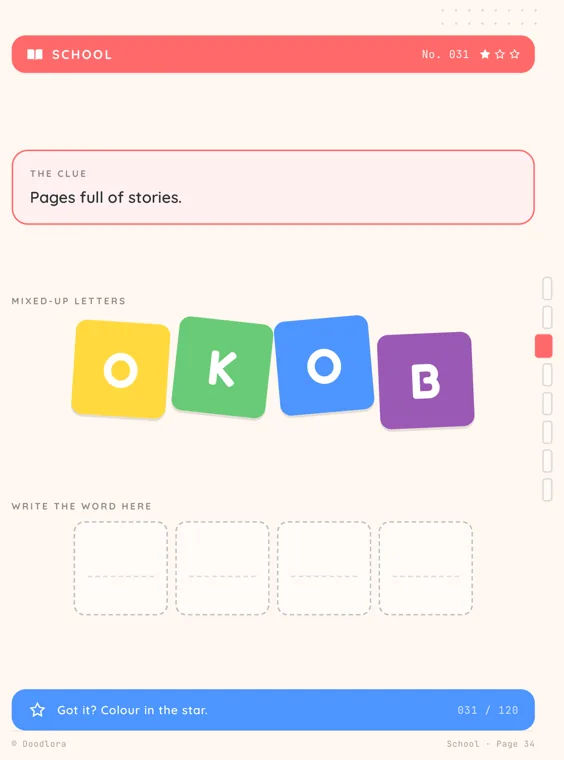
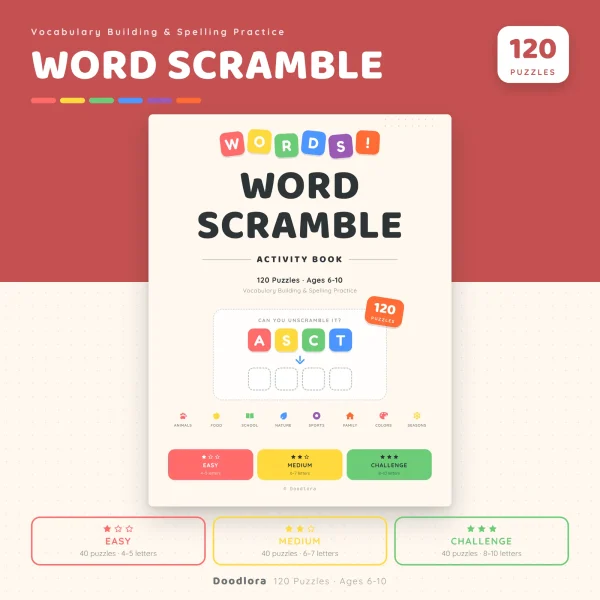
The school-theme pages of our word scramble book for kids give you 15 ready words, from BOOK and DESK up to CLASSROOM and PLAYGROUND, each with its own clue. They are puzzles 031 to 045, on pages 34 to 48, and the answer key on page 124 lists all 15. Project one page at a time, or hand each team a copy.
The catch: a few clues use British wording. CHALK is “you write with it on a blackboard,” ERASER “rubs out your mistakes,” and PLAYGROUND is “where you run and play at break time.” Read the clue aloud in your own words if your class says whiteboard and recess.
Harvest bingo
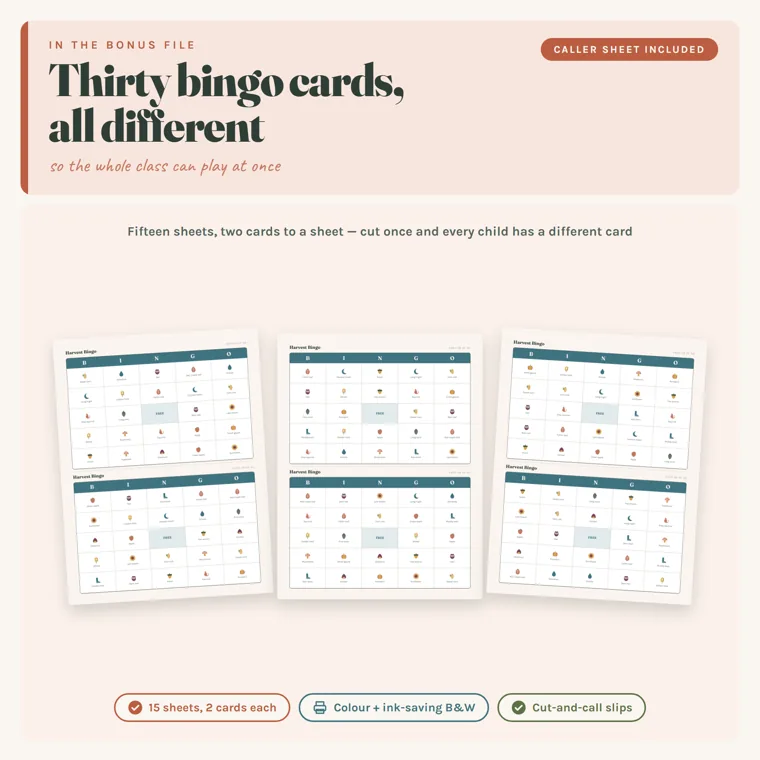
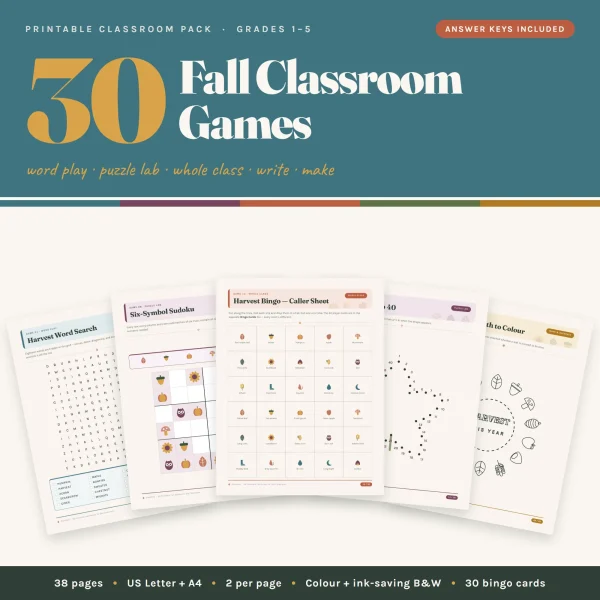
Harvest bingo handles a whole class of up to 30 and runs 15 to 20 minutes. It works best from October through Thanksgiving on November 26. The bonus file in our fall classroom games pack has 30 different picture cards, two to a sheet on 15 sheets, plus a caller page of 30 slips to cut, fold and pull from a hat. Every card has a free center square.
Call each slip, students mark the picture, and the first full row, column or diagonal wins. For a longer round, play on to a full card.
The catch is the vocabulary. Some caller words are British or easy to confuse: “Conker” is a horse chestnut, one slip names a gray squirrel while another just says “Squirrel,” and “Long cone” sits next to “Pine cone.” Hold up the card picture as you call, at least for the first game, so nobody marks the wrong square.
Egg drop for a STEM period
The egg drop fills a full 30-minute period for teams of any size from 4 to 30 students. Give each team one egg and the same set of straws, tape and paper. Teams have 20 minutes to build a container that protects the egg, with no extra materials allowed. Drop every container from the same height, such as a chair or a table, then open them together and look at what survived and what didn’t.
The catch is the mess. Hard-boil the eggs. The engineering problem stays the same, and you won’t spend lunch cleaning the floor. Lay down newspaper anyway.
Brain breaks when the room stops listening
Brain breaks are short, standing games for the moment a lesson has run too long. Five to ten minutes on their feet usually buys back focus for the next block. Use them as transitions, not prizes, so the whole class gets them.
Would You Rather, walk to a side
This is the fastest game here, at about 5 minutes for 2 to 30 students, and it needs no materials. Clear a path down the middle of the room and name one side A and the other B. Read a question aloud, and on your signal students walk to the side that matches their answer. Ask one or two students from each side to explain their choice in a sentence. Run six to ten questions, ending on a silly one.
School-day questions work best because every child has an opinion: walk to school or take the bus, recess before lunch or after. The full question lists by age are in would you rather questions for kids.
The catch: kids follow their friends to a side. Have everyone decide silently and point before you say “go,” then hold them to it.
Telephone
Telephone suits eight or more players and takes 5 to 10 minutes. Players stand in a line or circle. The first player whispers a message to the second, who whispers it to the third, and so on. The last player says the message out loud, and the first player reads the original. The fun is in how far the two drift apart.
Schools use it to show how fast gossip changes as it passes along, and with young children to practice listening and using a quiet voice. A round counts as a win when the message arrives intact with everyone whispering, not shouting.
The catch is a long line. With 25 students the message takes ages and the back of the line drifts off. Split into two lines of 12 or so, give both the same message, and compare the two endings.
Simon Says and Freeze Dance
Both are 10-minute standing games for 3 to 30 students, and the rules most kids already know. Simon Says needs nothing. Freeze Dance needs music you can stop without warning. The rainy day activities for kids page covers them in more detail.
The catch with both is elimination. The students who sit out are the ones who needed to move most. In Simon Says, bring anyone who’s out back in after two minutes. In Freeze Dance, run three or four short rounds and restart everyone each round.
Recess games for the playground
Recess games need a bigger space, clear boundaries, and rules everyone agrees on before the bell. These are the classics that work with a ball, some chalk, or nothing at all.
Four square
Four square takes four players at a time, with everyone else waiting in line, and it needs one ball and a square court split into four boxes. Many school blacktops already have one painted. Rounds are short and you can stop at any time, which is why it’s a recess staple.
The player in square 4 serves by bouncing the ball into another square. Whoever owns that square hits it with their hands into another square, and so on. A player is out for letting the ball bounce twice in their square, hitting it out of the court or onto a line, catching or holding it, or failing to hit it into another square. The player who is out goes to the back of the line, everyone moves up a square, and a new player steps into square 1.
The catch is arguments over lines. The standard rule says a ball that hits a line is out, so say that before the first serve, not after the first argument.
Freeze tag
Freeze tag needs six or more players and a marked area, and a round runs about 10 to 15 minutes. One player is “it.” Anyone tagged freezes in place. Players who are still free can tag a frozen player to unfreeze them. The game ends when “it” has frozen everyone except one player, who usually becomes “it” next. With a big group, use two or three taggers.
The catch is rough tagging. Set boundaries, agree that a tag is a light touch on the arm or back, and decide who referees. The US association for physical education teachers makes the same point: tag is fine when the adult modifies rules, sets boundaries and makes sure pupils are safe.
Red Light, Green Light
Red Light, Green Light needs five or more players and a long space, like a field or gym, and a round takes about 10 minutes. The caller stands at one end with their back to the others, who line up at the far end. On “green light,” players move toward the caller. On “red light,” the caller turns around and everyone must freeze. Anyone caught moving goes back to the start line. The first player to tag the caller wins and becomes the next caller.
The catch is the arguments about who moved. Make the caller name the person and say what they saw, and keep the send-back rule rather than knocking players out, so nobody spends the round standing on the sideline.
Duck, Duck, Goose
Duck, Duck, Goose is for the youngest grades, from preschool through early elementary. You need eight or more children, no equipment, and about 10 minutes. Children sit in a circle facing in. The picker walks around the outside, tapping each head and saying “duck,” then taps one child and says “goose.” The goose jumps up and chases the picker around the circle. If the picker reaches the goose’s empty spot first, the goose becomes the new picker.
The catch is that the same few children get picked every time. Add a rule that you can’t choose someone who has already been the goose.
Hopscotch
Hopscotch takes one to five players per court, a piece of chalk and a small marker such as a stone or beanbag. Many school blacktops have a court painted already. Players throw the marker into square 1, then hop through the court, on one foot in single squares and with both feet straddling side-by-side squares, skipping the square with the marker. At the end, they turn around, hop back, and pick up the marker on the way.
A turn ends if the player steps on a line, misses a square or loses balance, and the next turn picks up where the last one stopped. The first player to finish a run for every numbered square wins.
The catch: a marker that bounces out of the square ends that turn, so younger kids lose turns fast. A beanbag lands and stays put better than a stone.
Kickball
Kickball is the go-to for a whole class or two at once, split into two teams, and it’s played on a field with bases like baseball. The pitcher rolls an inflated rubber ball, the kicker kicks it, and runners try to circle the bases while the fielders try to get them out with the ball. Teams swap between kicking and fielding each inning, and the team with the most runs after a set number of innings wins.
There’s no bat and no hard ball, which is why it’s been a school recess game for decades. Decide the number of innings before you start so the game ends on time.
The catch is picking teams. Captains choosing one by one leaves the same kids picked last every time. Count off by twos instead.
Autumn scavenger hunt
The autumn scavenger hunt works for pairs or small teams in 15 to 20 minutes. The page lists 18 things to tick off, like a leaf bigger than your hand, a stick shaped like a Y and a cloud shaped like an animal. Nothing needs picking up. It’s game 17 in our fall classroom games pack, and the page says it also works on a walk or from a classroom window, which makes it a recess game for days when you can’t go out.
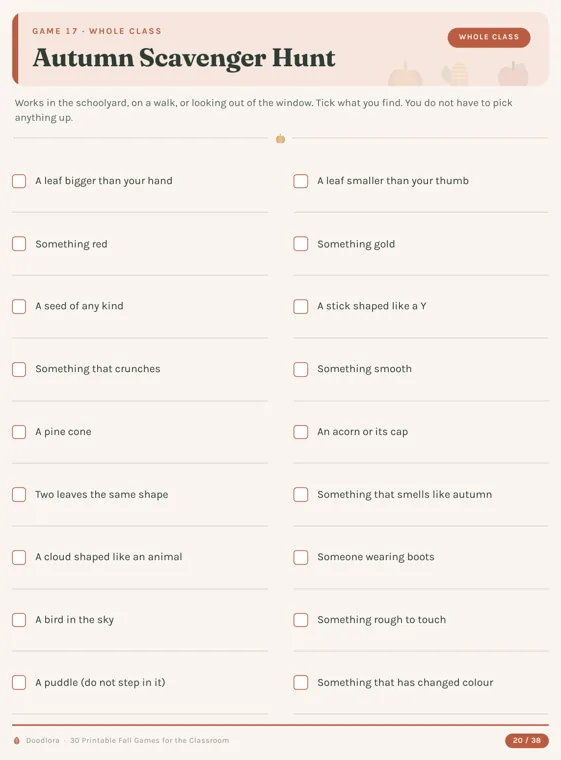
The catch: the puddle line. One square reads “A puddle (do not step in it).” Read that rule out loud before the door opens.
For more outdoor lists, see the nature scavenger hunt ideas.
Indoor recess on a rainy day
Indoor recess means 20 to 30 minutes in the classroom with a class that hasn’t burned off any energy. The best games keep kids in small groups at their tables, so the noise stays down and you don’t need to run anything from the front.
Would You Rather card piles at each table
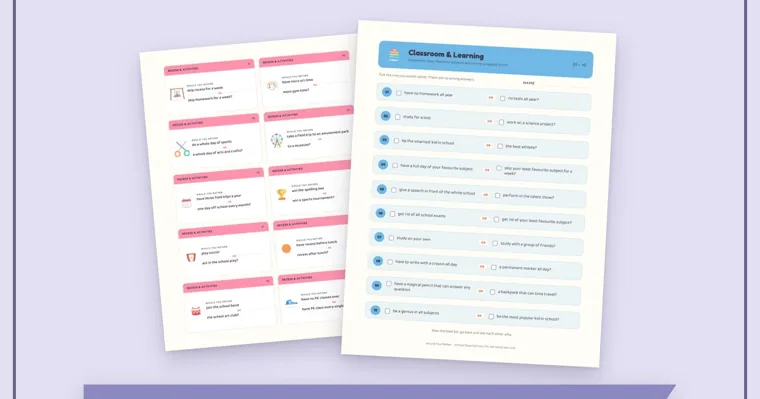
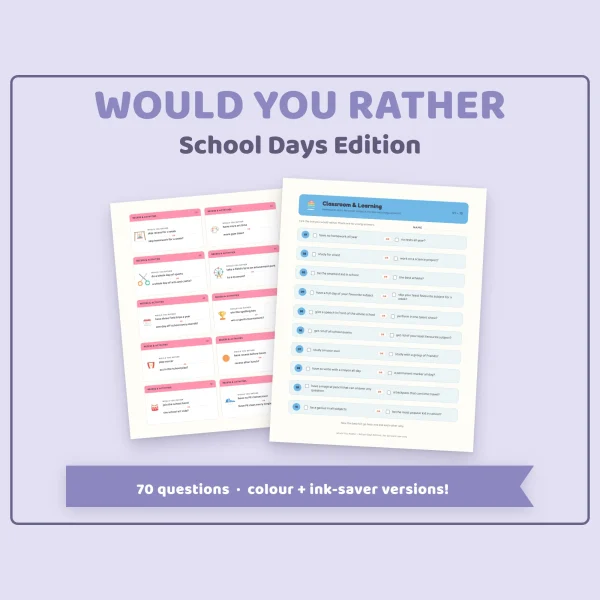
Card piles work for four to six kids per table and fill a whole indoor recess. Our School Days would you rather cards have 70 questions in seven color-coded topics, such as classroom, lunch, recess and wild imagination. Each topic has a page of ten cards to cut apart, plus a page of ten blank cards for students to write their own. Give each table one topic as a pile.
One child reads a card out loud, everyone at the table answers, and then someone asks “why?” There’s no score, so the game ends when the bell rings. “Indoor recess on a rainy day” and “something for a substitute teacher to run” are both on the pack’s own Ways to Play page.
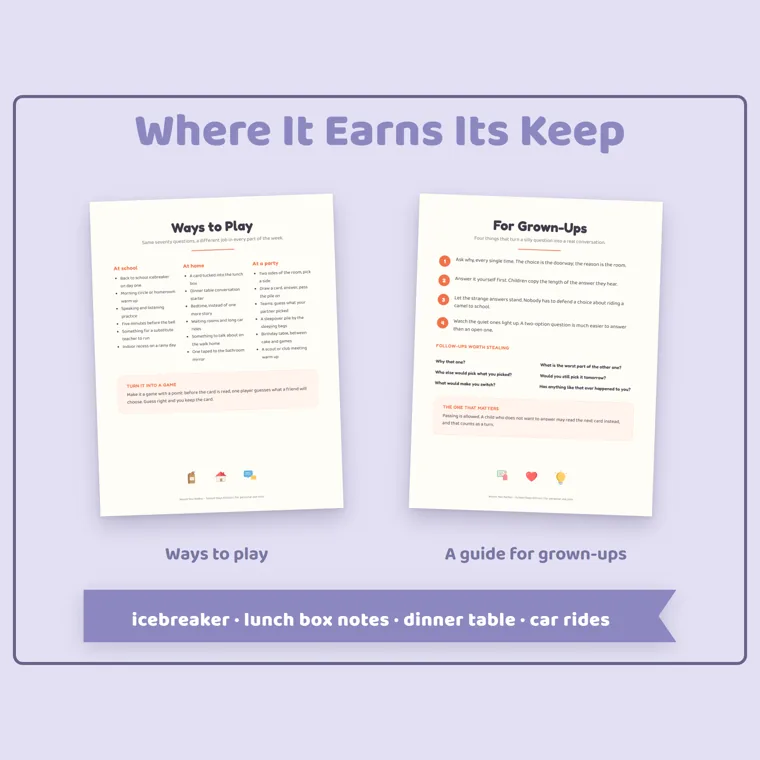
The catch: a few Friends and Feelings cards can land hard. Card 54 asks about being easily forgotten or remembered for something embarrassing. Card 60 asks about being the new kid or losing a best friend who moves away. Pull those from the pile if a child has just moved. The pack’s own rule also works well at every table: passing is allowed, and reading the next card counts as a turn.
Hot potato
Hot potato needs eight or more players in a circle, a soft object like a beanbag or a rolled-up pair of socks, and music. It takes about 10 minutes. Players toss the object around the circle while the music plays. Whoever is holding it when the music stops is out.
The catch is that eliminated players have nothing to do indoors. Instead of sitting out, have them join a second circle, so by the end there are two games running.
Word scramble pages at desks
Solo puzzle pages are the quiet option for kids who want to sit out the noise. A word scramble takes 5 to 10 minutes per page, and the four- and five-letter school words work for most second graders. Print a stack of school-theme pages from the scramble book above and leave them in a tray. A child who finishes one colors in its star on the puzzle map at the back.
For harder options, the brain teasers for kids page has logic puzzles and riddles sorted by age.
Games for the first weeks of school
The first weeks need games that teach names and the room itself. Most get-to-know-you games, like The Name Game, Two Truths and a Lie and Human Bingo, are in icebreaker games for kids. One more is worth running in week one.
Classroom scavenger hunt
The classroom scavenger hunt takes about 20 minutes for teams of three or four. Write a list of 10 to 15 things to find: the tissues, the pencil sharpener, where late work goes, the fire exit route, the class calendar, and where each student’s name appears in the room. Teams search together and write down where each item is, without moving anything. Set a 15-minute limit and stick to it, then go through the answers as a class.
The catch is choosing the list. Build it from the questions students ask you over and over in the second week. Every item they find themselves is one less question for you.
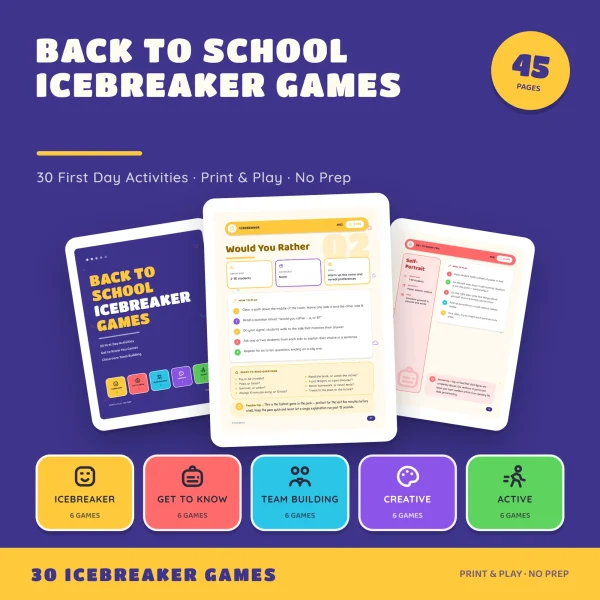
The page for this is game 30 in our first day of school activities pack, alongside 29 other games for the first week, each with group size, time and materials at the top.
One red-flag game to skip
Red Rover, where one team links arms and the other runs to break through the chain, has been banned by many schools because of the risk of injury. If students ask for it, play Red Light, Green Light instead. It has the same line-up and race to the other side, without the collisions.
Printables from this article
Related articles
Printable Party Games
Morning Meeting Questions for Kids: Monday, Friday, Check-In
Read-aloud morning meeting questions for K–5 teachers, grouped by day, grade and topic, with circle timing, partner sharing, help for shy students and the questions to keep out of a whole-class circle.
Printable Party Games
Princess Party Ideas: Games, Crafts, Food & a 2-Hour Plan
A fairy-tale princess birthday at home, sorted by party stage, with guest counts, timing, supplies and the snags to plan around for kids 3 to 8.
Printable Party Games
Games for a Couples Shower: Icebreakers and Team Games
Fourteen couples shower games sorted by when you need them: mixing two friend groups, getting the whole room playing, his side against hers, quizzing the couple and winding down.