Family Reunion Games and Ideas for All Ages, Plus Planning
The best family reunion games solve the two problems every reunion has: half the people don’t know how they’re related, and the ages run from toddlers to great-grandparents. So open with a game that sorts out who belongs to which branch, follow it with something grandparents and grandkids play side by side, and save the running games for late afternoon when the food has settled. Below are 15 games grouped by who is playing and where, followed by the planning and invitation wording that keeps the day on track.
Pick a family reunion game by group size, ages and space
Most reunions need one game from each of the first three rows below, plus a backup from the last row in case the weather turns. The times are our planning estimates for a group of about 30.
| If your reunion has… | Play | Group size | Time |
|---|---|---|---|
| Relatives who’ve never met | Branch-color name tags, baby photo match | Any | All day / 20 min |
| Grandparents and small kids at one table | Story circle, then-and-now quiz | 6 to 12 per table | 20 to 30 min |
| A dozen cousins under 12 | Relative autograph hunt, chalk family tree | 5 to 20 kids | 30 to 45 min |
| A park or big backyard | Egg toss, branch olympics | 20 to 100 | 15 min / 1 to 2 hours |
| A rented hall or rainy forecast | Talent show, bingo, heirloom guess | 15 to 80 | 20 to 60 min |
If you only have time to organize three things, do name tags, one table game and one field game. Anything more is a bonus.
Icebreaker games that sort out who’s who at a family reunion
Reunion icebreakers have a job that office icebreakers don’t: they have to explain the family tree without anyone feeling quizzed on it. These three do that in the first hour.
Branch-color name tags
- Players: everyone, all day
- Prep: name tag sheets, one marker color or sticker dot per branch of the family (usually one per grandparent or great-grandparent line)
Give each branch its own color. As people arrive, they write their first name large and, underneath, whose child or grandchild they are (“Maya, Ruth’s granddaughter”). Halfway through the afternoon, call a quick line-up where each color group stands together for a photo. That photo usually becomes the one people ask for afterward.
The catch is married-in relatives and partners. Let them take their spouse’s color, or give them a neutral color, but decide before the welcome table opens so nobody gets asked “which one are you?” at the door.
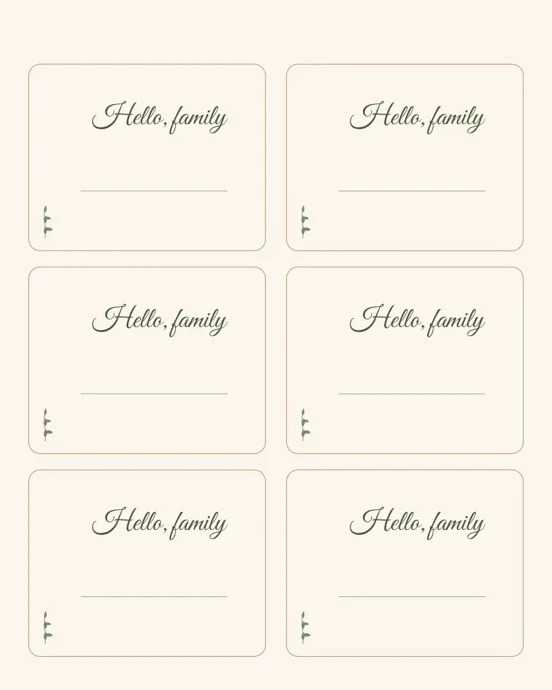
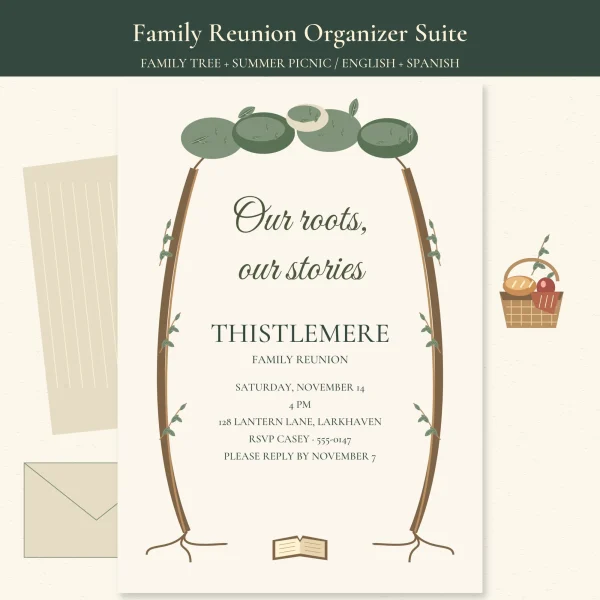
Our family reunion invitations and organizer set has this “Hello, family” name tag sheet in six-per-sheet and eight-per-sheet versions, in English and Spanish. The six-per-sheet version has more room for the “whose grandchild” line.
Baby photo match
- Players: 10 to 60 adults and teens
- Time: about 20 minutes, open-ended across the afternoon
- Prep: a baby or childhood photo from each willing relative, collected ahead by text or email; numbered printouts; answer slips
Pin the numbered photos to a board near the food. Guests write the number and their guess of who it is on a slip. Announce the answers after the meal, and give the person with the most correct guesses first pick of the dessert table.
Collect the photos at least two weeks ahead, because older relatives may need someone to scan a print for them. Leave out anyone who’d rather not join. Two cousins who look identical at age two is the fun part, not a reason to drop one.
Who Am I? relative edition
- Players: 6 to 30, ages 8 and up
- Time: 15 minutes
- Prep: sticky notes with names of relatives who are at the reunion
Stick a relative’s name on each player’s back without letting them see it. Players walk around asking yes-or-no questions (“Am I on Grandpa’s side?” “Do I live out of state?”) until they guess who they are. Once they guess, they go find that relative and introduce themselves.
Only use names of people who are actually there. The game falls flat when a player lands on a second cousin nobody in the room has met. For a mixer with a bingo card instead, human bingo works with reunion facts swapped in (“someone who was born in another state,” “someone who has the same middle name as you”).
Games that get grandparents and grandkids playing together
Once people know who’s who, put the oldest and youngest at the same table. A good reunion game here asks something only a grandparent can answer, so the kids have a reason to listen.
Story circle with interview cards
- Players: one or two older relatives plus 4 to 10 listeners of any age
- Time: 20 to 30 minutes per round
- Prep: index cards with one question each, a phone to record (ask first)
Shuffle the question cards and let the kids draw and read them aloud. The Smithsonian’s family folklore questionnaire starts with questions like “What do you know about your family surname?” and “How did your parents, grandparents, and other relatives come to meet and marry?” Both work well read out by a 9-year-old. The same questionnaire also says the best questions are the ones you write from what you know of your own family.
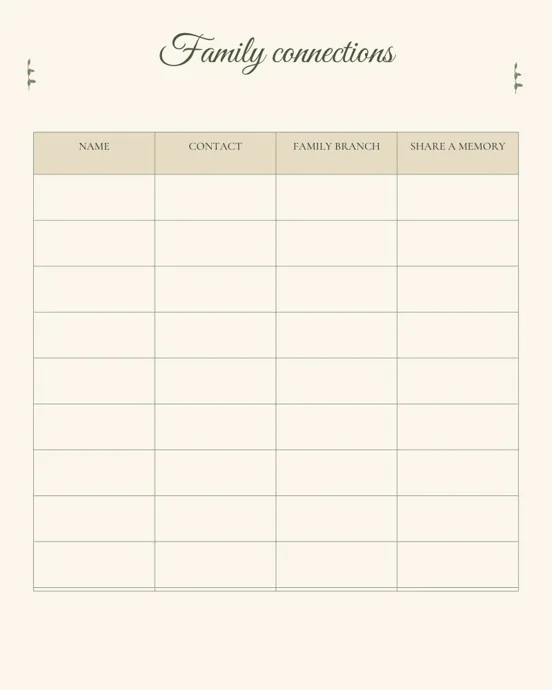
End each round after one person has told three stories, not when the cards run out. Anyone who’d rather write than talk can add a memory to a sign-in form instead. For more questions sorted by age, see our family history questions to ask grandparents.
Then-and-now quiz
- Players: two teams, one of grandparents and older adults, one of kids and teens
- Time: 20 minutes
- Prep: 10 questions for each side, written ahead with help from a parent in each generation
The kids answer questions about their grandparents’ childhood (“How did you call a friend before cell phones?” “What did a school lunch look like?”). The grandparents answer questions about the kids’ world (“What does a streamer do?” “Name one song on the radio right now”). The person who wrote the question reads the true answer and tells the story behind it.
Keep it to one round each way. The stories take longer than the answers, which is the point. If you want a fuller quiz with rounds and scoring, our guide to hosting a trivia night covers answer sheets and tie-breakers.
Family survey showdown
- Players: two teams of 4 to 8, the rest as audience
- Time: 30 minutes
- Prep: a short survey sent to relatives a few weeks ahead, tallied into a top-five answer list for 6 to 8 questions
Ask everyone the same questions before the reunion: “Name a food Grandma always made.” “Name a word that describes our family road trips.” Tally the answers. At the reunion, two teams take turns guessing the most common answers, scoring a point for each match. Three wrong guesses pass the question to the other team.
The survey is where this game usually stalls. Send it with the RSVP, keep it to eight questions, and accept answers by text so relatives who don’t do online forms can still join.
The domino and card table
- Players: 4 per table, rotating
- Time: all afternoon
- Prep: a shaded folding table, two decks of cards, a domino set
Many families have one game the older generation already plays, so give it a permanent table rather than a slot on the schedule. A standard double-six domino set has 28 tiles, which gets tight with more than four players. A double-nine set has 55 tiles and handles a bigger table.
Let the regulars teach the game to anyone over about 10 who sits down. Post a “winner stays, loser rotates” rule so the same four don’t hold the table all day.
Kids’ corner games for a pack of cousins
Cousins under 12 usually find each other within minutes, so their games need less setup and more structure than the adults’ games. Pick an older teen or two as cousin captains to run these while the adults talk.
Relative autograph hunt
- Players: 5 to 20 kids, ages 5 to 12 (younger ones paired with an older cousin)
- Time: 30 to 45 minutes
- Prep: a printed card per kid with 10 to 12 prompts, pencils
Each card lists things like “someone who was born in another country,” “someone who has the same birthday month as you” and “someone who knew Great-Grandpa.” Kids find a relative who fits each prompt and get their signature. A full card earns a turn at the prize basket.
The trap is having two or three relatives fit most of the prompts. Write at least half the prompts so they point to different people, and check the list against the RSVPs before printing.
Chalk family tree
- Players: any number of kids, ages 4 and up
- Time: 30 minutes
- Prep: sidewalk chalk, a long stretch of driveway or path, a printed list of names by branch
Draw a big trunk and one main branch per grandparent line. Kids add leaves with their own names, then go find aunts, uncles and cousins to fill in the rest. Older kids can add the year each person was born, if adults help.
Do this early in the day. By late afternoon the chalk tree has turned into the backdrop for the group photo, and rain or foot traffic can wipe it out by evening.
For tag, races and classic backyard games on top of these, see our list of outdoor games for kids by age.
Field games for a park or big backyard reunion
Running games work best after the meal and once the afternoon heat has eased. CDC heat guidance says to “do outdoor activities during the coolest parts of the day or evening,” and notes that people over 65 and young children may need extra care on hot days. Set up shade, put water within reach of every game, and remind people to drink before they feel thirsty.
Egg toss
- Players: pairs, as many as you have room for
- Time: about 15 minutes
- Prep: one raw egg per pair, plus spares, and a grassy space
Partners stand a step apart and toss an egg back and forth. After each catch where the egg survives, both step back and toss again. The last pair with an unbroken egg wins. That’s the basic team version described in Wikipedia’s entry on egg tossing, which also notes a popular variation with water balloons.
Pair a grandparent with a grandchild for at least one round. Keep it on grass, away from the food tables, and give the kids an old T-shirt to wear if their parents care about their clothes.
Branch olympics
- Players: 20 to 100, divided into teams by branch of the family
- Time: 1 to 2 hours
- Prep: a scoreboard on poster board, 4 to 6 events, small medals or ribbons
Teams wear their branch color and compete in a series of short events: an egg toss round, a tug of war, a three-legged race, a team trivia question. Every event awards points to every team (3 for first, 2 for second, 1 for showing up), so a small branch still finishes on the board.
Uneven branches are the real problem. If one grandparent had seven children and another had two, merge the small branches or let teams borrow players. For event rules and team splits for big crowds, our big group party games cover tug of war, capture the flag and relay setups.
Frozen T-shirt race
- Players: 4 to 8 at a time, teens and adults
- Time: 10 minutes
- Prep: one T-shirt per player, soaked in water, folded and frozen in a zip-top bag overnight, plus a cooler to keep them frozen
On “go,” players take their frozen T-shirt out of the bag and race to unfold it and put it on. The first one wearing it wins. Players can bang it on the ground, twist it or warm it with their hands.
The cooler is the step people forget. Shirts that sit in a hot car for an hour arrive half thawed and the race ends in a minute. If your reunion is at a lake, pool or beach, keep this game on dry ground. The American Red Cross says to designate a “water watcher” whenever a group is near water, and to have young children or inexperienced swimmers wear U.S. Coast Guard-approved life jackets.
Rainy-day reunion games for a hall or living room
A rented hall, a church fellowship room or a crowded living room needs games that stay in one place. These three hold a big group indoors without moving furniture.
Family talent show
- Players: 5 to 15 acts, everyone else as audience
- Time: 30 to 60 minutes
- Prep: a sign-up sheet at the welcome table, a host, a speaker for music
Acts can be anything: a song, a card trick, a dance from the cousins, a grandparent’s poem. Cap each act at three minutes and put the youngest kids early before they get shy. Hand out an award to every act (“Best Use of a Kitchen Spoon”) instead of ranking them.
Ask a teen to record the whole show on a phone. Relatives tend to pass that recording around for years.
Bingo for all ages
- Players: 10 to 80
- Time: 20 to 40 minutes
- Prep: bingo cards, a calling deck, markers, prizes
Bingo is the one game nearly every age can play at once. Little kids can play picture bingo next to grandparents playing numbers. Use family-themed squares (“someone in a reunion T-shirt,” “a dish from Aunt Rosa”) for one round if you want it to feel like your reunion. Our printable bingo rules cover how to call, check a win and settle a tie.
Heirloom guess
- Players: 10 to 40
- Time: 20 minutes
- Prep: 5 to 8 old objects brought by older relatives, each with a numbered card
Lay out the objects on a table: a kitchen tool, a pocketknife, a sewing gadget, an old camera. Guests guess what each one is and whose it was. Then ask whoever brought it to tell its story. Ask relatives to bring items they don’t mind being handled, or set fragile ones behind a “look, don’t touch” card.
How to plan a family reunion around the games
Good games only work if the right people are there, rested and fed. Here is the planning order we’d follow, from the first message to the day itself.
Pick a planner and a small committee. One person makes final calls. Two or three others take food, money and activities. A reunion run by “everyone” usually means nobody books the pavilion.
Set the date six months to a year out. Relatives who fly in need time, and popular park pavilions and halls book early in summer. Send a save-the-date as soon as the date is fixed, then the full invitation about two to three months before. Ask for replies a few weeks ahead so you can count food and T-shirts. If relatives are unsure how to answer, our guide to what RSVP means explains replies and deadlines.
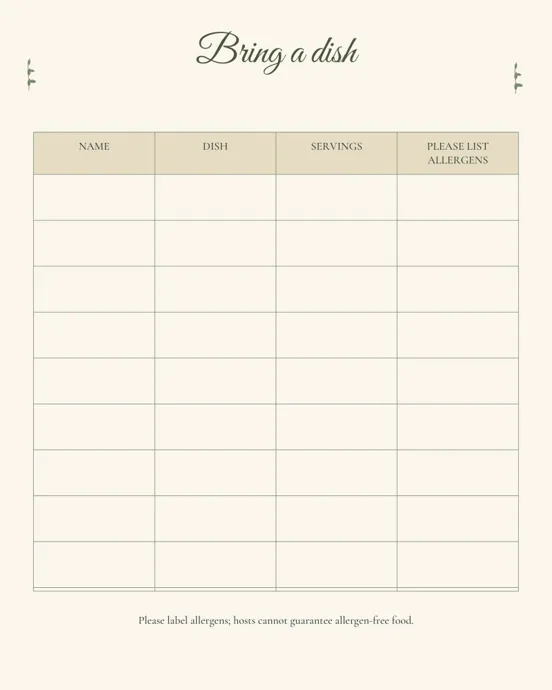
Split the budget before anyone spends. Decide what the shared pot covers (venue, main meat, paper goods, prizes) and what each household brings. A per-household share is easier to collect than a per-person one, and a potluck sign-up covers the sides.
Plan a family tree or photo wall. A long table or wall with a printed family tree, old photos and a sign-in form gives early arrivals something to do. Leave pens out so people can correct names and add birth dates. The corrections are often the best family history you’ll collect all year.
Print a schedule. A day schedule tells people when the games start, so the ones who want to play stay and the ones who want to sit know when to grab a chair. Keep it to four or five blocks.
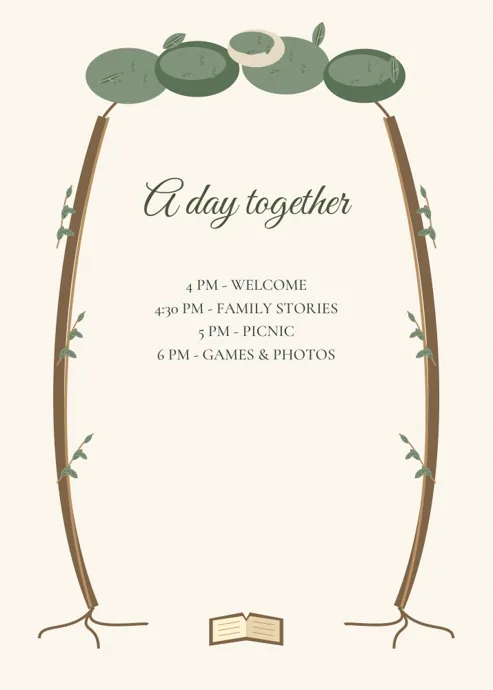
The organizer set we mentioned above also includes a lodging and directions card and the family information form, so the paperwork matches the invitation. Its 16 x 20 in welcome sign prints from a separate file, so send that one to a print shop instead of printing it on Letter paper.
Family reunion invitation wording
A family reunion invitation has more to say than a birthday invitation, because many guests travel. Make sure every invitation has:
- The family name and the word reunion (or get-together)
- Date, start time and, for a multi-day reunion, the end date
- Venue name and full address, plus a note on parking
- Who to RSVP to, how, and by what date
- What to bring (a dish, lawn chairs, old photos)
- Where to find lodging and the schedule, if those go on a separate card
Here are sample lines for different kinds of reunions. Swap in your family’s names and details.
Classic family reunion
“Together again! Join the Okafor family for our reunion picnic, Saturday, June 20, from noon until dusk at Riverside Park, Pavilion 3. Bring a lawn chair and a story. RSVP to Denise by May 30.”
Family tree theme
“Our roots run deep. Come meet the branches of the Delgado family at Grandma Lupe’s farm, July 11, 1 PM. Bring your favorite family photo for the memory wall. Reply to Tony by June 20.”
First reunion in years
“It’s been too long. Three generations of the Brennan family are getting together at the Elm Street Community Hall on August 8 at 2 PM. Dinner is on us; dessert is on you. Please let Kate know you’re coming by July 15.”
Potluck get-together
“A long table, good food and all of us around it. The Harris family get-together is Sunday, September 6, 3 PM, in Mark and Lisa’s backyard. Tell us your dish when you RSVP to Lisa by August 28.”
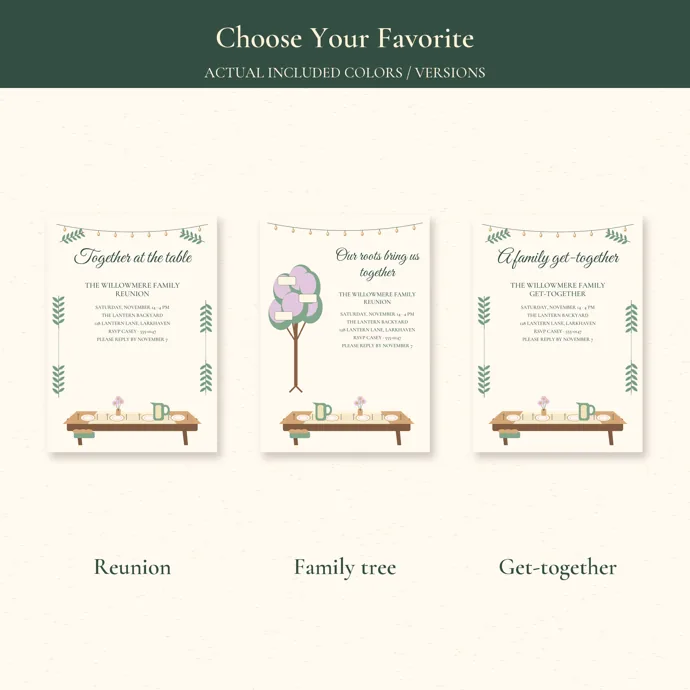
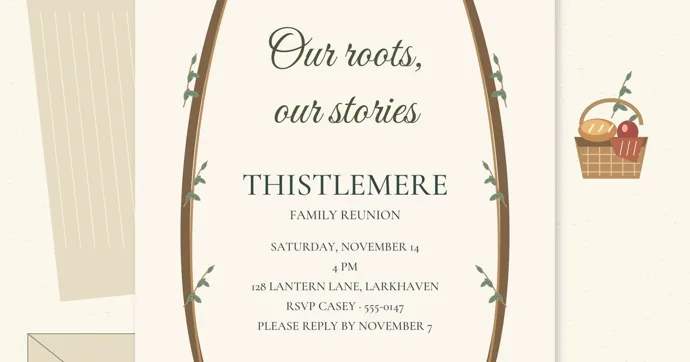
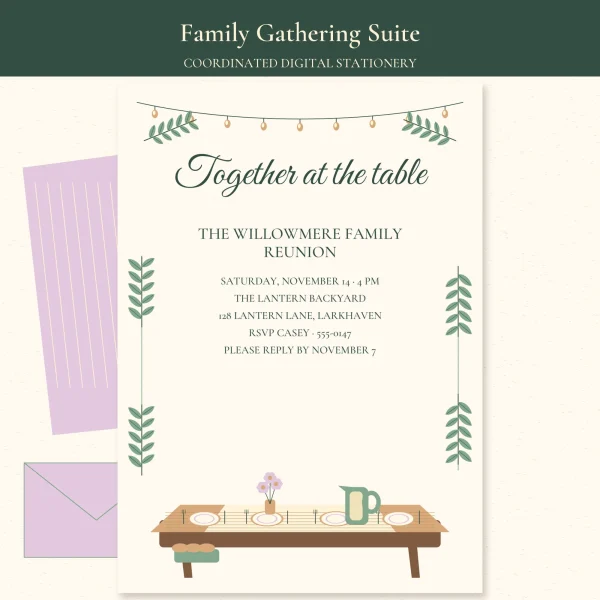
The family gathering invitation set carries these three fronts in Garden and Ocean colors, with a reply card that asks each guest which dish they’ll bring. Both of our reunion sets include matching Spanish versions, so a bilingual family can send each household the language it reads at home.
For more game ideas on the nights between reunions, our family game night ideas are sorted by the youngest player’s age.
Printables from this article
Related articles
Printable Invitations & Cards
Sweet 16 Wishes: What to Write in a 16th Birthday Card
A good sweet 16 wish names what sixteen actually brings, like a license, a first job or a later curfew, and says one true thing about the teen. Here are wishes sorted by who is signing the card, from parents to a coach, plus a section for boys and a list of lines to keep out of a post.
Printable Invitations & Cards
Happy Birthday Mom: Wishes, Messages & What to Write
What you write to your mom depends on who's holding the pen and where things stand between you. Here are birthday wishes for mom from daughters, sons and little kids, plus messages for a stepmom, a mother-in-law, a mom far away, a new mom's first birthday as a mom, milestone ages and a relationship that's complicated.
Printable Invitations & Cards
Birthday Wishes for a Friend: Best, Old and New Friends
A good birthday wish for a friend mentions something only the two of you share and points to the next time you'll see each other. Here's what to include for a best friend, an old friend, a new friend, a long-distance friend, a friend you just made up with and a group card, with sample wishes for each.