Best Outdoor Games for Kids and Families to Play Outside
The best outdoor games for kids are the ones that fit the group in front of you. Four preschoolers in a small yard need a short game with no one sitting out, like Duck, Duck, Goose. Twelve ten-year-olds in a park can handle Capture the Flag for an hour. Below are 18 outdoor games, grouped by age and space, with how many players each needs, what to bring, how a round goes and how it ends.
Start with the table, then jump to the group that matches your afternoon. You don’t need special equipment for most of these, and the few that do need something use ordinary household stuff you’ve probably got in a closet already, like chalk, a rope, old pillowcases or a flashlight.
Pick an outdoor game by age, group size and space
| Your situation | Games to try | Players | What to bring |
|---|---|---|---|
| Preschoolers in a backyard | Duck, Duck, Goose; What’s the Time, Mr. Wolf?; Mother, May I? | 5 or more | Nothing |
| A birthday with mixed ages | Pass the parcel on a blanket; sack race; egg-and-spoon race | 4 to 15 | Wrapped parcel, sacks or pillowcases, spoons |
| School-age kids in a big yard or park | Capture the flag; kick the can; freeze tag | 6 to 30 | Two flags or bandanas, an empty can |
| A driveway or playground blacktop | Four square; hopscotch | 1 to 8 | Chalk, a rubber playground ball, a small stone |
| Twenty minutes between food and cake | One-minute challenge relays | 2 to 20 | Socks, cups, a basket, printed cards |
| A summer evening | Flashlight tag; sardines | 4 or more | One flashlight |
| Grown-ups joining in | Tug of war; capture the flag | 6 or more | A thick rope |
| A walk, trail or farm visit | Nature scavenger hunt | 2 to 6 per list | Printed list, pencil, clipboard |
Two things matter more than which game you choose. Mark the boundaries before anyone runs, and decide what happens to a player who gets caught. Most outdoor games stall when the edges are fuzzy or when half the group is sitting out, and that boredom turns into frustration and arguments faster than any rule dispute.
Outdoor games for preschoolers and young kids, ages 3 to 6
Young kids do best with a game they can learn in one round, a grown-up who calls the turns, and a rule that brings caught players straight back in. Their attention and patience don’t last long. Plan 10 to 15 minutes per game and switch before interest drops, because a preschooler who’s bored will wander off to the sandbox and take two friends with them.
Duck, Duck, Goose
Players: 5 or more. Gear: none. Space: a patch of grass big enough for a circle.
Everyone sits in a circle facing in. One child walks around the outside, tapping each head and saying “duck.” On “goose,” the tapped child jumps up and chases the tapper around the circle. The tapper tries to sit in the goose’s empty spot before being tagged. If the tapper makes it, the goose becomes the new tapper.
A round ends when the tapper sits down or gets tagged, so there is no winner. Stop after everyone has been “goose” at least once. Some kids never get picked, so a grown-up can quietly suggest names to the tapper.
What’s the Time, Mr. Wolf?
Players: 4 or more. Gear: none. Space: a yard with a fence, a wall or a tree at one end.
One child is Mr. Wolf and stands at one end with their back to the group. The others line up at the far end and call out, “What’s the time, Mr. Wolf?” The wolf answers with a time, such as “five o’clock,” and everyone takes that many steps forward, counting aloud. When the wolf answers “dinner time!”, the wolf turns and chases. Everyone runs back to the starting line, which counts as safe.
The first child tagged is the next wolf. Harvard’s Center on the Developing Child recommends the game for building executive function skills in children aged 5 to 7, and it makes a good bridge between preschool circle games and real tag.
Red Light, Green Light
Players: 4 or more. Gear: none. Space: a long lawn or a quiet cul-de-sac.
One player, the caller, stands at one end facing away from the group. The rest line up at the other end. On “green light,” everyone moves toward the caller. On “red light,” the caller spins around and everyone must freeze. Anyone caught moving goes back to the start.
The first player to tag the caller becomes the next caller. Keep the field short for small kids, about the length of a backyard. On a long field, the slowest walker gets sent back three or four times and gives up.
Mother, May I?
Players: 3 or more. Gear: none. Space: any open stretch.
One player is “Mother” and stands at one end. The children line up at the other end and take turns asking, “Mother, may I take five giant steps?” Mother answers “Yes, you may,” or offers a different move, such as “No, but you may take three baby steps.” The child has to do whatever Mother says, even a step backward.
The first child to reach Mother wins and takes her place. Kids love inventing moves, so give them a few to start: frog hops, crab walks, twirls. Watch for one Mother who says “yes” only to a best friend. Swap Mother after every round.
Pass the parcel on a picnic blanket
Players: 4 to 15. Gear: a wrapped parcel, music from a phone or speaker. Space: a blanket in the shade.
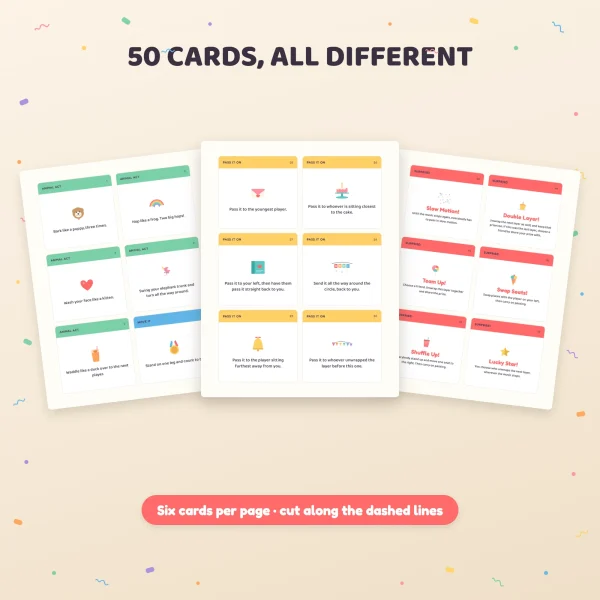
This one works as the cool-down between running games. Everyone sits in a circle on the blanket and passes a parcel wrapped in many layers while music plays. When the music stops, the child holding the parcel unwraps one layer. Our Pass the Parcel game puts a card in every layer, such as “Hop like a frog. Two big hops!” or “Pass it to the youngest player.” The child does the card and keeps the small prize from that layer.
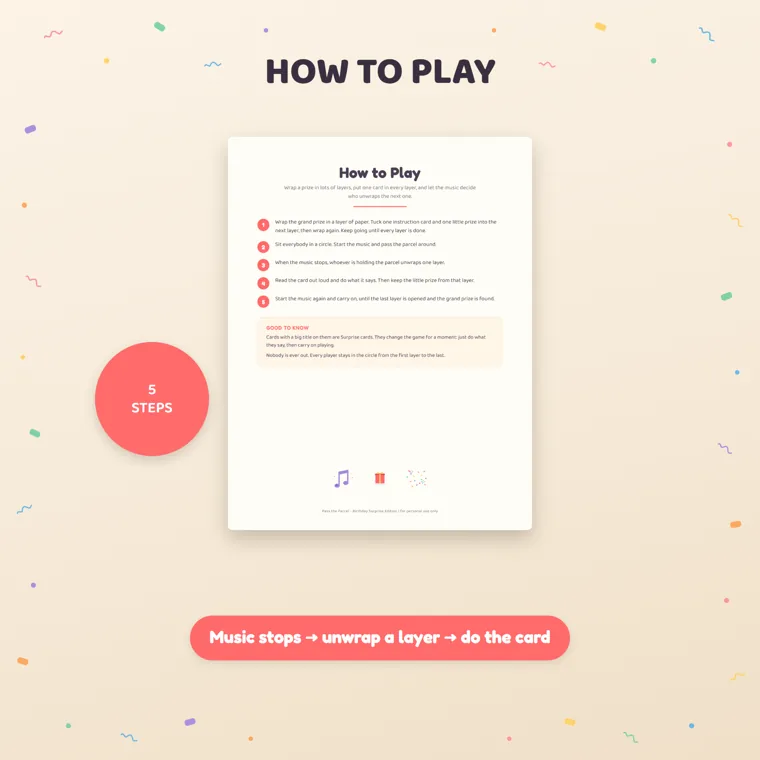
The game ends when the last layer opens and the grand prize comes out. The wrapping guide in the file says to use one layer per child, so everybody unwraps exactly once. Its music guide suggests a stop every 20 to 40 seconds and turning your back to the circle so you can’t see who has the parcel.
Outside, the wind is the problem. Tape each layer lightly, as the file suggests, but keep a bag on hand for torn paper so it doesn’t blow across the yard. The prize page also warns to leave out small parts and hard candies when children under three are in the group.
Running games for a backyard or park, ages 6 to 12
School-age kids want speed, teams and a way to get back into the game. Competition and fairness matter a lot at this age, and they’ll argue about a rule they didn’t hear explained. These six work in a big yard, a park or a schoolyard. Walk the boundaries with the group before the first round and name one “home” spot everyone can see.
Freeze tag
Players: 5 or more. Gear: none. Space: a yard with clear edges.
One player is “it.” Anyone tagged by “it” freezes on the spot. Any player still free can unfreeze a frozen player by touching them. The round ends when “it” has frozen everyone, or after a set time, such as three minutes.
Freeze tag fixes the biggest problem with plain tag: kids sitting out. With more than eight players, use two taggers. One tagger can’t freeze anyone faster than the others unfreeze them, and the tagger’s enthusiasm won’t survive five minutes of that.
Kick the can
Players: 3 to several dozen. Gear: an empty can, a bucket or a plastic pail. Space: a yard with hiding spots, or a cul-de-sac.
Put the can in the open. “It” covers their eyes and counts while everyone hides. “It” then hunts for players and tags them, and tagged players wait in a “jail” area within sight of the can. Any free player who sneaks in and kicks the can sets everyone in jail free, and “it” has to stand the can back up before carrying on.
The round ends when “it” has caught everyone. A common rule makes the player who has been in jail longest the next “it.” Agree on which yards and driveways are off limits before anyone hides. Use a plastic pail instead of a metal can if little kids are playing in sneakers or bare feet.
Capture the flag
Players: 8 to 30, in two teams. Gear: two flags, such as bandanas or T-shirts, and cones or sticks for a center line. Space: a field you can split in half.
Split the field into two territories, and each team hides or places its flag on its own side. Players try to cross into the other territory, grab the flag and carry it home without being tagged. On your own side you are safe. On the other side you can be tagged and sent to the other team’s jail. A teammate can free you by tagging you in jail.
The game ends when one team carries the other team’s flag back across the center line. Teams of six or more need a time limit on jail, such as three minutes, or the game freezes with half the players in jail. Wikipedia’s account of the game lists that three-minute rule as one common version. For a night game, glow sticks or a lantern make good flags.
Sardines
Players: 5 or more. Gear: none. Space: a yard with a few good hiding places.
Sardines is hide-and-seek turned inside out. One player hides while everyone else counts. Each seeker who finds the hider squeezes in and hides with them, so the hiding spot gets more and more crowded.
The round ends when the last seeker finds the pile, and that player hides next. It’s quieter than tag, so it works late in the party. Keep it outside the house and set clear limits, such as “not past the fence, not in the shed,” so no one hides somewhere unsafe.
Four square
Players: 4 at a time, plus a waiting line. Gear: a rubber playground ball, sidewalk chalk. Space: a driveway or blacktop.
Chalk a big square and divide it into four boxes, numbered 1 to 4. The player in square 4 serves by bouncing the ball into another square. Whoever’s square it lands in has to hit it with their hands into another square after one bounce. A player is out after missing, letting it bounce twice, or hitting it out.
The player who is out goes to the back of the line, everyone moves up a square, and the next in line steps into square 1. No one is out for long, which is why four square works on school playgrounds. Settle “is that on the line?” before the first serve.
Hopscotch
Players: 1 to 6. Gear: chalk and a small flat stone or bean bag. Space: a driveway or sidewalk.
Chalk a court of numbered squares, with single squares in a row and some pairs side by side. Toss the marker into square 1. Hop through the court, one foot on single squares and two feet on side-by-side squares, skipping the square with the marker. Turn at the end, hop back, and pick up the marker on the way. Then toss it into square 2.
Stepping on a line, missing a square or losing balance ends your turn. Next turn, you start where you left off. The first player to finish every number wins. For kids under five, skip the marker and just hop the court.
Races and relays for birthdays and field days
Races give every child a turn and a clear finish. Set the start and finish lines with chalk or a rope, and run heats of four or five so the slowest kids aren’t always last in a field of twenty. For more yard races at a party, see backyard birthday party games.
Sack race
Players: 2 or more. Gear: one sack per racer, such as burlap sacks or old pillowcases. Space: soft grass.
Each racer stands inside a sack, holds it up at the waist and hops from the start line to the finish. The first across wins.
Run it on grass, not pavement, because kids do fall. Pillowcases are fine for small kids, but older kids need a longer sack or they trip on the hem.
Egg-and-spoon race
Players: 2 or more, alone or as relay teams. Gear: a spoon and an egg for each racer. Space: a straight lawn.
Each racer balances an egg on a spoon and walks or runs to the finish. If the egg falls, the racer stops, puts it back and carries on from that spot. Teams can run it as a relay, passing the spoon.
Use hard-boiled eggs or plastic eggs for younger kids. With raw eggs and eight-year-olds, someone’s going to be cleaning shoes, and the concentration on their faces is half the entertainment anyway.
Three-legged race
Players: pairs. Gear: a scarf, bandana or soft strap for each pair. Space: grass.
Partners stand side by side, and you tie the left leg of one to the right leg of the other, just above the ankle. Pairs race to the finish line.
Pairs work best when the two kids are close in height. Give them one practice walk and a count, “tied leg, free leg,” before the real race. It’s really a cooperation game, and the pairs that talk to each other usually beat the pairs that sprint.
One-minute challenge relays
Players: 2 to 20. Gear: printed challenge cards and household odds and ends. Space: a lawn or patio with a table nearby.
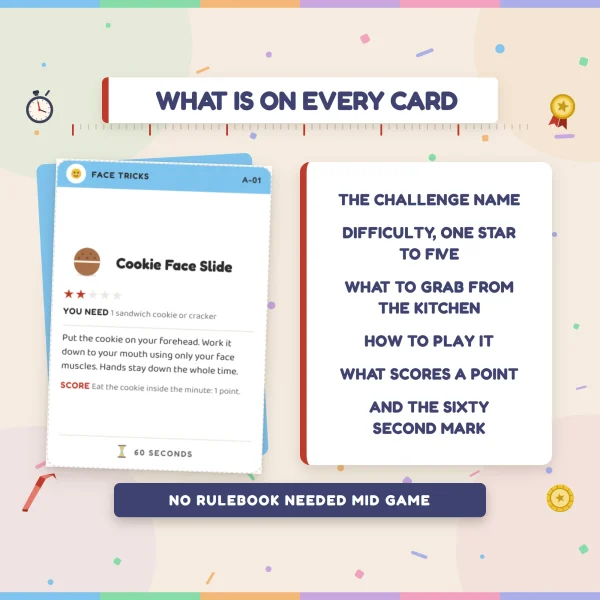
One-minute challenges are short tasks that each last 60 seconds. Our One Minute Challenge Party Games deck has 60 cards in six groups. It was written for a table and some open floor, but the Move It and Team Play groups carry outside well.
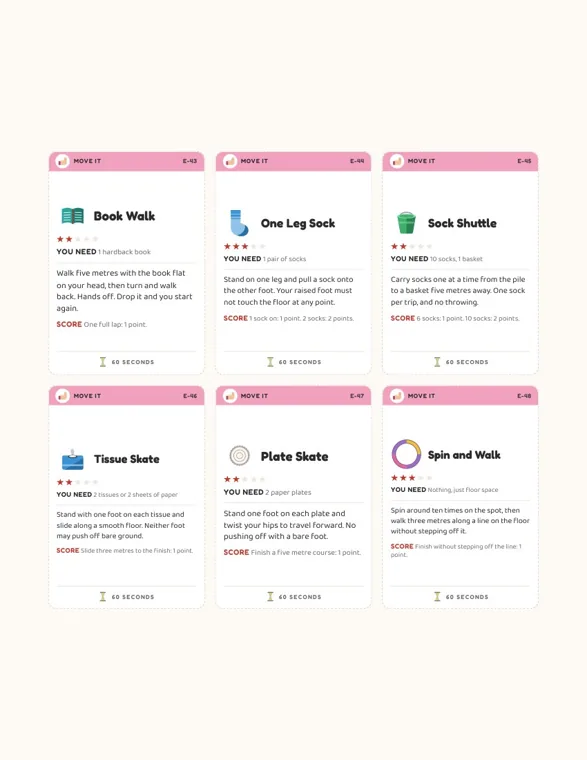
These cards make good outdoor relays:
- Sock Shuttle (E-45): carry ten socks one at a time to a basket five meters (about 16 feet) away, no throwing.
- Book Walk (E-43): walk five meters with a hardback book flat on your head and back again.
- Spin and Walk (E-48): spin ten times, then walk three meters (about 10 feet) along a line. On grass, lay a rope as the line.
- Pass the Water (E-50): a team card where each player holds a cup in their teeth and pours into the next player’s cup. The spills land on the lawn instead of your floor.
- Coat Relay (F-54): each player puts on an oversized jacket, takes it off and hands it down the line.
- Back to Back (F-57): two players squeeze a balloon between their backs and walk three meters and back.
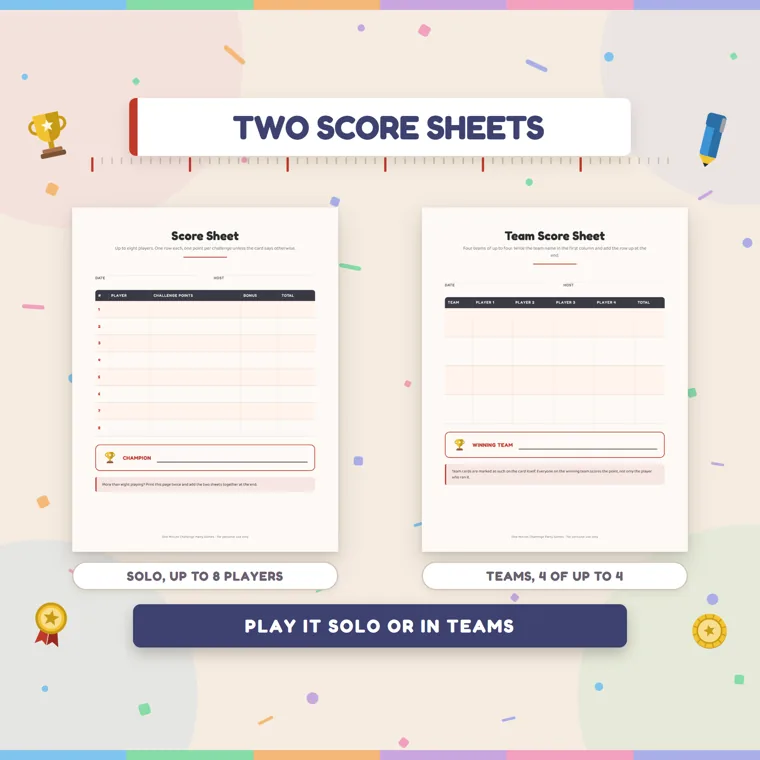
Leave out Tissue Skate and Plate Skate, which need a smooth floor. Leave out most balloon cards on a windy day too. The deck’s rules say six players is the sweet spot and twenty still works. Teams play on the team score sheet, four teams of up to four.
For under-eights, the Get Ready page suggests letting them stand closer and counting a near miss as a hit. Pick up every piece of a popped balloon from the grass right away. Torn balloon scraps are a choking risk for small children. More table and floor versions are in one-minute party game ideas.
Outdoor games for families and adults
When grown-ups play, the games can get bigger and the field longer. These two need adults, and both are better with them.
Tug of war
Players: 6 or more, in two even teams. Gear: a thick, soft rope, with a ribbon tied at the middle. Space: grass, with room behind both teams.
Mark a center line on the ground. Each team grips its end of the rope, with the ribbon over the line. On “pull,” both teams pull until the ribbon crosses into one side by an agreed distance. Best of three pulls wins.
Wikipedia’s account of the sport notes injuries to fingers and hands when ropes snap or slip, so set one rule: never wrap the rope around a hand or wrist. Mix adults and kids on both teams, and put the strongest pullers at the back, not the front.
Flashlight tag
Players: 4 or more. Gear: one flashlight. Space: a yard you know well in daylight.
Play it at dusk. “It” holds the flashlight and counts while everyone hides. Instead of tagging by hand, “it” tags by shining the beam on a player and calling their name. Tagged players come to a lit porch or a set “home” spot.
The last player found becomes the next “it.” Walk the yard before dark and move the hose, tools and toys someone could trip over. Kids who are scared of the dark can hold the flashlight first.
Capture the flag also works as a family game, with adults spread across both teams. For more ways to get kids playing away from screens, try these screen-free activities for kids.
A nature scavenger hunt for a slower walk
A scavenger hunt fits the moment when running games have worn everyone out, or when you’re on a trail where running isn’t safe. Each child gets a list and checks off what they spot.
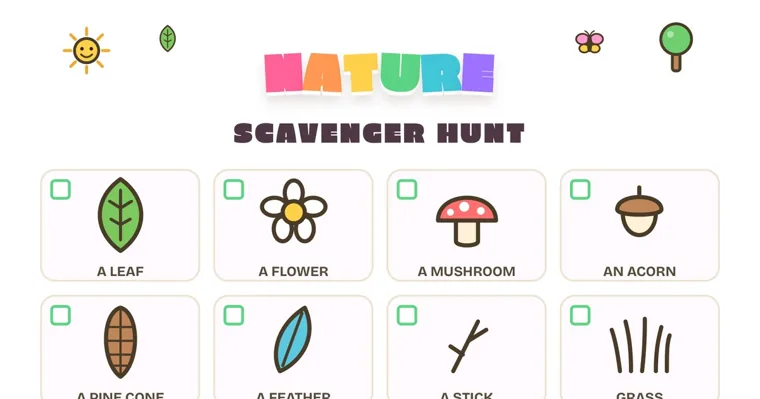
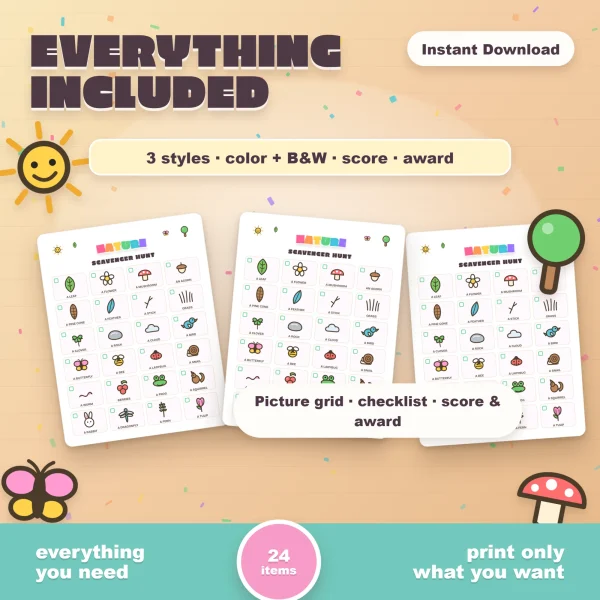
Our Nature Scavenger Hunt has 24 things to find, each shown as a small picture with its name, so kids who can’t read yet can still play. The file lists it for ages 3 and up and 2 to 6 players. The score page splits 20 of the items into common finds worth 1 point, such as a leaf or a rock, and rare finds worth 5, such as a feather or a frog.
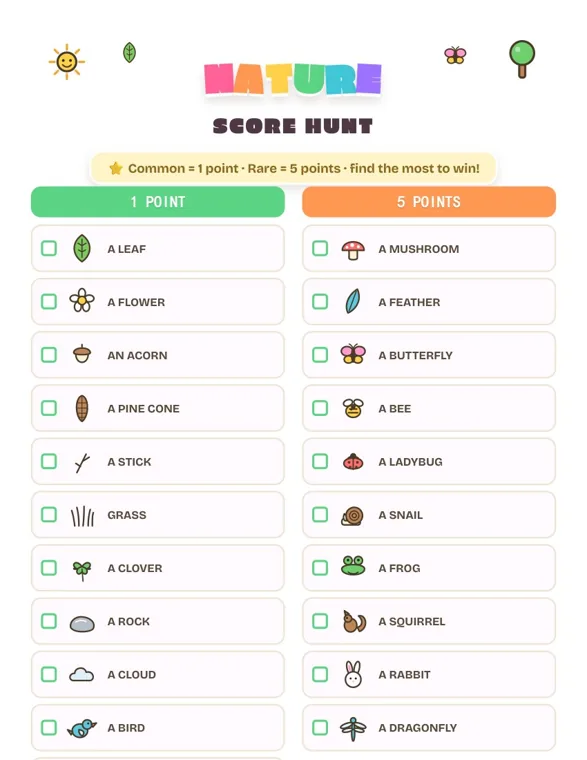
The hunt ends when time is up or someone checks every box, and the last page is an “I Did It! Nature Explorer” certificate. Teach the look-only rule before you start. Bees, frogs and berries are things to spot, not touch or pick, and berries on the list are never for tasting.
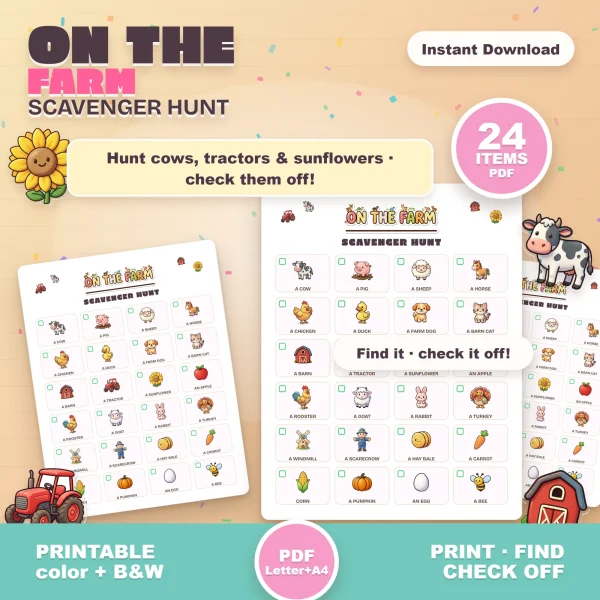
Visiting a farm? The Farm Scavenger Hunt swaps in a tractor, a scarecrow and farm animals. For seasonal lists, a preschool version and more scoring ideas, see nature scavenger hunt ideas.
When outdoor games go wrong
Most problems outside come from a few predictable things. You can head off nearly all of them before the first round, with about two minutes of explanation and a quick walk around the edges.
- Kids who are out stand around. Use rules that bring them back: unfreezing in freeze tag, a three-minute jail in capture the flag, the moving line in four square. In pass the parcel, nobody is ever out.
- Arguments about the edges. Walk the boundaries with the whole group and point to every edge. A rope, cones or chalk ends most “I was in!” fights.
- One child is always “it.” Rotate on a rule everyone hears up front, such as “the first one tagged is next,” and stick to it.
- Hot afternoons. Keep running games short, put the water and a shady blanket at “home,” and alternate a running game with a sitting one like pass the parcel.
- Mixed ages in one game. Pair older kids with younger ones as teammates instead of rivals. In races, run the heats by size.
A good outdoor afternoon usually runs in a loop. Start with a big running game while everyone’s energy is high, slow down with a sitting game when the faces get red, and finish with a race or a hunt that ends with a clear winner, a little celebration and a snack before anyone’s tired enough to cry.
Printables from this article
Related articles
Printable Party Games
New Year’s Eve Party Ideas: Themes, Food & a Night at Home
Choose the kind of New Year's Eve party first, then pick a theme, a timeline that ends where your guests will, food that can sit out for hours, and a countdown that fits the youngest person in the room.
Printable Party Games
Christmas Pajama Party Ideas: Invitation, Food & Games
Pick the kind of Christmas pajama party first, then send an invitation that says pajamas and pickup time, plan food and a simple timeline for that group, and end with bedtime, breakfast or a thank-you card.
Printable Party Games
Western Party Ideas: Cowboy Theme Food, Games and Decor
Pick the western party that fits your crowd first: a 90-minute cowpoke birthday for preschoolers, a two-hour cowgirl or rodeo party for older kids, an evening barbecue and line dance for adults, or a western day at school. Each plan below covers guests, timing, decor, food, games and how to wrap up.