Construction Vehicles: Names, Types and What Each One Does
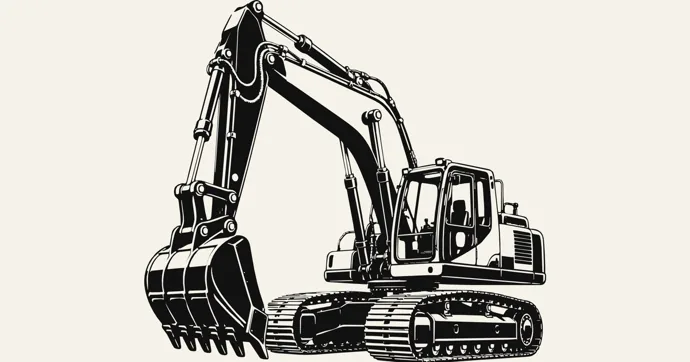
Construction vehicles are the heavy machines that dig, push, scoop, carry, mix, lift and flatten material on a building or road job, and almost every one is named for that job.
One part usually gives each machine away. A bucket on a long bending arm means an excavator. A wide blade across the front means a bulldozer. A box that tips up means a dump truck, and a big turning drum means a concrete mixer.
Below is a quick table of 12 construction vehicle names, then a closer look at each one grouped by the work it does. After that come the look-alikes kids mix up, three name games for home or a classroom, and how to watch a real worksite without getting too close.
Construction vehicle names at a glance
Use this table when a child points and asks “what’s that one?” The middle column is the clue to look for on the real machine. The picture cards under it are clipart, simple drawings made for printing, and what clipart is explains the file types they come in.
| Name | How to spot it | Its job | Where you’ll see it |
|---|---|---|---|
| Excavator | Long arm with a bucket; the cab turns on top of tracks or wheels | Digs holes and trenches, loads trucks | Building sites, pipe and road work |
| Bulldozer | Wide metal blade across the front, usually on tracks | Pushes dirt, sand, rubble or snow | New roads, land clearing |
| Backhoe loader | A bucket on the front and a digging arm on the back | Small digging and loading jobs | Street repairs, small building jobs |
| Wheel loader | Big front bucket on lifting arms, four large tires | Scoops material and drops it into trucks | Gravel piles, road jobs |
| Skid steer | Small and boxy, with lift arms beside the cab | Carries and loads in tight spaces | Backyards, small sites |
| Dump truck | Open box bed that tips up at the front | Carries dirt and gravel, then dumps it | Almost every big job |
| Concrete mixer truck | Large drum on the back that turns | Mixes and delivers concrete | Foundations, sidewalks |
| Road roller | Huge smooth drum where a wheel would be | Presses soil, gravel or asphalt flat | New roads, parking lots |
| Motor grader | Long, low machine with a blade under its middle | Scrapes the ground flat and even | Road building |
| Mobile crane | Long boom with a hook, on a truck or tracks | Lifts heavy loads | Tall buildings, bridges |
| Forklift | Two flat prongs on an upright mast | Lifts and moves pallets short distances | Warehouses, factories |
| Tractor | Built to pull, often with big rear wheels | Pulls trailers and machinery | Farms, some construction work |
Digging and pushing construction vehicles: excavator, bulldozer and backhoe
These three machines move the ground itself. They are the ones children usually name first, and the ones they mix up most.
Excavator
An excavator has three parts in a row: a boom, a shorter arm called the stick, and a bucket with teeth at the end. The cab sits on a platform that spins all the way around, so the machine can dig on one side and drop dirt on the other without driving. Underneath are tracks or, on some models, wheels.
Kids like this detail: a modern excavator digs by pulling its bucket back toward itself.
Look for one wherever a hole or trench is being dug, from house foundations to water pipes under a street.
Bulldozer
A bulldozer is a big tractor with a flat metal blade across the front, and its job is pushing. It shoves dirt, sand, rock, rubble and even snow. Most bulldozers ride on tracks, which keep them from sinking on soft or steep ground.
Some also carry a ripper at the back, a large hook that drags through hard ground to loosen it. You’ll see them clearing land and shaping new roads.
Backhoe loader
A backhoe loader is two machines in one: a loader bucket on the front and a small digging arm, the backhoe, on the back. It’s smaller than an excavator and drives on four tires, so it can travel down a street to the next job. That is why you see backhoes on city road repairs and small building projects. People in the trade often just call it a backhoe.
Loading and hauling construction vehicles: wheel loader, skid steer and dump truck
Once the ground is dug or pushed, something has to pick it up and take it away. That is the work of the next three.
Wheel loader
A wheel loader has a wide bucket on two lifting arms at the front and rides on four large tires. It scoops up soil, rock or sand and lifts it into another machine, most often a dump truck. It goes by many names, including front loader, front-end loader, bucket loader and payloader, so don’t be surprised if a book uses a different one.
Skid steer
A skid steer is the small, boxy loader you’ll spot in backyards and tight spaces. Its wheels don’t turn left and right. Instead, the wheels on one side spin faster than the other, or in the opposite direction, so the machine skids around. It can turn around in its own length. The lift arms take a bucket or many other tools, which makes it a handy helper on small jobs.
Dump truck
A dump truck carries loose material such as dirt, gravel or broken-up concrete. Its open box is hinged at the back. When the front of the box lifts, the load slides out onto the ground behind the truck. On a parked dump truck, kids can find the hinge at the back of the box, the spot the whole load tips over.
Road and building construction vehicles: mixer, roller, grader and crane
These four show up when a road or a building is going in. Each one does a single job that no other machine on the list can.
Concrete mixer truck
A concrete mixer combines cement, sand or gravel and water into concrete, using a drum that turns. On a mixer truck, that drum rides on the back, so the concrete arrives ready to pour. Ask your child to watch whether the drum is turning when the truck goes by. Look for mixer trucks at new foundations, driveways and sidewalks.
Road roller and motor grader
A road roller swaps a wheel for a huge, heavy drum. It rolls back and forth to press soil, gravel or fresh asphalt flat and hard. Many people call any road roller a steamroller, even though modern ones don’t run on steam.
A motor grader comes before the paving. It’s long and low, with steering wheels at the front, a long blade slung underneath the middle, and the cab and engine over the back wheels. The blade scrapes the ground into a smooth, even surface. Blades on big graders can be up to 24 feet (7.5 m) wide.
Mobile crane
A mobile crane is a crane that drives to the job. It sits on a truck-style carrier or on tracks, with a long boom that slides out in sections and a hook hanging from a cable. It lifts steel beams, roof parts and other loads too heavy for anything else, then folds up and drives away.
Forklifts and tractors: two more vehicles kids add to the list
Forklifts and tractors are not construction vehicles in the strict sense, yet they turn up in almost every vehicle book. Children ask about them alongside the excavator.
Forklift
A forklift lifts and moves loads over short distances. You can spot it by the two flat prongs, the forks, on an upright frame called the mast. The forks slide under a pallet, lift it and carry it to a shelf or a truck. Most forklifts work in warehouses and factories, and some people call them lift trucks or hi-los.
Tractor
A tractor is built to pull. It delivers lots of pulling power at slow speeds, so it can haul a trailer or drag farm machinery behind it. Most tractors work on farms, but they also show up in mining and construction.
A tractor with a bucket on the front can look a lot like a loader. On most farm tractors, the back wheels are much bigger than the front ones, which helps tell them apart.
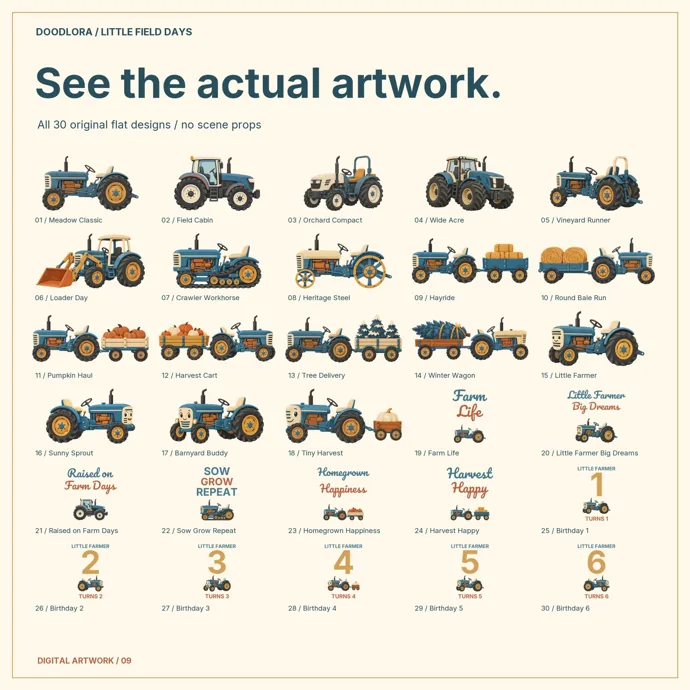
If your child loves farm machines more than worksite ones, our farm activities for preschool have games and a pumpkin patch hunt with a tractor in them.
Telling look-alike construction vehicles apart
A few pairs trip up kids and grown-ups alike. Each one has a single clue that settles it.
- Bulldozer or wheel loader? The bulldozer’s blade is a flat plate that pushes. The loader’s bucket is a scoop that carries. People often call a loader a bulldozer, but the name strictly belongs to the pusher.
- Excavator or backhoe loader? An excavator has one big arm and a cab that turns all the way around. A backhoe loader has a bucket on the front, a smaller arm on the back, and four tires.
- Dump truck or concrete mixer truck? A dump truck has an open box. A mixer truck has a closed, round drum that turns.
- Road roller or motor grader? The roller has a drum. The grader has a blade under its middle and wheels at both ends.
Pictures in books and clipart are simplified, so treat them as name cards, not as a guide to a real machine’s size or model. On a real machine, go by the clues above.
Teaching kids construction vehicle names: three games for home or class
The games below build from naming to sorting to spotting real machines outside. Each one suits a single child at a kitchen table or a small group at school.
Name-and-point cards (ages 2 to 4, about 10 minutes)
You need: six to eight vehicle pictures printed on card stock, cut into cards by an adult.
Lay out three cards. Say each name with its job word: “excavator, digs.” Then ask, “Where’s the one that digs?” and let your child point. Swap in a new card when they get the first three right. To finish, have them hand you each card as they say its name. Keep it to three cards at a time for two-year-olds. More than that turns into guessing.
Match the machine to its job (ages 4 to 7, 15 to 20 minutes)
You need: the vehicle cards, plus seven word cards reading DIG, PUSH, SCOOP, CARRY, MIX, LIFT and FLATTEN.
Spread the job cards in a row. Kids take turns drawing a vehicle card and placing it under its job, then saying why: “Dump truck goes under CARRY because the box holds dirt.” In a class of 20, run it at a table with four to six children while the rest draw. The game is done when every vehicle has a home.
Expect one argument. The backhoe loader fits DIG and SCOOP, and the excavator also loads trucks. Accept either answer if the child can name the part that does the job. That reasoning is the whole point.
Construction vehicle spotting walk (ages 3 to 8, 20 to 30 minutes)
You need: a tally sheet with small pictures of six to eight vehicles and a box beside each, a clipboard and a pencil.
Walk a route that passes a worksite, a road repair or a busy loading dock. Each time a child spots a machine on the sheet, they make a mark in its box. Back home or in class, count the marks and talk about which machine you saw most.
To finish, let each child draw their favorite. Our step-by-step fire truck drawing uses the same box-and-wheels start that works for a dump truck. If you’re building a whole community helpers unit, the construction worker tool belt craft pairs well with the walk.
Watching construction vehicles safely from the sidewalk
Big machines are a great show, but the people driving them often can’t see small children. Even teenagers in construction safety training are taught to stay away from the blind spots of heavy equipment, according to the youth training pages from Cal/OSHA, California’s workplace safety agency. A child at a fence is easy for a driver to miss.
A few rules keep the watching fun:
- Stay outside the fence, cones or barrier tape, even when the machines are parked and the site looks empty.
- Hold hands near the gate or driveway, where trucks pull in and back out.
- Stand back far enough that your child can see the whole machine, not just its tires.
- Don’t wave a driver over or try to get their attention. Wave from where you stand if they wave first.
Printing construction vehicle pictures for cards and classrooms
Any clear pictures work for the games above. Ours come from four clipart sets, and each one adds different machines to the card pile.
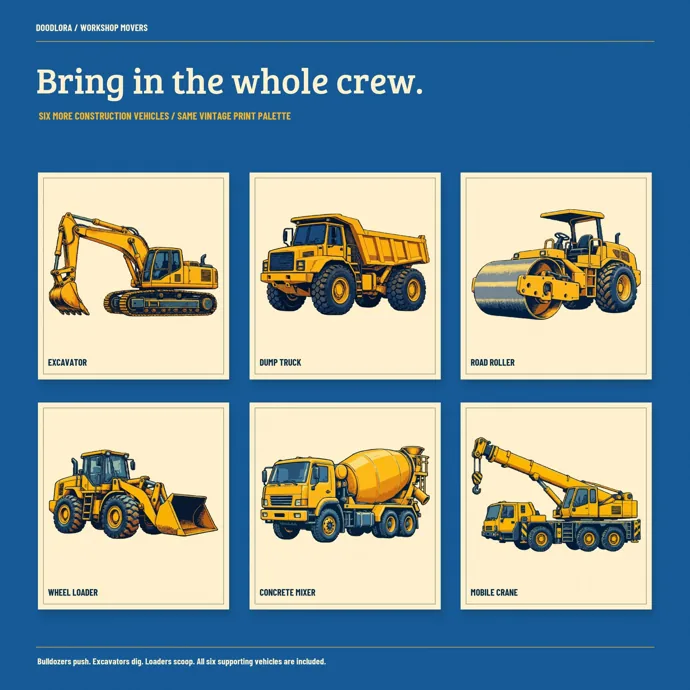
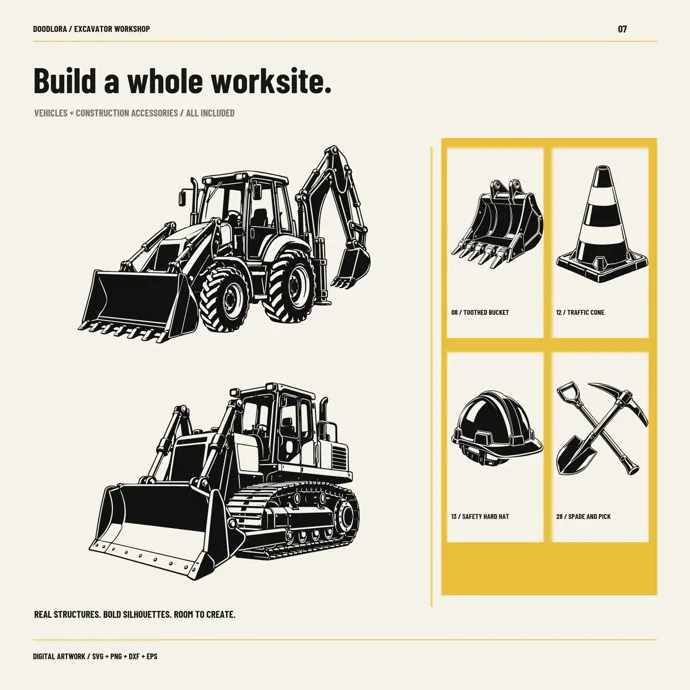
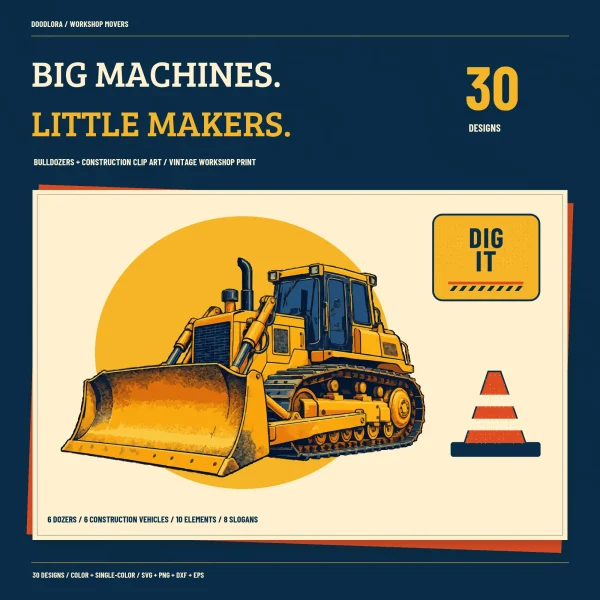
- Construction Clipart has six bulldozers from different sides and six other vehicles: an excavator, dump truck, road roller, wheel loader, concrete mixer and mobile crane. Ten worksite pieces such as cones and a hard hat make good extra cards.
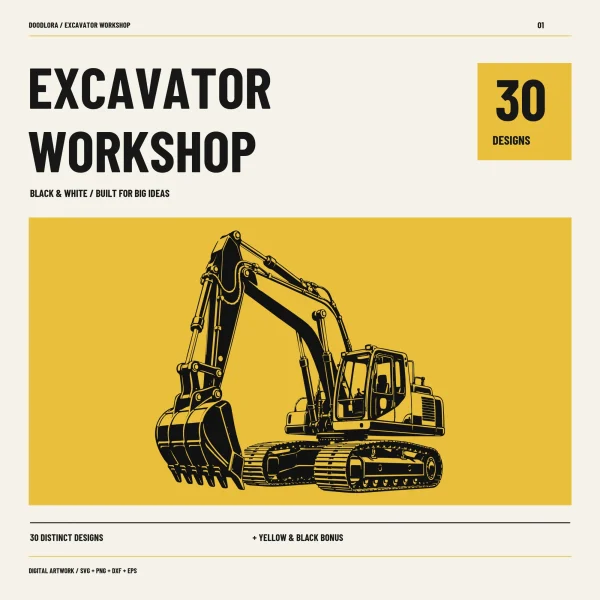
- Excavator Clipart is black and white, with many excavators plus a backhoe loader, a crawler dozer and a tipper truck. Line art like this is easy to print and color in.
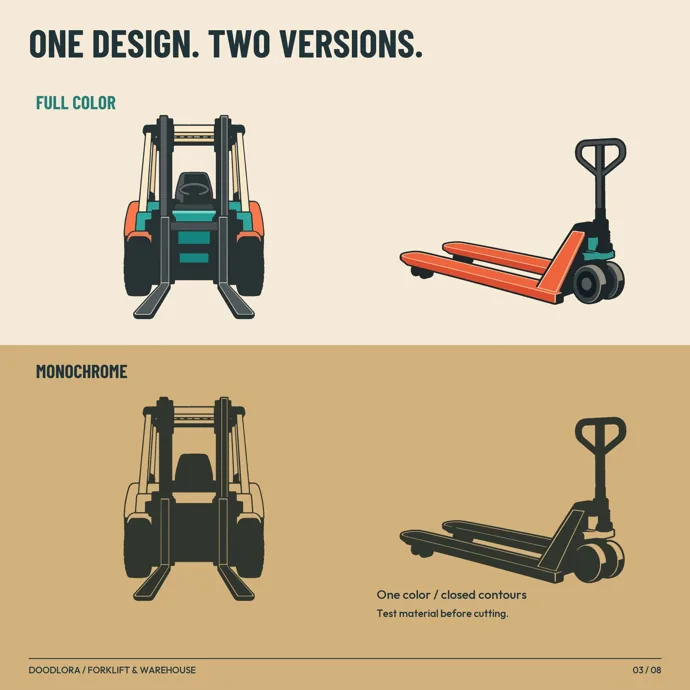
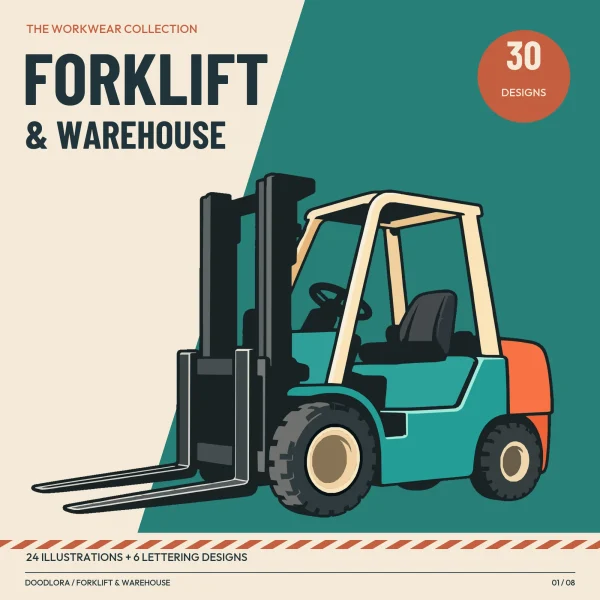
- Forklift Clipart has 12 forklifts and stackers and two pallet jacks, if your child is into warehouses.
- Tractor Clipart has eight working tractors and six pulling wagons.
For cards, use the PNG files, sized to about 3 by 4 inches each so four fit on a letter page. Our guide to how to use clipart walks through print size and when to pick PNG or SVG. A classroom set is fine too: our personal license lets a teacher print copies for their own class.
Printables from this article
Related articles
Clipart & SVG Cut Files
How to Draw a Truck: Easy Pickup, Big Rig and Cartoon
Split a pickup into three parts before you draw a single wheel: a bed, a cab and a hood. Keep the roof about 2.2 wheels tall and the bed rail level with the hood, and the truck looks right even before the details go on.
Clipart & SVG Cut Files
How to Draw a Train: Steam Engine, Cars and Tracks
Split the page into a 10-square grid, lay a long boiler tube across the middle, set a box cab at the back and a tall stack at the front, hang two big driving wheels under the cab end, then couple cars behind and run the rails to a vanishing point.
Clipart & SVG Cut Files
Hawk vs Falcon: Wings, Size, Hunting Style and Eagles
A falcon has long, narrow wings that taper to sharp points and flies on steady, quick wingbeats; a hawk has broader wings with rounded tips and either soars in slow circles or flaps hard and glides. Falcons kill with a notched beak and hawks with their talons, and eagles are the largest, heaviest-billed members of the hawk family.