Bobcat vs Lynx: Tail, Ear Tufts, Paws and Size Compared
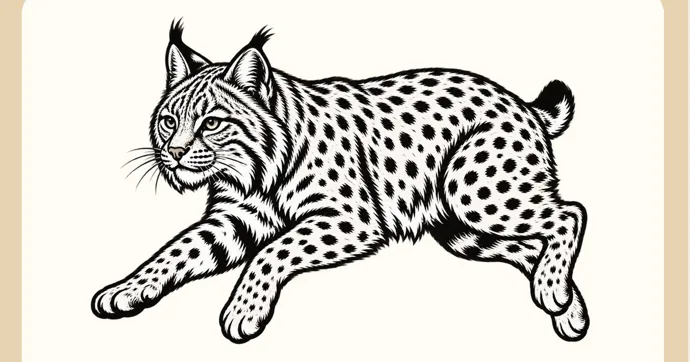
Check the tail first. A Canada lynx’s stubby tail has a tip that is solid black all the way around, while a bobcat’s tail is black only on top near the end and white underneath. Then look at the ears, where a lynx carries black tufts about an inch and a half long and a bobcat’s tufts are short. The feet come next: a lynx walks on huge, fur-covered paws at least twice the size of a bobcat’s, and its long hind legs give it a stooped, rear-high look. Last, think about where you are. Bobcats live across nearly all of the lower 48 states, but Canada lynx in the U.S. are limited to cold northern forests in Alaska, the Northwest, the northern Rockies, the Great Lakes edge and northern New England.
Both cats belong to the same genus, Lynx, so a bobcat is a kind of lynx, just a different species from the Canada lynx. In North America, “lynx” on its own almost always means the Canada lynx. The tail, feet and range are the reliable checks, and the coat and size are the ones that fool people.
Tail, ears, feet, legs and coat: what to look at
Use at least two of these before you decide. A single feature can mislead in a dim trail-camera frame, a snowy photo or a quick look at a cat crossing the road. Copied onto an index card, the five checks below also make a handy clue sheet for a nature scavenger hunt in northern woods.
The tail tip
The Vermont Fish & Wildlife Department puts the tail difference this way: a lynx’s tail looks about the same from above and below, and the tip is completely black all around. A bobcat’s tail has black bars on top and a lot of white underneath. Oregon’s wildlife department describes the bobcat tail the same way, white underneath and black-tipped, sometimes with a few blackish bars near the tip. So a bobcat seen from behind, with the tail flicked up, can look white-tipped, and a lynx never does.
Ear tufts and the backs of the ears
Every lynx species has black tufts on the ear tips, which is why tufts alone don’t settle it. Wikipedia gives a Canada lynx’s tufts as about 1.5 inches (4 cm) long. A bobcat’s tufts are short and, as Wikipedia notes, hard to pick out at even moderate distance. The backs of the ears help in a close photo. A bobcat’s are black with a large white spot, according to Oregon’s and New York’s wildlife agencies, and a Canada lynx’s are brown with a silvery-gray spot in the middle.
Feet and legs
A lynx’s feet are snowshoe-like and at least twice the size of a bobcat’s, the Vermont department says. Its hind legs are disproportionately long, which gives it a stooped appearance, with the back sloping down toward the shoulders. New York’s Department of Environmental Conservation (DEC) describes the bobcat the other way around: paws in proportion to its body, shorter legs and a stockier build. The San Diego Zoo adds one detail you’d only see up close, which is that a lynx has fur on the soles of its feet and a bobcat doesn’t.
Coat color and spots
Lynx fur is relatively bland and grayish, while bobcat fur is reddish brown with more distinct spots and streaks, per Vermont’s page. Wikipedia describes the Canada lynx’s coat as yellowish brown with little to no marking except underneath, and the bobcat’s as tan to grayish brown with black streaks and dark bars on the forelegs and tail. Treat this as a supporting clue only. New York’s DEC points out that most bobcats in that state have faint or indistinct spots, and Oregon’s notes that bobcat coats range from blonde to reddish to charcoal gray.
Bobcat vs Canada lynx comparison chart
Size is the weakest clue, and the ranges below show why: the weights overlap almost completely. Metric figures come from Wikipedia’s species pages, with the inch and pound conversions rounded.
| Bobcat | Canada lynx | |
|---|---|---|
| Tail tip | Black on top, white underneath | Black all the way around |
| Tail length | 3.5 to 8 in (9 to 20 cm); New York’s DEC gives 5 to 6 in | 2 to 5 in (5 to 13 cm) |
| Ear tufts | Short, hard to see from a distance | About 1.5 in (4 cm) |
| Back of the ear | Black with a large white spot | Brown with a silvery-gray spot |
| Feet | In proportion to the body, no fur on the soles | At least twice as big, furred soles |
| Legs | Shorter, stocky build | Long hind legs, stooped look |
| Coat | Tan, reddish or grayish brown, often spotted and streaked | Grayish or yellowish brown, few markings |
| Height at the shoulder | 12 to 24 in (30 to 60 cm) | 19 to 22 in (48 to 56 cm) |
| Weight, males | 14 to 40 lb (6.4 to 18.3 kg) | 13 to 37 lb (6 to 17 kg) |
| Weight, females | 9 to 34 lb (4 to 15.3 kg) | 11 to 26 lb (5 to 12 kg) |
| Track length | 1 to 3 in, about 1.75 in on average | 3 to 3.75 in in dirt, about 4.5 in in snow |
| Main food | Rabbits and hares, rodents, birds, deer | Snowshoe hare |
| Range | Southern Canada to southern Mexico | Canada, Alaska and pockets of the northern U.S. |
Why weight won’t settle it
Wikipedia’s Canada lynx article says the bobcat is generally the smaller cat, but where the two live side by side, bobcats tend to be larger and can still be mistaken for lynx. New York’s DEC gives average weights of 21 pounds for male bobcats and 14 pounds for females, both inside the lynx range. A long-legged lynx in thick winter fur also looks bigger than it weighs. Go back to the tail tip and the feet whenever size is the only thing you have.
Where bobcats and Canada lynx live
Bobcats: almost everywhere south of the snow
The bobcat’s historical range ran from southern Canada through the whole United States and into Mexico as far as Oaxaca, and Wikipedia reports that by 2010 bobcats were found in every contiguous state except Delaware. They use forests, swamps, deserts, farm edges and rocky ledges, and they can turn up in backyards where houses meet wild land. In Illinois, the Forest Preserve District of Will County notes that the bobcat is the only wild cat in the state, so a short-tailed wild cat seen there is a bobcat.
Canada lynx: deep-snow forest only
The Canada lynx lives mainly in Canada’s dense boreal forest, and its range follows the snowshoe hare’s. In the U.S., Wikipedia lists the Cascades and Blue Mountains of the Northwest, the Rocky Mountains, northern Minnesota and Michigan’s Upper Peninsula, and northern New England (Maine, New Hampshire and Vermont). Colorado reintroduced the lynx starting in 1999. New York’s DEC considers it extirpated in that state, though a lone lynx may pass through.
Why snow decides the boundary
Snow depth is what keeps the two cats mostly apart. A lynx’s paws can carry almost twice as much weight as a bobcat’s before sinking, so it hunts easily on soft snow. Bobcats don’t handle deep snow well and wait out heavy storms in shelter, which is why Wikipedia says snow depth, along with the lynx itself, limits how far north bobcats spread in Canada. Where both cats do overlap, in parts of Maine, Minnesota, the West and southern Canada, the field marks above matter most.
Tracks in mud and snow
Tracks often show up when the cat never does, and they follow the same rule as the paws. New York’s DEC puts lynx tracks at roughly twice the size of a bobcat’s. Wikipedia gives lynx tracks in dirt as 3 to 3.75 inches long and 3.5 to 4.5 inches wide, growing to about 4.5 by 5 inches in snow, where the toes spread. Bobcat tracks run 1 to 3 inches, about 1.75 inches on average.
Both cats leave four toe prints and no claw marks, because their claws pull in while they walk. A lynx’s thick foot fur can blur the toe pads in snow, so a large, fuzzy-edged round print is a lynx sign. Stride length helps too: 12 to 18 inches for a walking lynx and 5 to 16 inches for a bobcat, according to Wikipedia. When you photograph a print, lay a ruler or a glove beside it, since a close-up with nothing for scale makes the size hard to judge afterward.
Habits, food and sounds
Both cats live alone outside the breeding season, and both are most active around dawn and dusk, the San Diego Zoo says, resting by day in rock crevices, hollow logs or brush. Both are stalk-and-ambush hunters that creep close and pounce rather than chase.
Their menus show the biggest behavioral difference. The Canada lynx depends on the snowshoe hare, and in some areas it eats almost nothing else, according to the Forest Preserve District of Will County. The bobcat eats whatever its habitat offers: rabbits, mice, squirrels, ground birds and, in New York, a lot of deer, especially in winter.
As for sounds, the San Diego Zoo lists mews, yowls, spits and hisses, plus purring, much like a house cat. The zoo says lynx yowl and growl most during the breeding season, which for bobcats in New York is typically late winter.
The Eurasian lynx and the Iberian lynx
There are four lynx species in all. The Eurasian lynx is the largest and most widespread of them, found in 46 countries across Europe, northern Asia and the Middle East according to the San Diego Zoo, and it hunts mostly deer. The Iberian lynx, which lives only in Spain and Portugal, is about half the Eurasian lynx’s size and has the most spots of the four. Neither one lives wild in North America, so they only come into a bobcat vs lynx question in zoos or in photos from abroad.
Bobcats near homes and lynx sightings: what wildlife agencies ask
Oregon’s Department of Fish and Wildlife says bobcats are generally not considered a threat to people because of their smaller size, though very small children should always be watched outside. Its “Living with Bobcats” guide asks people to:
- Never feed bobcats or any other wildlife. Feeding other animals can draw a bobcat in too.
- Leave kittens where they are. Picking up bobcat kittens is illegal in Oregon, and feeding or raising them leaves the cats habituated to people, which can end with the animal being put down.
- Feed pets indoors, keep them in at night and keep dogs on a leash in wild areas.
- Keep the ground under bird feeders clean, since bobcats hunt birds and small mammals.
If a bobcat is causing problems, Oregon’s department recommends contacting its local district office for advice first. Rules differ from state to state, so your own state wildlife agency’s page is the one to follow.
Sightings are useful to biologists. New York’s DEC collects bobcat observations from the public through its website. The Canada lynx is state endangered in Vermont and federally threatened, and Vermont’s department asks hunters and trappers who come across a lynx or its signs to report it to a state wildlife biologist, which is why it publishes the tail, feet and fur checks above.
Making a bobcat vs lynx poster with our clipart
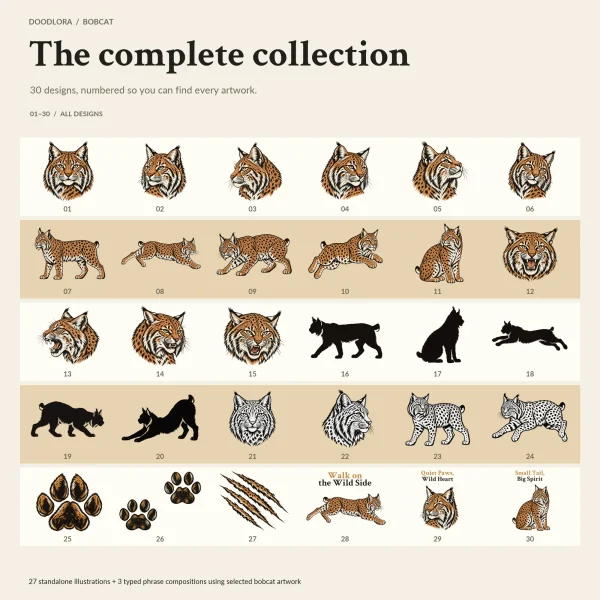
Every cat in our bobcat clipart set is a bobcat; there’s no lynx in it. A two-cat comparison poster still needs a lynx picture from somewhere else, and both cats need real photos for the parts that teach identification. Vermont’s lynx-or-bobcat page and the San Diego Zoo’s lynx page both have clear photos to point students to.
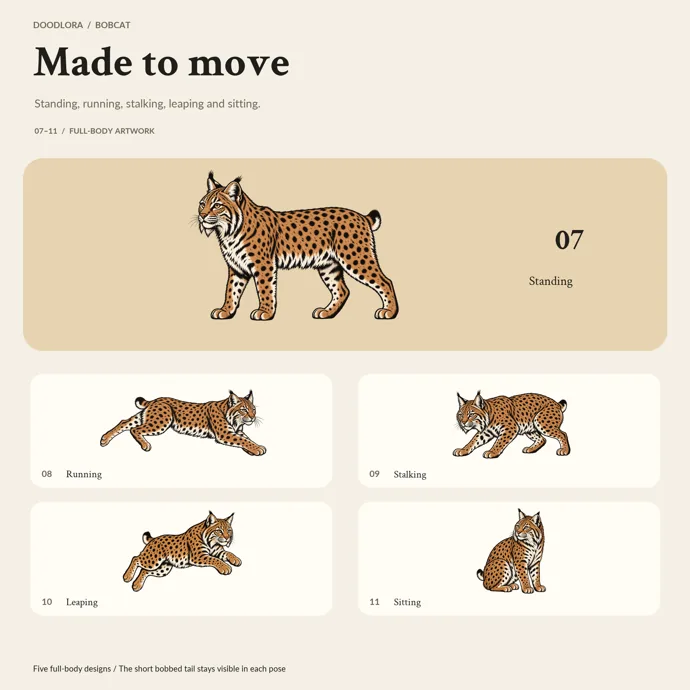
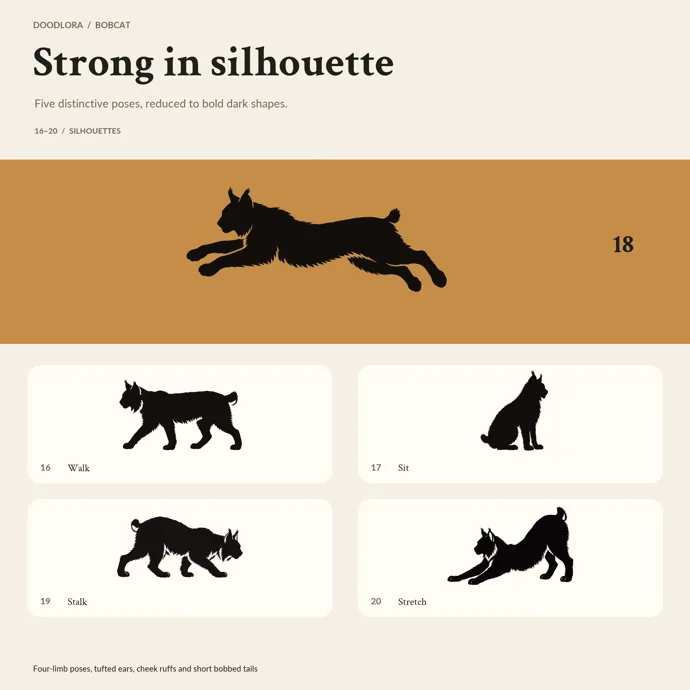
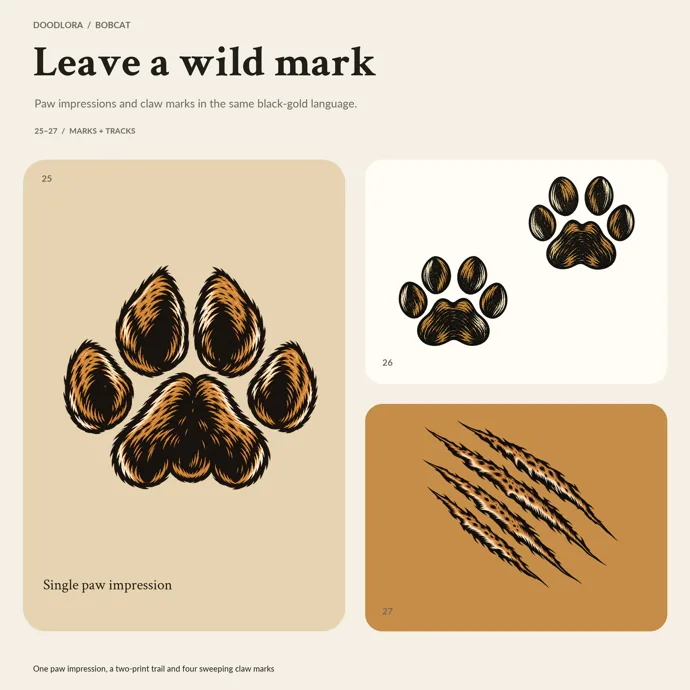
The drawings work best as the decorative layer: a title cat across the top, a border of tracks, or a cover for a report folder. The set has 30 designs, including six head portraits, five full-body poses, four black-and-white ink studies, five silhouettes and three paw and claw-mark pieces. You get every one of the 30 twice, once painted and once in black ink only.
A layout that works for a classroom poster or a science-fair board:
- Put the chart above in the middle as the main content, with “Tail tip,” “Ear tufts” and “Feet” as the three biggest labels.
- Place a bobcat photo and a lynx photo side by side above it, and draw arrows from each label to the tail, ears and paws.
- Use one of our full-body bobcats as the title art, and a silhouette as a small icon next to each bobcat fact.
- Finish with a range strip: “lower 48, almost everywhere” under the bobcat and “northern snow forests” under the lynx.
The PNG files are 3,600 by 3,600 pixels on a transparent background, so a cat drops onto a colored poster board or a slide without a white box around it. The guide in the set suggests printing paper accents at 3 to 4 inches wide. For printing, pick the PNG; our explainer on clipart file types says why, and the how-to-use-clipart guide works out how large a PNG can print before it turns soft.
For a cutting machine, the SVG and DXF files are the ones to open; the DXF files are made from the ink-only versions and set in inches. The guide recommends starting detailed cuts at about 10 inches wide and switching to the silhouettes for anything smaller, because whiskers and thin gaps in the fur get lost. The files haven’t been test-cut on any machine, so cut a small sample from scrap before the real piece. Besides the personal license, the bobcat set is sold with a commercial license, whose terms you can read on its product page. For more animal projects to pair with the poster, see our animal crafts.
Bobcat and lynx: short answers
Is a bobcat a type of lynx?
Yes. The bobcat, Lynx rufus, is one of the four species in the genus Lynx, along with the Canada lynx, the Eurasian lynx and the Iberian lynx. The San Diego Zoo notes that the bobcat is also called the bay lynx and the wildcat.
Which is bigger, a bobcat or a Canada lynx?
The Canada lynx is generally a little bigger and taller at the shoulder, but the weight ranges overlap, and big northern bobcats can outweigh a lynx. The long legs and big feet make a lynx look larger than it is.
Can bobcats and Canada lynx breed together?
Yes. Wikipedia reports that lynx-bobcat hybrids have been found at the southern edge of the lynx’s range, where the two species meet.
How big is a bobcat compared with a house cat?
About twice as large, according to both New York’s DEC and Oregon’s wildlife department. Oregon adds that a bobcat has longer legs, small feet and a compact, muscular body, and its short tail tells it apart from a house cat.
Why is it called a bobcat?
The name comes from the short, “bobbed” tail. Wikipedia and the San Diego Zoo both trace the name to it, and the bobbed tail is shared by every lynx species.
Printables from this article
Related articles
Clipart & SVG Cut Files
How to Draw a Truck: Easy Pickup, Big Rig and Cartoon
Split a pickup into three parts before you draw a single wheel: a bed, a cab and a hood. Keep the roof about 2.2 wheels tall and the bed rail level with the hood, and the truck looks right even before the details go on.
Clipart & SVG Cut Files
How to Draw a Train: Steam Engine, Cars and Tracks
Split the page into a 10-square grid, lay a long boiler tube across the middle, set a box cab at the back and a tall stack at the front, hang two big driving wheels under the cab end, then couple cars behind and run the rails to a vanishing point.
Clipart & SVG Cut Files
Hawk vs Falcon: Wings, Size, Hunting Style and Eagles
A falcon has long, narrow wings that taper to sharp points and flies on steady, quick wingbeats; a hawk has broader wings with rounded tips and either soars in slow circles or flaps hard and glides. Falcons kill with a notched beak and hawks with their talons, and eagles are the largest, heaviest-billed members of the hawk family.