 1 / 7
Bobcat Clipart: 30 Wild Cat Portraits, Snarling Heads, Silhouettes, Line Art and Paw Prints
Thirty bobcat drawings with tufted ears, a ruff of cheek fur, black-spotted ochre coats and a stub of a tail, drawn in dense black ink strokes. Snarling heads, five solid silhouettes, four black-and-white studies, paw tracks and claw marks sit next to the calmer portraits, and every design has an ink-only version.
$4.99
Buy any 3 or more printables and save 20% at checkout.
- Download right after payment — link works for 30 days, up to 5 downloads
- Files arrive as a ZIP with your license PDF inside
- Secure checkout by Stripe · Refund policy
This bobcat clipart shows the short-tailed North American wild cat thirty ways, all in one look: fur built from crowded black ink strokes laid over ochre and ivory, black spots down the legs and flanks, pale whiskers, a ruff flaring out from the cheeks and black tufts on the tips of the ears. The full-body cats all keep the stubby, black-tipped tail that sets a bobcat apart from the other spotted cats.
The faces range from calm to fierce, and four of them roar or snarl with the fangs bared. The set also has flat silhouettes, ink-only studies and paw tracks, so a single project can mix detailed and simple pieces from the same cat.
The set by number
| Numbers | What’s drawn |
|---|---|
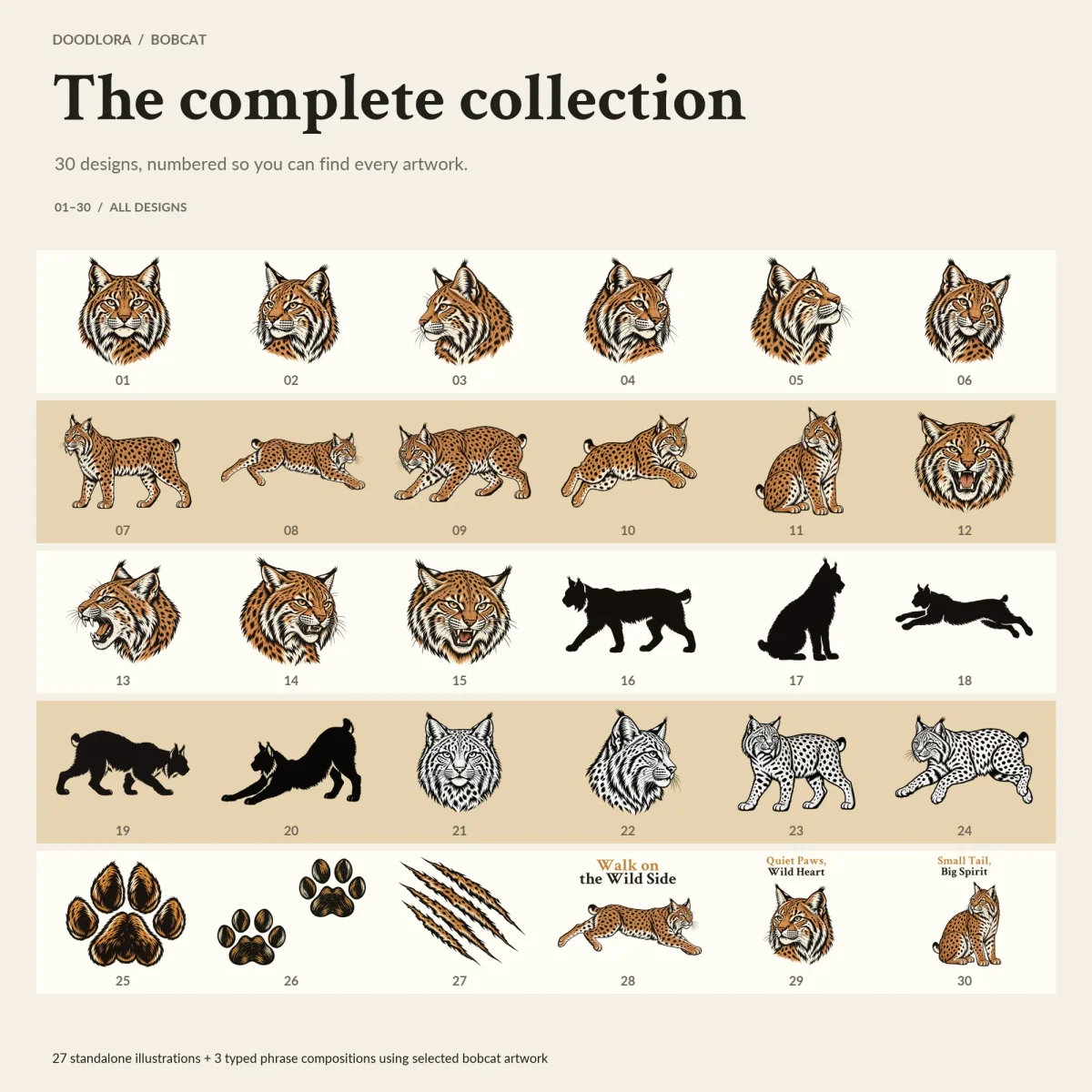
| 01–06 | Head-and-ruff portraits: looking straight out, turned three-quarters, in left profile, glancing back over the shoulder, gazing upward, and with the head tipped to one side |
| 07–11 | Whole cats: standing side-on, stretched out at a full run, stalking with the head low, leaping forward, and sitting upright looking off to the side |
| 12–15 | Fierce heads: a front-facing snarl, a side-view roar with the jaw wide open, a three-quarter snarl with the lips pulled back, and a lower, wider roar facing forward |
| 16–20 | Solid black silhouettes: walking, sitting, mid-leap, creeping low and stretching with the front legs out. Ear tufts and the short tail still read in outline |
| 21–24 | Black-and-white studies: a front head, a profile head, a standing cat and a running cat, all ink lines and spots on white with no color at all |
| 25–27 | A single large paw print, a pair of smaller tracks set on a diagonal, and four claw slashes |
| 28–30 | Phrases in a serif face, half ochre and half black: “Walk on the Wild Side” over the running cat from 08, “Quiet Paws, Wild Heart” over the head from 02, and “Small Tail, Big Spirit” over the sitting cat from 11 |
The phrase lettering is outlined inside the artwork, so the words open as shapes rather than editable text.
Ink-only versions and the DXF
Each monochrome file keeps only the black ink: the stroke pattern of the fur, the spots, the eyes and whiskers. Everything that was ochre or ivory becomes empty space, so the color of whatever you print on shows through as the coat. For 21 to 24, which are already black on white, the monochrome version simply drops the white fill. The silhouettes stay solid in both versions.
The color SVGs are much heavier than the monochrome ones, roughly 0.8 to 2 MB each for the painted cats, with several hundred separate color shapes apiece. They follow the PNG closely but simplify the finest fur texture, so they aren’t pixel-for-pixel copies of it. The 30 DXF files come from the monochrome artwork only. Most hold between 90 and about 200 closed outlines, the silhouettes 1 to 9, and the smallest specks of fur are left out.
Before cutting fur this fine
The artwork sits inside a 12 x 12 inch square with a margin around it. The guide suggests 10 to 11 inches wide for an adult shirt and 3 to 4 inches for paper accents, and it recommends starting detailed cuts at about 10 inches wide. At that size, look closely at the whiskers, the narrow gaps between fur strokes and the inside of letters like the “a” and “e”. Smaller than that, the silhouettes are the easier choice. The guide also says to keep each design grouped while resizing. Cut a small test on scrap material before the real piece.