Trivia for Seniors: 1950s, 1960s & 1970s Trivia Questions
Trivia for seniors works best as short rounds of about ten questions, read aloud, about the years when the players were teenagers and young adults. For most people in their 70s and 80s today, those years fall in the 1950s, 1960s and 1970s, so the 36 questions below are grouped by decade, and each answer was checked against the Wikipedia article on that event.
The setup comes first: how big to print, how many players, whether to use teams, and what to do when someone can’t hear or see well. The player counts and minutes in the table are rough guides rather than measurements; a chatty table runs long, and that is fine.
How to run trivia for seniors: players, print size and scoring
Pick the format by who is at the table. A holiday visit and an activity room need different setups, mostly in who reads the questions and how answers get collected.
| Situation | Players | Time | Format | Who reads |
|---|---|---|---|---|
| Holiday visit at the kitchen table | 2–6, mixed ages | 15–20 minutes, one decade | Everyone answers out loud, no teams | A grandchild or one adult |
| Activity room or senior center | 6–12 and a leader | 30–45 minutes, two or three rounds | Teams of 3–4, one answer sheet per team | The leader |
| One-to-one visit | 2 | About 10 minutes | Ask, then talk about the answer | The visitor |
For the activity-room row, the group page in our large-print book sets out a 45-minute session for 6 to 12 people led by one person.
Print size and reading the questions aloud
Large print starts at 16 point for the questions themselves. Our own large-print book sets its questions at that size and its answer choices at 14.5 point, a sensible floor for any handout you make. Print at 100% or “Actual size,” because “Fit to page” shrinks every letter by about 6% and quietly undoes the large print.
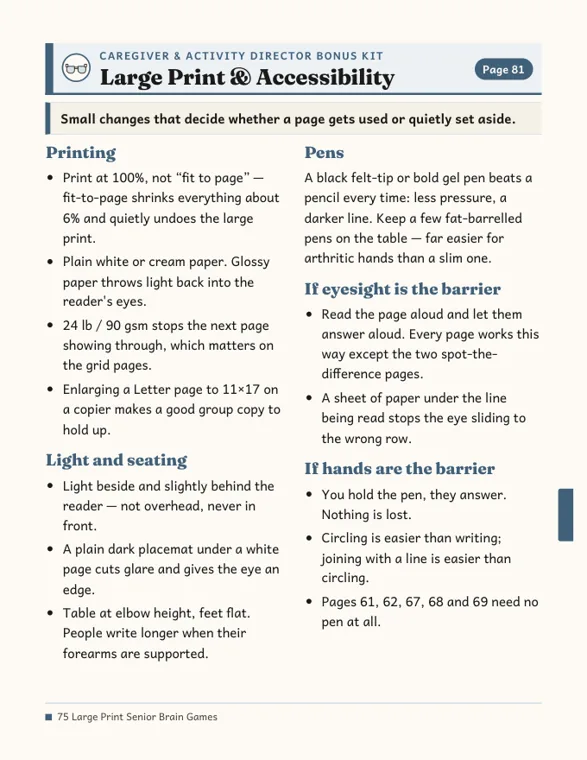
Hearing trouble is the bigger problem in most rooms. The reader should sit or stand where everyone can see their face, read each question twice at an easy pace, and only then read the choices. Writing the key word of each question on a whiteboard helps the players who catch only half of it. For multiple-choice rounds, give each team three cards marked A, B and C to hold up instead of calling out.
Poor eyesight needs no special pages: read everything aloud and take the answers out loud. A player with unsteady hands can say the answer while a teammate writes it down. Our activities for seniors guide has more games that need no pen at all, sorted for one person, a family visit or an activity room.
Teams, scoring and settling arguments
Teams of three or four keep anyone from being put on the spot. Give each team one answer sheet and a felt-tip pen, score one point per right answer, and never take points away. Ten questions make a round; read out the scores after each round, then stop for coffee and talk.
Going around the circle in order is the easy mistake. The warm-up page in our book warns against it for anything difficult, so start with whoever is keenest and let the others join in.
Year questions cause most of the arguments. Decide before the first question whether an answer has to be the exact year or can be a year or two off, and say the rule out loud. When nobody at the table knows an answer, read it out, share the short fact that goes with it, and move on. A question that stumps everyone isn’t worth a second try.
1950s trivia questions for seniors
The 1950s round leans on television, rock and roll and the first months of the space race, because those are things most players saw or heard as they happened. Read the answer after the guesses are in; the second sentence gives the group something to talk about.
Music, TV and toys of the 1950s
- Dick Clark hosted which afternoon dance show that went national on ABC in 1957? Answer: American Bandstand. It started in Philadelphia and first aired nationally on August 5, 1957.
- Which band had a number one hit with “Rock Around the Clock” after the song played in the 1955 film Blackboard Jungle? Answer: Bill Haley & His Comets. The record stayed at number one for two months.
- Buddy Holly’s band from Lubbock, Texas, was named after which insect? Answer: The Crickets. Their song “That’ll Be the Day” reached number one in September 1957.
- Which puppet shared the screen with Buffalo Bob Smith on children’s TV? Answer: Howdy Doody. Smith’s nickname came partly from his hometown, Buffalo, New York.
- In April 1952, which toy became the first toy advertised on television? Answer: Mr. Potato Head. The first sets were separate plastic parts with pushpins.
- Which company sold the first “TV Dinner” in 1953? Answer: Swanson. The first tray held a Thanksgiving meal of turkey, cornbread stuffing, peas and sweet potatoes.
News and everyday life in the 1950s
- Which general won the 1952 presidential election, with Richard Nixon as his running mate? Answer: Dwight D. Eisenhower. He beat Adlai Stevenson in a landslide.
- Which park did Walt Disney open in Anaheim, California, in July 1955? Answer: Disneyland. Its dedication was televised on ABC the day before the public opening.
- In April 1955, whose polio vaccine was announced as a success? Answer: Jonas Salk. He chose not to patent it.
- What was the name of the first artificial satellite, launched by the Soviet Union in October 1957? Answer: Sputnik 1. It sent a radio signal back to Earth for about three weeks.
- Which territory became the 49th state in January 1959? Answer: Alaska, on January 3, 1959.
- Which became the 50th state later that same year? Answer: Hawaii, on August 21, 1959. It is still the most recent state to join.
1960s trivia questions for seniors
1960s trivia has the deepest well of shared memories, from the race to space to Motown on the radio. Watch the Woodstock question: its answer is not Woodstock, which makes it a good one to save for the end of a round.
Space, sports and news of the 1960s
- Who won the 1960 presidential election after four debates with Richard Nixon, the first presidential debates shown on television? Answer: John F. Kennedy.
- On February 20, 1962, which astronaut became the first American to orbit Earth? Answer: John Glenn. His capsule was named Friendship 7.
- Where did Martin Luther King Jr. give his “I Have a Dream” speech in 1963? Answer: On the steps of the Lincoln Memorial in Washington, D.C., to more than 250,000 people.
- What did the Post Office add to American mail on July 1, 1963? Answer: The five-digit ZIP Code.
- The 1969 Woodstock festival took place on a dairy farm near which town? Answer: Bethel, New York, about 60 miles from the town of Woodstock. The crowd topped 460,000.
- Which team won the first Super Bowl in January 1967? Answer: The Green Bay Packers, 35–10 over the Kansas City Chiefs.
Music, TV and toys of the 1960s
- Which Detroit group, with Diana Ross among its original members, recorded “Where Did Our Love Go” in 1964? Answer: The Supremes.
- Which California band recorded “Surfin’ U.S.A.” in 1963? Answer: The Beach Boys, formed in Hawthorne, California, in 1961.
- Fred Flintstone and Barney Rubble lived in which Stone Age town? Answer: Bedrock.
- Which starship did Captain James T. Kirk command on Star Trek, first shown on NBC in 1966? Answer: The USS Enterprise.
- Which “action figure” did Hasbro introduce in February 1964? Answer: G.I. Joe, a 12-inch figure in its first version.
- Big Bird and Oscar the Grouch belong to which children’s show, first shown on November 10, 1969? Answer: Sesame Street. Visiting grandchildren usually know this one too.
1970s trivia questions for seniors
The 1970s round suits the younger end of a senior group, people now in their 60s and early 70s. It also has the most questions that teenagers can answer, which helps at a family table.
Movies and TV of the 1970s
- Which 1975 Steven Spielberg thriller was based on Peter Benchley’s novel? Answer: Jaws.
- Who starred as Tony Manero, a young man who spends his weekends at a disco, in 1977’s Saturday Night Fever? Answer: John Travolta.
- Henry Winkler played Fonzie on which sitcom about life in the 1950s and early 1960s? Answer: Happy Days, with Ron Howard as Richie Cunningham.
- Which 1977 TV miniseries was based on Alex Haley’s novel about his family? Answer: Roots, first shown on ABC in January 1977.
- Which comedy show first aired on NBC on October 11, 1975, with George Carlin as host? Answer: Saturday Night Live, then called NBC’s Saturday Night.
- Which family group had number one hits in 1970 with “ABC” and “I’ll Be There”? Answer: The Jackson 5.
News, sports and gadgets of the 1970s
- Which event was first held on April 22, 1970? Answer: Earth Day.
- Who beat Bobby Riggs in the 1973 “Battle of the Sexes” tennis match at the Houston Astrodome? Answer: Billie Jean King, in three sets.
- What was the name of the first American space station, launched by NASA in 1973? Answer: Skylab.
- Which president resigned on August 9, 1974? Answer: Richard Nixon, the only U.S. president ever to resign. Gerald Ford took over.
- In what year did the United States celebrate its Bicentennial on July 4? Answer: 1976, the 200th anniversary of the Declaration of Independence. Under an exact-year rule this one is fair, since anyone can do the sum from 1776.
- Sony began selling which portable cassette player in 1979? Answer: The Walkman.
Printed trivia pages for seniors who like pencil and paper
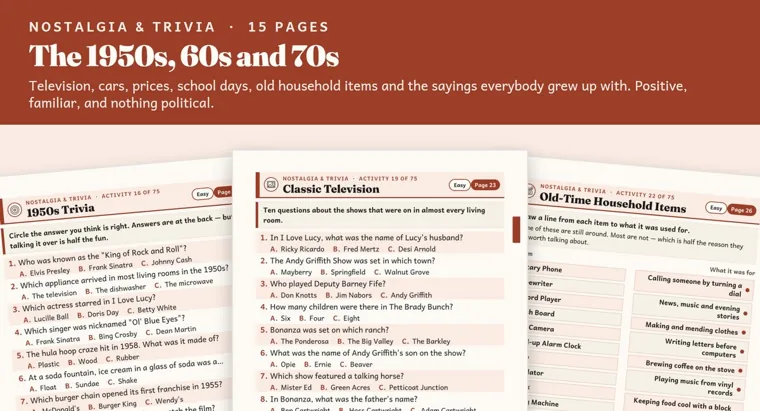
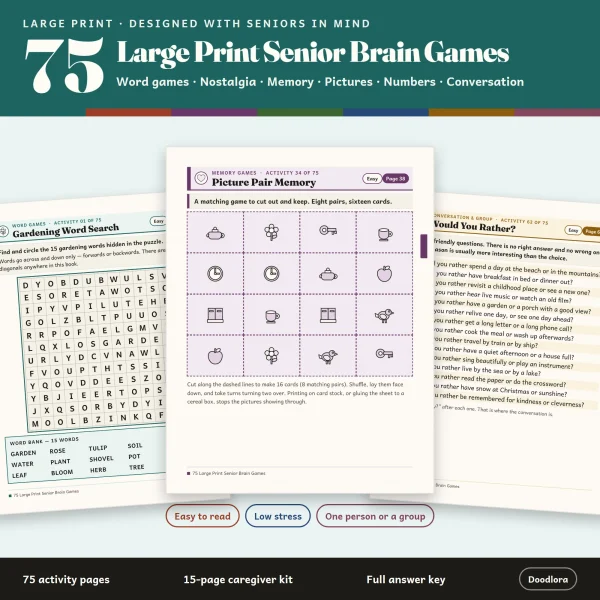
Some players would rather sit with a sheet and circle answers at their own pace. Our large-print activity book gives trivia 15 pages, pages 20 to 34. The 1950s, 1960s and 1970s each get their own page, and the rest cover TV shows, films, cars, household gadgets and guessing the decade. Each decade page has ten questions with three choices.
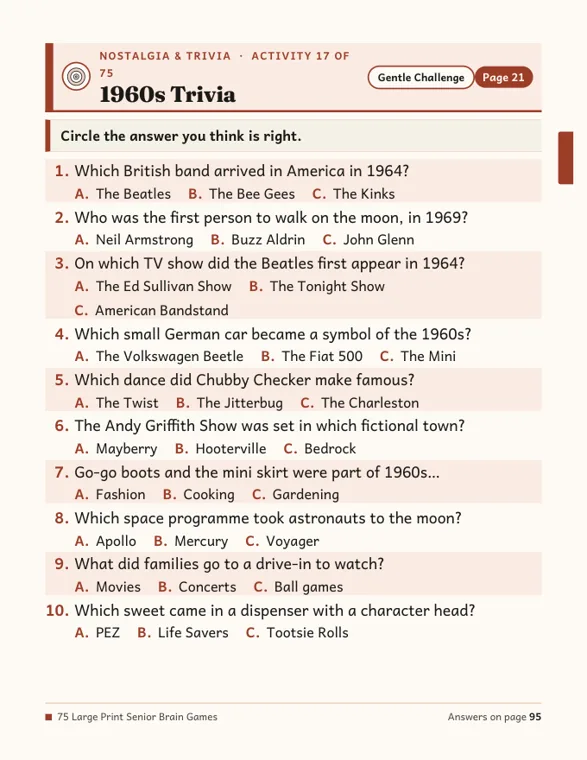
Fix one thing before you use those pages with a group. On the decade pages and the other multiple-choice pages in that section, the right answer is always choice A, and a sharp player notices by the third question. Handed out as worksheets, the pages still make a gentle warm-up; read aloud to a room, they work better if you change the order of the choices as you go.
The answer key at the back lists answers by activity number rather than by the page number printed in the corner. Look up the 1960s page under 17 in the key, not under 21.
Trivia for seniors when grandchildren join in
A holiday visit with three generations needs a different kind of round. Let a grandchild be the reader, since young eyes manage small print and the job gives a restless child something to do. Around Thanksgiving, our Thanksgiving trivia questions make an easy second round that every age at the table can try.
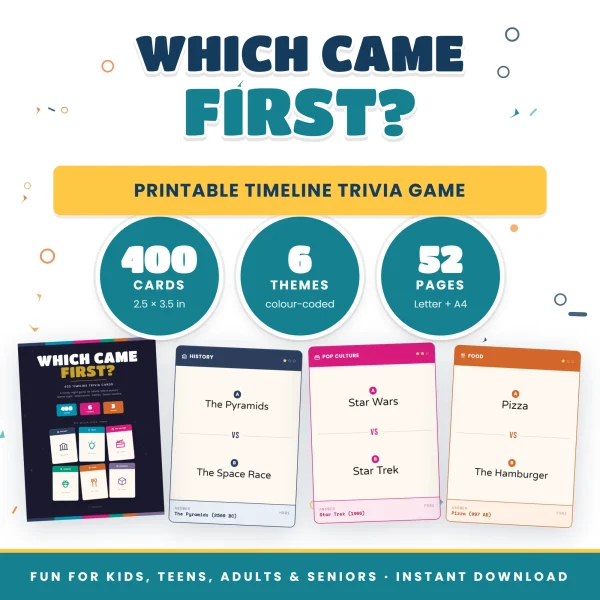
Which-came-first questions level the field, because nobody needs an exact date. Take two answers from the lists above and ask which happened first: Disneyland or Sputnik? Disneyland opened in July 1955, and Sputnik went up in October 1957. Our Which Came First? timeline cards do the same with 400 printed cards in six themes, and each card shows one to three stars for difficulty.
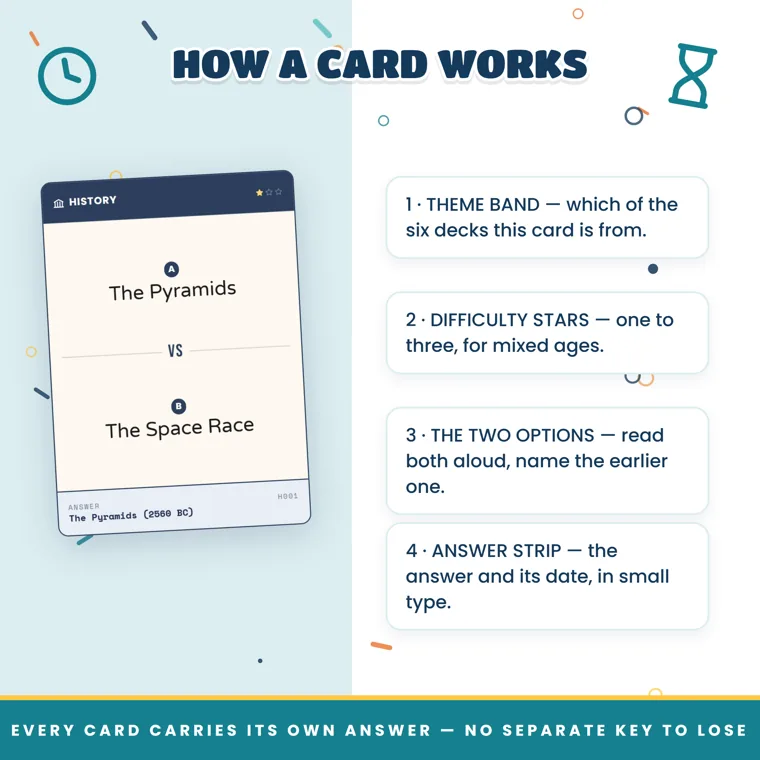
The answer and its year sit in a strip at the foot of every card, so the reader covers it with a thumb while reading. In the Points Race version, a player earns three bonus points for naming the year within 20 years. That generous rule ends most year arguments before they start.
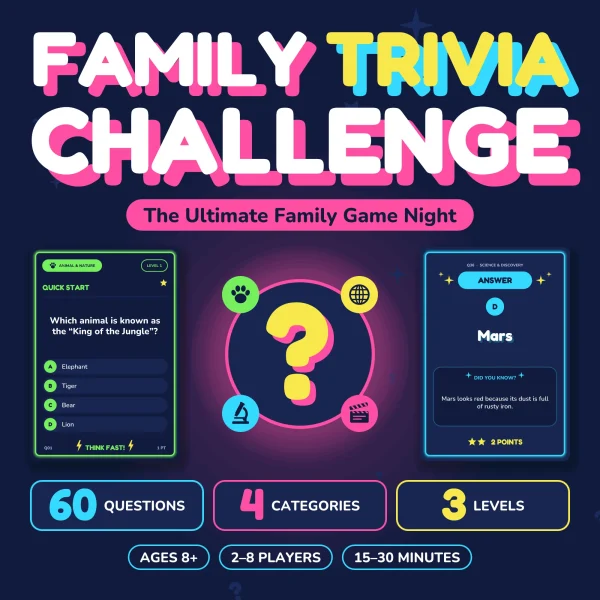
Turn the quiz around, too: a grandparent makes a fine quizmaster for the children’s questions. Our family trivia game has 60 question cards in four categories, from animals and nature to pop culture, at three levels worth 1, 2 or 3 points.

When the questions run out and the stories start, keep them going. Grandchildren who want to ask the questions themselves will find prompts for grandparents about family history in our family conversation starters. If the ages at the table run from six to eighty, the fairness tips in our family game night ideas are worth a look.
Writing your own trivia questions for seniors
Most groups run out of questions before they run out of interest, so sooner or later you will write your own. A few habits keep homemade questions fair:
- Ask about things people watched or heard. TV shows, songs, ads and the big stories on the evening news stick better than dates or names from a textbook.
- Prefer “which decade” over “which year.” A decade is easier to place, and three choices (1950s, 1960s or 1970s) make a quick round.
- Move the right answer around. If you write choices, put the correct one in a different spot each time.
- Check every answer before you print. Look each one up in an encyclopedia or a library reference, because a confident wrong answer sours a game fast.
- Skip painful subjects for a general group. Assassinations, wars and disasters can bring back grief; save them for a group that asks for history.
- Keep it national. Questions about one city’s team or local stores leave out anyone who grew up somewhere else, including people who moved to the U.S. as adults.
Before the game, read each question aloud once. If it takes more than one breath to say, shorten it, because a long question is hard to follow for a player who hears only part of it.
Printables from this article
Related articles
Brain Games for Seniors
How to Play Sudoku: Sudoku Rules and Tips for Beginners
Sudoku rules in plain words, a small puzzle solved one move at a time, the scanning and pencil-mark habits that crack a 9×9, and what to do when you get stuck.
Brain Games for Seniors
Word Games for Seniors: 16 Printable and Group Word Games
Sixteen word games for seniors, from large-print scrambles to Ghost and a three-minute word search race, sorted for one person, a family visit or a group.
Brain Games for Seniors
Memory Games for Seniors: 14 Printable and Group Activities
Fourteen memory games for seniors, from look-and-cover pages to picture pairs and I Packed My Bag, sorted for a kitchen-table visit, grandchildren or a group.