Possum vs Opossum: Differences, Opossum Facts and a Chart
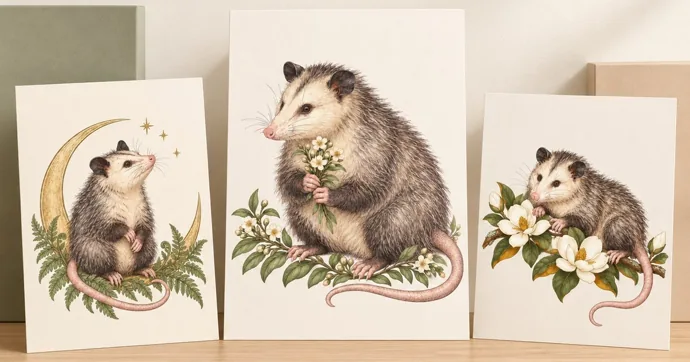
Is a possum the same as an opossum? In the United States and Canada, yes: both words name one animal, the Virginia opossum, and “possum” is simply the everyday short form. In Australia and New Zealand, no. There, a possum is a different marsupial, such as the common brushtail possum, which got the borrowed name because it looked a little like the American animal. The two sit in different marsupial orders, and the Australian ones are closer kin to kangaroos than to any opossum.
Further down: which word fits your writing, a two-animal chart, three clues for a photo or a footprint, the opossum facts that survive a fact-check, and what to do when one crosses your yard at night.
Possum or opossum: which word to use where you live
The word “opossum” belonged to the American animal first. Wikipedia traces it to a Powhatan word that English colonists wrote down as opassom or aposoum, from a Proto-Algonquian root meaning “white animal,” a fair name for a creature with a white face. John Smith described one in 1608 as having “an head like a Swine, and a taile like a Rat.”
Dropping the first syllable came naturally in speech. Wikipedia notes that in North America the animal is commonly called a possum, sometimes written ‘possum with an apostrophe to mark the missing “o.” After Europeans reached Australia, the same word was borrowed for the tree-climbing marsupials they found there.
So the right word depends on your reader:
- Talking or writing casually in the U.S.: “possum” is normal and nobody will misread it.
- A school report, museum-style label or science worksheet: write “Virginia opossum” the first time, then “opossum.” It is the only opossum species found in the United States and Canada, so there is no other one to mix it up with.
- Anything about Australia or New Zealand: use “possum” and name the kind, such as brushtail or ringtail possum. An American “opossum” doesn’t live there.
- A project that covers both: say early that they are two animals, because a kid reading “possum” in an Australian picture book and an American one is reading about different creatures.
Virginia opossum vs brushtail possum: side-by-side chart
The Virginia opossum is the only opossum north of Mexico, and the common brushtail possum is the Australian possum city dwellers see most often. Those are the two animals people usually mean, so they are the pair to compare.
| Virginia opossum (the American “possum”) | Common brushtail possum (Australia) | |
|---|---|---|
| Native range | Southern Canada through the U.S. and Mexico to Costa Rica | Australia; brought to New Zealand in the 1850s |
| Marsupial order | Didelphimorphia, the American opossums | Diprotodontia; closer kin to kangaroos than to opossums |
| Face and ears | White face, long pointed snout, thin hairless ears | Dark patches on the muzzle, large pointed ears |
| Tail | Long, bare and scaly, able to grip | Bushy, gripping at the tip with a bare patch underneath |
| Head and body | 13 to 22 in (33 to 55 cm) | 13 to 23 in (32 to 58 cm) |
| Tail length | 9.8 to 21.3 in (25 to 54 cm) | 9.4 to 16 in (24 to 40 cm) |
| Weight | Males 4.6 to 6.2 lb (2.1 to 2.8 kg), females 4.2 to 4.6 lb (1.9 to 2.1 kg) | 2.6 to 9.9 lb (1.2 to 4.5 kg) |
| Main food | Omnivore: insects, worms, small animals, carrion, fruit and seeds | Mostly leaves, with eucalyptus a big share, plus flowers, shoots and fruit |
| Babies | Litters of 4 to 25; about two months in the pouch, then rides on the mother’s back | One young at a time; 4 to 5 months in the pouch, then rides along or waits in the den until 7 to 9 months old |
| Life in the wild | About 1.5 to 2 years | Up to 13 years |
| Sounds | Hisses, growls and screeches when scared; males click during mating season | Clicks, grunts, hisses, alarm chatters, guttural coughs and screeching |
The size rows are the trap in this chart. The body lengths overlap almost completely and so do the weights, so a tape measure won’t tell them apart. The tail, the ears and, above all, the continent will. If your class is collecting look-alike animal pairs, alligator vs crocodile has the same kind of chart, with snouts and teeth doing the sorting.
How to tell which one you saw
Where you are settles it before anything else. A wild “possum” in the United States or Canada is a Virginia opossum, because no Australian possum lives wild in North America. A possum in an Australian garden or a New Zealand forest is one of the Australasian kinds. The clues below help when you’re looking at a photo, a zoo sign or a picture book with no place named.
Tail and ears: the fastest visual check
Look at the tail first. A Virginia opossum’s tail is long, pink to gray, scaly and nearly hairless, the “taile like a Rat” John Smith wrote about. A brushtail possum’s tail is furry and full for most of its length, which is where the name comes from. Then check the ears: thin, bare and dark on the opossum, larger and pointed on the brushtail.
Footprints in mud or snow
Virginia opossum tracks are easy to spot once you know the thumb. Both front and back prints show five finger-like toes, but on the hind foot the clawless thumb sticks out at 90 degrees or more from the other toes, sometimes almost backward. Wikipedia gives a typical adult front print of about 1.9 in long by 2.0 in wide (4.8 by 5.1 cm) and a hind print of about 2.5 by 2.3 in (6.4 by 5.7 cm). The other four toes on the hind print point the way the animal was walking.
Noises at night
Both animals are out at night, so you may hear one before you see it. A scared opossum hisses, growls or screeches with its mouth open. An Australian brushtail has a wider set of calls, including guttural coughs and alarm chatters, and it sometimes dens in the roof spaces of houses.
Opossum facts that hold up, and three that don’t
Opossum facts get passed around a lot, and some of them are wrong. Here is what the Smithsonian’s National Zoo, Connecticut’s wildlife division and Wikipedia’s sources support.
Facts worth knowing about the Virginia opossum
- It is North America’s only marsupial. The National Zoo calls it the only marsupial found north of Mexico.
- It has 50 teeth. That is more than any other North American land mammal, and a frightened opossum shows all of them when it hisses.
- The newborns are tiny. A litter of 4 to 25 young are each about the size of a kidney bean at birth, by the National Zoo’s count. They crawl into the pouch, stay about two months, and later ride on the mother’s back.
- Its life is short. In the wild a Virginia opossum may live 1.5 to 2 years; in human care, 3 or 4.
- It isn’t a rodent. People sometimes take it for a big rat, but it is a marsupial and not closely related to rodents at all.
Myth 1: opossums eat thousands of ticks
You will often read that one opossum eats about 5,000 ticks a season. The idea grew from a 2009 Cary Institute lab study, which estimated that opossums could eat thousands of ticks a week while grooming. A 2021 study of the stomach contents of wild opossums in Illinois found no ticks, and Wikipedia notes that no scientific paper as of 2023 had reported ticks in wild opossum stomachs. Insects such as grasshoppers, crickets and beetles make up most of the animal food they really eat.
Myth 2: opossums sleep hanging by their tails
The tail does grip, and an opossum uses it to steady itself on a branch or carry a bundle of leaves. Connecticut’s wildlife fact sheet says the tail is not built for hanging for long periods, and Wikipedia notes that dangling by the tail is more common in young opossums than in adults. The upside-down pose in cartoons and clipart is mostly a drawing habit.
Myth 3: every scared opossum plays dead
“Playing possum” is real, but the National Zoo says it is mostly young opossums that do it. Adults are more likely to bare their teeth, hiss, screech or run. When an opossum does feign death, it doesn’t look peaceful. It lies limp on its side with the mouth and eyes open and the tongue hanging out, its heart rate drops by half, and it can stay that way for several hours until the threat leaves.
If an opossum shows up in your yard
An opossum crossing your yard at night is usually just passing through to food. Connecticut’s wildlife division says having one around shouldn’t be a problem and gives the simplest advice: let opossums have their space and learn to live with them. It also points out that opossums don’t dig up yards, attack pets or dig burrows.
The open-mouthed hiss often makes people think an opossum is sick. Connecticut’s fact sheet calls rabies in opossums extremely rare, and the CDC’s general rule still applies to every wild animal: “The best way to avoid rabies in the U.S. is to keep your distance from wildlife.” In practice that means three things:
- Don’t touch it or poke it, even if it looks dead. A still opossum may be playing dead, and the CDC says never to approach animals that appear injured, sick or dead. The CDC also asks you to keep pets away from wild animals.
- Don’t feed it. Michigan’s Department of Natural Resources encourages local rules that prohibit feeding opossums and other wildlife.
- Take away what drew it in. Connecticut suggests bringing pet food in at night, keeping garbage covered in a garage or shed, and picking up fallen fruit under trees.
The same goes for Australian brushtail possums, which are sometimes hand-fed in backyards. Hand-feeding isn’t encouraged, because their claws are sharp and a scratch can carry infection.
Using opossum clipart for a report, card or cut project
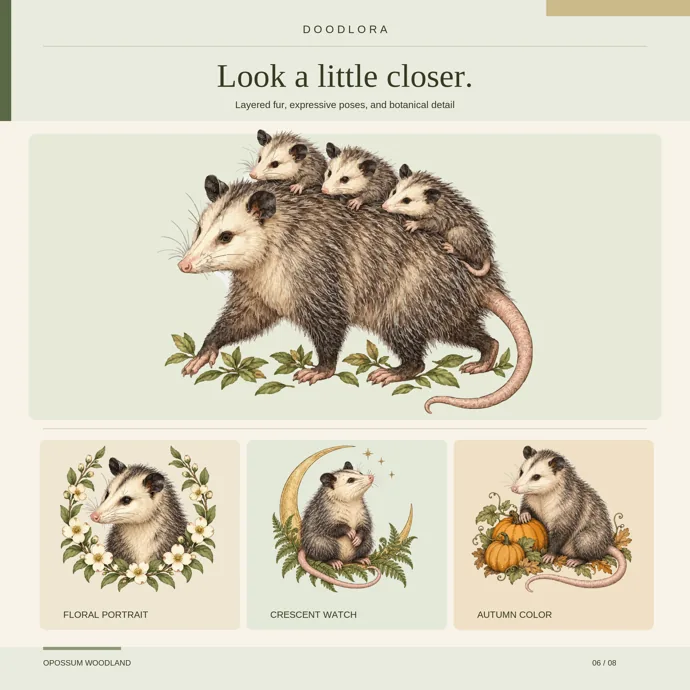
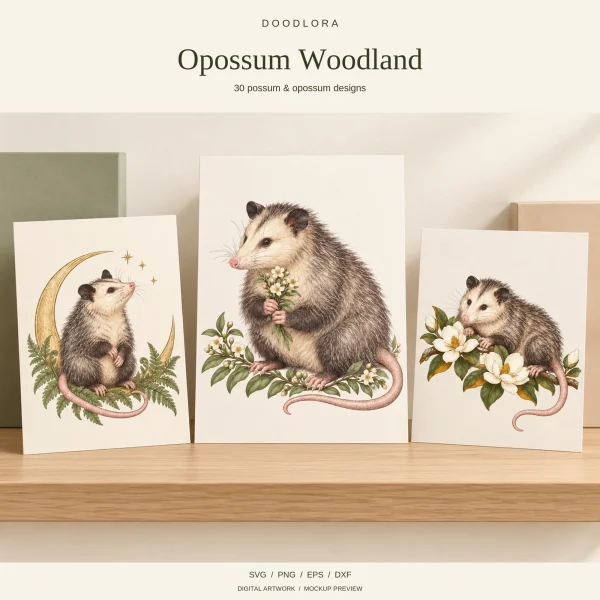
A class report on marsupials, a nature-journal page or a “possum vs opossum” poster needs a picture that shows the real features. Our possum clipart set has 30 opossum designs drawn in an old natural-history style. Apart from the four black silhouettes, every design shows the Virginia opossum’s pale face and dark ears. All of those except the four head-and-shoulders wreath portraits, 09 to 12, also show the long bare pink tail. There is no Australian possum in the set, so a two-sided poster needs a brushtail picture from somewhere else.
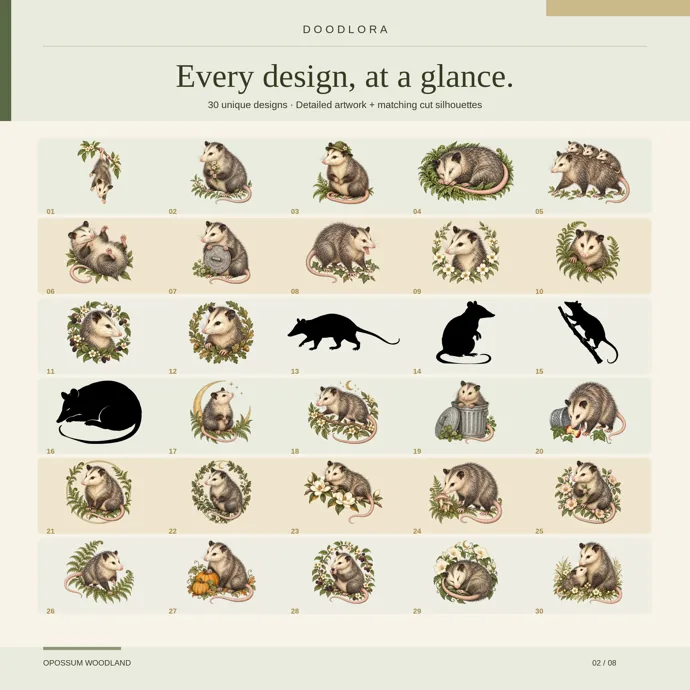
The artwork is decorative, so pick designs by what the page is teaching:
- For a fact page: the mother with three babies on her back (05) shows the back-riding stage, and the open-mouthed face in 08 matches the teeth-baring warning display.
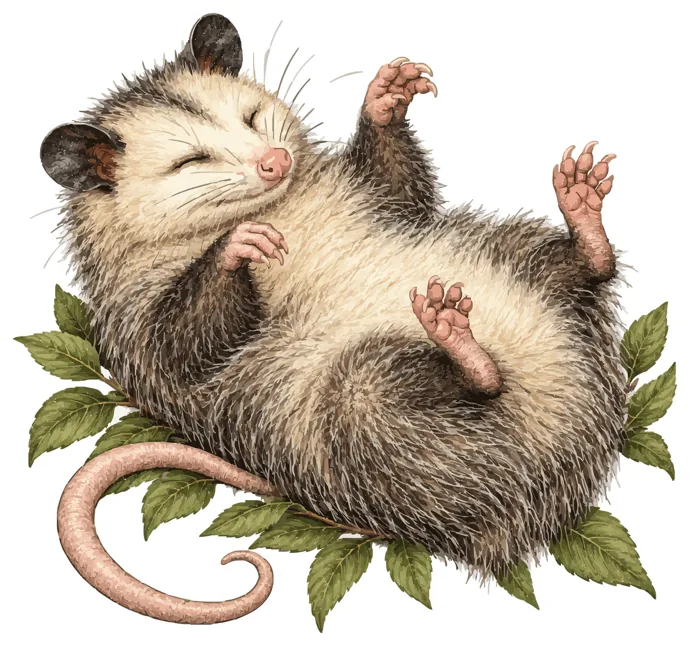
- For a cute card or sticker: the playing-dead pose (06), the hanging pose (01) and the trash can scenes (19 and 20) are the cartoon side of the opossum. Use them for fun, not as facts.
- For a quiz or a “guess the animal” game: the four plain black silhouettes, 13 to 16, show a walking, sitting, climbing and sleeping opossum with no detail to give the answer away.
Each design also comes as a single-color cut silhouette, and the DXF files follow those cut versions. For a cutting machine, use the cut folder or the DXF; the detailed SVGs are made of thousands of small color shapes and aren’t meant for cutting. One catch before you cut: the wreath portraits, 09 to 12, turn into round leafy discs with the face lost in the middle, so pick a design where the opossum stands on its own.
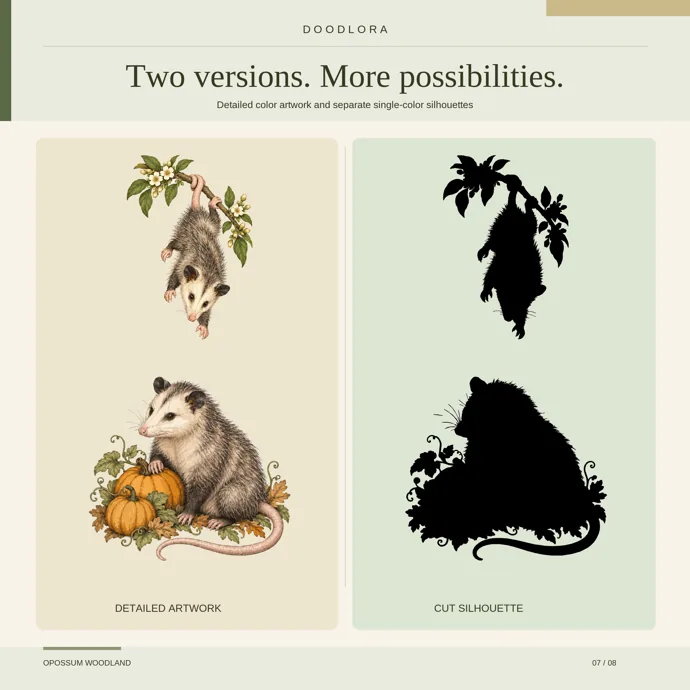
The PNGs are 3600 by 3600 pixels with a transparent background, the same 12-inch square as the SVG canvas, so they drop onto a colored report page without a white box. If you’re not sure whether a job needs the PNG or the SVG, our guide on how to use clipart walks through which file fits printing, documents and cutting. What is clipart explains outlines, silhouettes and which formats a cutting machine reads. This set also has a commercial license tier; the terms are on the product page.
For more ways to put animal pictures to work, our animal crafts for kids include clipart stickers, greeting cards and a tote transfer, sorted by age.
Other questions about possums and opossums
Is it “possum” or “opossum” in Australia?
In Australia the animals are called possums. The name was borrowed from the American opossum after Europeans arrived, but the Australian animals belong to a different order, Diprotodontia.
Do opossums live in Australia?
No wild opossums live in Australia. Opossums are native only to the Americas, where there are 126 species. The family started out in South America and reached North America after the two continents joined. The Virginia opossum is the one found in the United States and Canada.
Why are there opossums in Michigan and New England but not in old records?
The Virginia opossum has been spreading north for more than a century. Connecticut’s wildlife division says opossums weren’t found in the state before the early 1900s, and Wikipedia records the range moving into most of New England, Michigan and southern Ontario since 1900.
Printables from this article
Related articles
Clipart & SVG Cut Files
How to Draw a Truck: Easy Pickup, Big Rig and Cartoon
Split a pickup into three parts before you draw a single wheel: a bed, a cab and a hood. Keep the roof about 2.2 wheels tall and the bed rail level with the hood, and the truck looks right even before the details go on.
Clipart & SVG Cut Files
How to Draw a Train: Steam Engine, Cars and Tracks
Split the page into a 10-square grid, lay a long boiler tube across the middle, set a box cab at the back and a tall stack at the front, hang two big driving wheels under the cab end, then couple cars behind and run the rails to a vanishing point.
Clipart & SVG Cut Files
Hawk vs Falcon: Wings, Size, Hunting Style and Eagles
A falcon has long, narrow wings that taper to sharp points and flies on steady, quick wingbeats; a hawk has broader wings with rounded tips and either soars in slow circles or flaps hard and glides. Falcons kill with a notched beak and hawks with their talons, and eagles are the largest, heaviest-billed members of the hawk family.