Alligator vs Crocodile: Snout and Teeth Differences for Kids
To tell an alligator from a crocodile, check the snout and the teeth before anything else. An alligator has a broad, rounded snout shaped like a U, and with its mouth shut you mostly see upper teeth pointing down. A crocodile’s snout is narrower and pointed like a V, and the big fourth tooth on each side of its lower jaw stays in view when the mouth is closed. In the United States, color and water help too: adult alligators are dark gray to black and live mostly in fresh water, while American crocodiles are lighter and stay near salty coasts.
Below you’ll find a side-by-side chart, ways to explain the difference to a preschooler or a fourth grader, and the one corner of the country where both animals live in the wild.
How to tell an alligator from a crocodile: four checks
Start with the head, where the differences are easiest to see, then move on to color and habitat. The facts here come from the National Park Service pages for Everglades National Park and Big Cypress National Preserve, the Smithsonian’s National Zoo, and Wikipedia’s crocodile article. They describe the two species native to the U.S., the American alligator and the American crocodile.
| American alligator | American crocodile | |
|---|---|---|
| Snout seen from above | Short, wide and rounded, like a U | Longer, narrower and pointed, like a V |
| Teeth with the mouth closed | Mostly upper teeth, pointing down; the big fourth lower tooth sits in a socket and stays hidden | Teeth point both up and down; the fourth lower tooth shows on each side |
| Adult color | Dark gray to black | Lighter, grayish green to olive |
| Usual water | Fresh: swamps, marshes, lakes, slow rivers | Salty or brackish: coastal bays and estuaries |
| Salt glands | Not working, so salt water only for short periods | Working, so it can live on the saltwater coast |
| Range in the U.S. | Southeastern states, from North Carolina to Texas | Coastal south Florida |
| Size | Adult females average about 8.2 feet, males about 11.2 feet | Males can reach about 20 feet but rarely pass 14 feet in the wild; breeding females run 8 to 12 feet |
Alligator vs crocodile snout: U or V
Look at the head from above, or at a photo taken from above. An alligator’s snout is short and wide with a rounded tip, close to the letter U. A crocodile’s snout is longer and thinner and comes to a point, more like a V. The Big Cypress National Preserve answers page calls snout shape the main way to tell the two apart. The snout is also the part you’re most likely to see, since both animals can float with little more than the top of the head above water.
Alligator vs crocodile teeth when the mouth is shut
An alligator has an overbite. Its upper jaw is wider than the lower one, so when the mouth closes, the lower teeth tuck into pockets in the upper jaw and disappear. The few teeth you can see are upper teeth, pointing down. A crocodile’s upper and lower jaws are about the same width. With its mouth closed you see teeth pointing up and down, including a large fourth tooth on each side of the lower jaw. Wikipedia’s crocodile article calls that protruding tooth the most reliable feature when the head shape is hard to judge.
Skin color and the kind of water
Color is useful only with adults. Young alligators have bright yellow stripes on the tail, according to the Smithsonian’s National Zoo. The Everglades park’s page for kids says adult alligators are dark gray to black, never green, while crocodiles tend toward olive or gray. Water gives you the last clue. Alligators lack working salt glands and handle salt water only briefly, so they live in freshwater swamps, marshes, lakes and slow rivers. Crocodiles have salt glands and live along the coast in brackish and salt water.
Why cartoon alligators are green when real ones are dark
Ask a child to draw an alligator and you’ll probably get a green one, and most clipart does the same. Our own alligator SVG set is a fair example: 27 of its 30 designs show olive-green gators with darker spots and cream bellies, and the other 3 are dark green line drawings with no fill. Green is a cartoon habit, not a field mark. By the Park Service’s description, olive is closer to a crocodile’s color than to an alligator’s.
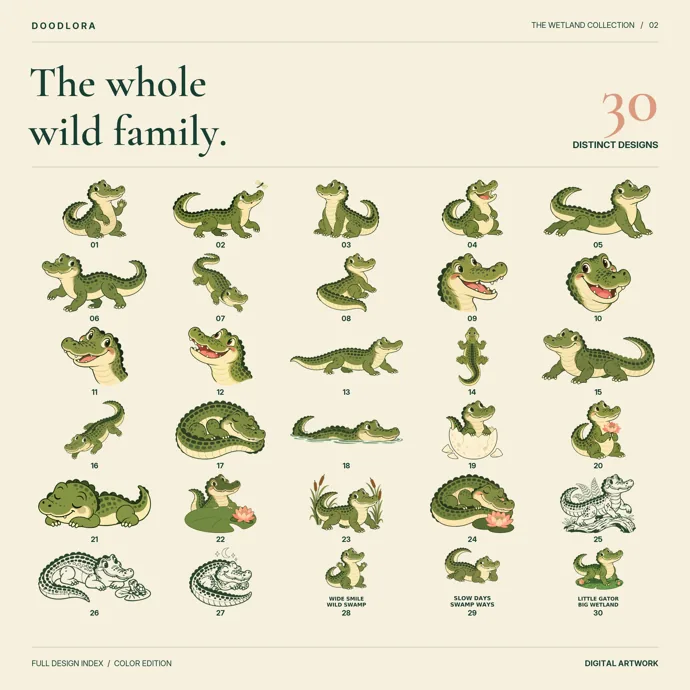
The cartoons do get two features right. The snouts end in a wide, rounded tip, and in the closed-mouth poses the few teeth that show hang down from the upper jaw. That’s how a real alligator’s mouth looks when shut. A picture like this works for practicing the snout and teeth checks, as long as you tell kids the real animal is much darker. Clipart comes as full-color art, line art, outlines and silhouettes, and the explainer on clipart types and file formats explains what each type is for.
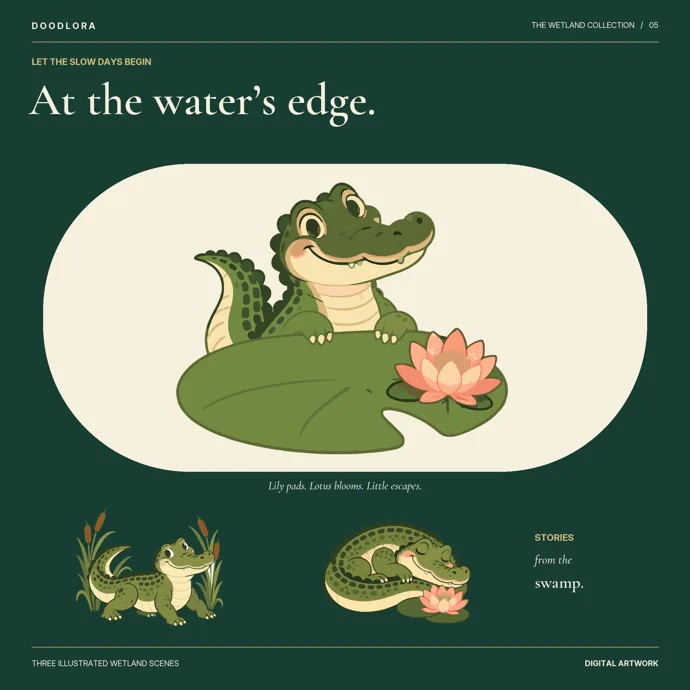
Open mouths are a different story. Once the jaws are apart, teeth show on top and bottom for both animals, so the closed-mouth tooth check tells you nothing. Keep the grinning heads for drawing practice and use a closed-mouth picture for the quiz.
How to explain alligator vs crocodile to kids
Kids remember the difference best when they get one clue at a time and a picture to point at. You don’t need a trip to a swamp: two pictures, a pencil and 10 to 30 minutes are enough, depending on age. Pick the version below that matches the child, and keep the safety lesson for the section on seeing the real animals.
Ages 3 to 5: one clue, the letter in the nose
For preschoolers, teach only the snout. Say: “An alligator’s nose is round, like the letter U. A crocodile’s nose is pointy, like the letter V.” Write a big U and a big V on two index cards. Show a picture, and let the child hold up the card that matches. Five to ten minutes is plenty. Finish by having the child trace a U around the nose of an alligator picture. The alligator letter A craft is a good follow-up the same week, since the A turned on its side becomes a pair of jaws.
One thing to watch: a preschooler who has only seen green cartoons may decide every green reptile is an alligator. Add one more sentence: “Real alligators are dark, almost black.”
Ages 6 to 9: four clues and a comparison card
School-age kids can handle the whole chart, and making a comparison card helps it stick. The activity takes 20 to 30 minutes for one child or a small table group.
You’ll need:
- One printed cartoon alligator per child; a line-art gator works best because the child chooses the color
- A blank half sheet of paper next to it
- Crayons or colored pencils, including dark gray and black
- A pencil for labels
Steps:
- Color the alligator dark gray or black, the way a real adult looks.
- On the blank half, draw a crocodile with the same body but a narrower, pointed snout.
- Add one tooth sticking up from the lower jaw on each side of the crocodile’s mouth.
- Label each animal: “U snout, fresh water” under the alligator and “V snout, salt water” under the crocodile.
- Swap cards with a partner and quiz each other: cover the labels and name the animal from the snout.
The common slip is drawing a full row of upper and lower teeth on both animals. Remind kids that the alligator hides its lower teeth when its mouth is closed. If the child wants a colorful card instead, a green crocodile is closer to life than a green alligator.
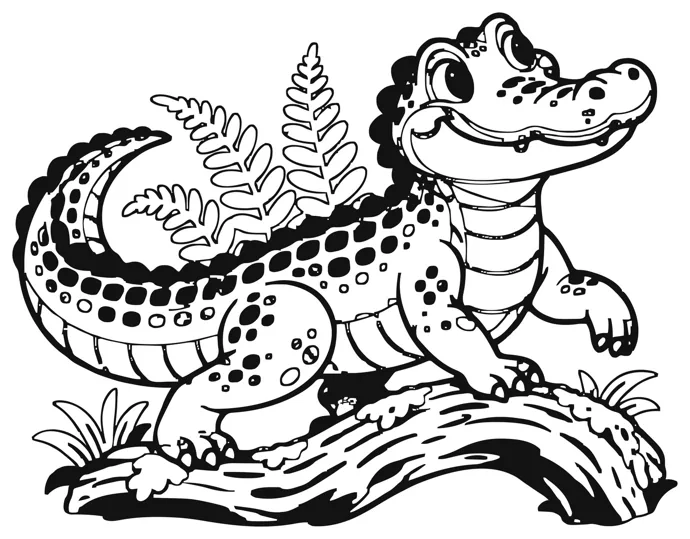
That gator is design 25 in the set, saved as an SVG, a transparent PNG, a DXF and an EPS. The canvas is 12 by 10 inches, larger than letter paper, so print the PNG with your printer’s fit-to-page setting turned on. Look closely before you hand it out: a few lines in the mono outline have small breaks, and markers can creep through those gaps. Crayons or colored pencils keep the color inside better. If you’re stocking a table for a younger child, see coloring supplies sorted by age.
Ages 10 and up: same shape, different families
Older kids can go past looks to why the two animals are so alike. Alligators and crocodiles both belong to a group called crocodilians, and the Park Service counts 23 species worldwide. Only 2 of them are native to the United States. They sit in separate families, though: alligators and caimans in one, true crocodiles in another. Wikipedia notes that DNA studies place crocodiles closer to gharials than to alligators.
A few facts work well as report starters:
- Only two living species are usually called alligators: the American alligator and the Chinese alligator, which lives in the lower Yangtze River region of eastern China.
- The American alligator recovered after legal protection began in 1967, yet the federal government still lists it as threatened because it looks so much like the American crocodile. The listing keeps hunters from mistaking one for the other.
- An alligator has 74 to 80 teeth at a time and replaces them as they wear down, which can add up to 3,000 teeth in a lifetime, according to the Smithsonian’s National Zoo.
Where to see alligators and crocodiles in the United States
South Florida is the only place where the two species live together. The Everglades park describes it as the meeting point of two ranges: alligators there are at the southern edge of theirs, and American crocodiles are at the northern edge of theirs. Alligators also live across the Southeast, from North Carolina to Texas, so many families can see one without going to Florida.
South Florida parks
In Everglades National Park, alligators are more numerous and typically live in fresh water, while the rarer crocodiles keep to coastal, brackish and salt water. Next door, Big Cypress National Preserve names the H.P. Williams Roadside Park, the Big Cypress Swamp Welcome Center and the Oasis Visitor Center as good spots for viewing alligators. The Oasis area draws alligators especially in the dry season, usually December through May. Crocodiles are much harder to find. Big Cypress reports only a few sightings in the preserve and says crocodiles are found mainly near Key Largo and in Florida Bay.
Zoos
A zoo is the easiest place for kids to compare the two up close and safely. The Smithsonian’s National Zoo in Washington, D.C., lists American alligators, Cuban crocodiles and Chinese alligators at its Reptile Discovery Center. The Cuban crocodile is a different species from the American one, but the snout and tooth checks still work. Check the zoo’s site before you go, since exhibits change.
Safety rules from the National Park Service
Everglades National Park asks visitors to stay 15 to 20 feet (4.5 to 6 meters) from wildlife and from the shoreline. Both alligators and crocodiles can move fast, and the park says they should never be approached. Its other rules are worth reading to kids before a visit:
- Keep small children and pets away from shorelines and from any alligator or crocodile basking in the sun.
- Never feed or bother them. Feeding is a criminal offense in the park and illegal anywhere in Florida.
- A gator lying still for hours isn’t dead or fake. Reptiles warm themselves in the sun and can move again at any moment.
- A crocodile resting with its mouth open is regulating its body temperature, not threatening anyone, but the distance rule still applies.
Quick answers to common alligator and crocodile questions
Which is more dangerous, an alligator or a crocodile?
Neither is safe to approach. Wikipedia’s crocodile article says true crocodiles show much higher levels of aggression than other crocodilians, and the Smithsonian’s National Zoo says alligators are generally thought to be calmer. American crocodiles in particular are shy, and the Everglades park says conflict with people rarely happens. The fearsome reputation belongs mostly to larger crocodile species in Australia and Africa.
Which one grows bigger?
The American crocodile can reach the greater length. Male crocodiles can grow to about 20 feet, though in the wild they rarely pass 14 feet. Adult male alligators average about 11.2 feet and females about 8.2 feet, and the Smithsonian’s National Zoo says the largest adults pass 12 feet.
Is a caiman a kind of alligator?
A caiman belongs to the alligator family, but it isn’t called an alligator. The Smithsonian’s National Zoo counts eight species in the alligator family and only two that go by the name alligator.
Printables from this article
Related articles
Clipart & SVG Cut Files
How to Draw a Truck: Easy Pickup, Big Rig and Cartoon
Split a pickup into three parts before you draw a single wheel: a bed, a cab and a hood. Keep the roof about 2.2 wheels tall and the bed rail level with the hood, and the truck looks right even before the details go on.
Clipart & SVG Cut Files
How to Draw a Train: Steam Engine, Cars and Tracks
Split the page into a 10-square grid, lay a long boiler tube across the middle, set a box cab at the back and a tall stack at the front, hang two big driving wheels under the cab end, then couple cars behind and run the rails to a vanishing point.
Clipart & SVG Cut Files
Hawk vs Falcon: Wings, Size, Hunting Style and Eagles
A falcon has long, narrow wings that taper to sharp points and flies on steady, quick wingbeats; a hawk has broader wings with rounded tips and either soars in slow circles or flaps hard and glides. Falcons kill with a notched beak and hawks with their talons, and eagles are the largest, heaviest-billed members of the hawk family.