Moon Phases Games for Kids: 8 Phases in Order & Activities
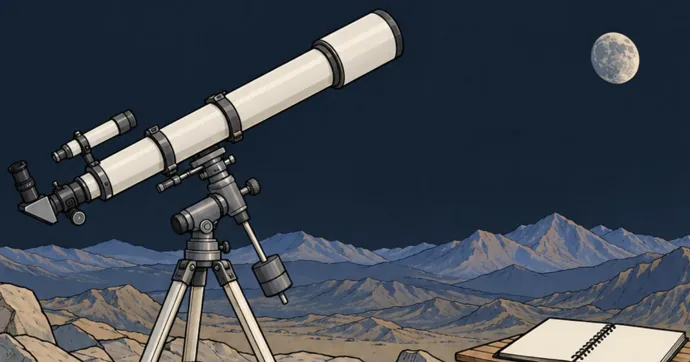
What are the phases of the Moon? They are the shapes of the Moon’s sunlit part as seen from Earth, and NASA lists eight of them in order: new Moon, waxing crescent, first quarter, waxing gibbous, full Moon, waning gibbous, third quarter and waning crescent. The Sun always lights half of the Moon. As the Moon circles Earth, more or less of that lit half turns toward us, and the whole cycle repeats about every 29.5 days.
That one idea, a ball lit from one side and seen from different angles, is what every game below practices. The early games teach the names and the order with cards and movement. The later ones use a lamp and a foam ball to show why the shapes change, and a month of real sky to check it. None of them needs a screen.
The 8 phases of the Moon in order
The order starts at the new Moon, when we can’t see the Moon at all, and grows to the full Moon in about two weeks. Then it shrinks back. NASA’s Space Place gives two words that make the order easy: waxing means the lit part is getting bigger, and waning means it is getting smaller. Crescent is a thin curved sliver, and gibbous is anything between a half and a full circle.
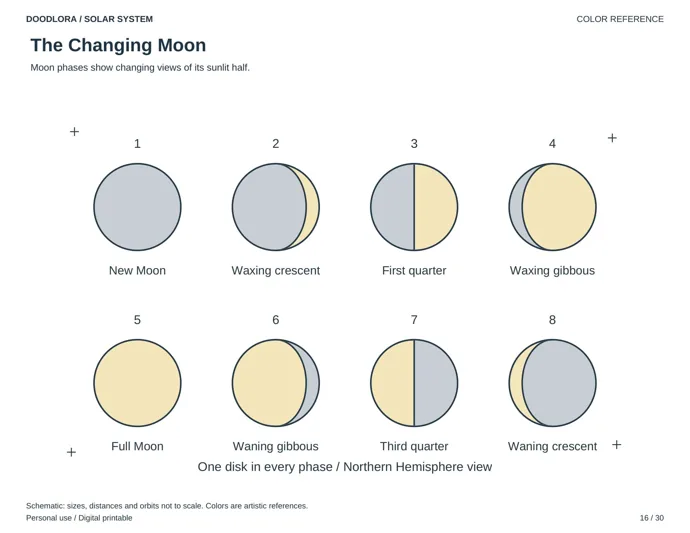
| # | Phase | What you see in the Northern Hemisphere | When it’s in the sky |
|---|---|---|---|
| 1 | New Moon | Nothing; the dark side faces us | Rises and sets with the Sun, but can’t be seen |
| 2 | Waxing crescent | A thin sliver lit on the right | Rises in the morning, sets after sunset |
| 3 | First quarter | The right half lit | Rises around midday, sets around the middle of the night |
| 4 | Waxing gibbous | More than half lit, still growing | Rises in the afternoon, sets before sunrise |
| 5 | Full Moon | The whole face lit | Rises at sunset, sets at sunrise |
| 6 | Waning gibbous | More than half lit, now shrinking | Rises after sunset, sets in the morning |
| 7 | Third quarter | The left half lit | Rises around the middle of the night, sets around midday |
| 8 | Waning crescent | A thin sliver lit on the left | Rises before sunrise, sets in the afternoon |
The rise and set times are NASA’s rough patterns for most latitudes. Those patterns explain why a child may spot a half moon on the way to school and never see a full moon in the afternoon. For an exact night, check a local moonrise table.
Two names trip kids up. The first quarter and third quarter look like half circles, but they are named for how far the Moon is through its monthly trip. NASA points out that the third quarter is also called the last quarter, so a worksheet may use either name.
The left and right in the table hold for the United States and the rest of the Northern Hemisphere. Wikipedia’s lunar phase article notes that viewers in the Southern Hemisphere see each shape turned around, so a waxing crescent there is lit on the left. If a cousin in Australia describes the Moon backwards, both of you are right.
Why the Moon’s shape changes, explained by age
The Moon makes no light of its own. NASA describes moonlight as sunlight reflected off the Moon’s surface, with the Sun always lighting one half and the other half dark. The Moon’s shape never changes. What changes is how much of the bright half faces us as the Moon moves around Earth.
Pick the version that matches what the child already knows. A 4-year-old needs one picture in their head, while a fifth grader can handle two numbers and a common mistake.
Ages 3 to 5. “The Sun lights up the Moon the way a lamp lights up a ball in a dark room. The Moon goes around and around us, so some nights we see lots of the bright side and some nights only a little.”
Ages 6 to 8. Half of the Moon is always lit, the side facing the Sun. When the Moon is between us and the Sun, the lit half faces away and we see a new Moon. When the Moon is on the far side of Earth from the Sun, the lit half faces us and we see a full Moon. Everything in between is a crescent, a quarter or a gibbous.
Ages 9 to 12. One trip around Earth takes the Moon about 27.3 days. Getting from one new Moon to the next takes longer, about 29.5 days, because of how sunlight hits the Moon as Earth moves too. The phases are not Earth’s shadow, a mistake Wikipedia’s lunar phase article lists among the common ones. Earth’s shadow only lands on the Moon during a lunar eclipse.
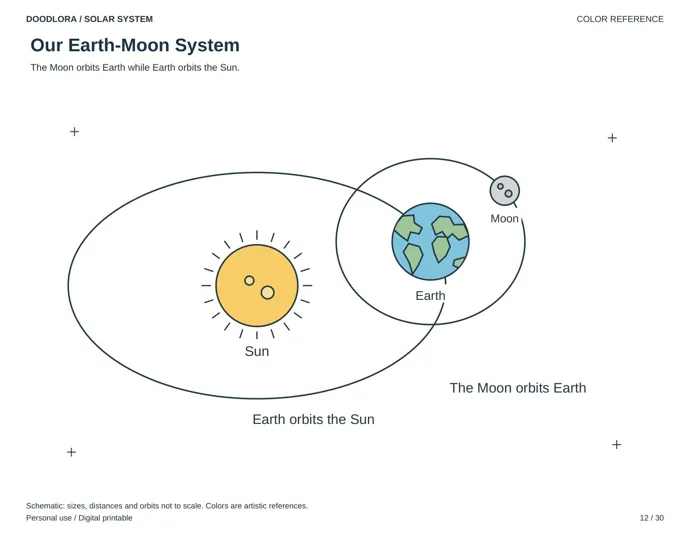
A diagram like this one helps older kids place the three bodies before the lamp-and-ball model. Ask them to point to where the Moon would sit for a full Moon, then for a new Moon. NASA’s numbers for the Moon’s distance, size and gravity, with lines to read aloud, are collected in space facts for kids.
Choose a moon phase game by age, group and time
Most of these games need paper, a set of phase cards or a lamp. Treat the ages and times as rough planning numbers for an adult running the game, not measured results, and stretch or shorten them for your group.
| Game | Ages | Players | Time | What you need |
|---|---|---|---|---|
| Full Moon, new Moon | 3–5 | 3–20 | 5 min | Open floor space |
| Daytime Moon hunt | 4–8 | Any | 5 min | A window or yard |
| Phase name match | 5–9 | 1–4 | 10–15 min | 16 cards |
| Waxing or waning? | 6–10 | 2–30 | 5–10 min | 8 phase cards |
| Phase order race | 6–10 | 2–4 teams | 5 min a round | 8 cards per team |
| Human moon line-up | 6–10 | 8 or more | 10 min | 8 large cards |
| Moon phase bingo | 6–11 | 3–30 | 15–20 min | 4×4 cards, clue list |
| Lamp-and-ball model | 8–13 | 1–30 | 20–30 min | Lamp, foam balls, pencils |
| Flashlight model at home | 6–10 | 1–2 | 15 min | Flashlight, ball |
| Spot the eclipse | 9–13 | 1–30 | 10 min | The lamp-and-ball setup |
| Real Moon or storybook Moon? | 6–11 | 1–6 | 15 min | Picture books, one coloring page |
| Moonrise quiz | 9–12 | 2–30 | 10 min | The phase table above |
| Moon log for a full cycle | 6–12 | 1 or more | 2 min a night for a month | A 30-box sheet |
Start a younger group with the movement game and the cards. Older kids get the most from the lamp model, then the moon log, which checks the model against the real sky.
Moon games for preschoolers: shapes and the daytime Moon
Preschoolers don’t need the eight names yet. Two shapes, a full circle and a thin crescent, plus the idea that the Moon looks different on different days, is plenty. Keep the games short and physical.
Full Moon, new Moon
Have the children spread out with room to stretch their arms. When you call “Full Moon!” they make a big circle with both arms over their heads. “Crescent!” means one arm curved like a letter C, and “New Moon!” means crouching down and covering their eyes, because the new Moon is the one we can’t see. Call the shapes in a mixed order for three or four minutes.
Add “half Moon” once the three shapes are easy: one arm straight up and one hand flat against it. End on “New Moon!” so the group finishes crouched and quiet, which makes a calm handover to the next sitting activity. Three to twenty children works, and the adult calling doesn’t need any props.
Daytime Moon hunt
Many young children think the Moon only comes out at night. NASA says it is often visible during the day as a faint, pale shape, and the table above shows when. A first quarter Moon rises around midday, so on those days it is often up during an afternoon walk or after school.
Stand at a window or in the yard and ask the children to find the Moon and tell you its shape. Keep one rule firm: never look at the Sun. NASA’s eye-safety page says it is not safe to look directly at the Sun without special solar eye protection, so turn the children so the Sun is behind them or blocked by a building before they search.
If the Moon isn’t up, that is a result too. Ask “Where do you think it went?” and try again in a few days. Preschoolers who want a nightly version can keep the 14-box moon diary from space activities for preschoolers, drawing the shape each evening for two weeks.
Card games for learning the phase names and order
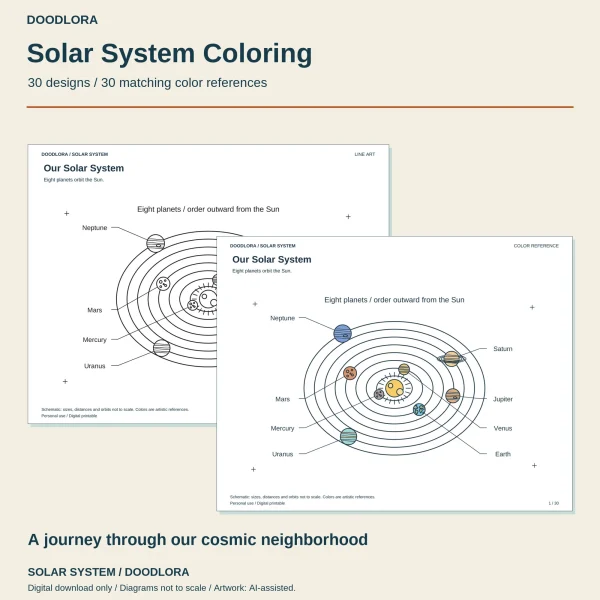
Once kids are about 5, cards turn the names into a game. You need a set of eight phase pictures and, for some games, eight name cards. Page 16 of our solar system coloring pages has all eight phases on one landscape sheet, numbered, with the names printed under each disk. The disks come out about 1.4 inches across on US Letter, so one sheet makes a small card set.
One snag on that page matters for every game here. In the line art, disk 2 (waxing crescent) and disk 6 (waning gibbous) carry the same curved line, and so do disks 4 and 8 and the two quarters. The new Moon and full Moon are both plain circles. Only the shading tells them apart. Have kids color the dark part gray using the color version as a guide, or print the color version for the cards. A teacher may print these pages for their own class, and a school may print them for its own activities, under our personal license.
Phase name match
Make 16 cards: the eight colored disks cut away from their labels, and eight name cards written on paper strips. Shuffle them face down in a 4-by-4 grid. Players take turns flipping two cards and keep a pair when a picture matches its name. The one with the most pairs wins. A game for two to four players takes 10 to 15 minutes.
Card stock matters. On thin paper, a dark gibbous shows through the back and gives the answer away. Turn order, scoring and how to print a deck that doesn’t show through are all in the memory game rules. For a child playing alone, lay the pictures face up and match the names to them against a timer.
Waxing or waning?
Hold up one phase card at a time. The group calls “Growing!” for a waxing phase and “Shrinking!” for a waning one. In the Northern Hemisphere the rule of thumb is that a Moon lit on the right is growing and a Moon lit on the left is shrinking. Five to ten minutes covers several rounds with a whole class.
The new Moon and full Moon are the trap cards. Neither one is growing or shrinking at that moment, so agree on a third call, such as “Turn around!”, before you start. Kids who learn the rule this way will be confused by pictures made in Australia or South America, so mention that the left-right rule flips south of the equator.
To finish, run one last round where a wrong call means sitting down, and end on the full Moon card so the last few standing all get a cheer.
Phase order race
Give each team of two or three a shuffled set of the eight picture cards. On “Go,” they lay the cards in order from new Moon to waning crescent. The first team to finish raises their hands, and everyone checks the row against the chart. Play best of three, and each round takes about five minutes with checking.
Because the phases run in a circle, a team may start at the full Moon and still have the order right. Decide before you start that every row begins at the new Moon, or accept any start that keeps the order going around. The usual wrong move is swapping a crescent and a gibbous on the same side, so check those pairs first.
Moon phase games for a whole class
A class of 20 to 30 needs games where everyone plays at once. The two below work at circle time or on a classroom floor, and both reuse the same phase pictures.
Moon phase bingo
Bingo needs more squares than there are phases. With only eight phases, a 3-by-3 card with a free center holds the same eight pictures on every card, just in a different order. Lines come too fast, ties are common, and a full-card game always ends with every card filled on the same call. Use a 4-by-4 grid instead and fill each card from a list of about 24: the eight phase pictures plus 16 moon words such as Sun, Earth, orbit, crater, sunlight, moonlight, waxing, waning, crescent, gibbous, moonrise, lunar eclipse, solar eclipse, telescope, astronaut and 29.5 days.
The caller reads a clue instead of a name. “The Moon is between us and the Sun, and we can’t see it” is the new Moon. “The left half is lit” is the third quarter. A line of four wins. Allow 15 to 20 minutes for a class. For making many different cards by hand or in a spreadsheet, see our steps on how to make bingo cards.
Human moon line-up
Print the eight phase pictures large, one per sheet. Hand them to eight children in a mixed order and ask them to line up in phase order without talking. Everyone else checks the line against the chart and calls out any swap. Then collect the cards, shuffle, and hand them to a new eight. With a class of 24, everyone gets a turn in about ten minutes.
For a harder round, put one child in the middle to play Earth, and have the eight card holders stand in a circle around them. A ninth child holds a paper Sun and stands outside the circle, off to one side. The new Moon card must stand nearest the Sun, and the full Moon card farthest away, on Earth’s far side. That turns the line-up into a rough map of where the Moon is for each phase.
The lamp-and-ball model: seeing why the shape changes
A lamp, a white ball and a dark room show the phases better than any picture. NASA runs this model in its classroom activity for grades 3 to 8, with the bulb as the Sun, the ball as the Moon and each student as Earth.
Classroom version with one lamp
You need a lamp with the shade taken off, set in the middle of a darkened room, and a white foam ball 3 inches (7.6 cm) or larger on a pencil for each student. Move desks aside so students can turn freely. An adult sets up the lamp and keeps the cord out of the walking path. A bare bulb can get hot, so tell kids before the lights go off that nobody touches the lamp or the bulb. For children under about 8, an adult pushes the pencils into the balls.
Follow NASA’s order. Each student holds the ball at arm’s length, a little above eye level.
- New Moon. Face the lamp. The lit side of the ball faces away from you, so you see a dark ball.
- Waxing crescent. Turn your body to the left, counterclockwise, about 45 degrees. A thin crescent lights up on the right edge of the ball.
- First quarter. Keep turning left until you are 90 degrees from where you started. The right half of the ball is lit.
- Waxing gibbous. Keep turning, and more of the ball lights up.
- Full Moon. Turn until the ball is directly opposite the lamp, with your back to the light. Hold the ball high enough that your head doesn’t block the light, and you see the whole face lit.
- Waning gibbous. Keep turning, and the lit part starts to shrink.
- Third quarter. Three-quarters of the way around, the left half is lit, the opposite side from the first quarter.
- Waning crescent. The lit part shrinks to a sliver, and you are back facing the lamp.
The most common problem is turning the wrong way. Turning right runs the phases backwards, so call “Turn left” at every step. NASA also reminds students that the turn they make in a few minutes takes the real Moon about a month. Plan on 20 to 30 minutes, including a second slow lap where students name each phase out loud.
Flashlight version at home
For one or two kids, a flashlight or a desk lamp with no shade works in a dark room. One person holds the light still at chest height and plays the Sun. The child stands a few steps away, holds a ball on a pencil or in an outstretched hand, and turns slowly to the left, naming each shape. Any light-colored ball works, though a smooth white one shows the edge between light and dark best.
A flashlight beam is narrower than a lamp’s glow. If the ball drifts out of the beam, the Sun-holder should aim at the ball and keep the flashlight in the same spot. About 15 minutes is enough, and swapping roles at the end lets the child see the Moon from the Sun’s side.
Moon phase challenges for ages 9 to 12
Older kids who know the names are ready to test them. These three challenges ask them to use the model, a picture and the timing table to reason things out.
Spot the eclipse
Set up the lamp-and-ball model again. Ask the class to find the one position where the ball goes completely dark because their head is in the way. That happens at the full Moon spot, when the head blocks the light, and NASA uses this exact move to show a lunar eclipse. Holding the ball in front of the lamp at the new Moon spot shows a solar eclipse.
Then ask the real question: if a full Moon comes every month, why don’t we get an eclipse every month? Wikipedia’s lunar phase article gives the answer. The Moon’s orbit is tilted by about 5 degrees, so the Moon usually passes a little above or below Earth’s shadow. Have students tilt their arm slightly so the ball passes over their head’s shadow. Ten minutes covers it.
Real Moon or storybook Moon?
A real crescent always has its bright, rounded edge facing the Sun, because the Sun lights the side of the Moon that faces it. Artists ignore this all the time, which makes a good puzzle. Hand out picture books, greeting cards or posters with a Moon in them and ask: could this Moon really happen?
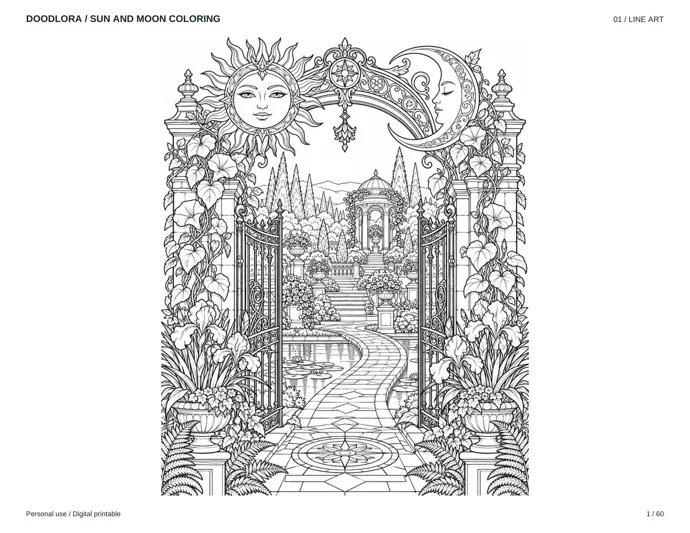
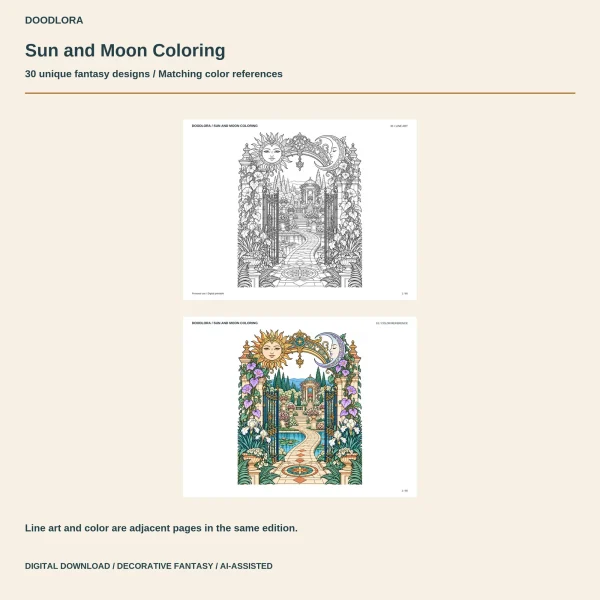
A ready example opens the sun and moon coloring pages: design 01, a garden gate. The sun sits at the upper left, but the crescent’s rounded edge bulges toward the right, away from the sun. The set’s own notes call the designs decorative fantasy, not astronomy, so this isn’t a mistake in the art. It is simply a Moon that the sky can’t make. The drawing is fine and busy, so older kids can color it and write one sentence on the back saying what would make it real, while younger ones just circle the sun and the moon and draw an arrow from one to the other.
Other storybook clues to look for are a full Moon high in the sky next to a midday sun, since NASA says a full Moon rises at sunset, and a crescent in the middle of the night. Allow 15 minutes, and let small groups share their best find.
Moonrise quiz
Read a situation and let teams answer from the phase table. “You see a half Moon high in the sky at 7 in the morning. Is it first quarter or third quarter?” (Third quarter, which rises around the middle of the night and sets around midday.) “Your family goes out at midnight and sees a big round Moon. Which phase?” (Full Moon, up from sunset to sunrise.)
Write six to eight questions and give a point for the phase and a bonus for the reason. The quiz takes about ten minutes. It turns the table into something kids use, and it prepares them to predict the Moon before they step outside for the log below.
Keeping a moon log for one full cycle
Every game so far uses cards or a model. The moon log checks all of it against the real sky. NASA’s classroom activity ends with a 30-day observation sheet, and that length covers one full cycle of about 29.5 days.
The 30-box moon log
Draw 30 boxes on a sheet, or 15 boxes on each of two sheets, and write the date above each box. Each evening, or at any time the Moon is up, the child draws the shape, writes the time, and notes where it was: low or high, and over which house, tree or street. Two minutes a night is plenty. Start at a new Moon so the log runs in the same order as the cards.
Clouds will block some nights, and the Moon won’t be up at bedtime for part of the month. NASA’s sheet handles both: on cloudy nights, note the weather and use the phase chart to work out which phase it should be. NASA also says the Moon rises a little later every day, which is why the evening Moon seems to disappear after the full Moon and turns up in the morning sky. Ages 6 and up can keep the log with an adult outside.
Look along the line between light and dark
For kids 9 and up with binoculars, the best views come in the evenings around the first quarter. Look along the edge where the lit part meets the dark part. Near that edge, sunlight comes in low, so craters and mountains cast long shadows and stand out.
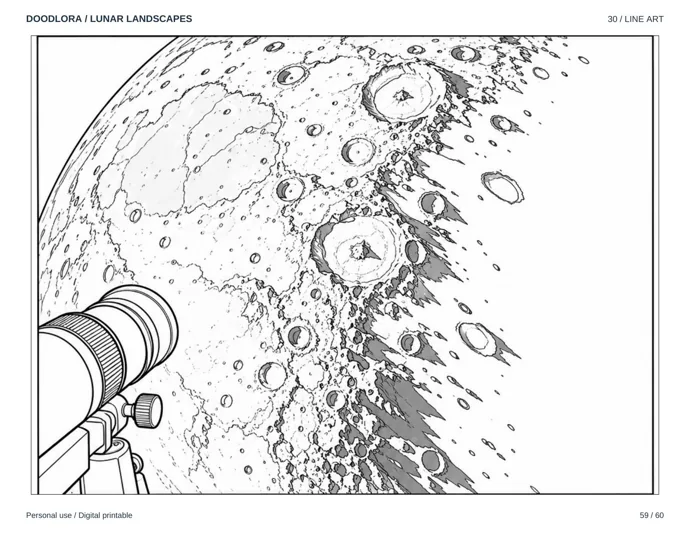
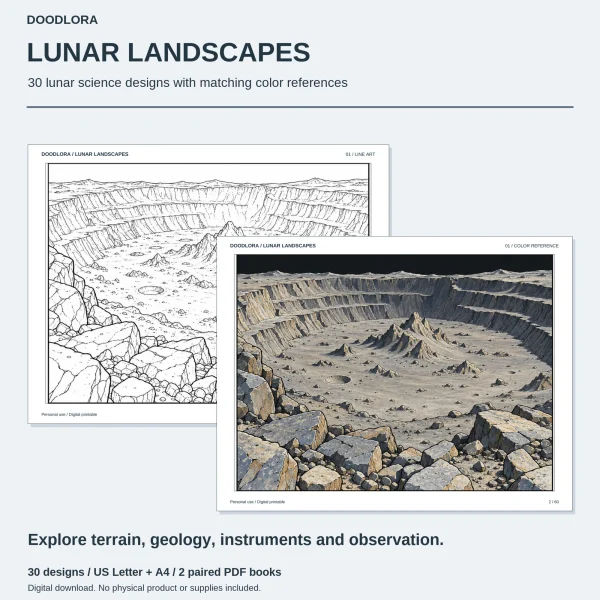
Design 30 of our moon coloring pages draws exactly this view, with deep shadows stretching away from the boundary. The set is made for teens and adults, with fine detail, so it suits a patient 10-year-old who wants to color what they just saw. Binoculars must never point at the Sun. NASA warns that viewing the Sun through binoculars without a special solar filter is unsafe, so only bring them out after sunset.
Putting the games together over one month
The games fit together best when they follow the real Moon. Look up the date of the next new Moon, then use it as day one.
In the first few days, before the Moon is easy to see, play the movement game or the card games to learn the names. When the waxing crescent appears in the evening sky, start the moon log. Around the first quarter, run the lamp-and-ball model, since the half-lit Moon in the evening sky matches what kids just saw on the ball.
Save bingo and the moonrise quiz for the week around the full Moon, when kids have a few log entries to draw on. Finish with “Real Moon or storybook Moon?” near the end of the cycle. By then a child can look at any crescent and say which side the Sun is on. For crafts that pair with the same lessons, such as a turning phase wheel, a phase garland and cookie phases, see our moon crafts.
Printables from this article
Related articles
Printable Coloring Pages
Types of Christmas Trees: Fir, Spruce, Pine, Real vs Fake
Most real Christmas trees sold in the US are firs, spruces, pines or cypress. Firs have soft needles and the strongest scent, spruces have stiff branches for heavy ornaments, pines hold their needles longest, and Leyland cypress has almost no scent. Here is how each one looks, smells and lasts, and how to keep it fresh and safe.
Printable Coloring Pages
How to Draw a Strawberry: Easy, Cut, Cute and Realistic
Build the berry from a cone with wide shoulders, lay the cap over the top, set the seeds in offset rows that shrink toward the edges, save a white shine spot, and then try a cut berry, a cute face or a shaded realistic one.
Printable Coloring Pages
The 5 Food Groups: MyPlate, the Food Pyramid and Examples
The five food groups the USDA's MyPlate used from 2011 to January 2026 are fruits, vegetables, grains, protein foods and dairy. Here is what MyPlate listed in each one, the foods that land in a surprising group, how the food pyramid turned into MyPlate and then a new pyramid, and a sorting activity built on coloring pages.