 1 / 10
Solar System Coloring Pages: 30 Labeled Diagrams from Planet Order to Eclipses, Moon Phases and a Mars Rover
Each page is a labeled diagram that shows how part of the solar system works, from the order of the planets to why a solar eclipse happens. The shapes are simple and roomy, and a numbered color version comes with every page.
$3.99
Buy any 3 or more printables and save 20% at checkout.
- Download right after payment — link works for 30 days, up to 5 downloads
- Files arrive as a ZIP with your license PDF inside
- Secure checkout by Stripe · Refund policy
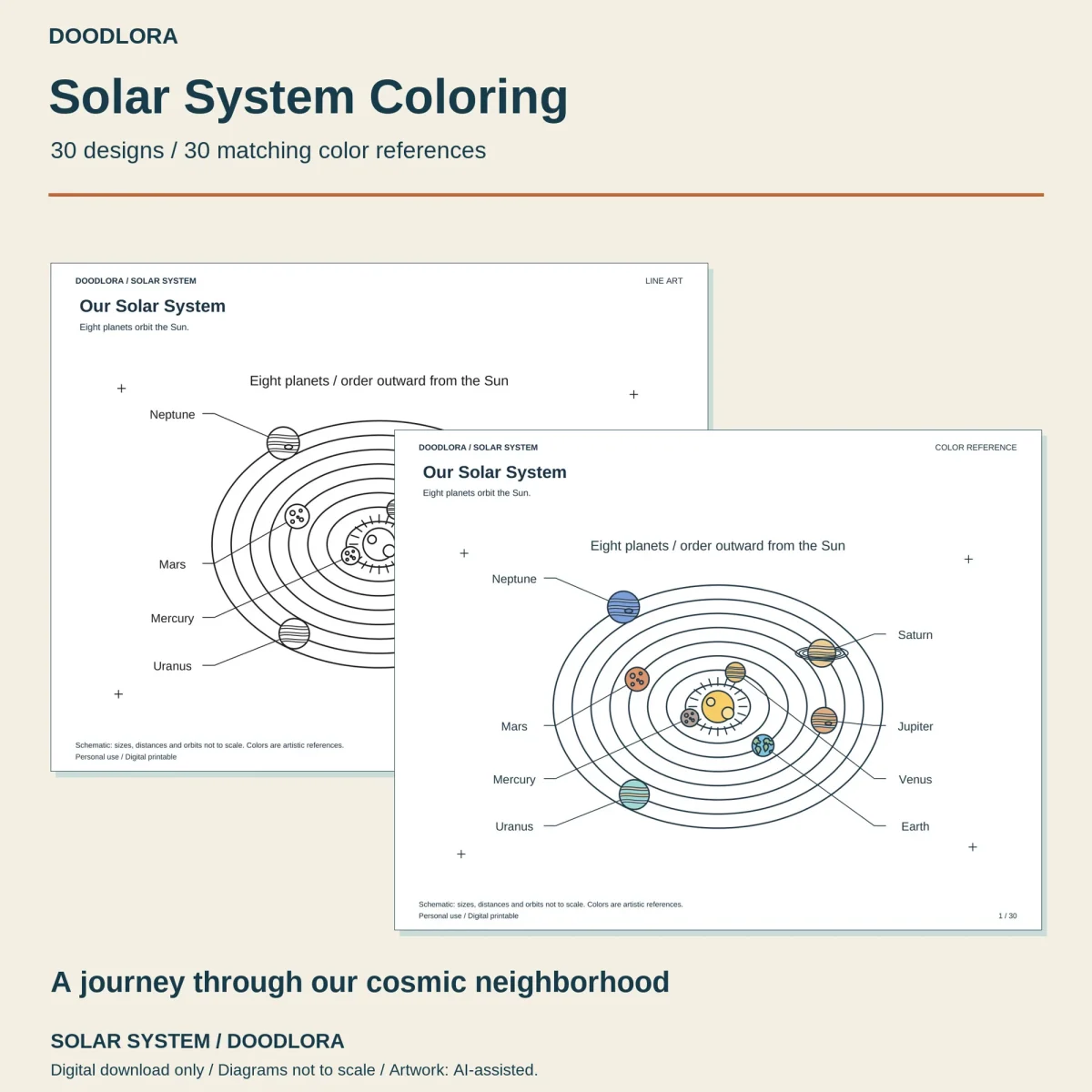
This solar system set teaches with labels. Every one of the 30 landscape pages is a small diagram with its parts named in print, a title and one sentence at the top, such as “Earth can pass between the Sun and the Moon” over the lunar eclipse. The planets are simple round shapes with a few stripes or craters, and there is plenty of open white space to fill.
What the diagrams cover
| Pages | Topic |
|---|---|
| 1–6 | The eight planets in order, the rocky inner planets, the gas giants, the ice giants, and the inner and outer groups |
| 7–9 | The main asteroid belt, the dwarf planet Ceres with an orbiter, and Pluto, Charon and the icy bodies beyond Neptune |
| 10–13 | The Sun’s gravity, spin versus orbit, Earth and Moon together, and day and night |
| 14–17 | A solar eclipse, a lunar eclipse, eight moon phases, and Earth at four points in its year |
| 18–20 | A comet with its tail pointing away from the Sun, asteroid versus comet, and meteoroid, meteor and meteorite |
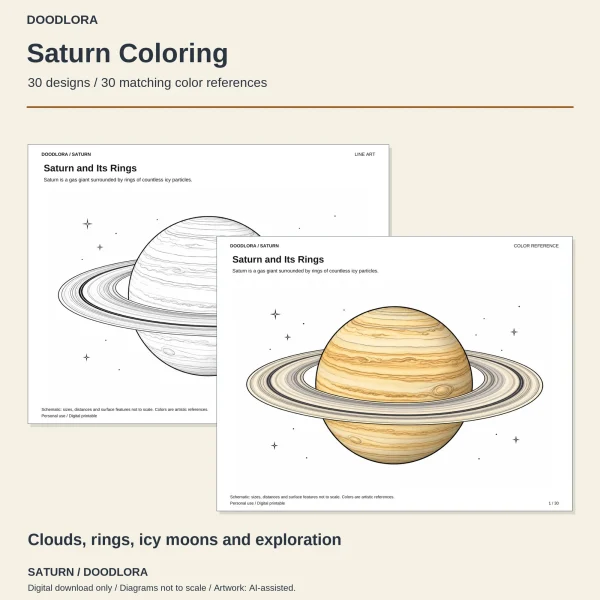
| 21–23 | Jupiter with Io, Europa, Ganymede and Callisto, Saturn with Titan, and a tilted view of the planets’ orbits |
| 24–30 | Ways of exploring: a flyby past Neptune, an orbiter mapping Mars, a Mars rover, a sample return, a radio dish receiving data, telescope, orbit and surface views, and a science lab |
The spacecraft on pages 8 and 24 to 29 are generic designs. The start-here notes call them concepts, not plans for any particular spacecraft.
Where the drawings simplify
The page footer repeats that nothing is to scale. Jupiter and Saturn sit next to Mercury at a similar size on the order pages, and the orbits are evenly spaced ovals. On the two eclipse pages the shadow is drawn as labeled umbra and penumbra cones, which is the point of the diagram, not the real proportions.
Pages where the color version helps most
On page 16 the outline only marks where light meets shadow on each moon disk. The color reference shades the dark part gray and the lit part cream, so you can see which side to fill for a waxing or waning phase. Page 13 does the same for day and night, and the eclipse pages shade the shadow cones. Print the line art at Actual Size with the paper turned landscape; A4 has the same 30 diagrams.
Questions
- Are the sizes and distances accurate?
- No. Every page says sizes, distances and orbits are not to scale, and the colors are artistic suggestions rather than calibrated science colors. The diagrams are there to show order and relationships.
- Which way do the moon phases face?
- Page 16 draws the eight phases as seen from the Northern Hemisphere, which the page itself states.