 1 / 7
Moon Coloring Pages: 30 Lunar Landscapes of Craters, Rilles, Lava Tubes and Robotic Explorers
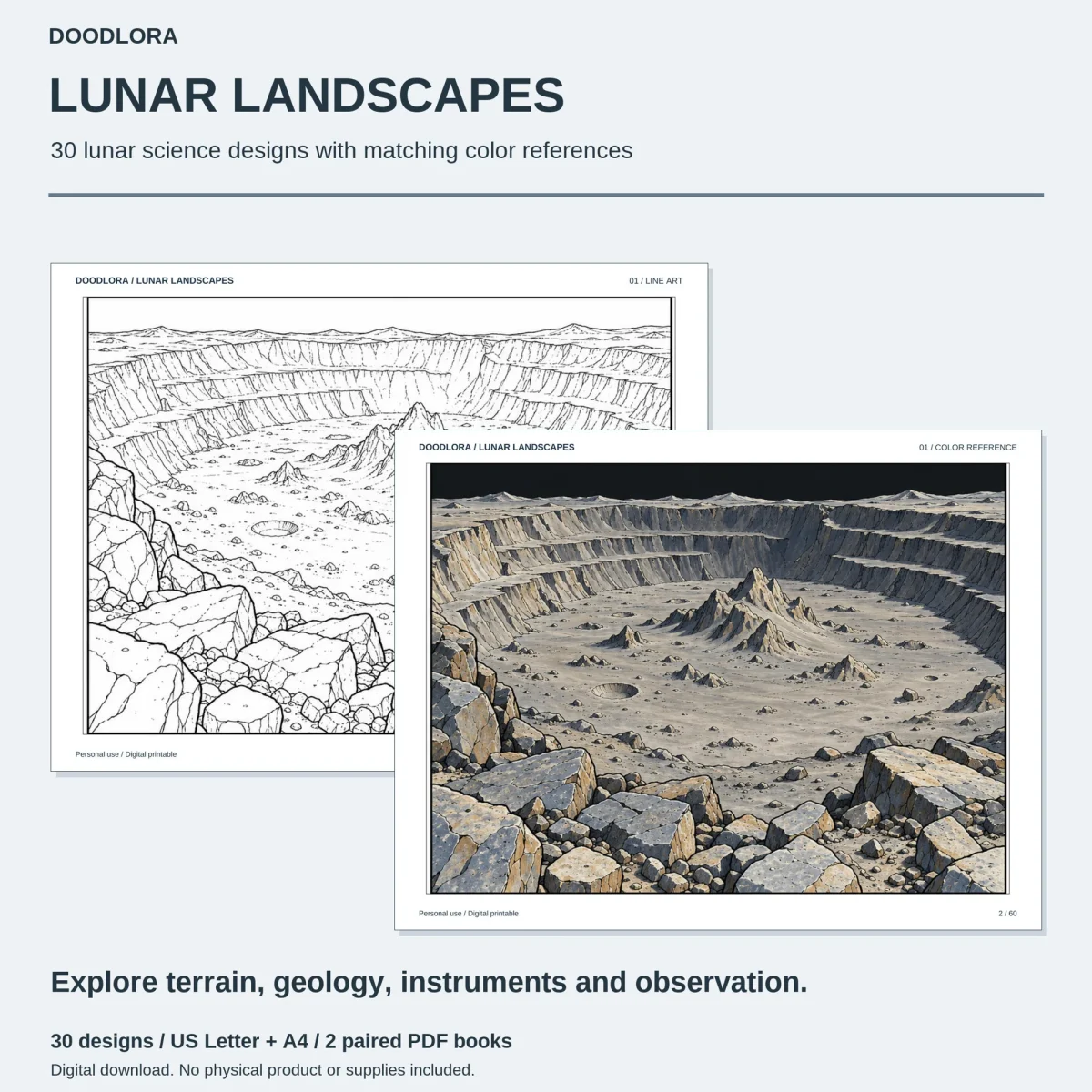
Thirty framed lunar landscapes where the ground itself is the subject: crater walls, lava plains, rilles, cracks and boulder tracks, with small rovers, suited explorers and instruments for scale. In the book, each drawing is followed by its color version.
$3.99
Buy any 3 or more printables and save 20% at checkout.
- Download right after payment — link works for 30 days, up to 5 downloads
- Files arrive as a ZIP with your license PDF inside
- Secure checkout by Stripe · Refund policy
These moon coloring pages look at the lunar surface up close, the way a geologist might. There’s no smiling crescent and no night sky over a rooftop. Each of the 30 designs is a framed, realistic landscape of rock, dust and craters, usually with big boulders filling the foreground.
The terrain designs
Craters get the most space: a terraced basin with central peaks (01), a lone mountain in a crater’s middle (06), bright rays of ejecta (07), a polar crater with a shadowed floor (12), a smooth floor of melted rock (14), a chain of small secondary craters (15), a sharp new rim beside a worn old one (17) and a cracked crater floor (18). The volcanic designs show a basalt plain with flow fronts (04), a winding rille (05), a broad dome (16) and a blanket of dark volcanic debris (19). Design 10 is a lava tube skylight seen from the rim, and 11 cuts the ground away to show the tube running underneath. There are also cratered highlands (08), a wrinkle ridge (09), a block of layered soil (02) and a slope where tumbling boulders have left a trail (13).
Small rovers or suited explorers turn up in 15 of the 30 designs, mostly small beside the rocks. The start-here notes describe the equipment as generic concepts, not a record of any mission that has flown.
Samples, instruments and observers
Designs 20 to 30 move to the tools. A dark basalt rock and a pale highland rock sit in trays under a magnifier, lunar soil grains are enlarged in a circle beside a microscope, a lander drills a core tube into the ground, and two orbiters measure the surface from above. Then come a small hopping robot, a domed seismometer, a laser reflector panel, a telescope with a sketchbook on Earth, a lunar globe on a desk of maps, and finally the cratered day-night line with a telescope tube poking into the corner.
What the pages show, and what the index adds
Each page carries only the drawing, a design number and a page count. The names and one-line science notes, such as “Maria are plains of ancient solidified basalt, not liquid seas,” are in the design index file, so keep it open while you color if you want to know what you’re looking at.
The color versions
The color page after each drawing uses grays and soft tans, with gold touches on the rovers and landers. Almost every outdoor scene has a solid black sky, so following them closely means filling a lot of black. The telescope scene on Earth is a navy night, and the globe sits on a warm wooden desk. Print the odd pages if you only want the line art.
Questions
- Does this set show the phases of the Moon?
- No. There are no phase diagrams and no crescent moons. Every design is the lunar surface or the tools used to study it. The nearest thing is design 30, the cratered line between day and night seen past the end of a telescope.
- How sharp are the drawings?
- Each one is a raster image about 1,024 pixels wide, spread across roughly 9.9 inches of the Letter page. The start-here notes say it is not vector art, so print at 100% rather than enlarging.