Monarch Butterfly Migration: Routes, Life Cycle and Facts
Where do monarch butterflies go in the fall? Monarchs that breed east of the Rocky Mountains fly south to about a dozen fir-covered mountain areas in central Mexico, some of them covering up to 3,000 miles (about 4,800 km). Monarchs from west of the Rockies fly to groves along the California coast instead. The ones that make the fall trip belong to a special late-summer generation that can live for months, while the trip back north is handed from one short-lived generation to the next.
The sections below follow that loop in order: the two routes, the long-lived fall generation, the winter roosts, the spring relay north, the four-stage life cycle and the two things anyone can do to help.
Eastern and western monarch migration at a glance
North America has two migrating groups of monarchs, split by the Rocky Mountains. The California Department of Fish and Wildlife (CDFW) describes them as genetically similar but with separate winter homes. This table compares them side by side.
| Eastern monarchs | Western monarchs | |
|---|---|---|
| Summer breeding range | Southern Canada and the northern and midwestern U.S. | West of the Rockies, fanning out from Arizona to Idaho |
| Winter destination | 11 to 12 mountain areas in the Mexican states of México and Michoacán | Coastal California, from around Santa Cruz south to San Diego |
| Winter trees | Oyamel fir | Eucalyptus, Monterey pine and Monterey cypress |
| Time at winter sites | About October or November to late March | About October to March |
| Fall route | Several flyways that merge into one through Central Texas | From land west of the Rockies toward the coast |
| Longest trip | Up to about 3,000 miles (4,800 km) | Shorter, depending on the starting point |
The figures come from the USDA Forest Service, Wikipedia’s monarch migration article and CDFW. Dates shift from year to year with the weather. Both groups lay their eggs on milkweed and pass through the same four-stage life cycle, which is why our butterfly crafts pair a paper plate life cycle with a monarch on milkweed coloring page.
The eastern monarch migration route to Mexico
The eastern trip is the longer of the two. According to Wikipedia, the move south begins at the northern edge of the summer range around August, and most eastern monarchs travel in September and October. A U.S. Fish and Wildlife Service (USFWS) story puts the usual start at mid-August. The cues are thought to be shorter days, falling temperatures, the changing angle of the sun and milkweed plants that are aging at the end of summer.
The USDA Forest Service says the eastern monarchs fly south along several flyways that merge into a single flyway in Central Texas. Wikipedia adds a smaller flyway along the Atlantic coast. Monarchs on that coastal path are less likely to turn up in Mexico later, so they may winter somewhere else or die at a higher rate.

A monarch covers about 50 to 100 miles (80 to 160 km) a day, and the whole trip can take up to two months, according to the Forest Service. The longest one-day flight it reports is 265 miles (426 km). Monarchs ride air currents and rising warm air to save energy. The USFWS notes that they can’t fly in rain or strong wind, or when their body temperature drops below 86°F (30°C).
Monarchs fly only by day, so every evening they need a roost. The Forest Service describes them gathering in pine, fir and cedar trees with thick canopies, often at the same sites year after year, then basking in the morning sun to warm up. Peninsulas funnel them toward the narrowest water crossing, where they wait for a gentle breeze. Wikipedia says the first monarchs reach the Mexican roosts in November.
The western monarch route to the California coast
Western monarchs don’t cross into Mexico. Wikipedia describes them leaving land west of the Rocky Mountains, as far north as Canada, and heading for winter sites near the coast of California. CDFW notes that in spring and summer they spread back out across the West from Arizona to Idaho to breed.
California has more than 200 winter sites, according to Wikipedia, with well-known ones at Pacific Grove, Santa Cruz and Grover Beach. Some western monarchs also winter in Baja California, the Central Valley and the Sierra Nevada foothills.
Not every monarch migrates. Monarchs in Florida and along the Gulf Coast can breed and survive through the winter, and a hard frost kills them there. Monarchs in the Caribbean and parts of Mexico breed all year round. Australia and New Zealand have monarchs that migrate only short distances.
Why the fall monarchs live eight months: the super generation
A monarch born in early summer lives only a few weeks. The monarch program Monarch Watch gives summer adults two to five weeks. Yet the eastern trip south takes up to two months, and the monarchs then spend the winter in Mexico. A different kind of monarch makes that possible.
The USFWS calls it the super generation. Shorter days, cooler weather and aging milkweed and nectar plants trigger its birth in late summer. These monarchs live eight times longer than their parents and grandparents, up to eight months by the USFWS count. Monarch Watch puts the upper end at eight or nine months.
The trick is a pause called diapause. Shorter days and cooler air hold back the hormone that drives breeding, so the fall monarchs put mating and egg-laying on hold. They store fat instead: Wikipedia reports fat levels as high as 34% in diapause monarchs. Those reserves fuel the flight south, the winter and the first leg back north in spring.
No fall monarch has made the trip before. The USDA Forest Service points out that this generation has never been to Mexico, yet it finds the same mountains. Researchers think monarchs use several cues together, including the position of the sun and Earth’s magnetic field, and they are still working out the details.
Winter roosts in Mexico’s fir forests and California’s coastal groves
Once the monarchs arrive, they spend the winter almost still, packed together in trees. The two winter homes look different, but Wikipedia lists what all good sites share: mild weather without frost, fairly high humidity, drinking water nearby and trees to roost in.
Oyamel fir forests in central Mexico
The eastern monarchs winter in the same 11 to 12 mountain areas year after year, according to the USDA Forest Service. The forests sit at about 7,900 to 11,800 feet (2,400 to 3,600 meters), nearly 2 miles above sea level. Temperatures there run from 32°F to 59°F (0°C to 15°C). Colder than that, and the monarchs have to burn their fat reserves. The damp forest air keeps them from drying out.
Tens of thousands of monarchs can cluster on a single tree. One monarch weighs less than a gram, but that many together can break branches. Mexico’s government created the Monarch Butterfly Biosphere Reserve to protect these forests. Wikipedia reports that the monarchs stay in diapause until about mid to late January. By early February the days stretch to just over 11 hours, and the monarchs start to come out of it.
Coastal groves in California
California winter sites are often in developed areas rather than deep forest. Many are stands of Monterey pine or eucalyptus. A National Park Service article notes that monarchs in Golden Gate National Recreation Area and the Presidio of San Francisco winter in eucalyptus groves. Those trees are invasive, so the parks focus on a few groves and work with monarch experts to keep the wind and temperature there as good as possible. Wikipedia adds that tagged monarchs have moved between roosts during the winter.
CDFW gives the western winter season as October to March. In that window, it asks people to limit pesticide use near winter sites.
The spring migration north takes several generations
The trip north works like a relay. As days lengthen and temperatures rise, the monarchs in Mexico finish the development they paused in the fall and start to breed. Mated females leave the winter sites before the males, and northbound monarchs don’t form roosts.
The monarchs that wintered in Mexico get only as far as Texas and Oklahoma, according to Wikipedia. There, they lay eggs on milkweed and die. Their offspring fly farther north, and each new generation pushes the range farther. Sources count the relay a little differently. The USDA Forest Service says it takes three to four generations to reach the northern U.S. and Canada, and Wikipedia calls the return a two to three generation process.

Here is the eastern year in one table, using the months Wikipedia and the Forest Service give. Exact timing varies with the weather.
| Months | What eastern monarchs are doing |
|---|---|
| Late Jan to Feb | Still clustered in Mexico; coming out of diapause as days pass 11 hours |
| March | Leaving the Mexican forests and heading north |
| Spring | Laying eggs in the southern U.S.; the next generation keeps moving north |
| Summer | Short-lived generations breeding across the northern U.S. and southern Canada |
| August to October | The super generation emerges and flies south |
| November to Jan | Arriving in Mexico and clustering in the fir forests |
The western monarchs follow a similar pattern on a smaller map. In spring they leave the coastal groves and spread back across the West to breed.
The monarch butterfly life cycle in four stages
Each monarch in that relay starts as an egg on milkweed, then lives as a caterpillar, a chrysalis and finally a winged adult. Monarch Watch says the trip from egg to adult takes about 30 days. The stage lengths below come from Monarch Watch.
| Stage | How long | What happens |
|---|---|---|
| Egg | 3 to 4 days | Laid one at a time on milkweed, often under a leaf near the top of the plant |
| Larva (caterpillar) | 10 to 14 days | Eats milkweed through five growth stages called instars, reaching about 1 to 1¾ inches (25 to 45 mm) |
| Pupa (chrysalis) | 10 to 14 days | Hangs from a silk pad while the adult body forms inside |
| Adult | 2 to 5 weeks in summer; up to 8 or 9 months for the fall generation | Mates, lays eggs and drinks nectar; the fall generation migrates before it breeds |

Milkweed is the key to the first two stages. A National Park Service article calls it the only plant monarch larvae can eat, and Monarch Watch estimates that a female lays probably 100 to 300 eggs in her life on average. Ladybugs change body form in the same four steps, and the ladybug life cycle page explains why a cool spell can stretch each step out.
Helping monarchs at home: plant native milkweed and nectar flowers
Because the whole relay depends on milkweed along the way, planting it is the most direct help. The USFWS factsheet on monarchs asks people to plant milkweed native to their area. It names swamp, butterfly, common, whorled and showy milkweed as options to look into. You don’t need a big yard; the factsheet says a balcony planter will do.
Adult monarchs also need nectar for the trip. The USFWS suggests native kinds of aster, blazing star, coneflower, goldenrod and hyssop, with something in bloom from April through October. Your local or state native plant society can tell you which species grow wild where you live. The factsheet also recommends hand-trimming pests and gardening organically so you use fewer pesticides.

In the West, CDFW asks gardeners to favor early-season milkweeds, such as California milkweed, heart leaf milkweed, desert milkweed and woolly milkweed. It also asks people to make sure plants from nurseries are pesticide-free.
Two pitfalls are worth knowing before you plant or pick anything up:
- Tropical milkweed is debated. Wikipedia notes that tropical milkweed (Asclepias curassavica), an introduced ornamental plant, can feed caterpillars, but there is controversy about planting it because of a monarch parasite called OE. Ask a native plant society for a native species instead.
- Monarchs stay in the wild. CDFW explains that California law requires a state permit to handle monarchs, take them from the wild or raise them in captivity for research, education or propagation. Watch from a distance and leave them where you find them.
Counting monarchs with official monitoring projects
The other way to help is to count. Volunteer counts feed real research: a National Park Service article notes that more than 20 years of volunteer data went into measuring the western monarch decline. The USFWS factsheet calls this community science and names three projects: the International Monarch Monitoring Blitz, Journey North and the Integrated Monarch Monitoring Program. Some of them run at national wildlife refuges, so a nearby refuge is a good place to ask.
The USDA Forest Service points to Journey North for tracking the spring migration and to the Western Monarch Milkweed Mapper for reporting monarchs and milkweed across the western U.S. The same National Park Service article adds the Western Monarch Count for volunteers who would rather count butterflies, and iNaturalist for logging sightings. Each project posts its own instructions and seasons, so read them before you head out.
These projects ask you to look and report, not to collect. Kids who want to hold everything they see can practice the opposite on a walk first; the look-only list in our nature scavenger hunt ideas sorts what may be picked up from what stays put.
Teaching the migration with monarch printables
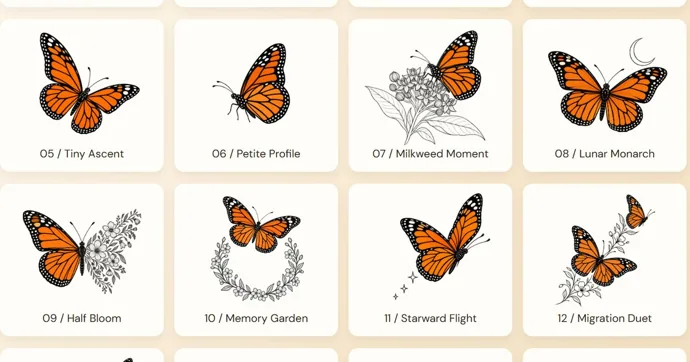
A migration lesson needs pictures more than words, especially for younger kids. All four pictures in this article come from one set, our monarch butterfly outlines, which draws the monarch 20 different ways. Each design gets two pages in the US Letter PDF: its black outline among pages 1 to 20 and its color version 20 pages later, so Migration Duet sits on pages 12 and 32. An A4 PDF has the same layout.
Here is one way to use them with a class or at home:
- Draw the two routes. On a blank North America map, mark the Rockies, then draw one arrow from southern Canada to central Mexico and a shorter one to the California coast.
- Add the fall flyer. Print Migration Duet in color and pin it beside the Mexico arrow to stand for the super generation.
- Show the relay. Print Rising Trio and place it along the northbound arrow. Ask how many generations it takes to get back, and compare the two answers in the spring section above.
- Finish with the plant. Have each child color an outline copy of Milkweed Moment while you talk about why the caterpillars need milkweed.
The set’s own guide says its decorative details are stylized, not scientific diagrams, so use field guides or the agencies above for identifying real monarchs. The paper plate life cycle from the butterfly crafts linked near the top makes a good follow-up session. Before blowing a PNG up to poster size, check the pixels-per-inch math in how to use clipart.
The set also comes as SVG, PNG and DXF files. A separate commercial license option is available for it; see the product page for the terms. For other animal sets, start from the Doodlora Studio front page and open the clipart section.
Monarch butterfly facts people ask about
These three questions come up often once the routes are clear.
Do the same monarchs fly south and come back north?
Only partly. The fall monarchs that reach Mexico start the trip north in March, but they get only as far as about Texas and Oklahoma before they lay eggs and die. Their offspring and later generations finish the return, so the monarchs that head south the next fall are several generations removed from the ones that left Mexico.
How far does a monarch fly in one day?
The USDA Forest Service gives a typical range of 50 to 100 miles (80 to 160 km) a day. The farthest single-day flight it reports is 265 miles (426 km). Monarchs travel only in daylight and stop when it rains, the wind is strong or their body cools below 86°F (30°C).
Are monarch butterflies endangered?
The USFWS has proposed listing the monarch as threatened under the Endangered Species Act, and its monarch page says protections would not apply until a final rule takes effect. Check the agency’s monarch page for the current status. CDFW lists habitat loss, disease, pesticides and climate change among the reasons both migrating groups have declined.
The migration is easiest to follow as one loop: south in a single long-lived generation, a still winter in the trees, then north in short relays on milkweed. Pick one stop on that loop, such as the fir forests or the spring relay, and build your lesson around it.
Printables from this article

Related articles
Clipart & SVG Cut Files
How to Draw a Truck: Easy Pickup, Big Rig and Cartoon
Split a pickup into three parts before you draw a single wheel: a bed, a cab and a hood. Keep the roof about 2.2 wheels tall and the bed rail level with the hood, and the truck looks right even before the details go on.
Clipart & SVG Cut Files
How to Draw a Train: Steam Engine, Cars and Tracks
Split the page into a 10-square grid, lay a long boiler tube across the middle, set a box cab at the back and a tall stack at the front, hang two big driving wheels under the cab end, then couple cars behind and run the rails to a vanishing point.
Clipart & SVG Cut Files
Hawk vs Falcon: Wings, Size, Hunting Style and Eagles
A falcon has long, narrow wings that taper to sharp points and flies on steady, quick wingbeats; a hawk has broader wings with rounded tips and either soars in slow circles or flaps hard and glides. Falcons kill with a notched beak and hawks with their talons, and eagles are the largest, heaviest-billed members of the hawk family.